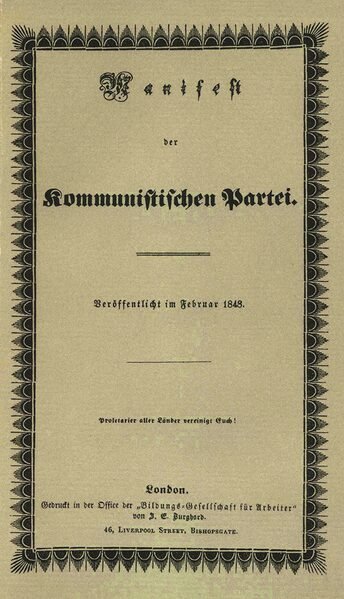
The first edition of “The Communist Manifesto” was published in German under the title “Manifest der Kommunistischen Partei” in 1848.
The Communist Manifesto is a foundational text of Marxism. It offers a comprehensive critique of capitalism and a vision for a classless, egalitarian society.
Origins and Purpose
The Communist Manifesto, authored by Karl Marx and Friedrich Engels in 1848, was commissioned by the Communist League, a group seeking to unify revolutionary movements across Europe. Written during the Revolutions of 1848, the pamphlet served as a call to action and a theoretical guide for the working class. Its primary aim was to present historical materialism—a framework that posits that societal development is driven by material and economic factors, particularly class struggles. The work remains one of the most influential political documents, shaping ideologies and movements for over a century.
Historical Materialism and Class Struggles
The manifesto begins with the assertion that “the history of all hitherto existing society is the history of class struggles.” Marx and Engels analyze society’s evolution through its modes of production: from primitive communism and antiquity to feudalism and capitalism. Each stage is marked by the rise of a dominant class exploiting a subordinate one. Under capitalism, the bourgeoisie (owners of production) exploit the proletariat (working class), perpetuating inequality.
By focusing on the relationship between the means of production (resources and tools), relations of production (social relationships tied to production), and forces of production (technological and labor capacity), the authors argue that changes in the economic “base” drive transformations in society’s “superstructure” (political, legal, and cultural institutions). This dynamic reveals capitalism’s inherent instability and its tendency to revolutionize itself, ultimately sowing the seeds of its own demise.
Critique of Capitalism
Marx and Engels present capitalism as an exploitative system that commodifies labor, alienates workers, and disrupts traditional social bonds. The bourgeoisie, in their relentless pursuit of profit, constantly revolutionize production methods, dissolve old social orders, and expand globally. However, this expansion comes at the cost of social stability, as capitalism creates economic crises, inequality, and a polarized society.
The authors argue that capitalism’s inherent contradictions—such as overproduction, the concentration of wealth, and the proletariat’s growing consciousness—will eventually lead to its downfall. The working class, unified by shared struggles, is portrayed as the force capable of overthrowing the bourgeoisie and establishing a classless society.
Vision of Communism
The manifesto envisions communism as a stateless, classless society where the free development of individuals fosters collective prosperity. This vision rejects private property, which the authors see as a tool of exploitation. They argue for the abolition of property concentrated in the hands of a few and its transformation into common ownership for the benefit of all.
Communism, as described, would eliminate the alienation experienced under capitalism, allowing individuals to fully realize their potential. The authors emphasize that this transformation requires revolutionary change, driven by the proletariat.
Transitional Measures
To achieve a communist society, Marx and Engels propose a series of transitional policies aimed at dismantling the capitalist system. These include:
- Abolition of private property and inheritance.
- Introduction of a progressive income tax.
- Nationalization of key industries, transportation, and communication.
- Centralization of credit through a state-run national bank.
- Expansion of publicly owned land and sustainable agriculture.
- Enforcement of universal labor obligations.
- Free and universal education, coupled with the abolition of child labor.
These measures, they argue, would pave the way for a socialist society that prioritizes equality and collective welfare.
Structure of the Communist Manifesto
The manifesto is divided into four sections:
Bourgeois and Proletarians
This section outlines the theory of historical materialism and the dynamics of class struggle. It highlights the rise of the bourgeoisie as the dominant class under capitalism, emphasizing their role in shaping modern society. However, the same forces that empower the bourgeoisie also generate their “grave-diggers,” the proletariat, who will eventually rise in revolution.
Proletarians and Communists
Here, Marx and Engels clarify the relationship between communists and the broader working class. Communists represent the interests of the proletariat as a whole, advocating for international solidarity and systemic change. They address criticisms of communism, rejecting claims that it discourages work or undermines individuality, and present their transitional demands.
Socialist and Communist Literature
This section critiques other contemporary socialist movements, categorizing them into reactionary socialism, bourgeois socialism, and critical-utopian socialism. Marx and Engels argue that these approaches fail to recognize the revolutionary potential of the proletariat and the necessity of systemic change.
Position of the Communists in Relation to Opposition Parties
The manifesto concludes with a discussion of communist alliances with other revolutionary movements. It supports democratic socialists while maintaining that the proletariat’s interests must remain paramount. The section ends with the famous rallying cry: “Workers of the world, unite! You have nothing to lose but your chains!”
Writing and Publication
Marx and Engels wrote the manifesto between late 1847 and early 1848, following intense discussions within the Communist League. Engels initially drafted a “Confession of Faith” and “Principles of Communism,” but Marx argued for a more historical and analytical format. The final draft was completed under tight deadlines, with Marx taking the lead in writing.
First published in German in London in February 1848, the manifesto quickly spread across Europe, coinciding with the revolutionary upheavals of the time. It was later translated into multiple languages, with Engels playing a key role in promoting its ideas. Despite initial obscurity, the manifesto gained prominence as socialist movements grew in the late 19th and early 20th centuries.
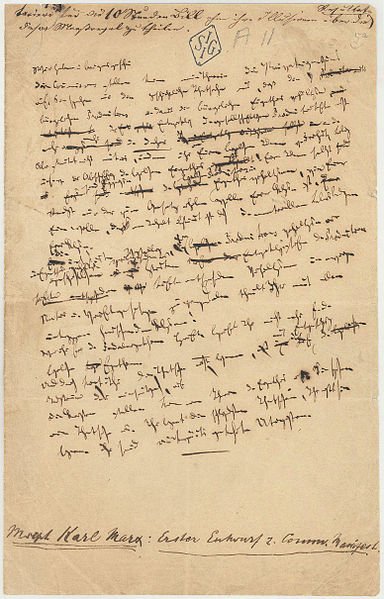
The only surviving handwritten page from Karl Marx’s first draft of the Manifesto.
Impact and Legacy
While initially limited in scope, the manifesto’s influence expanded with the rise of socialist and labor movements. By the 1870s, it became a cornerstone text for the growing Social Democratic parties in Europe. The document was frequently republished, with new prefaces by Marx and Engels reflecting on its relevance to changing political contexts.
Following the 1917 Russian Revolution, the manifesto became a central text for Marxist-Leninist ideology. It was widely distributed by communist states, including the Soviet Union, which promoted it as essential reading for party members and intellectuals. Its themes of class struggle and revolution resonated with anti-colonial movements and socialist uprisings worldwide.
Marx and Engels themselves acknowledged some limitations of the manifesto. In later editions, they revised certain passages to reflect new developments, such as the growth of the middle class.
Even after the collapse of the Soviet Union, the manifesto remains a powerful critique of capitalism. Scholars and activists continue to draw on its analysis of inequality, globalization, and economic crises. Its call for international solidarity and systemic change has inspired movements addressing climate change, labor rights, and social justice.
Criticisms and Misinterpretations of the Communist Manifesto
Critics of The Communist Manifesto often point to its perceived determinism, arguing that its predictions about capitalism’s collapse and the proletariat’s rise have not been realized. Others highlight the violent implications of revolution and question the feasibility of a classless society. Additionally, the manifesto has been criticized for underestimating the resilience of capitalism and the complexities of modern economies.
Marx and Engels themselves acknowledged some limitations of the manifesto. In later editions, they revised certain passages to reflect new developments, such as the growth of the middle class. However, they maintained that the core principles—class struggle and the need for systemic change—remained relevant.
Literary and Philosophical Influences
Marx and Engels drew on a wide range of intellectual traditions in crafting the manifesto. Influenced by Hegelian dialectics, French socialism, and English political economy, they synthesized these ideas into a materialist framework. The manifesto also reflects literary influences, such as Shakespeare and Milton, which shaped its rhetorical style and themes.
This blend of philosophy, economics, and literature gives the manifesto its enduring power, combining analytical rigor with evocative language. Its opening line, “A spectre is haunting Europe,” exemplifies its ability to capture the imagination and rally support for a revolutionary cause.
Frequently Asked Questions
What is the central thesis of the Communist Manifesto?
The manifesto argues that “the history of all hitherto existing society is the history of class struggles,” where the ruling class exploits the oppressed. Under capitalism, the bourgeoisie exploit the proletariat, but this system will inevitably collapse through revolution, leading to a classless, communist society.
What does the manifesto say about capitalism?
It critiques capitalism for its exploitation of workers and its global expansion. Marx and Engels credit capitalism for revolutionizing production but argue that it alienates workers and creates the conditions for its own downfall.

What is the role of the proletariat in the manifesto?
The proletariat, or working class, is seen as the revolutionary force that will overthrow the bourgeoisie. Through class consciousness and unity, the proletariat will lead the transition to a communist society.
What transitional policies do Marx and Engels propose?
They advocate for the abolition of private property, progressive income tax, nationalization of industries, free public education, abolition of child labor, and universal labor obligations as steps toward a communist society.
How does the manifesto address objections to communism?
It defends communism against accusations such as promoting laziness or communal relationships, emphasizing that it seeks to abolish exploitation and create equality by eliminating class distinctions.
Why is the manifesto historically significant?
Written during the Revolutions of 1848, it became one of the most influential political documents. It provided a framework for analyzing society and inspired revolutionary movements worldwide, especially in the 20th century.