Geoffrey Chaucer: Life, Major Works and Accomplishments of the Famed English Poet
Geoffrey Chaucer (c. 1343–1400), often celebrated as the “father of English literature,” played a transformative role in shaping the English literary tradition.
Renowned for his groundbreaking work The Canterbury Tales, Chaucer elevated English to a language of literary and intellectual importance at a time when Anglo-Norman French and Latin were the dominant languages of the educated elite.
His career spanned various roles, including poet, philosopher, bureaucrat, diplomat, and courtier, all of which influenced his writing and contributed to his multifaceted perspective on society. Through his writings, Chaucer provided a rich portrayal of English life and pioneered poetic expression in Middle English, leaving an enduring legacy.
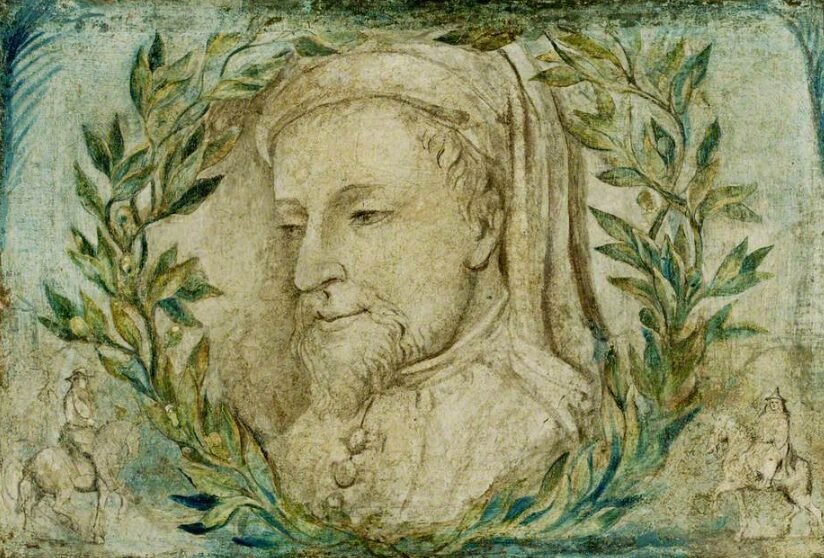
Portrait of Chaucer by English poet and painter William Blake, c. 1800
Early Life and Background
Geoffrey Chaucer was likely born around 1343 in London to a family involved in the wine trade. This background placed him within the urban middle class, giving him early exposure to the bustling and multicultural environment of London, which would later feature prominently in his works.
Chaucer’s family connections, combined with his keen intellect, helped him secure a place in the household of Elizabeth de Burgh, Countess of Ulster, in his teens. This position gave him access to noble society and opened doors to opportunities in government service.
During the 1350s, Chaucer served as a page to Elizabeth, where he acquired the education and courtly manners befitting his role. He also fought in the Hundred Years’ War, was captured by the French, and later ransomed with funds provided by King Edward III, illustrating the esteem in which he was held even in his youth. These early experiences gave him valuable insights into the upper classes and courtly life, themes he would explore in his poetry.
Civil Service and Career
19th-century depiction of Geoffrey Chaucer
Chaucer’s career in civil service began in earnest during the 1360s, when he worked as a diplomat, courtier, and customs official.
He undertook several diplomatic missions, traveling to Spain, Italy, and France, which exposed him to the works of prominent European authors such as Dante, Petrarch, and Boccaccio. Their writings influenced Chaucer’s own literary output, and his exposure to European culture helped shape his unique style, blending the narrative depth of Italian literature with English sensibilities.
In 1386, Chaucer was elected as a member of Parliament for Kent, marking the height of his public service career.
Chaucer held various roles under King Edward III and later under King Richard II, gaining a broad view of English society. His work as a customs controller for London’s wool trade and as a justice of the peace offered him insights into the workings of trade, law, and urban life.
In 1386, Chaucer was elected as a member of Parliament for Kent, marking the height of his public service career. His experiences among different social classes informed his depictions of the diverse characters in The Canterbury Tales, which represented a microcosm of English society.
Major Works

Manuscript portrait of Chaucer, 1412
Chaucer’s literary career was distinguished by both innovative narrative techniques and a pioneering use of the English language, which set him apart from his contemporaries. His works cover a wide range of genres and themes, from courtly love to philosophical inquiries and satirical reflections on society.
The Book of the Duchess
One of Chaucer’s earliest known works, The Book of the Duchess, was written around 1368 as an elegy for Blanche, the wife of Chaucer’s patron, John of Gaunt. This allegorical poem portrays a dream in which the narrator encounters a grieving knight who laments the loss of his beloved lady.
The poem is notable for its exploration of courtly love and its compassionate approach to mourning and loss. The Book of the Duchess reflects Chaucer’s skill with allegory and introduces themes of love and loyalty that would recur throughout his career.
The House of Fame
In The House of Fame (c. 1379-1380), Chaucer experiments with dream vision and explores themes of fame, fortune, and the ephemeral nature of reputation. The poem follows a narrator who is taken on a surreal journey to the House of Fame, where he observes the fickle nature of human praise and fame. Through this work, Chaucer critiques society’s obsession with fame and explores the limitations of human ambition. The poem also reveals Chaucer’s growing interest in narrative complexity and his inclination toward irony, qualities that would define his later works.
Troilus and Criseyde
Troilus and Criseyde, written in the 1380s, is often regarded as one of Chaucer’s masterpieces and showcases his depth in handling romance and tragedy. The poem is based on a story from Boccaccio’s Il Filostrato and tells the tale of the doomed love between Troilus, a Trojan prince, and Criseyde, set against the backdrop of the Trojan War.
In this work, Chaucer demonstrates his ability to create psychologically complex characters and a layered narrative that addresses themes of love, loyalty, fate, and human vulnerability. Troilus and Criseyde reflects Chaucer’s mastery of the poetic form, particularly in its use of rhyme royal, a stanzaic form that would later influence English poetry.
The Legend of Good Women
The Legend of Good Women is a collection of stories written in the 1380s or early 1390s, celebrating virtuous women from history and mythology who suffered for love. Each tale portrays a female figure, from Cleopatra to Dido, whose devotion and fidelity are highlighted.
The collection can be seen as Chaucer’s commentary on the ideals of courtly love and the expectations placed upon women. This work is notable for its exploration of female virtue and fidelity, although modern critics often debate whether Chaucer intended these portrayals to be genuine or subtly ironic.
The Canterbury Tales
The Canterbury Tales is Chaucer’s most famous work and is considered one of the greatest achievements in English literature. Written in the late 1380s and 1390s, the collection is structured around a frame narrative in which a group of pilgrims journeying to the shrine of Thomas Becket at Canterbury agree to each tell stories to pass the time. Each pilgrim represents a different social class, occupation, and personality, creating a broad, dynamic tapestry of English society.
The tales themselves cover a range of genres, including romance, comedy, tragedy, and moral fables, and each reflects the unique worldview of the teller. The Miller’s Tale, for example, is a bawdy, humorous story that contrasts sharply with the Knight’s Tale, a romantic chivalric epic.
Through The Canterbury Tales, Chaucer brings to life a diverse cast of characters, offering both humorous and critical perspectives on human nature and societal norms. His use of Middle English in this work was instrumental in legitimizing the language as a vehicle for sophisticated literary expression.

Title page of Geoffrey Chaucer’s Canterbury Tales, c. 1400
Chaucer’s Influence on English Language and Literature
Chaucer’s decision to write in Middle English, rather than the Anglo-Norman French or Latin favored by the elite, was groundbreaking. His works helped establish English as a language of literature, proving its versatility and expressive potential. By introducing new words and adapting others, Chaucer expanded the English vocabulary significantly. It is estimated that nearly two thousand words appear in English for the first time in his manuscripts.
Chaucer’s literary innovation extended to his narrative techniques and use of irony, humor, and social commentary, which set a precedent for future English literature. His contemporary, Thomas Hoccleve, called him “the firste fyndere of our fair langage,” acknowledging Chaucer’s pivotal role in establishing English as a poetic medium. Chaucer’s skill in character development and his layered storytelling techniques laid the foundation for later English poets, from Edmund Spenser to William Shakespeare.
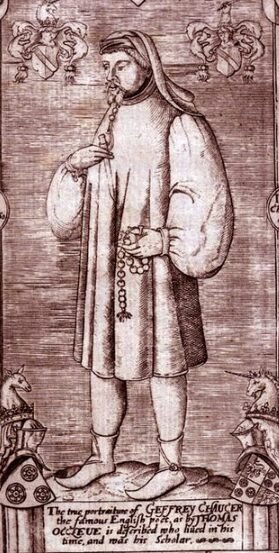
Geoffrey Chaucer played a key role in establishing English as a legitimate literary language, competing with Anglo-Norman French and Latin. Image: Engraving of Chaucer from Speght’s edition shows Chaucer’s arms and Roet arms, with Chaucer’s crest featuring a unicorn head.
READ MORE: Most Famous English Poets and their Accomplishments
Later Life and Death
In the final years of his life, Chaucer continued to write and work within the royal court, although details about his later works and activities remain unclear. His last recorded payment as a court official was in 1399, and he likely spent his final years in London.
Chaucer passed away on October 25, 1400, and was buried in Westminster Abbey, becoming the first poet to be interred in what is now known as Poets’ Corner.
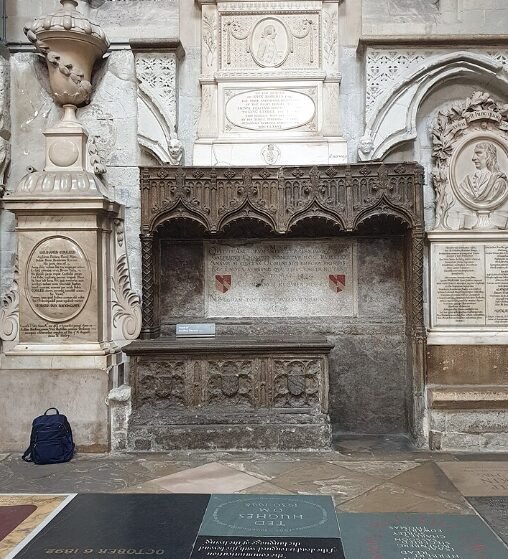
Tomb of Geoffrey Chaucer in Poets’ Corner, Westminster Abbey, London
Legacy and Lasting Influence
Chaucer’s legacy extends far beyond his contributions to the English language and literature. His works provided a new way to understand and depict human nature, exploring the virtues, flaws, and intricacies of people from all walks of life.
Through his humor, wit, and empathetic portrayals, he brought a vivid realism to his characters, allowing readers to see reflections of themselves and their society. This focus on character, along with his use of satire and social commentary, would influence writers for centuries.

Geoffrey Chaucer, often called the “father of English literature,” is celebrated as one of England’s most influential poets, primarily for his work The Canterbury Tales. Image: Statue of Geoffrey Chaucer, dressed as a Canterbury pilgrim, on the corner of Best Lane and the High Street, Canterbury, Kent, England
His approach to storytelling, blending realism with allegory, humor with moral reflection, and everyday speech with poetic language, has made him an enduring figure in literary history. The universality of his themes, from the complexities of love to the nature of ambition and pride, keeps Chaucer relevant to readers today. His influence on writers, including Shakespeare, Edmund Spenser, and John Milton, is evident in their works, which echo Chaucer’s stylistic innovations and narrative depth.
In modern times, The Canterbury Tales continues to be studied, adapted, and celebrated. Chaucer’s legacy as the “father of English literature” rests not only on his pioneering use of the English language but also on his insightful observations about humanity.
By capturing the voices and perspectives of people from all social strata, he created a body of work that resonates across cultures and eras, confirming his place as one of the foundational figures in English literary tradition.
Frequently Asked Questions about Geoffrey Chaucer
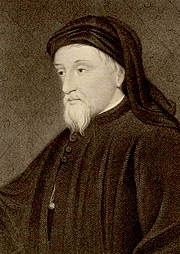
Chaucer was a phenomenal and celebrated English poet of the Middle Ages and inventor of some of the greatest poetic works in history
What is Chaucer’s most famous work, and what themes does it explore?
Chaucer’s most famous work is The Canterbury Tales, which blends realism, humor, and social commentary, laying the foundation for English literary tradition.
In addition to poetry, what other fields did Chaucer contribute to?
Chaucer was also a philosopher and astronomer. He wrote A Treatise on the Astrolabe for his son, Lewis, marking one of the earliest technical works in English.
How did Chaucer’s public service career influence his writing?
His career as a courtier, diplomat, and bureaucrat exposed him to various levels of English society, which informed his depiction of different social classes in The Canterbury Tales.
Name some of Chaucer’s other significant works besides The Canterbury Tales.
Some of Chaucer’s other notable works include The Book of the Duchess, The House of Fame, The Legend of Good Women, and Troilus and Criseyde.
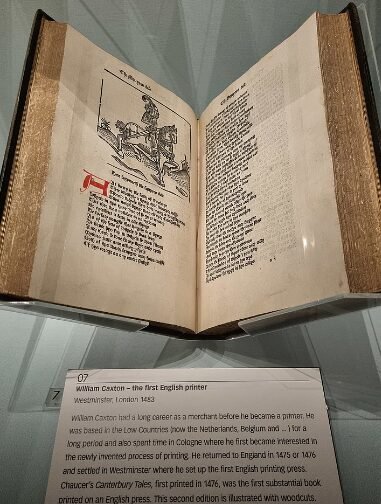
Canterbury Tales, William Caxton edition
How did The Book of the Duchess and The House of Fame reflect Chaucer’s innovative approach to literature?
The Book of the Duchess combines personal experience with allegory, while The House of Fame explores themes of fame and fortune, showcasing Chaucer’s unique narrative style.
What is Troilus and Criseyde about, and how does it demonstrate Chaucer’s skill?
Troilus and Criseyde reinterprets the classical tale of doomed lovers Troilus and Cressida, highlighting Chaucer’s talent for character development and tragic themes.
How did Chaucer’s use of Middle English impact the language and literature?
Chaucer’s choice to write in Middle English, rather than French or Latin, helped establish English as a language for intellectual and artistic expression, shaping its vocabulary and structure.
What did Chaucer’s contemporary Thomas Hoccleve say about him?
Thomas Hoccleve praised Chaucer as “the firste fyndere of our fair langage,” recognizing him as the first to demonstrate English’s potential for poetic expression.
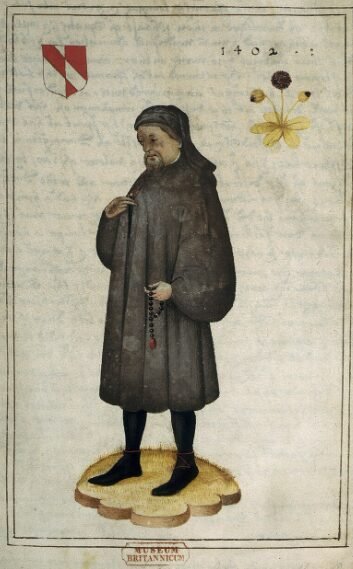
16th-century depiction of Chaucer
How many words are credited to Chaucer for their first appearance in English?
Nearly two thousand English words are first attested in Chaucer’s works, reflecting his impact on expanding the language’s vocabulary.
Where was Chaucer buried, and what does this reflect about his legacy?
Chaucer was the first writer buried in Poets’ Corner in Westminster Abbey, reflecting the respect and recognition he earned by the end of his life.
How did Chaucer’s work influence later English writers and poets?
Chaucer’s blending of humor, social insight, and linguistic innovation set a standard for English literary excellence, inspiring generations of writers and establishing a tradition in English literature.

Geoffrey Chaucer’s Blue Plaque in London, England





