Dante Alighieri
Dante Alighieri was a famous Italian poet, best known for producing one of the best Italian literary works from the Middle Ages, “Divine Comedy.” His legendary poem served as the bridge between the medieval and Renaissance era, as opinions and thoughts shifted from religion to humanity.
Alighieri was also very active in politics in his hometown of Florence, where he was exiled for speaking against abuse of power and corruption led by the popes of that time. He was also known for implementing vernacular language in literature, making it more accessible to many others outside of elite circles. It also led to his Tuscan dialect becoming the standard Italian language.
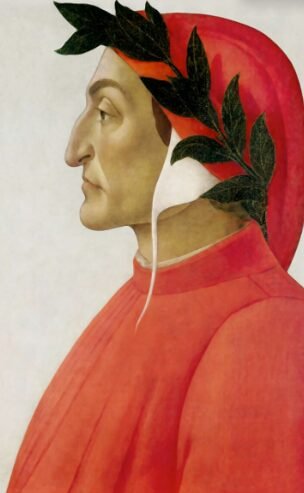
Image: Posthumous portrait in tempera by Italian painter Sandro Botticelli, 1495
Early Life
Alighieri was born in Florence, Italy in a moderately wealthy family. As a young child, he received some level of formal education, which introduced him to poetry.
By the time he was a teenager, he had lost both his parents. Prior to their date, he had been betrothed to marry Gemma Donati. Around 1283/1284, the couple married and had four children. However, Gemma and Alighieri likely did not have a happy marriage, as he still pined for his first love, Beatrice Portinari. When Beatrice died in 1290, she became his muse and featured heavily in his later works.

At twelve, Dante was betrothed to Gemma di Manetto Donati but loved Beatrice Portinari. Despite limited interaction, he wrote extensively about Beatrice, with his love poems collected in “La Vita Nuova” (“The New Life”). Image: Dante’s house museum in Florence. The house has been significantly altered since Dante’s time.
Political Career
Alighieri was a knight and in 1289, he fought in the Battle of Campaldino (June 11, 1289), between his hometown and another city, Arezzo. After the battle, he entered politics, working as a municipal official. He was eventually elected as prior of Florence in 1300.
As prior, he wished to see his home city free from the influence of the church since he viewed the institution as one that was morally corrupt. At that time Florence was a turbulent city, filled with factions, with one side defending the papacy and the other, the Roman empire.
In 1302, Alighieri’s relationship with the leading political faction at the time, the Black Guelphs, waned, and he was exiled by the leaders who were supporters of the Pope Boniface VIII. Boniface, as well as other notable figures in Florentine politics would eventually feature in Alighieri’s “Dante’s Inferno.” As a result, he was condemned to exile for two years and required to pay a fine. He refused to pay the fine since he believed he had done no wrong and also because the Black Guelphs had seized all his assets. Instead, he was condemned to perpetual exile and if he ever did return to Florence, would have been burned at stake. His sentence was only rescinded centuries later in 2008.
The exile period served as the beginning of his most artistic era.
Exile and Literary Career
While in exile, Alighieri traveled extensively. He also sided with the opposing faction, the White Guelphs and helped them regain power in Florence, but that proved to be unsuccessful. Alighieri left politics altogether and focused on his writing.
In 1304, while he was in Bologna, he started writing his Latin treatise “De Vulgari Eloquentia”, where he advocated for the enrichment of the Italian language with aspects of various dialects for it to be considered a serious literary language. He believed that having a more unified language would play a part in the unification of the divided Italian territories. He never completed the treatise, but it still played a crucial role for many years to come.
Two years later, when the exiles from Florence were asked to leave Bologna, Alighieri settled in Padua. However, many other reports also believed him to be in Paris, France within that period. In 1308, his hope was restored when Henry of Luxembourg was made emperor, ruling as Henry VII.
Alighieri wrote “De Monarchia”, a three-part book that became one of his most popular written works on the monarchy. In the book, he claimed that the emperor got his authority to rule directly from God and not the pope. However, Henry VII quickly became less popular and as his enemies increased his numbers, so did threats against his throne. Alighieri recognized his enemies as members of the government of Florence and wrote against their actions. It was also during that time that he was inspired to write “The Divine Comedy.”
Famous Works by Dante
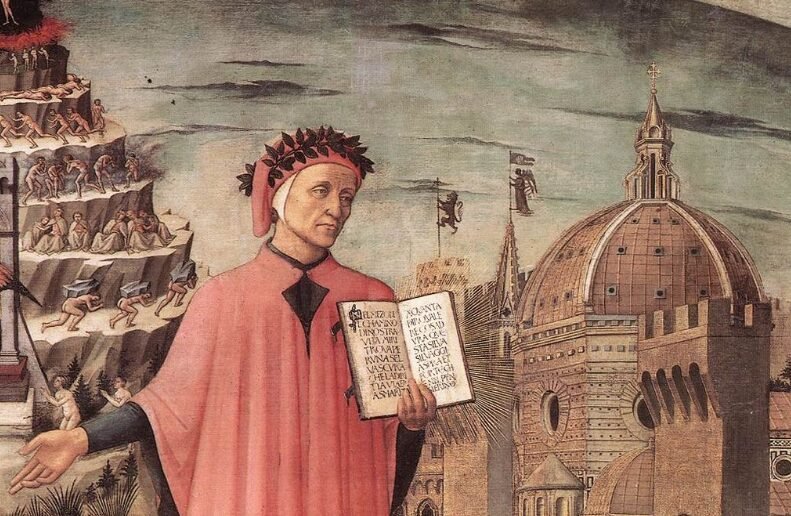
Dante’s “The Divine Comedy” is an autobiographical journey through Hell, Purgatory, and Paradise. Unlike Homer and Virgil’s epics, it features contemporary figures and offers Dante’s philosophical and moral insights. Image: Dante, poised between the mountain of purgatory and the city of Florence, displays the incipit Nel mezzo del cammin di nostra vita in a detail of Domenico di Michelino’s painting, Florence, 1465.
By 1314, Alighieri had finished writing “Inferno”, which was a segment set in hell in “The Divine Comedy”. He completed the entire book in 1317 when he was living in Ravenna in Northern Italy.
He wrote “The Divine Comedy” to warn corrupt societies to become more righteous in their works. He wrote the poem from his perspective and it followed his journey through the three realms of the dead that Christians believed in: hell, purgatory, and heaven. His former love, Beatrice featured in the “Paradiso” segment, as she guided him to heaven. Alighieri also included other characters such as his great-great-grandfather, as well as Saints Francis and Bernard, and other figures he had interacted with in his entire life who he encountered in his journey through the three realms of death.
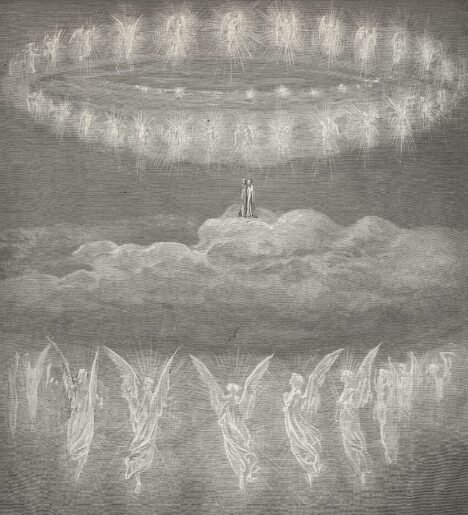
“The Divine Comedy,” written in vernacular Italian rather than Latin or Greek, reached a broader audience, boosting literacy. Its monumental influence makes Dante one of history’s greatest writers, alongside Shakespeare, as noted by T.S. Eliot. Image: Illustration for Paradiso (of The Divine Comedy) by Gustave Doré
“The Divine Comedy” quickly became the driving factor for the evolution of Italian literature and established the language as literary one. In his attempt to unify the Italian language, he became one of the pioneers of the Renaissance.
Alighieri is also credited for other poems, including “Convivio”, which was a collection of some of his longest poem, as well as, “A Question of the Water and of the Land”, “Il Flore”, “Detto d’Amore”, “La Vita Nuova”, “Le Rime”, and “Eclogues.”
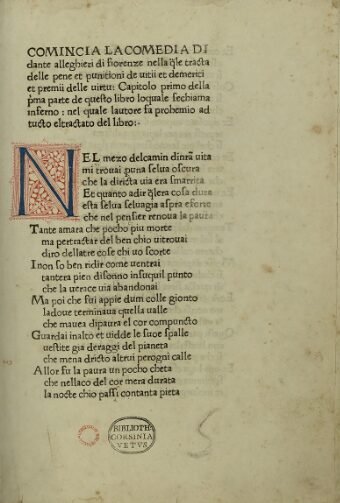
The enduring relevance of “Divine Comedy” lies in its continued study and admiration, making it a staple of literary education and a source of inspiration for readers worldwide. Image: Divina Commedia (1472)
Death
Alighieri spent his final days in Ravenna, eventually passing away in 1321 after contracting quartan malaria during a diplomatic mission to Venice. He was survived by his three children and wife, Gemma. He was buried in Ravenna and in 1483, the city erected a tomb for the poet.
Following his death, Alighieri’s home city of Florence made several requests to have his remains. However, Ravenna refused, going as far to protecting his body in a monastery. In 1829, Florence built a tomb for him, but it continued to remain empty.
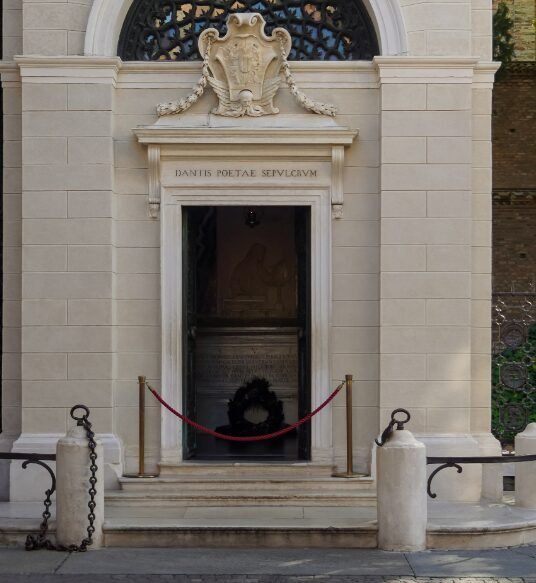
Dante shaped Italian poetry and left a lasting impact on modern literature. His works influenced Italy’s aspirations and destinies. Image: Dante Alieghri tomb in Ravenna, Italy
Did you know…?
In Italy, Dante is often called “il Sommo Poeta” (“the Supreme Poet”), signifying his preeminent status in Italian culture and literature.
Accomplishments
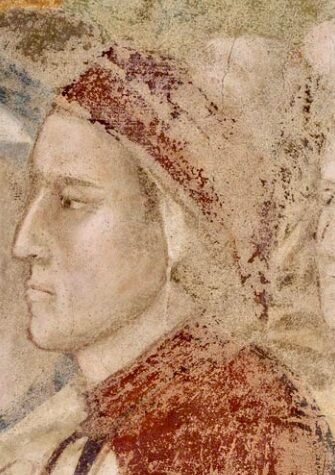
Dante’s legacy continues to inspire and influence literature and culture through his masterful storytelling, innovative poetic forms, and the enduring power of his works to transcend time and place. Image: Alleged Dante portrait attributed to Italian painter Giotto, in the chapel of the Bargello palace, Florence. It was painted c. 1335 and has been restored.
- Alighieri’s “The Divine Comedy” continues to be a relevant piece of literature centuries later. By the early 15thcentury, there had been at least 12 commentaries on the poem’s significance and meaning. His work largely inspired other Western poets and writers for many centuries. He was also the first of many writers whose works were studied as ancient classics in universities worldwide. He became known as the “divino poeta” and in 1555 a splendid edition of his poem was published in Venice.
- After his death, Italian writer Giovanni Boccaccio wrote the first formal biography chronicling Alighieri’s life entitled “Vita di Dante.”
- Italy named its first dreadnought battleship Dante Alighieri in the writer’s honor.
- In 1921, six hundred years after his death, he was declared by the then Pope Benedict XV as one of the many celebrated geniuses worthy of praise by the Catholic church. He was also called the “pride and glory” of humanity.
- Pope Paul VI donated a golden iron Greek Cross to Alighieri’s burial site in Ravenna in celebration of his 700thbirthday anniversary. In 2020, Pope Francis blessed the cross.
- In 2008, the city of Florence officially apologized for the poet’s exile 700 years earlier. In 2021, a re-trial of Alighieri was held in Florence to clear his name from any accusations.
- During his 750th birthday in 2015, Pope Francis released the apostolic letter “Cando lucis aeternae” in his honor.
Most Famous Poets of All Time and Their Notable Masterpieces
Questions and Answers about Dante Alighieri
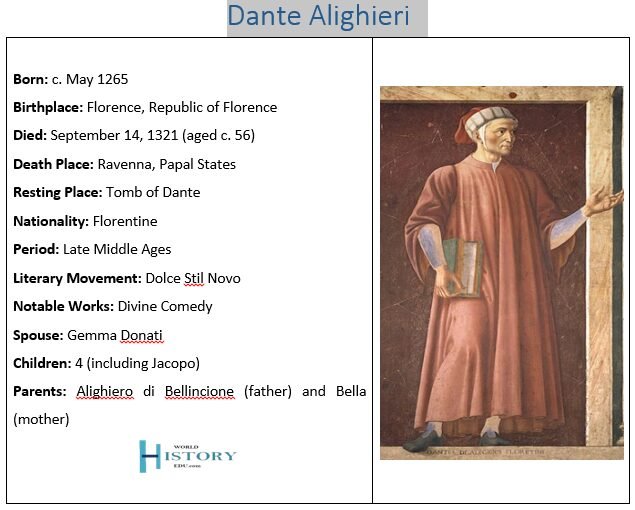
Dante Alighieri, born Durante Alighieri in 1265 Florence, Italy, authored “The Divine Comedy.” His life and works have been celebrated and studied in various forms, including biographies, critical essays, visual art, and adaptations in other media. Image: Mural of Dante in the Uffizi, Florence, by Italian Renaissance painter Andrea del Castagno, c. 1450
Who were Dante’s parents?
Born in Florence around 1265, Dante Alighieri was the son of Alighiero di Bellincione and Bella di Abati. Born to a notable family, his mother died when he was seven. His father remarried and had two more children.
Dante received formal education in grammar, language, and philosophy.
What is Dante Alighieri’s full baptized name?
Dante Alighieri was most likely baptized as Durante di Alighiero degli Alighieri.
What is Dante Alighieri widely known for?
Dante is widely known for his seminal work, the “Divine Comedy,” which is regarded as one of the most important poems of the Middle Ages and the greatest literary work in the Italian language.
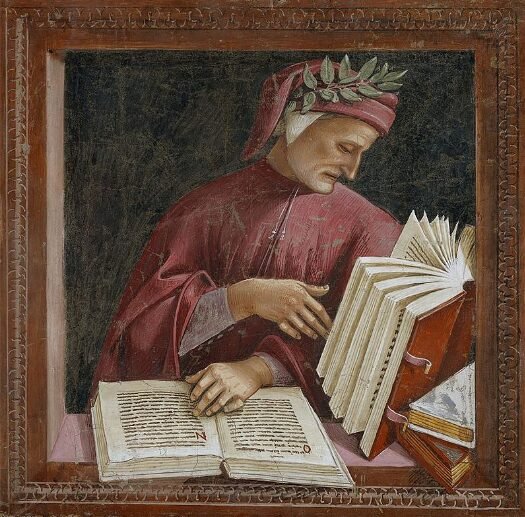
Image: Dante Alighieri, detail from Luca Signorelli’s fresco in the Chapel of San Brizio, Orvieto Cathedra
What was the original title of “Divine Comedy” and who renamed it “Divina”?
The original title of “Divine Comedy” was “Comedìa” (modern Italian: “Commedia”), and it was later renamed “Divina” by Giovanni Boccaccio.
What are the three parts of “Divine Comedy”?
The three parts of “Divine Comedy” are Inferno (Hell), Purgatorio (Purgatory), and Paradiso (Heaven).
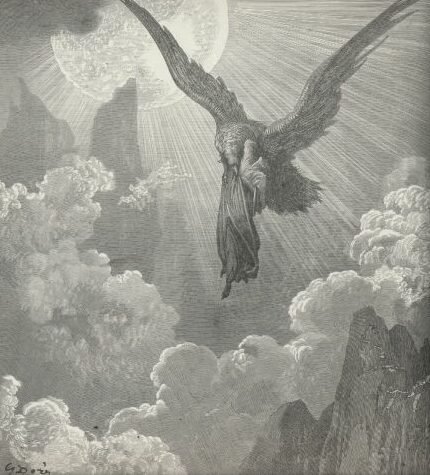
Image: Illustration for Purgatorio (of The Divine Comedy) by Gustave Doré
Why was Dante’s choice to write in the Italian vernacular revolutionary?
Dante’s choice to write in the Italian vernacular was revolutionary because it broadened the audience for his works, which were previously accessible only to the educated elite who understood Latin, and played a critical role in shaping the modern Italian language.
What is “De vulgari eloquentia” about, and why is it significant?
“De vulgari eloquentia” is a treatise by Dante that defends the use of the vernacular in literature. It is significant because it was one of the first scholarly works to argue for the legitimacy of writing in one’s native tongue.

Image: Dante on the national side of the Italian 2 Euro coin
How did Dante’s “Divine Comedy” influence the literary world?
“Divine Comedy” influenced the literary world by setting a precedent for future Italian writers to write in the vernacular, inspiring countless works of art and literature, and introducing the terza rima rhyme scheme.
Which notable English writers were influenced by Dante’s works?
Notable English writers influenced by Dante’s works include Geoffrey Chaucer, John Milton, and Alfred Tennyson.
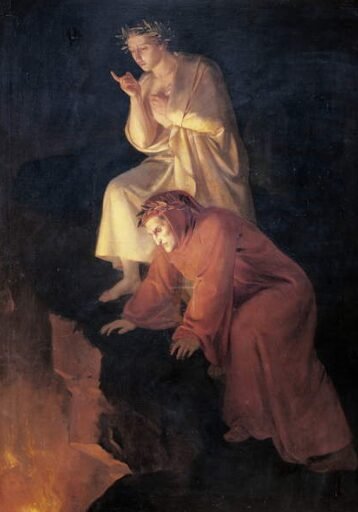
English literature first acknowledged his greatness through Chaucer. Though overshadowed by Petrarch in Tudor times and ignored in the Restoration era, Dante’s legacy endured. Image: Dante and Virgil visiting Hell, as depicted in Inferno, painted by Rafael Flores, 1855
Why is Dante referred to as “the father of the Italian language”?
Dante is referred to as “the father of the Italian language” because his works helped establish the Florentine dialect as the basis for modern Italian.
Who are the “tre corone” of Italian literature, and why is Dante included among them?
The “tre corone” (“three crowns”) of Italian literature are Dante, Petrarch, and Boccaccio. Dante is included among them because their works collectively shaped the course of Italian and Western literary traditions.
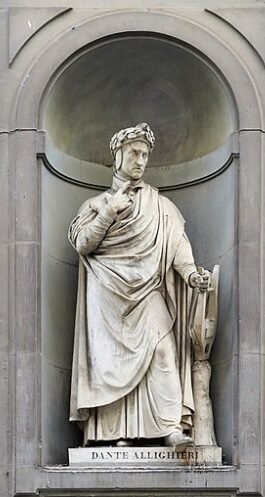
Dante wrote “The New Life” (1295) and “Divine Comedy” in the Italian vernacular, helping to establish the modern-day standardized Italian language. Image: Statue of Dante at the Uffizi in Florence, Italy
How did Dante’s early life and political career influence his writing?
Dante’s early life in Florence, his formal education, and his political career, marked by his opposition to papal interference in Florentine affairs, profoundly influenced his writing. His exile in 1302 prompted him to focus on his literary endeavors, including writing the “Divine Comedy.”
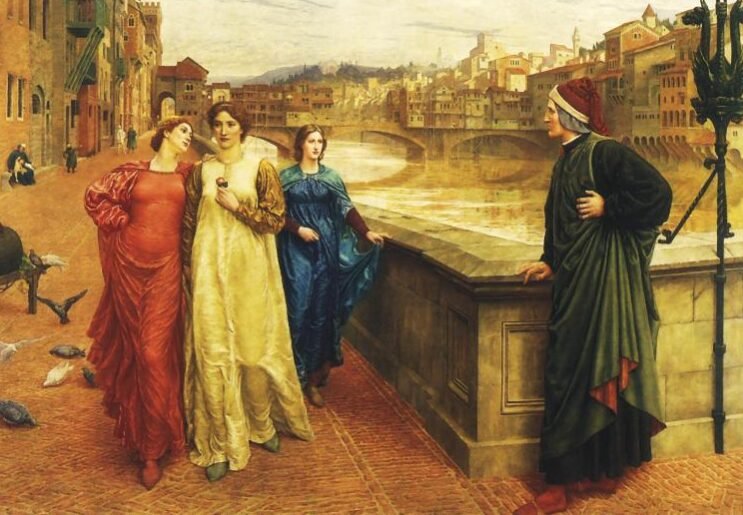
At nine, Dante saw Beatrice Portinari and fell in love, a feeling confirmed nine years later when she greeted him. This love greatly influenced his literary works. Image: Dante and Beatrice, by English Victorian painter Henry Holiday, inspired by La Vita Nuova, 1883
What poetic form did Dante introduce, and why is it significant?
Dante introduced the terza rima, an interlocking three-line rhyme scheme, which adds a musical quality to “Divine Comedy” and has been emulated by numerous poets since its inception.
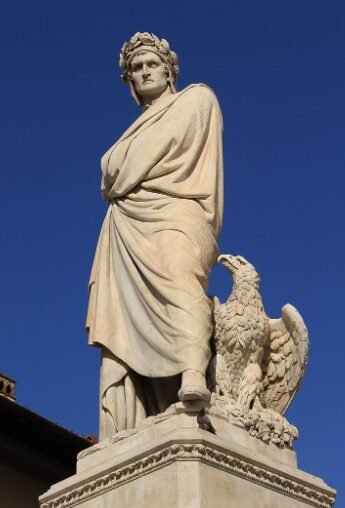
Dante’s decision to write in the vernacular revolutionized literary expression by making profound philosophical and theological ideas accessible to a broader audience. Image: Statue of Dante in the Piazza Santa Croce in Florence, Enrico Pazzi, 1865





