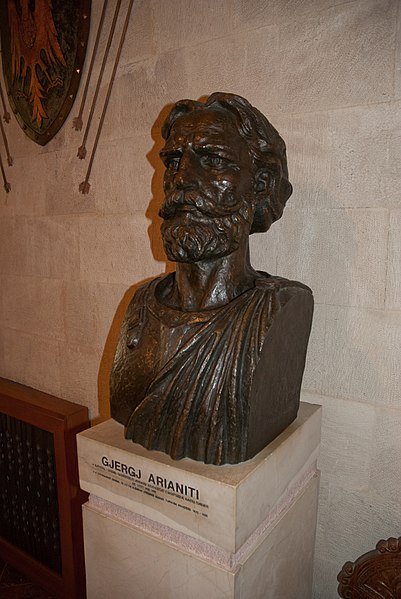
A bust of Gjergj Arianit, situated in Krujë, northern-central Albania.
Gjergj Arianiti (1383–1462) stands as one of the most prominent figures in medieval Albanian history. A feudal lord and military commander, he led several successful campaigns against the Ottoman Empire, earning respect throughout Europe. Despite political complexities and alliances that shifted over time, his contributions to the Albanian resistance against Ottoman domination remain significant.
Name and Variants
Gjergj Arianiti’s name appears in several forms depending on the historical context. In Albanian, he is widely known as Gjergj Arianiti, while English texts often render it as George Arianiti. His name also appeared in Slavic records as “Golem Arianit Komnenovic,” and a French document from the era of Charles VII referred to him as “Haryanites.” These variations highlight his prominence across different regions and languages.
Origins and Early Life
Gjergj was born to Komnen Arianiti, who ruled lands around Durrës. His mother’s lineage is debated, with some historians suggesting she was from the Sevati family, while others propose she belonged to the Zaharia family. Gjergj was the eldest of three brothers, with Muzakë and Vladan being his siblings. His marriage to Maria Muzaka, a member of the influential Muzaka family, expanded his territories, eventually stretching from Mallakastër to southern Vlorë and later north to Debar and Bitola.
Following the Ottoman conquest of Albania, Gjergj was compelled to serve as a hostage at the Ottoman court to ensure his loyalty. By 1427, he returned to Albania, resuming governance over his territories.
Gjergj Arianiti’s Campaigns Against the Ottoman Empire
Gjergj Arianiti emerged as a key leader during the Albanian Revolt of 1432–36. Ottoman reforms threatened the autonomy of Albanian nobles, prompting widespread resistance. Initially cautious, Gjergj soon saw an opportunity to reclaim his family’s dominions. After banishing Ottoman-appointed sipahi from his lands, he led a series of successful campaigns, defeating Ottoman forces in several battles.
One of his most notable victories occurred in the winter of 1432–33 near Bërzeshtë, where Gjergj’s forces ambushed and routed an Ottoman army. These triumphs not only bolstered Albanian morale but also garnered attention and support from European powers like Pope Eugene IV and Alfonso V of Aragon.
In 1443, Gjergj Arianiti once again rebelled against Ottoman rule. This rebellion coincided with the defeat of Ottoman forces at Niš and Skanderbeg’s defection. Gjergj played a pivotal role in the establishment of the League of Lezhë, an alliance of Albanian nobles aimed at resisting Ottoman advances.
Despite their alliance, tensions often arose between Gjergj and Skanderbeg. By 1449, Gjergj left the League, allying with Venice to protect his interests. However, he returned to support key battles, including the defense of Krujë and the recapture of Svetigrad. His military acumen and strong ties with the Kastrioti family, solidified through the marriage of his daughter Donika to Skanderbeg, were instrumental in the Albanian resistance.
Political Alliances and Rivalries
Gjergj’s political strategies were marked by shifting alliances. He initially allied with the Kingdom of Naples in 1446 but later turned to Venice in 1456. These moves reflected his efforts to navigate the complex geopolitical landscape while safeguarding his territories. Despite occasional rivalries with Skanderbeg, Gjergj remained committed to the broader Albanian cause, fighting the Ottomans until his death in 1462.
Legacy as a Military Leader
Gjergj Arianiti’s military tactics were characterized by ambushes, strategic retreats, and sudden strikes. His ability to adapt to the terrain and outmaneuver larger Ottoman forces earned him widespread acclaim. His victories were celebrated across Europe, where he was hailed as a “protector of freedom.”
Through his actions and alliances, Gjergj Arianiti ensured that the spirit of Albanian freedom remained alive for generations to come.
One of his greatest achievements was his role in maintaining Albanian resistance during the turbulent 15th century. His leadership inspired both his contemporaries and future generations, solidifying his place in Albanian history.
Possessions and Capitals
Gjergj Arianiti’s territories were strategically located, serving as a buffer against Ottoman invasions. He maintained two capitals: Kaninë near the coast and Sopot in the eastern mountains. These strongholds played crucial roles in the defense of Albania and served as key centers of resistance.
Family and Marriages
Gjergj Arianiti married twice and fathered numerous children who played significant roles in Albanian and European history.
First Marriage to Maria Muzaka
From his first marriage, Gjergj had eight daughters, including:
- Donika Arianiti: Married Skanderbeg, becoming Albania’s first Queen Consort.
- Goisava: Married Ivan I of Zeta, contributing to alliances in the region.
- Chiranna: Wed Nicholas Pal Dukagjini, strengthening ties with another powerful Albanian family.
- Angjelina: Married Stefan Branković, later venerated as a saint by the Orthodox Church.
Second Marriage to Pietrina Francone
From this union, Gjergj had five more children, including:
- Constantine Arianiti: A diplomat who served as regent of Montferrat.
- Maria Arianiti: Married Bartolomeo della Rovere, connecting the family to the influential Della Rovere dynasty.
Through these marriages, Gjergj’s descendants integrated into various noble families across Europe, extending his legacy beyond Albania.
Final Campaigns and Death
Gjergj Arianiti continued his resistance against the Ottoman Empire until his final years. Between 1460 and 1462, he led his last campaigns, demonstrating remarkable resilience despite advancing age. His ability to rally support and outmaneuver the Ottomans solidified his reputation as one of Albania’s greatest leaders.
Gjergj Arianiti passed away in 1462, leaving behind a legacy of courage, leadership, and unwavering dedication to his people’s freedom.
Frequently Asked Questions
What was his relationship with Skanderbeg?
He was an ally and sometimes a rival of Skanderbeg, his son-in-law. Arianiti was part of the League of Lezhë but left and rejoined multiple times due to political and territorial conflicts.
What were his key military achievements?
Arianiti successfully led campaigns against the Ottoman Empire, employing ambush tactics. His victories in the 1430s and 1440s strengthened the Albanian resistance and inspired European allies.
What role did Gjergj Arianiti play in the League of Lezhë?
A founding member of the League, he contributed significantly to its military campaigns. Despite leaving the alliance at times, his family ties and efforts supported the Albanian cause.
What was his relationship with European powers?
He allied with Naples, Venice, and the Papacy, securing promises of aid. His efforts were celebrated by European leaders who feared Ottoman expansion.
What were his territorial holdings?
Arianiti controlled lands between Librazhd and Elbasan, expanding to Bitola. His two capitals, Kaninë and Sopot, were key defensive and administrative centers.
How did his family influence his legacy?
Through his daughters’ marriages, Arianiti formed alliances with prominent Albanian, Serbian, and Italian noble families, strengthening ties with Europe.
What was his lasting impact?
Arianiti’s leadership, military strategies, and alliances bolstered Albania’s resistance against the Ottomans, preserving Albanian autonomy and inspiring European solidarity.





