Greco-Bactrian Kingdom: History & Major Facts
The Greco-Bactrian Kingdom was a powerful and culturally significant Hellenistic state that existed from around 256 BC to approximately 120 BC in Central Asia.
The kingdom’s history, major accomplishments, and eventual downfall represent a crucial chapter in the history of cultural exchange between the East and West, where Greek influence extended far beyond the Mediterranean, interacting with Indian, Persian, and Central Asian traditions.
At its height, the kingdom encompassed much of present-day Afghanistan, Tajikistan, Uzbekistan, Turkmenistan, and parts of Kazakhstan, Pakistan, and Iran.
Foundation and Early History
The Greco-Bactrian Kingdom was founded by Diodotus I, a former satrap (governor) of the Seleucid Empire, which was itself one of the successor states formed after the death of Alexanderthe Great in 323 BC. Following Alexander’s death, his vast empire was divided among his generals (the Diadochi), and Seleucus I Nicator, one of Alexander’s commanders, established the Seleucid Empire that controlled a large portion of Alexander’s eastern territories, including Bactria.
Diodotus I, who was appointed as the satrap of Bactria, eventually declared independence from the Seleucid Empire around 256 BC. This breakaway kingdom was one of several Hellenisticstates that emerged after Alexander’s empire fractured.
Bactria, known for its fertility, wealth, and strategic location, was ideal for the establishment of a strong, prosperous state. The early Greco-Bactrian Kingdom flourished due to the region’s rich natural resources and its position along key trade routes between the East and West, which facilitated the exchange of goods, ideas, and culture.
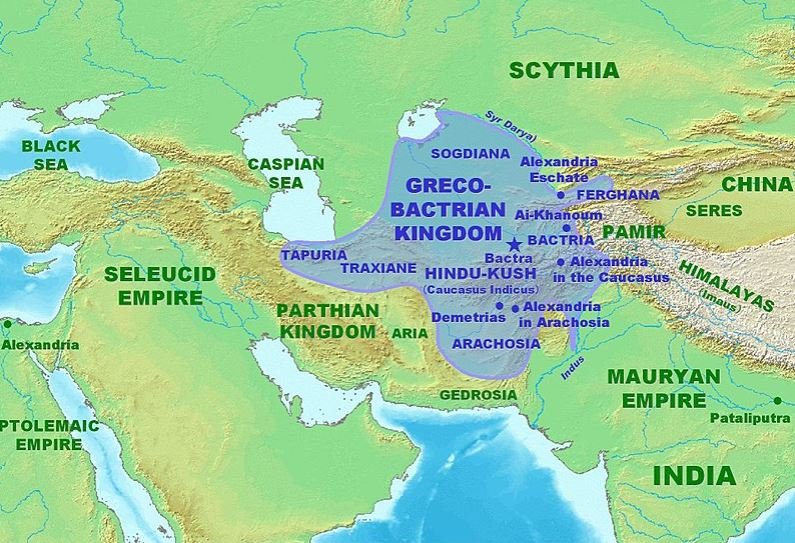
Image: A map depicting the extent of the Greco-Bactrian Kingdom around 170 BC, during the reign of Eucratides the Great.
READ MORE: Successor Wars that erupted after the death of Alexander the Great
The Role of Alexander the Great
Greek influence in Bactria predated Diodotus I’s establishment of the Greco-Bactrian Kingdom. Alexander the Great had conquered Bactria in 327 BC during his campaigns in Central Asia. He founded several cities in the region, many of them named Alexandria after himself. These cities were populated with Greek settlers, primarily Macedonian soldiers and their families, who were encouraged to remain in Bactria as colonists. This laid the groundwork for the Hellenistic culture that would flourish in the region during the period of the Greco-Bactrian Kingdom.
The arrival of Macedonian and other Greek settlers introduced Greek customs, language, and political organization to Bactria, creating a hybrid culture that blended Greek and local traditions. Bactria became a melting pot where Greek and Central Asian cultures coexisted and influenced each other, contributing to the distinct Hellenistic identity that developed in the region.

Image: A mosaic work of Alexander the Great
READ MORE: Battles that Alexander the Great fought in
Diodotus I and Diodotus II
Diodotus I is credited with successfully establishing the Greco-Bactrian Kingdom. After declaring independence from the Seleucids, Diodotus I adopted the title of king and ruled over a prosperous and expanding kingdom. His success in consolidating power in Bactria was likely due to the region’s natural wealth, as well as his ability to maintain strong defenses against potential enemies, including neighboring nomadic tribes and the Seleucids.
Upon Diodotus I’s death, his son Diodotus II succeeded him as king. Diodotus II continued his father’s policies and further expanded the kingdom. Under his rule, the Greco-Bactrian Kingdom remained independent from the Seleucids, and Diodotus II even formed an alliance with the Parthians, another group that had recently rebelled against the Seleucid Empire. This alliance helped solidify Bactria’s independence from Seleucid control and allowed Diodotus II to focus on the internal development of the kingdom.

Image: Gold coin of Diodotus I, circa 245 BC.
Euthydemus I and Expansion
The next major figure in Greco-Bactrian history was Euthydemus I, who overthrew the Diodotid dynasty and established his own rule around 230 BC. Euthydemus I is known for having defended Bactria against an invasion by the Seleucid king Antiochus III the Great. Antiochus sought to bring Bactria back under Seleucid control, but Euthydemus successfully resisted the invasion during a long and difficult campaign. After defeating the Seleucids, Euthydemus secured recognition of his sovereignty over Bactria through a treaty with Antiochus III, which marked an important moment of diplomatic success for the kingdom.
During Euthydemus’s reign, the Greco-Bactrian Kingdom reached new heights of prosperity and territorial expansion. He continued to strengthen the kingdom’s economy by controlling important trade routes and maintaining strong diplomatic relations with neighboring states.
Demetrius I and the Indo-Greek Expansion
Euthydemus I’s son, Demetrius I, further expanded the Greco-Bactrian Kingdom’s influence through a series of military campaigns in northwestern India around 190 BC. Demetrius’s invasion of India marked a significant turning point in the history of both the Greco-Bactrian Kingdom and the broader region. Demetrius’s conquests led to the establishment of the Indo-Greek Kingdom, a successor state to the Greco-Bactrian Kingdom that extended Greek control over parts of the Indian subcontinent.
The Indo-Greek Kingdom played an important role in the transmission of Hellenistic culture into India. Greek artistic styles, coinage, and architectural techniques influenced Indian society, and Greek kings like Apollodotus I and Pantaleon were the first to issue coins in the Indian standard. Greek influence also contributed to the development of Greco-Buddhist art, a unique fusion of Greek and Indian artistic traditions that represented deities and figures from both cultures in human form.
Ai-Khanoum: A Hellenistic City
One of the most important archaeological sites associated with the Greco-Bactrian Kingdom is the city of Ai-Khanoum, located in present-day Afghanistan. Ai-Khanoum was founded by the Greeks and became one of the most significant cities in the region. Excavations at Ai-Khanoum have revealed a wealth of information about the urban planning and cultural life of the Greco-Bactrians.
The city was laid out in the typical Hellenistic style, with a Greek theater, gymnasium, temples, and houses with colonnaded courtyards. Ai-Khanoum also featured a royal palace and a vast library, suggesting that the city was not only a political and economic center but also a hub of learning and culture. The architecture of Ai-Khanoum reflects the blending of Greek and local Central Asian influences, a hallmark of the Greco-Bactrian period.
Eucratides the Great and the Height of the Kingdom
The Greco-Bactrian Kingdom reached the height of its power under Eucratides the Great, who ruled from around 171 BC. Eucratides came to power through a coup and founded his own dynasty. His reign is notable for his successful military campaigns, including an invasion of India, where he fought against the Indo-Greek kings and minted Indian coins.
Eucratides’s reign was a time of both expansion and consolidation for the Greco-Bactrian Kingdom. His campaigns in India extended Bactrian influence and demonstrated the military strength of the kingdom. However, Eucratides’s rule was also marked by internal strife. According to ancient sources, Eucratides was eventually murdered by his own son, a sign of the growing instability within the kingdom.
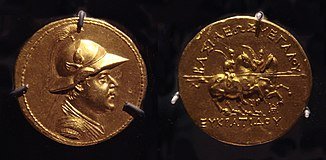
Image: Gold coin of Eucratides the Great
Decline and Fall
The decline of the Greco-Bactrian Kingdom began in the mid-2nd century BC, largely due to both internal and external pressures. The Parthians, a rising power in the region, posed a significant threat to Bactria, while nomadic tribes such as the Sakas and the Yuezhi launched invasions that further weakened the kingdom’s defenses. After Eucratides’s death, the kingdom fragmented into smaller, less cohesive states, which made it vulnerable to external attacks.
The final Greco-Bactrian king, Heliocles, ruled until around 120 BC, at which point the kingdom effectively ceased to exist. Bactria was eventually overrun by the Yuezhi, a nomadic group from the north, who established their own rule in the region.
Legacy and Cultural Influence
Although the Greco-Bactrian Kingdom was relatively short-lived, its cultural and historical impact was profound. One of the most significant legacies of the Greco-Bactrians was the Hellenization of Central Asia. Greek culture, language, art, and architecture spread throughout the region, influencing not only the local Bactrian population but also the nomadic groups who settled in Bactria after the kingdom’s collapse.
The Yuezhi, who conquered Bactria and later established the Kushan Empire around 30 AD, adopted many aspects of Greek culture, including the Greek alphabet and the worship of Greek deities. The Kushans played a key role in preserving Hellenistic traditions in Central Asia and continued to use Greek-style coinage and art for centuries after the fall of the Greco-Bactrian Kingdom.
Another major cultural legacy of the Greco-Bactrian Kingdom was its role in the development of Greco-Buddhist art. The fusion of Greek artistic techniques with Indian religious themes resulted in a unique style of art that influenced the visual representation of Buddhist and Hindu deities. For the first time in Indian art, deities were depicted in human form, a development that can be traced back to the influence of Greek art in the region.
Greco-Bactrian Influence on India
The Greco-Bactrians had a lasting impact on the Indian subcontinent through the Indo-Greek Kingdom, which continued to exist after the fall of the Greco-Bactrian state. The Indo-Greeks were instrumental in the cultural and economic exchange between India and the Hellenistic world, and their coins, inscribed in both Greek and Indian scripts, provide valuable evidence of the integration of these two cultures.
Greek influence on Indian art, architecture, and religion can be seen in the Greco-Buddhist sculptures of Gandhara, where the classical Greek style was adapted to depict scenes from Buddhist life. This artistic tradition had a profound influence on the development of Buddhist iconography and helped shape the way Buddhism spread throughout Asia.
Greek Legacy in Central Asia
Even after the fall of the Greco-Bactrian Kingdom, Greek culture remained embedded in Central Asia. Many aspects of Greek administration, language, and customs continued under the rule of subsequent powers, including the Kushans. The region’s role as a cultural crossroads between the East and West ensured that the Hellenistic legacy endured long after the Greeks had lost political control.
Furthermore, the Greek alphabet remained in use among local populations for many years, and Greek coins continued to circulate as a form of currency. The memory of the Greco-Bactrian Kingdom and its accomplishments lived on in the art, architecture, and religious traditions of the region, particularly through the fusion of Greek and local traditions in Hellenistic-Buddhist art.
Conclusion
The Greco-Bactrian Kingdom was a unique and significant Hellenistic state that left an indelible mark on the history of Central Asia and India. Its blend of Greek and local cultural elements created a hybrid civilization that fostered artistic, religious, and political exchange between the East and West. The kingdom’s influence persisted long after its political collapse, particularly through the Kushan Empire and the spread of Greco-Buddhist art.
The Greco-Bactrian Kingdom serves as an example of how the legacies of Alexander the Great’s conquests continued to shape the world for centuries. Its role as a bridge between the Greek world and the cultures of Central Asia and India exemplifies the far-reaching impact of Hellenistic civilization, and its contributions to the arts, religion, and culture resonate in the history of these regions to this day.
Frequently Asked Questions

Where was the Greco-Bactrian Kingdom located?
The kingdom encompassed present-day Afghanistan, Tajikistan, Uzbekistan, Turkmenistan, and parts of Kazakhstan, Pakistan, and Iran. At its height, its influence extended eastward, with some reports suggesting military campaigns reaching the borders of China.
How did the Greco-Bactrian Kingdom come into existence?
After Alexander the Great conquered Bactria in 327 BC, he established many cities, bringing Greek settlers to the region. After his death, Bactria became part of the Seleucid Empire until Diodotus I established the Greco-Bactrian Kingdom in the 3rd century BC by breaking away from Seleucid rule.
What was the significance of King Demetrius’s military campaigns?
King Demetrius, son of Euthydemus, led Greco-Bactrian forces into northwestern India between 190 and 180 BC, establishing the Indo-Greek Kingdom as a successor state. This expansion significantly integrated the region culturally and economically with India.
What archaeological evidence reflects the Hellenistic influence in Bactria?
Excavations of the city of Ai-Khanoum in northeastern Afghanistan showcase the region’s Hellenistic influences, with Greek-style urban planning, theaters, gymnasiums, and colonnaded houses being uncovered.
Who was Eucratides the Great, and what was his significance?
Eucratides the Great ruled around 171 BC and brought the Greco-Bactrian Kingdom to its zenith. He expanded the kingdom by invading India, minting Indian coins, and holding territory as far as the Hydaspes River. However, his reign also marked the beginning of the kingdom’s decline.
What led to the decline of the Greco-Bactrian Kingdom?
The kingdom declined due to internal strife, including Eucratides’ murder by his son, as well as external threats from the Parthians and nomadic tribes like the Sakas and Yuezhi. The kingdom ultimately collapsed with the death of its last king, Heliocles.
What happened after the fall of the Greco-Bactrian Kingdom?
Even after the fall, Hellenistic culture persisted in the region. The Yuezhi, who invaded Bactria, adopted Greek customs and founded the Kushan Empire around 30 AD. This blending of cultures influenced the development of Greco-Buddhist art, where Greek artistic styles were combined with Indian religious iconography.
What is the legacy of the Greco-Bactrian Kingdom?
The Greco-Bactrian Kingdom played a crucial role in spreading Hellenistic culture into Central Asia and India. Its influence persisted through the Kushan Empire and contributed to the development of Greco-Buddhist art, marking a significant cultural exchange between the East and the West.





