Death of Alexander the Great
The death of Alexander the Great, one of history’s most renowned military leaders and conquerors, remains one of the most debated events in the ancient world. Alexander’s unexpected demise in 323 BC not only marked the end of his empire but also sparked numerous theories regarding the circumstances of his death. From possible natural causes such as disease to allegations of foul play, Alexander’s death continues to intrigue historians and scholars alike.
READ MORE: Major Accomplishments of Alexander the Great
In this exploration, World History Edu delves into the events leading up to his death, the possible causes, and the aftermath that shaped the course of history.

Image: A mosaic of Alexander the Great
The Context Before Alexander’s Death
By the time of his death, Alexander had established one of the largest empires the world had ever seen, stretching from Greece to northwestern India.
In February 323 BC, Alexander ordered his army to prepare for a march to Babylon, which he intended to make the capital of his vast empire.
According to Arrian, an ancient historian, after crossing the Tigris River, Alexander was met by Chaldean priests who warned him against entering Babylon at that particular time. They claimed that their god Bel had predicted that entering the city would be fatal for Alexander. The priests also advised Alexander to avoid marching westward, as that direction was associated with decline. Instead, they recommended that he enter Babylon from the east.
Alexander initially heeded their warning, attempting to enter the city through an alternate route, but was forced to abandon it due to the swampy terrain.
Some scholars suggest that Babylonian astrologers sought to avert the prophesied misfortune by temporarily placing a substitute king on the throne of Babylon, a ritual known as the “substitute king” ceremony. The Greeks, however, did not understand this tradition, and it did not affect Alexander’s plans.
Calanus’ Prophecy
Another notable event leading up to Alexander’s death involved a Hindu Naga sadhu named Calanus, who had accompanied Alexander’s army from Punjab.
Calanus, whom the Greeks referred to as a gymnosophist (naked philosopher), was 73 years old when he decided to end his life by self-immolation. He had grown weak from the harsh Persian climate and preferred death to living in a debilitated state. Alexander tried to dissuade him, but Calanus remained resolute, and the task of constructing his funeral pyre was entrusted to one of his generals and advisors Ptolemy (later Ptolemy I Soter).
Before ascending the pyre, Calanus reportedly told Alexander, “We shall meet in Babylon.” At the time, Alexander had no immediate plans to go to Babylon, so the significance of Calanus’ words remained unclear.
It wasn’t until after Alexander’s death in Babylon that his followers recalled Calanus’ cryptic statement and interpreted it as a prophecy of Alexander’s death. This event added an air of mysticism and foreshadowing to the final months of the king’s life.

The Illness and Death of Alexander
In the spring of 323 BC, shortly after entering Babylon, Alexander fell ill following a banquet. Historical sources record that he experienced a high fever, severe pain, and physical weakness. Despite his deteriorating condition, Alexander continued to interact with his officers and make plans for future campaigns, including an invasion of Arabia. Over the course of the next several days, however, his condition worsened. Various accounts describe symptoms such as chills, sweats, exhaustion, and intense abdominal pain.
By the second week of June 323 BC, Alexander was unable to speak, and his generals began to fear for his life. He became bedridden, and when his soldiers demanded to see him one last time, he was reportedly too weak to speak but acknowledged their presence by raising his hand.
Alexander died in the palace of Nebuchadnezzar II in Babylon on either the evening of June 10 or June 11, 323 BC, at the age of 32. His death was met with widespread mourning, both in Babylon and throughout his vast empire. Macedonian soldiers wept openly, and even local residents expressed sorrow at the loss of the great king.
According to some sources, Achaemenid subjects were forced to shave their heads in mourning, and Sisygambis, the mother of the Persian king Darius III (whom Alexander had defeated), was said to have committed suicide upon hearing of his death.
READ MORE: Successor wars that erupted after the death of Alexander the Great
Theories About the Cause of Alexander’s Death
The exact cause of Alexander’s death has been the subject of speculation for centuries. While some historians believe that he died from natural causes, others suggest that he may have been poisoned. The difficulty in determining the true cause of death stems from the lack of concrete evidence and the variation in historical accounts.

Image: The head of Alexander the Great.
Typhoid Fever
One of the most widely accepted theories is that Alexander died of typhoid fever, a common and potentially fatal disease in ancient Babylon. According to a 1998 report by the University of Maryland School of Medicine, the symptoms recorded in historical accounts — including high fever, chills, sweats, and abdominal pain — are consistent with typhoid fever. The disease is caused by the bacterium Salmonella Typhi and is typically spread through contaminated food and water. In ancient Babylon, where sanitation was poor, typhoid fever was a prevalent threat.
During the week leading up to his death, Alexander’s condition seemed to deteriorate progressively, and he experienced severe abdominal pain, which could be indicative of complications from typhoid. Additionally, historical sources describe a loss of speech in Alexander’s final days, which may have been caused by complications from the disease. However, some aspects of Alexander’s illness, such as the paralysis reported by some sources, do not align entirely with typhoid fever, leading scholars to consider other possibilities.
Malaria
Another potential cause of Alexander’s death is malaria, a disease caused by parasites transmitted through mosquito bites. Historian Andrew Chugg has suggested that Alexander contracted malaria two weeks before his death while inspecting flood defenses near Babylon. Chugg based his argument on the Ephemerides, a journal kept by Alexander’s secretary, Eumenes of Cardia, which records that Alexander experienced an intermittent fever during his illness. The fever curve described in the journal is characteristic of Plasmodium falciparum, the parasite responsible for malaria. Given Alexander’s travel history and the presence of marshes near Babylon, it is plausible that he contracted malaria during his inspection of the flood defenses.
Poisoning
Poisoning is another theory that has persisted throughout history. Some ancient sources suggest that Alexander may have been poisoned by one of his generals, wives, or half-brothers. The most famous account of this theory appears in the Liber de Morte Testamentoque Alexandri (“The Book on the Death and Testament of Alexander”), which accuses Antipater, one of Alexander’s generals, of orchestrating the poisoning. Antipater allegedly used a poison so strong that it had to be transported in a horse’s hoof.
However, there are several problems with the poisoning theory. First, the slow progression of Alexander’s illness — lasting nearly two weeks — does not align with the effects of most fast-acting poisons. Second, many of the ancient accounts that support the poisoning theory are politically motivated and aimed at discrediting certain figures in Alexander’s court.
Modern toxicologists have also weighed in on the possibility of poisoning. In 2014, New Zealand toxicologist Leo Schep proposed that Alexander may have been poisoned by wine made from the plant Veratrum album, also known as white hellebore. This plant can cause prolonged symptoms, including vomiting, abdominal pain, and slowing of the heart, which are consistent with some of the accounts of Alexander’s final days. Ancient Greek historian Diodorus also noted that Alexander experienced pain after drinking a large bowl of wine, which could support this theory. However, without definitive evidence, the poisoning theory remains speculative.
West Nile Fever
Another theory, proposed by epidemiologists John Marr and Charles Calisher, is that Alexander died of West Nile fever, a disease caused by a mosquito-borne virus. Marr and Calisher argued that the symptoms of West Nile fever — including fever, fatigue, and neurological complications — match the accounts of Alexander’s illness. However, other scholars have criticized this theory, pointing out that West Nile fever primarily affects elderly individuals or those with weakened immune systems. Since Alexander was only 32 years old and had been in excellent health for most of his life, it seems unlikely that he would have succumbed to this disease.
Guillain-Barré Syndrome
A more recent theory is that Alexander may have suffered from Guillain-Barré syndrome (GBS), a rare autoimmune disorder that can cause paralysis. GBS is often triggered by an infection, such as typhoid fever, and can lead to a progressive weakening of the muscles. Some scholars argue that Alexander’s symptoms — including paralysis, inability to speak, and a prolonged state of apparent death — are consistent with GBS. The theory also explains why Alexander’s body reportedly did not decompose for several days after his death; he may have been in a deep coma rather than actually dead.
The Aftermath of Alexander’s Death
Alexander’s death sent shockwaves throughout his empire. He left no clear successor, which led to a power struggle among his generals, known as the Diadochi (successors). These generals eventually divided his empire into several smaller kingdoms, which would later become known as the Hellenistic kingdoms. Among the most prominent of these kingdoms were the Ptolemaic Kingdom in Egypt, the Seleucid Empire in the Near East, and the Antigonid Kingdom in Macedonia.
The immediate aftermath of Alexander’s death was chaotic, as various factions vied for control of his vast empire. His body became a symbol of legitimacy, and its location was highly contested. Initially, a grand funerary cart was constructed to transport Alexander’s body from Babylon to Macedonia, but one of his generals, Ptolemy I Soter, intercepted the cart in Syria and took the body to Egypt. There, Alexander was buried in Memphis, and later his remains were moved to Alexandria, where they were enshrined in a mausoleum.
The Mystery of Alexander’s Tomb
Alexander’s tomb became a major site of pilgrimage and was visited by several Roman leaders, including Augustus, who reportedly placed a wreath on Alexander’s tomb and a golden diadem on his head. However, by the 4th century AD, the location of Alexander’s tomb was lost, and its whereabouts remain unknown to this day.
Numerous theories and legends surround the fate of Alexander’s body. Some accounts claim that the tomb was looted during the Roman period, while others suggest that it was destroyed during a series of earthquakes in Alexandria. Various explorers and archaeologists have searched for the tomb over the centuries, but it has yet to be found.

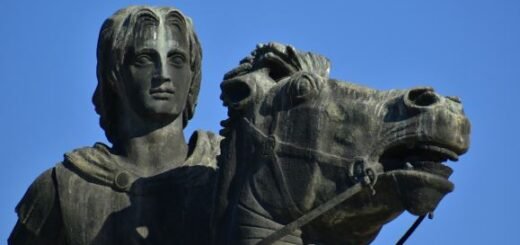
Image: A statue of Alexander the Great
Legacy of Alexander’s Death
Despite the uncertainty surrounding the cause of his death, Alexander the Great’s legacy has endured for more than two millennia. His military conquests and the empire he built spread Greek culture and ideas across a vast portion of the world, leading to the development of Hellenistic civilization.
Even after his death, his image as a legendary conqueror persisted, and his life story became a source of inspiration for subsequent generations of leaders and military strategists.
In conclusion, the death of Alexander the Great remains a mystery that may never be fully solved. While various theories, including typhoid fever, malaria, and poisoning, offer plausible explanations, no definitive evidence exists to confirm any single cause. Nevertheless, the historical significance of Alexander’s death cannot be overstated, as it marked the end of one of history’s greatest empires and set the stage for the tumultuous period of the Diadochi.
READ MORE: Major Battles Alexander the Great fought in
Frequently Asked Questions
What was the condition of Alexander’s body after his death?
Historical accounts mention that Alexander’s body began to decompose six days after his death. His cause of death remains debated, with theories ranging from liver disease and poisoning to typhoid fever and malaria.
What are some theories about Alexander the Great’s death?
Theories about Alexander’s death include typhoid fever, malaria, poisoning, and even Guillain-Barré syndrome. Some suggest he was poisoned by wine made from the plant Veratrum album, which could cause prolonged symptoms. Others argue that he may have died of natural causes, such as a fever or infection.
Toxicologist Leo Schep proposed in 2014 that Alexander could have been poisoned by wine made from the plant Veratrum album, known to cause symptoms similar to those Alexander reportedly experienced.
Some researchers speculate that Alexander might have suffered from Guillain-Barré syndrome, which could have been triggered by typhoid fever. This theory is based on reports that Alexander’s body did not decompose for six days after his death, suggesting he might have been in a coma.
What happened to Alexander the Great’s body after his death?
After Alexander’s death, his body was preserved and transported out of Babylon on a funerary cart, which reportedly took two years to prepare. It was taken to Egypt by his general, Ptolemy I Soter, and initially interred in Memphis before being moved to Alexandria.
Where was Alexander the Great’s body buried?
Alexander’s body was buried in Memphis before being transferred to Alexandria. However, by the 4th century AD, the location of his tomb was lost. Various historical figures claimed to have seen the tomb in later centuries, but its whereabouts remain unknown.
Who took possession of Alexander’s body on its way to Macedonia?
On its way to Macedonia, Alexander’s body was intercepted in Syria by his general, Ptolemy I Soter, who diverted it to Egypt for burial.