Helheim: The Realm of the Norse Goddess of Death

Helheim is not merely a realm of the dead but a reflection of the human experience and the natural cycle of existence.
In Norse mythology, the cosmos is divided into nine distinct worlds, each inhabited by different beings such as gods, giants, dwarfs, and humans. Among these realms lies Helheim, the underworld domain ruled by Hel, the enigmatic goddess of death.
Helheim holds a significant place in Norse cosmology as the final destination for many souls after death. This realm is not merely a place of punishment but a complex world with its own rules and inhabitants.
Norse mythology experts at WHE take an in-depth look at Helheim, providing insight into the Norse perception of death, the afterlife, and the moral values of the Viking Age.
Origins and Etymology
The term “Helheim” combines “Hel,” the name of the goddess, and “heim,” meaning “home” or “world” in Old Norse. Therefore, Helheim translates to “the home of Hel.” The word “Hel” is cognate with the Old English “hell,” but it’s essential to note that Helheim differs significantly from the Christian concept of hell.
While the Christian hell is primarily a place of eternal torment for sinners, Helheim in Norse mythology is a more nuanced realm, serving as the abode for those who did not die gloriously in battle.
Hel: The Goddess of Death

Hel occupies a complex place in Norse mythology, serving as both a deity and a realm associated with the afterlife. Image: Norse Goddess Hel (1889) by Johannes Gehrts.
Hel, the ruler of Helheim, is a daughter of the trickster god Loki and the giantess Angrboða. She is often depicted as a somber figure, with a visage that is half alive and half dead—one side of her body appearing normal, while the other is emaciated and corpse-like. This duality symbolizes her connection to both the living and the dead. Hel’s role is to govern the souls that arrive in her realm, providing them with a place in the afterlife.
The Realm of Helheim

Helheim is the home of dead people who went selected by Odin’s warrior maidens (the Valkyries). Its ruler is the giantess Hel, daughter of Loki
Location in the Norse Cosmos
Helheim is situated in the depths of Niflheim, one of the nine worlds, which is characterized by its cold and misty environment. Niflheim, meaning “Mist Home,” is a primordial realm of ice and fog. Helheim lies beneath the roots of Yggdrasil, the World Tree that connects all realms. Access to Helheim is not straightforward; it is separated from the world of the living by formidable barriers and guarded routes.
The Journey to Helheim
Souls destined for Helheim embark on a perilous journey after death. They must traverse treacherous landscapes, including crossing the river Gjöll, which is spanned by the bridge Gjallarbrú. This bridge is guarded by the maiden Móðguðr, who challenges the souls and inquires about their identities and intentions. The journey symbolizes the separation of the soul from the physical world and the challenges faced in the transition to the afterlife.
Characteristics of Helheim
Helheim is often described as a grim and desolate place, shrouded in darkness and cold. However, it is not necessarily a place of eternal suffering. The realm serves as a resting place for those who died of illness, old age, or other non-heroic means. In Helheim, souls continue a shadowy existence, reflecting the Norse belief in an afterlife that mirrors one’s earthly life but devoid of its pleasures and warmth.
Contrasts with Valhalla and Folkvangr
In Norse mythology, the manner of one’s death significantly influences their afterlife destination. Warriors who die heroically in battle may be chosen by Odin to reside in Valhalla or by Freyja to dwell in Folkvangr. These realms offer honor and glory, where the fallen engage in eternal feasting and combat. In contrast, Helheim receives those who did not meet such fates. This distinction underscores the Norse cultural emphasis on bravery and valor.

In Norse mythology, the land of dead is basically divided into three main regions – Valhalla, Hel (or Helheim), and Fólkvangr.
Helheim in Mythological Narratives
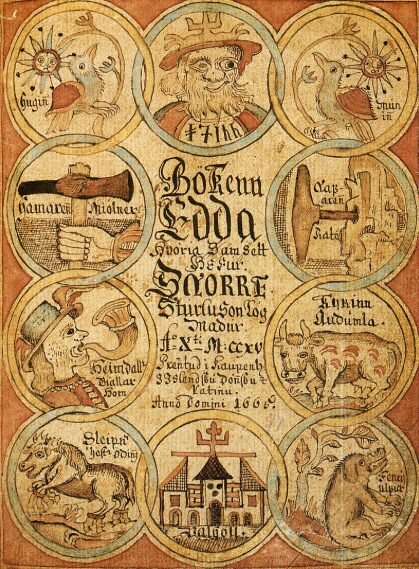
In the section “Gylfaginning” of the Prose Edda, Hel is depicted as a realm where those who die from illness or old age go, contrasting with Valhalla, where fallen warriors reside. Image: Title page of a late manuscript of the Prose Edda written by Snorri Sturluson (13th century), showing the Ancient Norse Gods Odin, Heimdallr, Sleipnir, and other figures from Norse mythology
The Death of Balder

In the Prose Edda, Baldr dies and goes to Hel, and Hermóðr rides Sleipnir to attempt his retrieval. Image: Burial of Baldur: Odin’s last words to Baldr (1908) by W. G. Collingwood.
One of the most poignant tales involving Helheim is the death of Balder (Baldr or Baldur), the beloved god of light and purity. Deceived by Loki, Balder is killed, and his soul descends to Helheim. The gods, stricken by grief, send Hermóðr, Balder’s brother, on a mission to retrieve him.
Riding Odin’s eight-legged horse Sleipnir, Hermóðr journeys to Helheim and pleads with Hel for Balder’s release. Hel agrees on the condition that all things in the world weep for Balder. Despite the gods’ efforts, the mission fails due to Loki’s interference, and Balder remains in Helheim until after Ragnarök. This story highlights the irreversible nature of death and the limitations even gods face regarding fate.

Hermóðr rides to Hel on Sleipnir. The Norse god meets Hel and Baldr. From the 18th century Icelandic manuscript NKS 1867 4to.
Odin’s Journey to Helheim

While some depictions emphasize Hel as a neutral place where the dead reside, others introduce elements of judgment or punishment, possibly influenced by Christian eschatology. Image: Odin Rides to Hel (1908) by English author and artist W. G. Collingwood.
In another narrative, Odin himself ventures into Helheim to seek wisdom. Disguised and using his shamanic abilities, he communicates with the dead to gain knowledge of the future. This journey illustrates the permeability between the realms and the importance placed on wisdom and prophecy in Norse culture.
Brunhildr’s Journey to Hel

Brunhildr’s journey to Hel is a tale from Norse mythology, reflecting themes of honor, betrayal, and the afterlife.
Brunhildr, a Valkyrie, fell in love with the hero Sigurd, but their relationship was marked by treachery due to curses and broken oaths. After Sigurd’s death, Brunhildr chose to join him in death, ordering a grand funeral pyre where she was burned alongside her beloved.
Brunhild, whose name translates to “bright battle” or “armor battle”, is one of the most famous valkyries in Norse mythology. In addition to the Völsunga saga, her story is also told in chapter 41 of the Gylfaginning, a book in the Prose Edda. In the Poetic Edda, Brynhildr’s passage to Hel after death is recounted.
In the Poetic Edda, Brynhildr’s passage to Hel after death is recounted, as well as Odin’s visit to Hel while alive on his horse Sleipnir.
Brunhildr’s journey to Hel signifies her unwavering loyalty to Sigurd and her defiance of earthly constraints, blending tragedy with elements of Norse honor and destiny.

According to some interpretations, Brunhildr’s spirit traveled to Hel, the realm of the dead, ruled by the goddess Hel. In Helheim, Brunhildr would find a somber afterlife, where the dead reside in eternal shadow. Image: Amalie Materna playing Brünnhilde in Wagner’s Ring des Nibelungen
Significance of Helheim

Cultural and Religious Implications
Helheim reflects the Norse understanding of death and the afterlife, which is less moralistic than some other traditions. The realm is not inherently punitive; rather, it is a natural part of the cosmic order. The existence of Helheim emphasizes acceptance of death as an inevitable transition and reinforces the values of courage and honor in life.
Funerary Practices
The Norse people often included grave goods with the deceased, such as weapons, tools, and personal items, to aid them in the afterlife. These practices indicate a belief in a continuation of existence beyond death and the need for provisions in Helheim or other realms. Ship burials and elaborate tombs were reserved for the wealthy or noble, signifying their status even after death.
Helheim and Ragnarök
At Ragnarök, the prophesied end of the world, it is foretold that Hel will release the dead to join the forces against the gods. Helheim thus plays a crucial role in the cyclical nature of Norse cosmology, where destruction leads to renewal. The participation of Helheim’s inhabitants in Ragnarök symbolizes the interconnectedness of life and death.
Modern Interpretations and Influence

Hel is an afterlife realm in Norse mythology, governed by the goddess Hel.
Literature and Media
Helheim has captured the imagination of modern authors, artists, and creators. It appears in various forms of literature, comics, and video games, often reinterpreted to fit contemporary narratives. While some depictions remain faithful to the original myths, others take creative liberties, expanding on Helheim’s characteristics and its ruler.
Misconceptions
Due to similarities in name and concept, Helheim is sometimes conflated with the Christian hell. However, it’s important to recognize that Helheim is not a place of eternal damnation. The Norse afterlife lacks the moral dichotomy of reward and punishment based on ethical behavior; instead, it reflects the values and societal norms of the Viking Age.
Helheim in Comparative Mythology
Comparing Helheim to other underworlds, such as the Greek Hades or the Mesopotamian Kur, reveals common themes in human understanding of death. These realms often serve as places where souls reside after life, governed by deities associated with death. Such comparisons highlight universal questions about mortality and the afterlife across cultures.
Conclusion
Helheim, as the realm of the Norse goddess of death, occupies a vital place in Norse mythology. It embodies the Norse perspective on death—not as an end but as a continuation in a different form. The realm reflects the societal values of the time, emphasizing honor in life and acceptance of one’s fate. Helheim’s portrayal in myths provides insight into how the Norse people understood the cosmos, the afterlife, and the forces that govern existence.
The tales involving Helheim serve as narratives that explore themes of loss, fate, and the limitations of even the mightiest beings. They remind us of the inevitability of death and the importance of living a life worthy of remembrance. In modern times, Helheim continues to fascinate and inspire, bridging the ancient and contemporary worlds through enduring myths and stories.
Frequently Asked Questions

Various Icelandic sources offer differing descriptions of the Norse realm of Hel, and some people were buried with items to aid their journey there. Image: Norse goddess Hel and the realm of the dead
What does the term “Hel” signify in Old Norse mythology, and how is it connected to other Germanic languages?
In Old Norse mythology, “Hel” refers both to the realm of the dead and the goddess who rules over it. This term has cognates in various Germanic languages, such as Old English “hell,” Old Frisian “helle,” Old Saxon “hellia,” and Old High German “hella,” all denoting an underworld or place of the dead. These words trace back to the Proto-Germanic noun haljō, meaning “concealed place” or “the underworld,” reflecting a shared linguistic and cultural heritage among Germanic peoples.
How is the Proto-Indo-European root kel- or kol- related to the concept of Hel and other words like “hall” and “Valhalla”?
The Proto-Indo-European root kel- or kol-, meaning “to cover,” “to conceal,” or “to save,” is the origin of the Proto-Germanic term haljō, from which “Hel” is derived. This root signifies the underworld as a hidden or covered place. It is also the source of the word “hall” in modern English and “Valhalla” in Norse mythology—both stemming from Proto-Germanic hallō, meaning “covered place.” Thus, “Hel,” “hall,” and “Valhalla” are etymologically connected through the idea of enclosed spaces.
What are some related terms in early Germanic languages associated with haljō, and what do they imply about beliefs in magic or the afterlife?
Related terms include halja-rūnō(n), reconstructed from Gothic haliurunnae and Old English helle-rúne, meaning “sorceress” or “necromancer.” This compound combines haljō (“underworld”) with rūnō (“rune” or “secret”), suggesting a link between the underworld and secret knowledge or magic. Another term is halja-wītjan, from Old Norse hel-víti and Old English helle-wíte, referring to “hell” or “hell-torment.” This combines haljō with wītjan (“understanding” or “wits”), possibly indicating the underworld as a place of mental anguish or punishment.
In the Poetic Edda, how is Hel depicted, and what role does it play in the events of Ragnarök?
In the Poetic Edda, Hel is often associated with death and the afterlife. In the poem “Völuspá,” a seeress prophesies that Hel will have a significant role during Ragnarök, the end-of-the-world battle. She mentions a “sooty-red cock” crowing in Hel’s halls, signaling the onset of cataclysmic events alongside cocks crowing in other realms like Jotunheim and Valhalla. This imagery underscores Hel’s integral part in the cosmic upheaval.
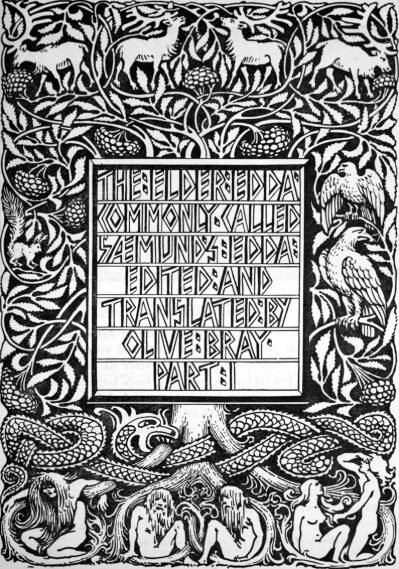
Literary sources like the Poetic Edda and Prose Edda provide varied portrayals of Hel, reflecting the richness and diversity of Norse cosmology. Image: The title page of Olive Bray’s English translation of Codex Regius entitled Poetic Edda depicting the tree Yggdrasil and a number of its inhabitants (1908) by W. G. Collingwood
What information does the Prose Edda provide about Hel as both a place and a deity?
The Prose Edda, written by Snorri Sturluson, offers detailed descriptions of Hel. In the section “Gylfaginning,” Hel is depicted as a realm where those who die from illness or old age go, contrasting with Valhalla, where fallen warriors reside. Hel, the goddess, is described as the daughter of Loki and is banished by Odin to rule over the underworld. Her dwelling, Éljúðnir, is portrayed as a vast hall with high walls and gates, befitting her status as the overseer of the dead.
What was Hermóðr’s journey to Hel in the Prose Edda and its significance?
In the Prose Edda, after the death of Baldr, his brother Hermóðr undertakes a perilous journey to Hel to plead for Baldr’s release. Riding the eight-legged horse Sleipnir, Hermóðr travels for nine nights through dark valleys, crosses the golden-roofed Gjöll bridge guarded by the maiden Móðguð, and reaches Hel’s hall. Despite his efforts, Hel, the goddess, sets conditions that ultimately cannot be met, highlighting the irreversible nature of death and the limitations of the gods.
How does the Gesta Danorum depict a journey resembling one to Hel, and what elements align with Norse beliefs about the afterlife?
In the Gesta Danorum, King Hadingus is guided by a mysterious woman into the underworld. They cross a dark river filled with weapons and witness warriors eternally reenacting battles, symbolizing the continuation of earthly pursuits after death. This account mirrors Norse beliefs where the dead engage in activities reminiscent of their lives, reinforcing the concept of an active afterlife and the existence of realms like Hel.
What are some scholarly interpretations regarding Snorri Sturluson’s portrayal of Hel, particularly by Hilda Ellis Davidson?
Scholar Hilda Ellis Davidson suggests that Snorri Sturluson’s detailed depiction of Hel in the Prose Edda may reflect his own interpretations or embellishments, as earlier sources provide less information. She points out inconsistencies, such as Baldr’s death not fitting the criteria of those who go to Hel, indicating that Snorri might have incorporated contemporary beliefs or his understanding of Christian concepts into the mythology.
In what ways might Christian ideas have influenced the Norse depiction of Hel in medieval writings?
During the medieval period, Norse myths were often transcribed by Christian scholars who might have infused Christian notions of the afterlife into the narratives. Elements like moral judgment, punishment, and reward could have been introduced or emphasized, altering the original pagan concepts of Hel. This blending of beliefs is evident in descriptions of Hel that resemble Christian ideas of hell as a place of torment.
Why is the Proto-Indo-European root kel- significant in understanding the etymology of “Hel” and related terms?
The root kel-, meaning “to cover” or “to conceal,” is fundamental in tracing the etymology of “Hel” and related terms like “hall” and “Valhalla.” It conveys the concept of the underworld as a hidden or enclosed place. Understanding this root helps explain the linguistic connections between different words associated with death and the afterlife across Indo-European languages, highlighting common cultural themes regarding the unseen realm of the dead.





