Relationship between Achilles and Patroclus
Achilles and Patroclus are central figures in Homer’s Iliad, their bond serving as a cornerstone for much of the epic’s narrative tension and emotional depth. Their relationship is not only a personal one but also deeply symbolic, embodying themes of loyalty, grief, and heroism. Across centuries, interpretations of their connection have varied, reflecting cultural attitudes and scholarly debates.

The bond between Achilles and Patroclus is central to the Iliad and other Trojan War narratives. Image: Achilles tending the wounded Patroclus
Achilles and Patroclus in the Iliad
Achilles and Patroclus share a deep and multifaceted relationship, characterized by mutual respect and affection. They live together near the Greek fleet, their tent a private space where their camaraderie is evident.
In Book IX, during an embassy to persuade Achilles to rejoin the battle, Odysseus and Ajax find Achilles singing and playing the lyre, with Patroclus at his side. This intimate moment highlights their close companionship.

Patroclus on an antique fresco from the House of the Tragic Poet in Pompeii, 1st century AD (Naples National Archaeological Museum, Italy)
Achilles, the mightiest Greek warrior, withdraws from battle due to a conflict with Agamemnon. Despite his absence, Patroclus remains active in the Greek camp.
In Book XI, Nestor advises Patroclus to guide Achilles back into the fight or, failing that, to wear Achilles’ armor to inspire and intimidate the Trojans. This advice sets the stage for Patroclus’ tragic involvement in the war.

Patroclus leading the Myrmidons to battle
Patroclus’ Death and Its Impact

The body of Patroclus borne by Menelaus, Roman sculpture, Florence, Italy
When the Trojans breach the Greek defenses, Patroclus dons Achilles’ armor, successfully repelling them and killing Sarpedon, Zeus’s son. However, Patroclus overextends himself and is killed by Hector, the Trojan prince.
News of his death devastates Achilles. Overcome with grief, Achilles mourns Patroclus in a deeply personal and emotional manner, lamenting his loss with a tenderness that contrasts sharply with his usual stoicism.
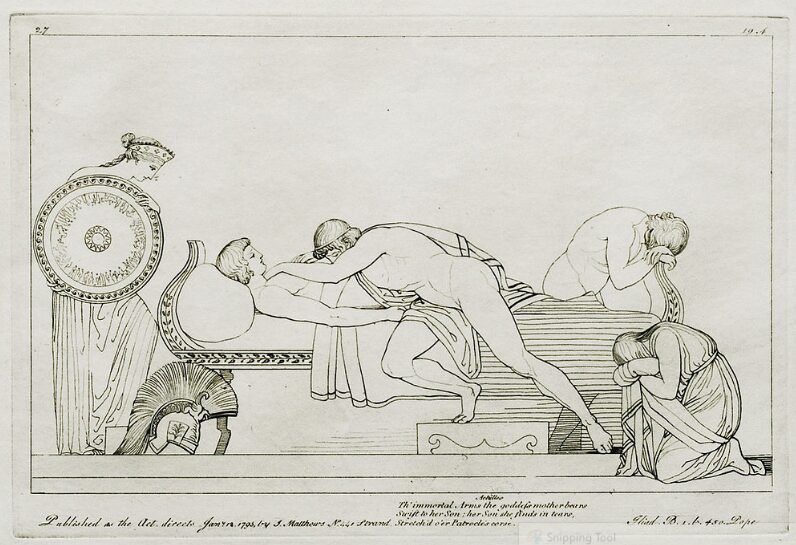
While Homer does not explicitly depict them as lovers, later Greek authors, including Aeschylus, Aeschines, and Plato, often portrayed their relationship as romantic. Image: Achilles mourning Patrocles, British artist John Flaxman, 1795.
Achilles’ mourning culminates in a request to mix his ashes with Patroclus’ upon his death, symbolizing their inseparable bond. Driven by rage and sorrow, Achilles returns to battle, seeking vengeance. His single-minded pursuit leads to Hector’s death, an act that becomes one of the Iliad’s most famous and brutal moments.

The Funeral of Patroclus by French painter Jacques-Louis David, 1778.
Themes in Their Relationship
Achilles’ grief over Patroclus is profound and personal. His reaction, including smearing himself with ash and refusing to eat, mirrors the mourning rituals of the time but is uniquely intense, underscoring the depth of their connection.
Patroclus’ decision to fight in Achilles’ stead, and his eventual death, highlights his loyalty. Achilles’ subsequent vengeance illustrates his dedication to honoring Patroclus.
Patroclus’ death serves as a catalyst for Achilles’ confrontation with his own mortality, a central theme of the Iliad. It forces Achilles to grapple with the ephemeral nature of life and the enduring legacy of heroism.

Menelaus and Meriones lift the body of Patroclus while Odysseus and others look on (Etruscan relief, 2nd century BC)
Classical Interpretations

Achilles killed Trojan hero Hector to avenge the death of his great friend Patroclus | Image: Triumphant Achilles dragging Hector’s body around Troy, from a panoramic fresco of the Achilleion
Homer’s Depiction
In the Iliad, Homer does not explicitly portray Achilles and Patroclus as lovers but emphasizes their profound companionship. The term hetaîros (companion) is used to describe their relationship, and Achilles refers to Patroclus as polù phíltatos (most beloved). The ambiguity of their bond has allowed for varying interpretations over time.
Athenian Perspectives
In Classical Athens, the relationship between Achilles and Patroclus was often viewed through the lens of paiderasteia, a socially recognized bond between an older man (erastes) and a younger male (eromenos). Writers like Aeschylus and Plato explored this framework, albeit with differing views:
- Aeschylus: In The Myrmidons, Achilles is portrayed as the erastes who avenges the death of his eromenos, Patroclus, even at the cost of his own life.
- Plato: In the Symposium, Phaedrus argues that Patroclus was the erastes due to his guidance and influence over the younger Achilles.
These interpretations reflect cultural norms of the time, projecting their own values onto Homer’s characters.

Ancient Greek polychromatic pottery painting (dating to c. 300 BC) of Achilles during the Trojan War
Alternative Views
Other writers, like Xenophon, rejected the romantic interpretation, presenting Achilles and Patroclus as chaste companions. Xenophon highlighted their bond as one of mutual respect and devotion, similar to other legendary pairs like Orestes and Pylades.
Modern Interpretations

Modern interpretations of Achilles and Patroclus’ bond vary, with some suggesting a homosexual aspect, while others see no direct evidence and dismiss such views as speculative. Image: Achilles Lamenting the Death of Patroclus (1855) by the Russian realist Nikolai Ge
Queer Readings
In contemporary scholarship, particularly within queer studies, the relationship is often examined as a potential representation of same-sex love. Scholars argue that the depth of their bond and the language used to describe it suggest a romantic dimension, though this remains speculative.
Platonic Interpretations
Others maintain that Achilles and Patroclus represent a model of platonic male friendship. These interpretations emphasize their camaraderie and shared heroism, viewing their relationship as a powerful example of loyalty and mutual respect.
Narrative and Symbolic Function
Regardless of its exact nature, their bond serves a critical narrative function in the Iliad. It drives Achilles’ actions, shapes the emotional core of the epic, and underscores key themes like mortality, vengeance, and the nature of heroism.
Post-Classical Depictions
Alexander the Great and his companion Hephaestion modeled their relationship on Achilles and Patroclus, visiting their tomb during their campaign in Troy. This act underscored the enduring cultural significance of the pair.
In William Shakespeare’s Troilus and Cressida, Shakespeare depicts Achilles and Patroclus as lovers, reflecting Renaissance attitudes and interpretations of the classical myth.
American writer Madeline Miller’s The Song of Achilles (2011) reimagines their bond as a romantic relationship, emphasizing the emotional and physical intimacy between the two.
Cultural and Literary Legacy
Achilles and Patroclus remain one of the most enduring examples of male companionship in Western literature. Their relationship has been variously interpreted as platonic, romantic, or a blend of both, reflecting the values and perspectives of different times and cultures. Central to the Iliad, their bond exemplifies the complexities of human connection, making their story resonate across millennia.





