History of Ptolemy the Gnostic and his letter to Flora
Ptolemy the Gnostic, a renowned Greek-Egyptian scholar, is often considered one of the most influential figures in the development of the Western school of Valentinian Gnosticism, which was influential in Rome, Italy, and Southern Gaul. One of the notable works attributed to Ptolemy is the Letter to Flora, which, provides critical insights into his worldview, relationships with other intellectual figures, and the cultural and intellectual environment of his time.
Historical Context
To understand the significance of Ptolemy’s Letter to Flora, it is essential to place it within the broader context of Ptolemy’s life and era. Ptolemy was born around 100 CE in Alexandria, a city that was a major center of learning in the ancient world. Alexandria had long been a melting pot of different cultures, knowledge, and intellectual traditions, which helped foster the development of Hellenistic science.
Ptolemy lived during the height of the Roman Empire’s influence, and his works were deeply influenced by the blend of Greek, Egyptian, and Roman traditions.
Ptolemy the Gnostic was a prominent disciple of the Gnostic teacher Valentinius, active during the 2nd century CE. He likely lived until around 180 CE, but few concrete details about his life are known.
The Letter to Flora, written in the context of these intellectual currents, provides a unique glimpse into Ptolemy’s personal relationships and serves as the principal source for understanding Ptolemy’s theological perspectives. The letter itself is believed to have been addressed to a woman named Flora, though little is known about her. Some scholars have argued that the letter is not only a personal correspondence but also a philosophical and intellectual document.
The Letter to Flora: An Intellectual Document
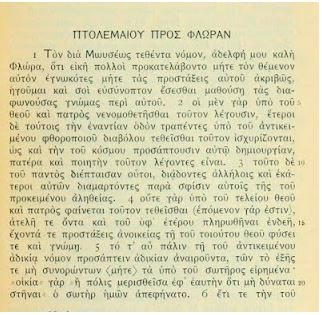
Ptolemy’s epistle to Flora
The Letter to Flora is often viewed as an example of Ptolemy’s engagement with the broader intellectual community. Unlike his more technical works, which were designed to be read by scholars and students, the Letter to Flora appears to have been intended for a more general audience. The letter reflects Ptolemy’s ability to communicate complex ideas in a way that would be accessible to someone outside the formal academic sphere.
The “Letter to Flora” outlines a Gnostic view of the Mosaic Law, dividing it into three origins: God’s pure divine law, Moses’s human-influenced laws, and laws from Israel’s elders.
The contents of the letter suggest that Ptolemy and Flora had a close intellectual relationship, possibly one of mentor and student. Ptolemy’s tone is respectful and considerate, and the letter is structured as a response to a query from Flora.

Questions and answers
Who was Ptolemy the Gnostic, and what was his stance on the authority of the scriptures?
Ptolemy the Gnostic, a student of Valentinius, argued that not all biblical texts were equally inspired. He believed the New Testament held superior authority over the Old Testament due to its purity and divine truth.
How did Ptolemy hierarchize the biblical scriptures in his interpretation?
Ptolemy, like other Gnostics, viewed some scriptures as more divine and authoritative than others, placing the New Testament above the Old Testament in terms of spiritual purity and authenticity.
What was Ptolemy’s perspective on the Ten Commandments and the Old Testament laws?
Ptolemy believed the Ten Commandments were the purest form of God’s law, but still imperfect and incomplete without the fulfillment brought by Jesus Christ. He viewed the rest of the Old Testament laws as tainted by human influence.
How did Ptolemy respond to the argument that the Mosaic Law was divinely ordained?
Ptolemy rejected the view that the Mosaic Law was purely divine, asserting that it was a composite of contributions from God, Moses, and the elders, with human influences distorting the original divine message.
What were the three categories Ptolemy used to classify God’s laws, and what did they represent?
Ptolemy classified God’s laws into three categories: “pure legislation,” which was fulfilled by Christ; laws dealing with human relations, which he considered inferior and inconsistent with Christ’s nature; and spiritually symbolic laws, which Jesus transformed into higher spiritual ideals.
What does Ptolemy’s view on the Demiurge imply about the Old Testament God?
Ptolemy’s view on the Demiurge, a lower deity in Gnostic thought, suggests that the God of the Old Testament was not the true, benevolent God, but rather a lower, imperfect being who shaped many of the Old Testament laws.
How did Ptolemy’s ideas about the Old and New Testament gods compare to those of Marcion of Sinope?
Like Marcion, Ptolemy considered the God of the Old Testament to be the Demiurge, an inferior deity responsible for the creation of the material world, distinct from the true God of the New Testament.
What influence did Ptolemy’s beliefs have on later Christian theological debates?
Ptolemy’s beliefs, considered heretical by many, influenced later debates about the nature of God, the relationship between the Old and New Testaments, and the authenticity of the biblical texts, contributing to the formation of orthodox Christian creeds.





