History of the Black Stone in Mecca
The Black Stone, known in Arabic as al-Ḥajar al-Aswad, is a revered Islamic relic embedded in the eastern corner of the Kaaba in Mecca, Saudi Arabia. According to Islamic tradition, the stone dates back to the time of Adam and Eve and has played a significant role in religious rituals.
Over centuries, it has been venerated, protected, and restored, solidifying its status as an important symbol in Islamic heritage. While Muslims hold the Black Stone in great esteem, theological interpretations clarify that it holds historical and spiritual importance rather than any divine attributes.

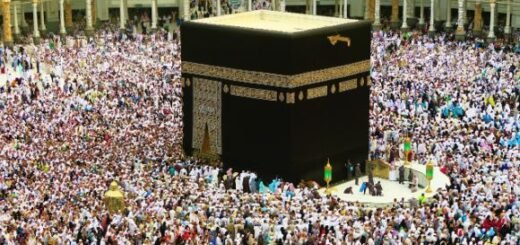
The Black Stone is placed in one of the corners of the Kaaba.
Historical Background
Before the advent of Islam, the Black Stone was already a significant religious object for Arabian tribes. The Kaaba, which housed numerous idols worshiped by pre-Islamic Meccans, contained this revered stone.
Islamic tradition recounts that Prophet Muhammad, at the age of 35, was instrumental in resolving a dispute among Meccan clans over its placement during the Kaaba’s reconstruction.
The Black Stone (al-Ḥajar al-Aswad) is a revered Islamic relic set into the eastern corner of the Kaaba in Mecca, Saudi Arabia.
By placing the stone on a cloth and allowing each clan leader to hold a corner before setting it in its designated place, Muhammad established a diplomatic solution, further elevating the stone’s status in Islamic history.
Physical Description
The Black Stone is fragmented into several pieces that are held together by a silver frame, fastened by silver nails to the Kaaba’s exterior. The fragments appear as seven or eight smaller pieces within a cemented matrix. The visible portion of the stone measures approximately 20 cm by 16 cm.
While its origins remain speculative, the Black Stone’s symbolic role in Islamic tradition is profound, serving as a marker of spiritual connection, historical continuity, and reverence.
Historical accounts indicate that its original dimensions were significantly larger, but due to various incidents over time, including looting and damage, its size has diminished. The stone is set in the east corner of the Kaaba, a position that may have ritualistic significance, possibly linked to astronomical considerations.
Descriptions by European Travelers
Several European travelers disguised themselves as Muslim pilgrims to gain access to the Kaaba and document their observations of the Black Stone.
For example, Swiss explorer Johann Ludwig Burckhardt (1814) described it as an irregular oval made up of smaller stones cemented together, appearing smooth and polished due to continuous touching and kissing by pilgrims.
Richard Francis Burton (1853) noted its metallic black appearance, with a slightly concave center and reddish-brown cement around the sides. Other accounts indicate that the stone possesses a fine-grained interior with embedded greenish specks.
Religious Significance
Muslims performing the Hajj pilgrimage or Umrah partake in the ritual of tawaf, where they circumambulate the Kaaba seven times. During this ritual, pilgrims strive to touch or kiss the Black Stone, emulating the actions of Prophet Muhammad.
However, Islamic scholars emphasize that the stone has no intrinsic divine power and is instead a relic of historical and spiritual significance.
Caliph Umar ibn al-Khattab famously stated, “I know that you are only a stone and can neither harm nor benefit anyone. Had I not seen the Messenger of Allah kissing you, I would not have kissed you.”
Theories on Its Origin
The origins of the Black Stone remain a subject of scholarly debate. Various theories suggest that it could be:
- A basalt rock, given its dark color and smooth texture.
- An agate or natural glass, formed from volcanic activity.
- A stony meteorite, due to its veneration and perceived celestial origin.
Scientific analysis has been limited, but medieval records claim the stone floated on water, which could indicate it is composed of a lightweight material such as pumice.
Some researchers propose that it may be an impactite, a type of natural glass formed by meteorite impacts, possibly linked to ancient meteoritic events in the Arabian Peninsula.

Incidents of Damage and Restoration
The Black Stone has suffered various damages over the centuries, often due to attacks and desecrations:
- 683 CE: The Kaaba was besieged during a conflict between Umayyad forces and Abdullah ibn al-Zubayr. A catapult stone struck the Black Stone, causing fractures.
- 930 CE: The Qarmatians, a rebellious sect, stole the Black Stone and took it to their stronghold in Bahrain. It was returned 23 years later after a ransom was paid, but it was fragmented further in the process.
- 1674 CE: The stone was smeared with excrement in an alleged act of sacrilege, leading to unrest among the pilgrims.
- Over time, Ottoman rulers and later Saudi custodians ensured the preservation of the Black Stone by encasing it in silver frames. Older frames were periodically replaced and transported to Istanbul, where they remain preserved as sacred relics.
Symbolism in Islam
The Black Stone holds deep symbolic significance for Muslims. It is often referred to as “the right hand of God” (yamin-Allah), metaphorically representing a believer’s covenant with the divine. Some traditions suggest that it was originally a pure white stone, which turned black due to humanity’s sins. The stone is said to bear witness on the Day of Judgment, speaking in favor of those who sincerely kissed it during their pilgrimage.
Ritual Role in Hajj and Umrah
During the pilgrimage rituals, the Black Stone is integral to the tawaf process. Pilgrims attempt to kiss it directly, but due to large crowds, most opt to point toward it while reciting the Takbir (“Allahu Akbar”). It marks the starting point of each circumambulation, guiding the pilgrims through the seven rounds required to complete the ritual.
Despite being fragmented and subjected to various attacks, the Black Stone remains a focal point of pilgrimage and devotion.
Additionally, the Black Stone is perfumed regularly by the mosque’s custodians, which creates complications for pilgrims in ihram (a state of consecration), as they are prohibited from using scented substances. In such cases, expiatory actions (kaffara) are required if accidental contact occurs.

The Kaaba during Hajj is a profound sight, surrounded by millions of pilgrims dressed in white.
Myths and Legends
Islamic tradition maintains that the Black Stone was given to Adam and Eve as a heavenly gift and placed in the original Kaaba. Another legend claims that it was once an angel in the Garden of Eden, punished and transformed into stone. Some stories also describe how the angel Jibrael (Gabriel) revealed the stone to Prophet Ibrahim (Abraham), who embedded it into the Kaaba’s structure.
Scientific Investigations and Controversies
Modern geology has yet to conduct a comprehensive analysis of the Black Stone due to its sacred status. However, various hypotheses attempt to classify its composition:
- The meteoritic hypothesis gained traction in the 19th century when geologists observed that many ancient cultures revered meteorites.
- A volcanic origin theory suggests it could be a type of basalt, common in the Arabian Peninsula.
- The Wabar impact event in Saudi Arabia has been proposed as a possible source, producing black glassy fragments similar to the Black Stone.
Despite these theories, no conclusive evidence confirms the stone’s true nature. Given its sanctity, it remains untested by modern scientific methods.

Frequently Asked Questions
What is the significance of the Black Stone in Islam?
Muslims believe it dates back to Adam and Eve and was placed in the Kaaba by Prophet Muhammad in 605 CE. It is touched or kissed by pilgrims during the Hajj.
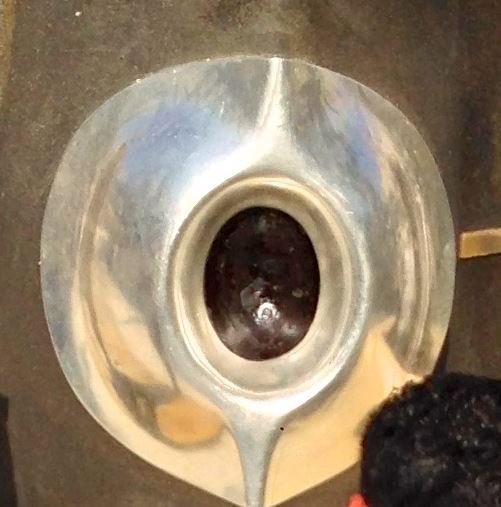
The Black Stone, as seen from an opening in the Kaaba.
Was the Black Stone venerated before Islam?
Yes, it was revered in pre-Islamic pagan times as part of the Kaaba’s religious significance.
What does the Black Stone look like today?
It consists of several fragmented pieces, cemented together in a silver frame, measuring approximately 20 cm by 16 cm.
Is the Black Stone a meteorite?
Some theories suggest it might be a meteorite, but its origins remain unconfirmed due to a lack of scientific analysis.
Why do Muslims kiss or touch the Black Stone?
This practice follows the example of Prophet Muhammad, but Islamic scholars emphasize it has no divine power.

An illustration of the front of the Black Stone.
Has the Black Stone ever been damaged?
Yes, it was shattered and stolen in 930 CE by the Qarmatians and later returned in pieces, now held together by cement.
What role does the Black Stone play in Hajj?
It marks the starting and ending point of the tawaf, the ritual of circumambulating the Kaaba seven times.
What did Umar ibn al-Khattab say about the Black Stone?
He stated that the Stone has no inherent power but kissed it only because Prophet Muhammad did.
Has the Black Stone been studied scientifically?
No modern scientific studies have been conducted, leaving its true composition speculative.
Why are images of Prophet Muhammad often avoided in Islamic art? – History and Major Facts