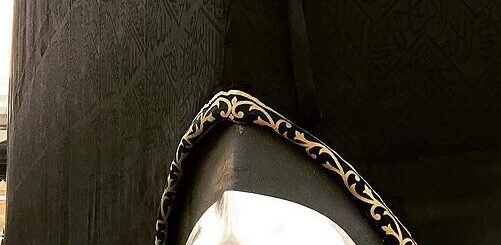
The Kaaba
The Kaaba stands as the most sacred site in Islam, a symbol of unity and devotion for over a billion Muslims worldwide. Located in the heart of Masjid al-Haram in Mecca, Saudi Arabia, this cube-shaped stone structure has a rich history, profound origin stories, and immense significance that transcends time and geography.
In the article below, World History Edu explores the Kaaba’s historical evolution, its foundational myths, and its enduring importance in the Islamic faith.
Historical Background

Historically, figures like Ibrahim and his son Ismail rebuilt the Kaaba, cementing its spiritual legacy. Pilgrims perform Tawaf, circling the Kaaba seven times, a vital ritual of Hajj and Umrah. Image: A view of the Kaaba with several Muslims around it.
Pre-Islamic Era
Before the rise of Islam in the 7th century CE, the Kaaba was already a central religious and commercial hub in the Arabian Peninsula. Mecca, with the Kaaba at its core, served as a sanctuary where various Bedouin tribes congregated annually for pilgrimage. This gathering was not only a religious event but also a significant trading fair. Merchants from diverse regions exchanged goods such as skins, leather, clarified butter, woolens, and camels, many of which were destined for the Roman army’s extensive needs.
The Kaaba during this period was adorned with numerous idols representing different deities worshipped by the tribes. The principal idol was Hubal, revered by the Quraysh tribe, which dominated Mecca’s religious landscape. Inside the Kaaba, sculptures and paintings depicted a pantheon of pagan gods, angels, and figures like Ibrahim (Abraham) holding divination arrows and Isa (Jesus) with Maryam (Mary). These images underscored the Kaaba’s role as a symbolic intersection where the sacred met the profane.
Early Islamic Period
The advent of Islam marked a transformative period for the Kaaba. Prophet Muhammad, born in Mecca around 570 CE, began preaching monotheism, challenging the entrenched polytheistic practices centered around the Kaaba. Around 600 CE, he participated in the Kaaba’s reconstruction following damage from fire and flood. A pivotal event during this reconstruction was Muhammad resolving a dispute among Meccan clans over the placement of the Black Stone. By placing the stone himself, he symbolically united the rival tribes under a single sacred symbol, reinforcing the Kaaba’s central role in Islamic worship.
Revered as the Baytullah (“House of God”), the Kaaba serves as the qibla—the direction Muslims worldwide face during prayer.
Initially, Muslims faced Jerusalem during prayers. However, in 624 CE, following the revelation of Surah 2:144, the qibla (direction of prayer) was redirected to the Kaaba. This shift solidified the Kaaba’s significance as the focal point of Islamic worship. In 630 CE, Muhammad led the peaceful conquest of Mecca, removing idols and purifying the Kaaba. This act not only unified the Muslim community under the worship of Allah but also transformed the Kaaba into a purely monotheistic sanctuary. The preservation of images of Maryam and Isa, alongside the eradication of other depictions, highlights the nuanced approach to iconography in early Islam.
Medieval to Modern Periods
Throughout history, the Kaaba has endured numerous trials and undergone several reconstructions. Significant events include:
- Umayyad Siege (683 CE): The Kaaba was severely damaged by fire during the first siege of Mecca. Abdullah ibn al-Zubayr rebuilt it, incorporating the Hatīm, a remnant of the original structure.
- Umayyad Reconstruction (692 CE): The Umayyad army, led by al-Hajjaj ibn Yusuf, razed al-Zubayr’s Kaaba and reconstructed it on the original Quraysh foundations, restoring its cubic shape.
- Qarmatian Theft (930 CE): The Qarmatians audaciously stole the Black Stone, desecrating the sacred site. They held it until the Abbasids ransomed it in 952 CE, underscoring the Kaaba’s enduring significance.
- Ottoman Restorations (17th Century): Following heavy rains and flooding in 1626 CE, the Kaaba was rebuilt using granite stones from Mecca under the reign of Ottoman Emperor Murad IV. This period also saw the addition of the Mīzāb ar-Raḥmah (golden rain spout) and the Shadherwaan structure to protect the Kaaba from rainwater.
- Modern Enhancements: Contemporary developments include the expansion of Masjid al-Haram and technological improvements to accommodate millions of pilgrims. The Kiswah, the embroidered black silk covering of the Kaaba, is replaced annually during Hajj, featuring intricate gold Qur’anic verses.

Origin Stories and Etymology
Etymology of “Kaaba”
The term “Kaaba” (Arabic: كعبة) literally translates to “the cube,” aptly describing its distinctive shape. The Kaaba is also known by various names in the Qur’an, such as:
- al-Bayt (“the House”)
- Baytī (“My House”)
- Baytik al-Muḥarram (“Your Inviolable House”)
- al-Bayt al-Ḥarām (“The Sacred House”)
- al-Bayt al-‘Atīq (“The Ancient House”)
These names emphasize the Kaaba’s profound spiritual significance and its enduring presence in Islamic tradition.
The origins of the name “Kaaba” are subject to scholarly debate. Historian Eduard Glaser suggested a connection to the southern Arabian or Ethiopian word “mikrab,” meaning temple. However, Patricia Crone disputes this etymology, highlighting the complexity of tracing ancient linguistic roots. Regardless of its linguistic origins, the Kaaba’s role as a central place of worship is unequivocal.
Islamic Cosmology and Foundational Myths
According to Islamic tradition, the Kaaba was the first House of Worship for humanity, built by the prophets Ibrahim (Abraham) and his son Ismail (Ishmael) on divine instructions. This origin story is pivotal, linking the Kaaba to the broader Abrahamic faiths and establishing its foundational role in Islam.
Originally, Muslims prayed facing Jerusalem, but a divine revelation to Prophet Muhammad redirected their focus to the Kaaba.
The Black Stone (al-Hajar al-Aswad), embedded in the eastern corner of the Kaaba, is believed to be a remnant from the original construction. It is considered a tangible link between the earthly and the divine, symbolizing the connection between heaven and earth. Islamic cosmology holds that the Kaaba was the first place of worship dedicated solely to Allah, reinforcing its status as the epicenter of monotheistic faith.
Pre-Islamic Religious Landscape
Idolatry and Polytheism
Before Islam, the Kaaba was a thriving center of polytheistic worship. The Quraysh tribe, dominant in Mecca, venerated Hubal as their principal deity. The Kaaba housed numerous idols representing various gods worshipped by different tribes, reflecting the region’s diverse religious practices. Sculptures and paintings inside the Kaaba depicted not only pagan gods but also angels and significant figures like Ibrahim and Isa with Maryam.
This polytheistic tradition underscored the Kaaba’s role as a religious nexus, where sacred rituals and tribal identities converged. The presence of the Black Stone, believed to be a meteorite, further enhanced the Kaaba’s mystical and sacred aura, symbolizing a divine connection.
Pilgrimage and Trade
The annual pilgrimage to the Kaaba fostered religious devotion and economic prosperity. Despite tribal rivalries, Bedouin tribes set aside their differences to perform rituals and engage in trade. The pilgrimage was an occasion for social interaction, religious expression, and commercial exchange, making Mecca a vital economic and spiritual hub in pre-Islamic Arabia.
Muhammad’s Transformation of the Kaaba
During Muhammad’s lifetime, the Kaaba underwent significant transformation. Around 600 CE, he participated in its reconstruction after damage from fire and flood. A critical moment in this period was Muhammad’s resolution of a dispute among Meccan clans over the placement of the Black Stone. By placing the stone himself, he unified the rival tribes under a single sacred symbol, reinforcing the Kaaba’s role as the central point of Islamic worship.
Initially, Muslims faced Jerusalem during prayers. However, in 624 CE, following the revelation of Surah 2:144, the qibla was redirected to the Kaaba. This change not only emphasized the Kaaba’s centrality in Islamic worship but also symbolized a break from previous religious practices, establishing a distinct Islamic identity.
In 630 CE, Muhammad led the peaceful conquest of Mecca, removing idols and purifying the Kaaba. This act eradicated polytheism from the sacred site, transforming it into a monotheistic sanctuary dedicated solely to Allah. The preservation of images of Maryam and Isa, while erasing other depictions, illustrates the nuanced approach to iconography in early Islam, balancing respect for certain figures with the rejection of idolatry.
Architectural Grandeur and Sacred Elements
The Kaaba stands approximately 15 meters high, with sides measuring around 12 by 10.5 meters. Its exterior is clad in smooth granite, while the interior features marble and limestone flooring, white marble walls with darker trimmings, and intricate inscriptions. The cube shape, from which the Kaaba derives its name, symbolizes stability and permanence.
Key Architectural Features
- Bāb ar-Raḥmah (Door of Mercy):
- Elevated above ground level, this ornate door is adorned with gold embroidery.
- Replaced in 1979 to enhance its splendor, it serves as the main entrance to the Kaaba.
- Mīzāb ar-Raḥmah:
- A golden rain spout added in 1627 to protect the Kaaba from rainwater.
- Positioned above the Bāb ar-Raḥmah, it channels rain away from the structure.
- Hatīm (Hijr Ismail):
- A semi-circular wall adjacent to the Kaaba, signifying the original foundation.
- Considered part of the sacred space, it is not entered during Tawaf (circumambulation).
- Maqam Ibrahim:
- An enclosure housing the imprint of Abraham’s feet.
- Symbolizes Ibrahim’s pivotal role in the Kaaba’s construction and his legacy in Islamic tradition.
- Kiswah:
- The embroidered black silk covering replaced annually during Hajj.
- Features gold Qur’anic verses and intricate designs, symbolizing the Kaaba’s sanctity.
- Rukns:
- The four corners of the Kaaba align with the cardinal directions, each bearing unique names and symbolic significance.
- These corners enhance the architectural symmetry and spiritual alignment of the structure.
- The Black Stone (al-Hajar al-Aswad):
- Set in the eastern corner of the Kaaba, it remains a focal point for pilgrims performing Tawaf.
- Believed to be a meteorite, it symbolizes a tangible link between heaven and earth.
Interior Elements
Inside the Kaaba, the floor is made of marble and limestone, elevated about 2 meters above the ground. The interior walls are clad with white marble, trimmed with darker stones. The space houses marble tablets inscribed with historical records, including contributions from notable rulers like the Circassian Sultans Barsbay and Qaitbay, who undertook significant restoration projects in the 15th century. These inscriptions document architectural enhancements and reflect the ongoing reverence and care bestowed upon the Kaaba.
Rituals and Pilgrimage
Tawaf: The Circumambulation Ritual
Tawaf is one of the central rituals in Islam, performed during both Hajj and Umrah pilgrimages. It involves circumambulating the Kaaba seven times in a counterclockwise direction. This act symbolizes the unity of Muslims in worshiping one God and moving in harmony together around the Kaaba.
Procedure and Significance
- Starting Point: Pilgrims begin Tawaf at the corner of the Kaaba where the Black Stone is located, attempting to kiss or touch it. However, due to large crowds, this is often challenging.
- Recitations: During each round, pilgrims recite the Basmala (“In the name of Allah, the Most Compassionate, the Most Merciful”) and Takbir (“Allahu Akbar” – “Allah is the Greatest”), fostering a sense of collective devotion and spiritual elevation.
- Types of Tawaf:
- Tawaf al-Qudūm: Performed by those arriving in Mecca.
- Tawaf aṭ-Ṭaḥīyah: Conducted upon entering Masjid al-Haram.
- Tawaf al-‘Umrah: Specific to the Umrah pilgrimage.
- Tawaf al-Wadā’: A farewell circumambulation before leaving Mecca.
- Tawaf az-Zīyārah: Associated with visiting or compensatory rituals during Hajj.
These various forms of Tawaf cater to different spiritual needs and stages of the pilgrimage, reinforcing the Kaaba’s central role in Islamic worship.
Hajj and Umrah Pilgrimages
- Hajj: One of the Five Pillars of Islam, Hajj is an annual pilgrimage that attracts millions of Muslims from around the world. It encompasses several rituals, including Tawaf, Sa’i (walking between the hills of Safa and Marwah), standing at Arafah, and symbolic stoning of the pillars representing Satan.
- Umrah: Known as the “lesser pilgrimage,” Umrah can be performed at any time of the year and includes rituals similar to Hajj, such as Tawaf and Sa’i, but lacks some of the Hajj-specific rites.
Both pilgrimages aim to strengthen faith, promote unity, and provide spiritual renewal, with the Kaaba serving as the epicenter of these transformative experiences.
Symbolism and Spirituality
The Kaaba embodies the core tenets of Islam—monotheism and unity. By directing prayers towards the Kaaba, Muslims worldwide align their spiritual practices with a common focal point, fostering a sense of global community and shared devotion.
The Kaaba is more than a physical structure; it represents a profound spiritual connection between the believer and Allah. The act of Tawaf, moving in a unified direction, symbolizes the collective journey of Muslims towards spiritual fulfillment and divine proximity.
The Kaaba’s alignment with celestial bodies, such as the star Canopus, emphasizes its connection to the cosmos. This celestial harmony symbolizes the alignment between heaven and earth, reinforcing the Kaaba’s role as a bridge between the divine and the mortal realms.
The Kaaba’s origin story links it to the Abrahamic faiths, with prophets Ibrahim and Ismail playing crucial roles in its construction. This connection bridges the narratives of Judaism, Christianity, and Islam, highlighting the Kaaba’s role in fostering a unified monotheistic tradition that transcends tribal and cultural boundaries.
Cleansing and Preservation
Cleaning of the Sacred Kaaba
Maintaining the sanctity of the Kaaba is a meticulous process undertaken twice a year during the Cleaning of the Sacred Kaaba ceremony. This ritual involves purifying the interior using Zamzam water scented with Oud perfume, overseen by the Banī Shaybah tribe—the custodians appointed by Muhammad.
Procedure
- Preparation: Preparations begin a day before the ceremony, mixing Zamzam water with luxurious perfumes such as Tayef rose, ‘oud, and musk.
- Cleaning: On the designated dates (1st of Sha’baan and 15th of Muharram), the Governor of the Makkah Province and dignitaries clean the interior. Marble surfaces are wiped with palm leaves dipped in the scented water, ensuring the Kaaba remains pristine.
- Completion: The entire process is completed within two hours to accommodate the continuous flow of pilgrims and maintain the Kaaba’s sanctity.
This ritual underscores the importance of cleanliness and reverence in Islamic worship, preserving the Kaaba as a symbol of faith and purity.
Cultural and Historical Legacy
Throughout centuries, the Kaaba has been a silent witness to pivotal historical events and transformations within the Islamic world. From its reconstruction after sieges and natural disasters to Ottoman-era restorations, each phase of the Kaaba’s history reflects broader socio-political dynamics and the resilience of the Islamic faith.
The Qarmatians’ theft of the Black Stone in the 10th century is a notable historical incident that highlights the Kaaba’s enduring significance. Their act of desecration and subsequent ransom of the stone by the Abbasids underscore the sacred value placed on the Kaaba’s elements and the lengths to which different groups would go to control or protect this holy site.
The Ottoman Empire played a crucial role in the Kaaba’s maintenance and restoration. Following heavy rains and flooding in 1626 CE, Emperor Murad IV oversaw the rebuilding of the Kaaba using granite stones from Mecca. Ottoman restorations also included the addition of the Mīzāb ar-Raḥmah and the Shadherwaan structure, enhancing the Kaaba’s architectural resilience and aesthetic grandeur.
In contemporary times, the Kaaba has undergone significant expansions to accommodate the millions of pilgrims visiting Mecca each year. Technological advancements and architectural enhancements ensure the Kaaba remains accessible and revered. The Kiswah, updated annually with intricate gold Qur’anic inscriptions, continues to symbolize the Kaaba’s sanctity and beauty.
The Kaaba’s profound influence is evident in its depiction on Saudi and Iranian currency, symbolizing its universal recognition and reverence across Muslim-majority nations. Its image serves as a constant reminder of the Kaaba’s central role in Islamic identity and unity.

Global Unity and Spiritual Connection
The Kaaba serves as a unifying focal point for Muslims around the globe. Regardless of geographic location, Muslims orient their prayers towards the Kaaba, symbolizing a shared direction of faith and devotion. This physical alignment fosters a sense of global community, reinforcing the principles of unity and equality that lie at the heart of Islam.
The annual Hajj pilgrimage epitomizes the Kaaba’s role in fostering global unity. Millions of pilgrims from diverse backgrounds converge in Mecca, performing rituals that date back to the time of Ibrahim and Ismail. This convergence not only strengthens individual faith but also cultivates a collective identity, transcending ethnic, linguistic, and cultural differences. Hajj serves as a powerful demonstration of Islam’s universal message of equality, solidarity, and submission to Allah.
Pilgrims return from Hajj and Umrah with a sense of spiritual renewal and deeper connection to their faith. The Kaaba, as the epicenter of these transformative experiences, embodies the timeless principles of devotion, community, and reverence that define Islam. This spiritual connection reinforces the Kaaba’s enduring presence in the hearts and minds of Muslims worldwide.
Conclusion
The Kaaba is more than just a physical structure; it is the heart of Islamic spirituality, history, and community. From its pre-Islamic origins as a polytheistic sanctuary to its transformation into a monotheistic epicenter under Prophet Muhammad, the Kaaba has played a pivotal role in shaping Islamic identity and unity. Its architectural grandeur, rich historical legacy, and profound spiritual significance continue to make the Kaaba a central symbol of faith for Muslims globally.
Frequently Asked Questions

Image: An 1880 photo, by Muhammad Sadiq, of the Kaaba.
What is the Kaaba and its significance in Islam?
The Kaaba is a cube-shaped stone structure located at the center of Masjid al-Haram in Mecca, Saudi Arabia. It is the most sacred site in Islam, serving as the qibla—the direction Muslims face during prayer—and is central to the Hajj and Umrah pilgrimages.
What does “al-Ka‘bah” mean in Arabic?
“Al-Ka‘bah” literally translates to “the cube” in Arabic, aptly describing the Kaaba’s distinctive cube shape.
What are the various names of the Kaaba mentioned in the Qur’an?
In the Qur’an, the Kaaba is referred to by several names, including al-Bayt (“the House”), Baytī (“My House”), Baytik al-Muḥarram (“Your Inviolable House”), al-Bayt al-Ḥarām (“The Sacred House”), and al-Bayt al-‘Atīq (“The Ancient House”).
What is the origin of the name “Kaaba”?
The origin of “Kaaba” is debated among scholars. Historian Eduard Glaser suggested it may derive from the southern Arabian or Ethiopian word “mikrab,” meaning temple, though Patricia Crone disputes this etymology. Regardless, the name underscores its central role in worship.
What was the role of the Kaaba in pre-Islamic Arabia?
In pre-Islamic Arabia, the Kaaba served as a sanctuary for various Bedouin tribes who gathered annually for pilgrimages. This convergence fostered religious devotion and vibrant trade, with merchants exchanging goods like skins, leather, clarified butter, woolens, and camels.
What idols were present in the Kaaba before Islam, and what happened to them?
Before Islam, the Kaaba housed numerous idols representing different deities, with Hubal being the principal idol worshipped by the Quraysh tribe. Muhammad destroyed these idols after his conquest of Mecca, symbolizing the eradication of polytheism in favor of monotheism.
How has the Kaaba been rebuilt and restored throughout history?
The Kaaba has been rebuilt multiple times due to damages from fires, floods, and sieges. Notably, it was reconstructed by Abdullah ibn al-Zubayr after the Umayyad siege in 683 CE and again by the Umayyads in 692 CE. It was also restored after the Qarmatians stole the Black Stone in 930 CE and following floods in 1626 CE.
What role did Muhammad play in transforming the Kaaba?
Muhammad participated in the Kaaba’s reconstruction around 600 CE after damage from fire and flood. He resolved a dispute among Meccan clans over the placement of the Black Stone by placing it himself, uniting the tribes. In 630 CE, he led the peaceful conquest of Mecca, removed idols, and purified the Kaaba, reinforcing its role as a monotheistic sanctuary.
What are the key architectural features of the Kaaba?
The Kaaba stands approximately 15 meters high, with sides measuring around 12 by 10.5 meters. Key features include:
- Bāb ar-Raḥmah (Door of Mercy): An ornate door elevated above ground level.
- Mīzāb ar-Raḥmah: A golden rain spout added in 1627.
- Hatīm (Hijr Ismail): A semi-circular wall adjacent to the Kaaba.
- Maqam Ibrahim: An enclosure housing the imprint of Abraham’s feet.
- Kiswah: The embroidered black silk covering replaced annually.
- Rukns: The four corners aligned with the cardinal directions.
- The Black Stone (al-Hajar al-Aswad): Set in the eastern corner.
What is Tawaf and its significance?
Tawaf is the Islamic ritual of circumambulating the Kaaba seven times in a counterclockwise direction. It symbolizes the unity of Muslims in worshiping one God. Pilgrims begin Tawaf at the Black Stone, attempting to kiss or touch it, and recite the Basmala and Takbir during each round.
What symbolism and spiritual meanings are associated with the Kaaba?
The Kaaba embodies deep spiritual meanings as the first House of Worship built by prophets Ibrahim and Ismail. The Black Stone serves as a link between earth and heaven. Its alignment with celestial bodies, like the star Canopus, symbolizes harmony between heaven and earth. The Maqam Ibrahim and Hatīm represent the enduring legacy of Abrahamic faiths, fostering a unified monotheistic tradition.
How is the Kaaba maintained and preserved?
The Kaaba is meticulously maintained through regular cleaning and restoration. Twice a year, during the Cleaning of the Sacred Kaaba ceremony, the interior is purified using Zamzam water scented with Oud perfume. This ritual, overseen by the Banī Shaybah tribe—custodians appointed by Muhammad—ensures the Kaaba remains a pristine symbol of faith. The cleaning involves wiping marble surfaces with palm leaves and is completed within two hours to accommodate pilgrims.