Honorius: The Roman Emperor who prohibited men from wearing trousers in Rome
Honorius (384–423) was Roman emperor from 393 to 423, ruling the Western Roman Empire. The younger son of Theodosius I and Aelia Flaccilla, he became emperor under Stilicho’s regency after his father’s death in 395. While his brother Arcadius ruled the Eastern Empire, Honorius faced instability and decline in the West. His reign was marked by the 410 sack of Rome by the Visigoths, the first since 390 BCE, symbolizing the empire’s waning power. Honorius’s era epitomized the Western Empire’s growing fragmentation.

Aureus of Roman Emperor Honorius
Early Life
Flavius Honorius (384–423) was born on September 9, 384, in Constantinople to Emperor Theodosius I and Aelia Flaccilla. He was the younger brother of Arcadius, ruler of the Eastern Roman Empire, and half-brother to Galla Placidia, born from Theodosius’s second marriage to Galla.

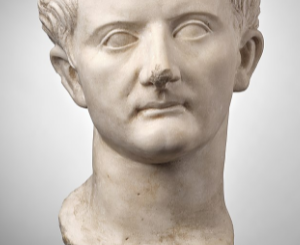
Image: A sculpture work depicting the bust of Theodosius I.
After his mother’s death in 386, Honorius became part of a dynastic legacy tied to both the Eastern and Western Roman Empires. At the age of nine, he was declared co-emperor with his father in 393, consolidating his position as heir to the Western Roman Empire.

Aelia Flaccilla – wife of Emperor Theodosius I
When Theodosius died in 395, the empire was divided between Honorius, ruling the Western half, and Arcadius, ruling the Eastern half. Honorius ascended to the throne at the young age of ten, under the regency of Stilicho, a general of mixed Roman and Vandal descent.
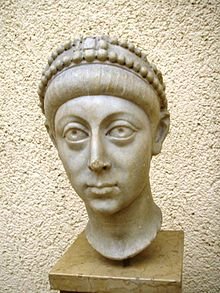
During Theodosius I’s celebration ceremony of quinquennelia in 383, he elevated his eldest son Arcadius to co-emperor. Image: Roman Emperor Arcadius – son of Emperor Theodosius I
Early Reign and Stilicho’s Influence
Honorius’s reign began during a tumultuous period marked by barbarian invasions and internal instability. Stilicho served as the de facto ruler, wielding significant power in the Western Empire.
To strengthen ties, Stilicho married his daughter Maria to Honorius. He effectively defended the empire against numerous threats, including Alaric I and the Visigoths, and Radagaisus, who invaded Italy with a large force in 405.

Roman Emperor Honorius and his wife Maria
Despite Stilicho’s military successes, the empire faced increasing strain. In 401, Honorius relocated the capital from Milan to Ravenna due to its defensible location amid marshes and fortifications. However, Ravenna’s remote position made it difficult for Roman forces to respond quickly to threats, weakening the empire’s ability to defend its heartlands.
Invasions and Internal Challenges
Under Honorius, the Western Roman Empire faced several major crises. In 406, Vandals, Suebi, and Alans crossed the frozen Rhine into Gaul, destabilizing the region. Meanwhile, Britain faced increasing isolation as Roman forces were redirected to defend Italy and Gaul. In 410, Honorius reportedly instructed British leaders to defend themselves, effectively severing ties with the province.
Usurpations further strained the empire. Constantine III declared himself emperor in Britain in 407 and invaded Gaul, establishing control over parts of the province. Although his rebellion was eventually suppressed by Honorius’s general Constantius, it exposed the empire’s vulnerabilities.
The Fall of Stilicho
Stilicho’s downfall marked a turning point in Honorius’s reign. In 408, court intrigue led by Olympius resulted in Stilicho’s execution under accusations of treason. This decision weakened the empire’s defenses, as Stilicho’s loyal federate troops defected to Alaric I. Without Stilicho’s leadership, the Western Empire struggled to manage the growing Visigothic threat.

Stilicho (c. 359–408) was a Roman military commander of partial Vandal descent who rose to significant power in the Western Roman Empire. Married to Serena, Emperor Theodosius I’s niece, he served as guardian to the young Emperor Honorius. Despite initial successes against barbarian invasions, political intrigues led to Roman general Stilicho’s arrest and execution in 408. Image: An ivory diptych shows Stilicho (or Aetius) with wife Serena and son Eucherius, circa 395, Monza Cathedral.
The Sack of Rome
Alaric, emboldened by Rome’s weakened state, invaded Italy multiple times between 408 and 410. In 410, after failed negotiations with Honorius, Alaric’s forces sacked Rome. Though the sack was relatively mild, it was a symbolic blow to Roman prestige. It marked the first time in nearly 800 years that Rome had fallen to a foreign power, highlighting the decline of the Western Empire.
Honorius’s passive leadership during the crisis drew criticism. While Alaric besieged Rome, Honorius remained in Ravenna, reportedly indifferent to the gravity of the situation. The sack reverberated throughout the empire, further eroding confidence in imperial authority.
Relations with the Church and Legal Reforms
Honorius aligned closely with the Christian Church, reinforcing its dominance within the empire. His reign also saw decrees against pagan practices and the promotion of church construction. These policies strengthened ties with Christian leaders and reflected the increasing integration of Christianity into Roman governance.
Honorius’s legal reforms were influenced by the legacy of his father, Theodosius I. He emphasized justice and sought to stabilize the empire through legislative measures, though these efforts had limited success given the empire’s deteriorating state.
Bans on men wearing trousers and Gladiatorial Games
During his reign, Emperor Honorius issued a decree prohibiting men from wearing trousers in Rome, reflecting his efforts to maintain traditional Roman customs amidst cultural shifts brought by barbarian influence.
Additionally, Honorius played a key role in ending gladiatorial games, a practice deeply embedded in Roman entertainment but increasingly at odds with Christian values. He banned gladiatorial combats in 399 and reinforced the prohibition in 404, reportedly motivated by the martyrdom of Telemachus, a Christian monk.
Telemachus had entered an arena to protest the brutality of the games and was killed by an enraged crowd. This act of sacrifice prompted Honorius to take decisive action, aligning with the Christian Church’s growing influence in the empire. These policies highlighted the transition of Rome from its pagan traditions toward a Christianized identity under Honorius’s reign, symbolizing a broader cultural shift in the late Roman Empire.
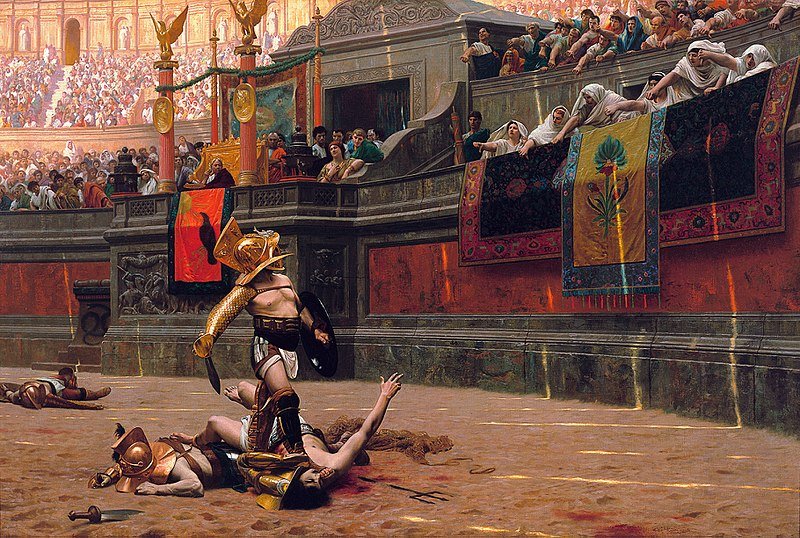
Emperor Honorius officially banned gladiator combats in 404 CE after the martyrdom of a Christian monk who protested the games. Image: Pollice Verso (“With a Turned Thumb”), an 1872 painting by French painter and sculptor Jean-Léon Gérôme
Decline of Western Provinces
The Western Roman Empire fragmented further under Honorius’s rule. In Gaul, barbarian tribes including the Vandals and Visigoths established territories, undermining Roman control. By 418, Honorius granted the Visigoths land in southwestern Gaul as federates, marking a shift toward reliance on barbarian allies.
In Hispania, Vandals, Suebi, and Alans continued their incursions, while North Africa, the empire’s breadbasket, faced increasing threats. The loss of these provinces weakened the empire economically and militarily, contributing to its decline.
Alliances and Family Ties
Honorius’s sister, Galla Placidia, played a pivotal role in his reign. After being captured by the Visigoths during Alaric’s campaigns, she married Ataulf, Alaric’s successor. This marriage temporarily stabilized relations between the Visigoths and the Roman Empire. In 417, Galla Placidia married Constantius, one of Honorius’s most capable generals. Constantius was later elevated to co-emperor in 421, though he died shortly thereafter.
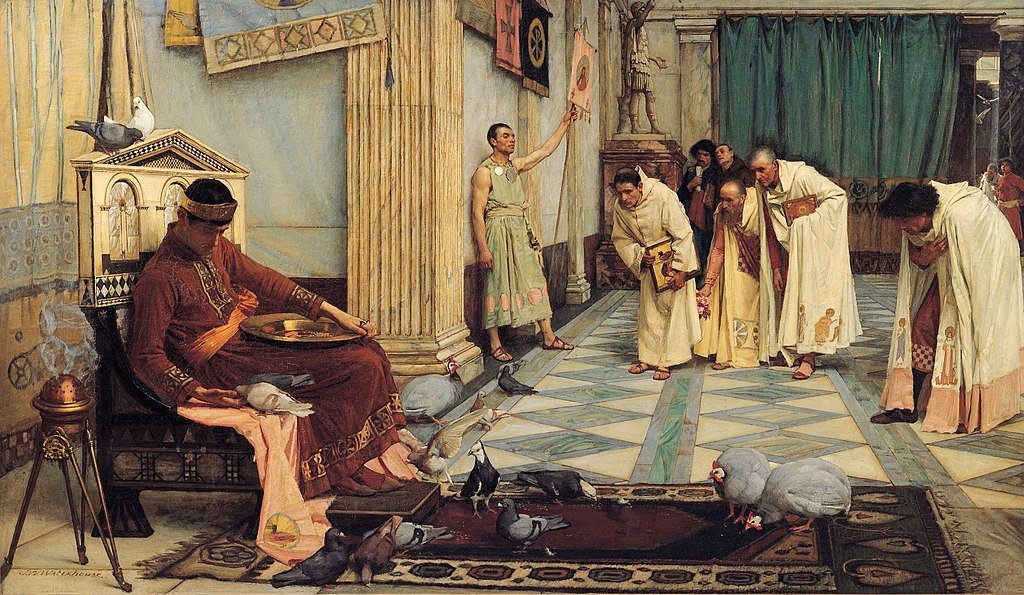
The Favourites of the Emperor Honorius, by English painter John William Waterhouse, 1883
Final Years and Death
Honorius’s later years were marked by continued instability. Barbarian incursions persisted, and the Western Empire lost key territories. Honorius’s relationship with Galla Placidia deteriorated, leading her to flee to Constantinople with her children, including the future Emperor Valentinian III.
Honorius died of edema on August 15, 423, leaving no heir. His death led to a brief interregnum before his nephew Valentinian III was installed as emperor with Eastern support.
Legacy
Honorius is widely regarded as a weak and ineffective ruler whose reign symbolized the decline of the Western Roman Empire. His reliance on court factions, passive leadership, and inability to address crises contributed to the empire’s fragmentation. The sack of Rome and the loss of provinces like Britain and Gaul underscored the diminishing power of the Western Empire.
Despite his shortcomings, Honorius’s reign was a pivotal period in Roman history. It highlighted the internal weaknesses and external pressures that ultimately led to the fall of the Western Roman Empire in 476. His close alignment with the Church reinforced Christianity’s central role in the empire, shaping the religious landscape of medieval Europe.
Frequently Asked Questions

Honorius was the Western Roman Emperor from 395 to 423, known for ruling during the decline of the empire. Image: Honorius on the consular diptych of Anicius Petronius Probus (406)