How did Leif Erikson reach North America?
Leif Erikson, a prominent Norse explorer, is widely recognized as one of the first Europeans to reach North America, centuries before Christopher Columbus. His journey to what is now known as North America is documented primarily through Norse sagas and supported by archaeological evidence.
Understanding how Leif Erikson reached North America involves examining his background, the motivations behind his voyage, the methods and routes employed, and the legacy of his expedition.

Leif Erikson remains a pivotal figure in the history of exploration, representing the Norse ventures into North America centuries before Columbus. Image: Leif Eriksson Discovers America by Norwegian painter Hans Dahl (1849–1937)
Background and Upbringing
Leif Erikson was born around the 970s in Iceland, though his family originally hailed from Norway. His father, Erik the Red, was a notable Norse settler who established the first permanent Norse settlements in Greenland after being exiled from Iceland due to manslaughter charges against his father.
Growing up in Greenland’s Eastern Settlement, Leif was raised in an environment of exploration and resilience. The harsh and isolated conditions of Greenland required exceptional maritime skills and determination, traits that Leif would later exhibit in his voyages.
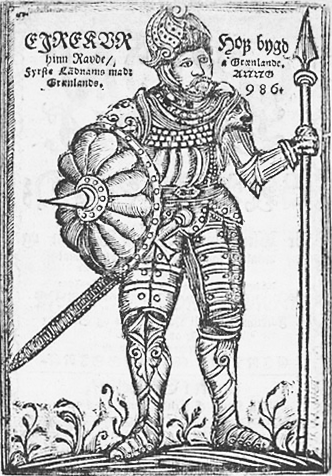
Raised in Greenland by his father Erik the Red, Leif became chief after his father’s death and had two sons, Thorgils and Thorkell. Image: Erik the Red from Arngrímur Jónsson’s Grönlandia.
Motivations for the Voyage
Leif Erikson’s journey to North America was influenced by several factors. Primarily, his time spent at the court of Norwegian King Olaf Tryggvason played a significant role. During his stay, Leif converted to Christianity, a transformative experience that not only altered his personal beliefs but also set the stage for his future missions. King Olaf commissioned Leif to return to Greenland to convert the Norse settlers to Christianity. This mission of religious conversion was a key motivator for Leif’s voyage westward.
Additionally, Leif was inspired by the accounts of earlier explorers. Notably, Bjarni Herjólfsson, another Norse explorer, had reportedly been blown off course during a voyage from Iceland to Greenland. Bjarni sighted an unfamiliar land to the west but did not disembark, believing it to be part of Greenland. Upon returning to Greenland, Bjarni shared his discoveries, sparking interest and curiosity among the settlers, including Leif Erikson. This blend of religious duty and exploratory zeal propelled Leif to undertake his expedition.
Preparation and Assembly of the Expedition
Leif’s preparation for the voyage involved meticulous planning and the assembly of a competent crew. He purchased Bjarni Herjólfsson’s ship, which was already known for its seaworthiness and capacity to handle long voyages. Leif gathered a crew of approximately thirty-five men, ensuring that the expedition was adequately staffed for the challenges of transatlantic navigation and potential conflicts.
The Norse were renowned for their advanced shipbuilding techniques, particularly the construction of the longship. These vessels were sleek, with shallow drafts that allowed navigation through both open seas and narrow fjords. The versatility and durability of the Norse ships made them ideal for long-distance exploration, capable of withstanding the rough conditions of the North Atlantic.
Navigation Techniques
Navigating the North Atlantic during the Viking Age required exceptional skill and knowledge. The Norse used a combination of celestial navigation, coastal landmarks, and environmental indicators to guide their voyages. Key navigational tools included the sunstone, a type of mineral believed to help locate the sun in overcast conditions, and the sun compass, which helped determine direction based on the sun’s position.
Leif Erikson and his crew would have relied on these techniques, along with their intimate knowledge of the North Atlantic’s currents and weather patterns. The ability to read the natural signs, such as bird flight patterns, ocean swells, and icebergs, was crucial for successful navigation. This expertise enabled them to traverse vast distances and adapt to unexpected challenges, such as storms that could alter their course.
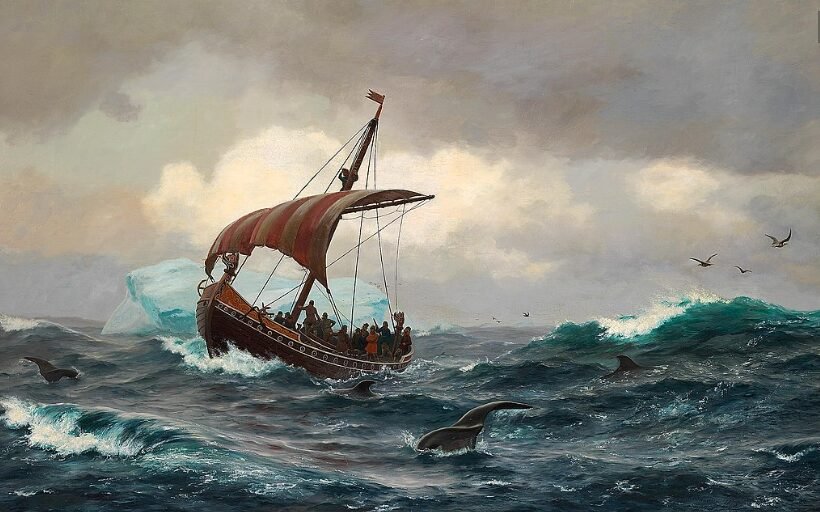
Summer in the Greenland coast circa the year 1000 by Danish painter Carl Rasmussen (1874)
The Voyage Westward
Leif’s journey commenced from Greenland’s Brattahlíð, the family estate established by Erik the Red. Departing from this settlement, the expedition sailed westward across the North Atlantic. The voyage was arduous, characterized by unpredictable weather, treacherous sea conditions, and the constant need for resource management. However, the Norse seafarers’ resilience and maritime prowess ensured their progress despite these obstacles.
Discovery According to the Sagas
Leif Erikson’s discovery of North America is chronicled in two main Norse sagas: the Saga of Erik the Red and the Saga of the Greenlanders. Each provides a slightly different account of the events leading to the discovery of Vinland, the Norse name for parts of North America.
Saga of Erik the Red’s Account
In the Saga of Erik the Red, Leif’s discovery of Vinland was somewhat accidental. While en route from Norway to Greenland to fulfill his mission of converting the settlers to Christianity, Leif encountered a severe storm that diverted his course. The storm forced the expedition to land on an unfamiliar shore, where they discovered fertile land with wild grapes, self-sown wheat, and maple trees—resources that were rare in the North Atlantic regions they inhabited.
Recognizing the potential of this new land, Leif and his crew explored the area, gathering samples of its abundant resources. They established a temporary settlement and named the region Vinland, meaning “Wineland,” due to the presence of grapevines. After spending the winter, Leif decided to return to Greenland with the valuable resources and to rescue shipwrecked sailors they encountered along the way. This successful and fortuitous journey earned Leif the nickname “Leif the Lucky.” Although Leif did not return to Vinland, his discovery inspired subsequent expeditions, including those led by Thorfinn Karlsefni.

First page of the Saga of Erik the Red, written by an Icelandic Cleric, 13th century.
Saga of the Greenlanders’ Account
The Saga of the Greenlanders offers a slightly different narrative. According to this account, Leif was not the first European to discover Vinland. Instead, it credits Bjarni Herjólfsson, who had been blown off course during a voyage from Iceland to Greenland and sighted the land to the west. Bjarni did not land but returned to Greenland to report his findings, igniting interest among the settlers.
Approximately fifteen years later, Leif Erikson, inspired by Bjarni’s account, organized an expedition to explore the described land. He purchased Bjarni’s ship, assembled his crew, and set sail westward. On this voyage, Leif and his men first reached Helluland (interpreted as Baffin Island or northern Labrador) and Markland (likely near Cape Porcupine, Labrador). These discoveries aligned with their navigational knowledge and further fueled their quest.
Continuing their westward journey, Leif eventually reached Vinland, a land characterized by its mild climate, fertile soil, and plentiful salmon. There, Leif and his crew established a small settlement named Leifsbudir (Leif’s Booths). During their stay, one of the crew members, Tyrker, discovered the presence of grapevines, reinforcing the name Vinland. After spending the winter, Leif returned to Greenland with significant resources, including grapes and timber, and rescued an Icelandic castaway. This successful mission solidified his reputation as “Leif the Lucky” and set a precedent for future explorations.

“‘Leif the Lucky’ is recorded in Hauksbók, the oldest 14th-century manuscript of the Saga of Erik the Red.”
The Return Voyage
Leif Erikson’s return to Greenland was as critical as his initial voyage. Upon returning, he brought back not only valuable resources but also stories of the fertile and promising land to the west. This return journey demonstrated the viability of Vinland as a resource-rich area, encouraging further expeditions. Additionally, rescuing shipwrecked sailors highlighted Leif’s leadership and generosity, further enhancing his standing among the Norse settlers.
Archaeological Evidence Supporting the Sagas
Modern archaeological discoveries have provided tangible evidence supporting the sagas’ accounts of Norse exploration in North America. The most significant finding is the site at L’Anse aux Meadows in Newfoundland, Canada. Discovered in the early 1960s by Norwegian explorer Helge Ingstad and archaeologist Anne Stine Ingstad, this site features remnants of Norse longhouses, workshops, and other structures consistent with a Norse settlement.
It must aslo be noted that Carbon dating places the site’s occupation between 990 and 1050 CE, with tree-ring analysis specifically dating to 1021 CE, aligning closely with the estimated time of Leif Erikson’s voyage.
According to Icelandic sagas, Leif Erikson founded a settlement at Vinland, likely near present-day Newfoundland’s L’Anse aux Meadows.
L’Anse aux Meadows is believed to have served as a base for further exploration rather than a permanent settlement, functioning as a ship repair station or waypoint for voyages deeper into Vinland. This discovery corroborates the sagas’ descriptions of multiple settlements within Vinland, such as Straumfjǫrðr and Hóp, suggesting that the Norse presence in North America was more extensive than initially thought.

A modern replica of L’Anse aux Meadows, occupied around 1021, was designated a UNESCO World Heritage Site in 1968.
Navigational Challenges and Strategies
Leif Erikson’s successful navigation across the North Atlantic and his arrival in Vinland were feats of remarkable skill and adaptability. The Norse navigators employed a combination of traditional maritime techniques and innovative strategies to overcome the challenges of long-distance sea voyages.
The Norse used the sun, moon, and stars to determine their position and direction. Sunstones, such as Iceland spar, may have been used to locate the sun on overcast days, aiding in maintaining their course.
Experienced navigators read natural signs like ocean currents, wind patterns, and bird migrations to guide their journey. Observing the behavior of sea birds, such as gulls, helped in identifying landmasses, as birds tend to flock towards land.
Once near the North American coast, the Norse relied on visible landmarks to navigate. The identification of distinct coastal features helped them chart their path and locate suitable landing sites for exploration and settlement.
The Norse longships were pivotal to their exploration capabilities. These ships were built for speed, flexibility, and durability, allowing the Norse to traverse both open ocean and narrow fjords. Their shallow drafts enabled them to land on previously inaccessible shores, facilitating exploration and settlement.
The Significance of Vinland
Vinland represented a region rich in resources, making it a valuable destination for the Norse. The abundance of timber, grapes, and fish such as salmon suggested that Vinland could support sustained habitation and economic activities. These resources were scarce in Greenland, driving the Norse to seek new lands for trade, sustenance, and expansion.
The establishment of Leifsbudir and other temporary settlements indicated that Vinland was not only a land of immediate opportunity but also a potential hub for further exploration and exploitation. However, despite the initial successes, the Norse did not establish permanent colonies in North America. Factors such as hostile encounters with Indigenous populations, logistical challenges, and the logistical difficulty of maintaining distant settlements likely contributed to the eventual abandonment of Vinland.
Legacy and Impact

While some aspects of his life and expeditions are debated or potentially embellished, Leif Erikson’s legacy as a trailblazer in transatlantic exploration endures. Image: Modern artistic rendering of Leif Erikson in Leif Erikson Park, Duluth, Minnesota
Leif Erikson’s voyage to North America had a lasting impact on Norse exploration and European awareness of the western lands. His successful expedition demonstrated the feasibility of transatlantic voyages and opened the door for future explorations. While the Norse presence in Vinland was short-lived, it laid the groundwork for later European expeditions to the Americas.
The discovery of Vinland also had cultural and historical significance. It showcased the Norse as skilled navigators and explorers, capable of reaching and adapting to new environments. This legacy influenced subsequent generations, inspiring further maritime exploration and contributing to the broader narrative of human exploration and discovery.

A Faroe Islands postage stamp titled “Discovery of America” honors both Leif Erikson and Christopher Columbus.
Conclusion
Leif Erikson’s journey to North America was a culmination of his upbringing, motivations, navigational expertise, and the Norse tradition of exploration. Driven by a combination of religious duty, curiosity, and the pursuit of resources, Leif successfully navigated the North Atlantic, overcoming formidable challenges to discover Vinland. Supported by archaeological evidence like L’Anse aux Meadows, Leif’s voyage stands as a testament to the Norse seafarers’ remarkable skills and adventurous spirit.
Leif Erikson’s expedition not only marked a significant milestone in the history of exploration but also left an enduring legacy that continues to be celebrated and studied. His journey exemplifies the human drive to explore, adapt, and expand horizons, embodying the spirit of discovery that has propelled humanity forward through the ages.
RELATED: Most Famous Explorers of the Age of Discovery
Other Important Questions and Answers

Leif Erikson’s voyages, as recorded in the sagas and supported by archaeological findings, highlight the extensive maritime skills and adventurous spirit of the Norse people. Image: Leiv Eirikson Discovering America by Norwegian painter Christian Krohg (1893)
Who were Leif Erikson’s parents and grandfather?
Leif Erikson was the son of Erik the Red and his wife Thjodhild (Þjóðhildur). Through his paternal line, he was the grandson of Thorvald Ásvaldsson.
Where was Leif Erikson likely born and raised?
Leif Erikson was likely born in Iceland, where his parents met, possibly near Breiðafjörður or at the farm Haukadal. He was raised on the family estate Brattahlíð in the Eastern Settlement of Greenland after his father established the first permanent settlement there around 986 CE.

What is Leif Erikson’s most renowned achievement?
Leif Erikson is most renowned for discovering Vinland, believed to be part of coastal North America, making him one of the first Europeans to set foot on the continent.

Leif Erikson memorial statue at Shilshole Bay Marina, Port of Seattle, Washington.
Which sagas chronicle Leif Erikson’s voyage to Vinland?
Leif Erikson’s voyage to Vinland is chronicled in the Saga of Erik the Red and the Saga of the Greenlanders, both written around 1200 CE.
According to the Saga of Erik the Red, how did Leif Erikson discover Vinland?
In the Saga of Erik the Red, Leif Erikson discovered Vinland after a storm diverted him off course while traveling from Norway to Greenland. Intending to introduce Christianity to the Greenlanders, the unexpected land featured wild grapes, wheat, and maple trees. He returned to Greenland with samples and rescued shipwrecked sailors, earning the nickname “Leif the Lucky.”
How does the Saga of the Greenlanders’ account of Vinland differ from the Saga of Erik the Red?
The Saga of the Greenlanders credits Bjarni Herjólfsson as the first European to sight Vinland after being blown off course. Inspired by Bjarni’s account, Leif later organized an expedition, discovered Vinland, established a settlement called Leifsbudir, and returned to Greenland with resources and rescued castaways.
What archaeological site supports the sagas’ accounts of Norse exploration in North America?
The archaeological site at L’Anse aux Meadows in Newfoundland, identified by Helge and Anne Stine Ingstad in the early 1960s, supports the sagas’ accounts. Carbon dating estimates it was occupied between 990–1050 CE, with tree-ring analysis dating to 1021, making it the first known European settlement in North America.

Erikson commemorative stamp, issued 9 October 1968, Leif Erikson Day
What role did Christianity play in Leif Erikson’s life and voyages?
Leif Erikson converted to Christianity while at the court of Norwegian King Olaf Tryggvesson. King Olaf commissioned him to return to Greenland to convert the settlers. During this mission, a storm led to his discovery of Vinland. In some accounts, Leif also facilitated the conversion of the entire Greenland community.
When did Leif Erikson become the chief of Greenland, and when did he die?
After Erik the Red’s death shortly after 1000 CE, Leif became the paramount chief of Greenland. He is last mentioned alive in 1018, and his son Thorkel succeeded him by 1025. Leif likely died in Greenland between these dates.
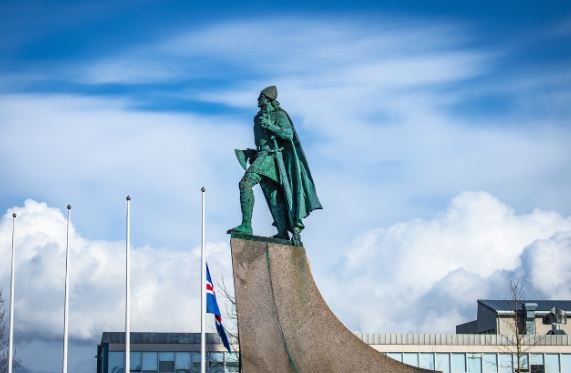
Commemorations through statues, holidays, and cultural references ensure that Leif Erikson’s contributions continue to be recognized and celebrated, underscoring the enduring fascination with the Viking Age and its explorers. Image: Leif Eriksson Memorial (1929–1932), Reykjavík, Iceland. This statue is at the front of the Hallgrímskirkja.
How is Leif Erikson regarded in terms of historicity?
Leif Erikson is widely regarded as a historical figure and is considered the first known European to reach continental North America. However, some details of his life, such as the existence of his sister Freydís and foster father Tyrker, are debated and may be fictional or embellished.
What legacy did Leif Erikson leave in Norse and Medieval Europe?
Leif Erikson’s voyages inspired other Norse explorers to attempt similar journeys to Vinland for trade and resources. His discoveries were referenced by medieval European writers, such as Adam of Bremen, and his legacy may have influenced later explorers like Christopher Columbus.

Did Leif Erikson have any recorded encounters with Indigenous peoples of Vinland?
Leif Erikson himself did not have recorded interactions with Indigenous peoples. However, later Norse explorers did, often referring to them as “skrælingi.” These encounters were generally hostile, leading to conflicts and the eventual abandonment of Norse settlements in Vinland.
What are some modern commemorations of Leif Erikson?
Modern commemorations of Leif Erikson include statues in cities like Boston, Milwaukee, Chicago, St. Paul, Duluth, Seattle, and Reykjavík. Leif Erikson Day is celebrated annually on October 9th in the United States, established in 1964. Additionally, awards, ships named after him, and cultural references like Robert Frost’s poem “Wild Grapes” honor his legacy.

Leif Erikson by Norwegian-American sculptor John K. Daniels, 1948–49, near the Minnesota State Capitol.