How Saudi Arabia and Iran Became Sworn Enemies

As long as both Iran and Saudi Arabia see themselves as leaders of competing visions for the Middle East, the rivalry is likely to continue shaping the region’s politics and conflicts for years to come.
The rivalry between Saudi Arabia and Iran is one of the most prominent geopolitical conflicts in the Middle East. It involves a complex interplay of historical, religious, political, and ideological factors that have shaped their relationship over decades. Here is a detailed examination of how these two countries, which were not always at odds, became bitter adversaries.
Historical Background: Divergent Roots and Rival Identities
The roots of the Saudi-Iranian rivalry can be traced back to the historical differences between Sunni and Shia Islam, which have shaped the identities of the two countries. Saudi Arabia is predominantly Sunni, following the Wahhabi interpretation of Islam, which is a conservative branch of Sunni Islam that emphasizes a return to what it sees as the original teachings of Islam. In contrast, Iran is a Shia-majority country, with Twelver Shia Islam being the state religion.
While these religious differences existed for centuries, they were not the primary cause of conflict until the 20th century. For much of their early histories, Saudi Arabia and Iran coexisted without direct confrontation, partly because they were focused on different internal and external challenges.
The 20th Century: Nation-Building and the Seeds of Rivalry
Both Saudi Arabia and Iran underwent significant transformations in the early 20th century. Saudi Arabia was founded in 1932 by Abdulaziz Ibn Saud after a series of conquests that unified much of the Arabian Peninsula under his rule. The discovery of vast oil reserves in 1938 and the subsequent alliance with the United States helped establish Saudi Arabia as a significant power in the region.
Meanwhile, Iran, known as Persia until 1935, underwent its own modernization process under Reza Shah Pahlavi, who sought to reduce foreign influence and modernize the state along secular and nationalist lines. After World War II, Iran also discovered significant oil reserves, setting the stage for its own rise as a regional power.
During the early 20th century, the relationship between the two nations was marked by cooperation and shared interests. Both countries, for example, were members of the Baghdad Pact (later CENTO) during the 1950s, a pro-Western defense organization in the Middle East that aimed to counter Soviet influence during the Cold War.
However, these cooperative moments were underpinned by a degree of mutual suspicion. Iran, under the Pahlavi dynasty, saw itself as the successor of the ancient Persian empires and harbored aspirations to lead the region. Saudi Arabia, on the other hand, viewed itself as the custodian of Islam’s two holiest cities, Mecca and Medina, and sought to assert its religious and political influence across the Muslim world.
The 1979 Iranian Revolution: A Turning Point

The Iranian Revolution successfully brought the end of the Persian monarchy – a monarchy of more than 2500 years.
The Iranian Revolution of 1979 was a critical turning point in the relationship between Saudi Arabia and Iran. The overthrow of the U.S.-backed Shah of Iran and the establishment of the Islamic Republic under Ayatollah Khomeini transformed Iran from a pro-Western monarchy into a revolutionary state with a theocratic government.

Iranian Revolution slogans.
Khomeini’s new regime sought to export its revolutionary ideals across the Muslim world, promoting the idea of Islamic governance and encouraging the overthrow of secular or monarchical regimes. This stance alarmed the Saudi leadership, who saw the revolution as a direct threat to their own legitimacy. The new Iranian government not only challenged the political status quo but also portrayed Saudi Arabia’s monarchy as illegitimate and too closely aligned with Western interests.
The revolution effectively marked the beginning of the ideological conflict between the two countries. Saudi Arabia, feeling threatened by the spread of revolutionary Shia Islam and Iran’s attempts to export its ideology, positioned itself as the leader of the Sunni Muslim world and the defender of conservative Islamic values.

By December 1978, it had become apparently clear that the protesters did not intend backing down, as more and more people poured into the street calling for the end of the shah’s reign.
The Iran-Iraq War: Proxy Conflicts Begin
The Iran-Iraq War (1980-1988) further deepened the animosity between Saudi Arabia and Iran. The war began when Iraq, led by Saddam Hussein, invaded Iran, fearing the spread of the Iranian revolution and seeking to take advantage of Iran’s post-revolutionary instability.
Saudi Arabia, along with other Gulf monarchies, supported Iraq financially and diplomatically. The Saudis viewed Iraq’s invasion as a way to contain Iran’s revolutionary fervor and prevent the spread of its ideology. Saudi Arabia, along with Kuwait and other Gulf states, provided Iraq with billions of dollars in financial aid and even allowed its territory to be used for logistical support.
Iran, on the other hand, condemned Saudi support for Iraq as a betrayal of Islam and accused Saudi Arabia of being a puppet of the United States. The war reinforced the perception of an ideological divide between the two countries, with Iran promoting its brand of revolutionary Islam and Saudi Arabia backing a more conservative, monarchical order.
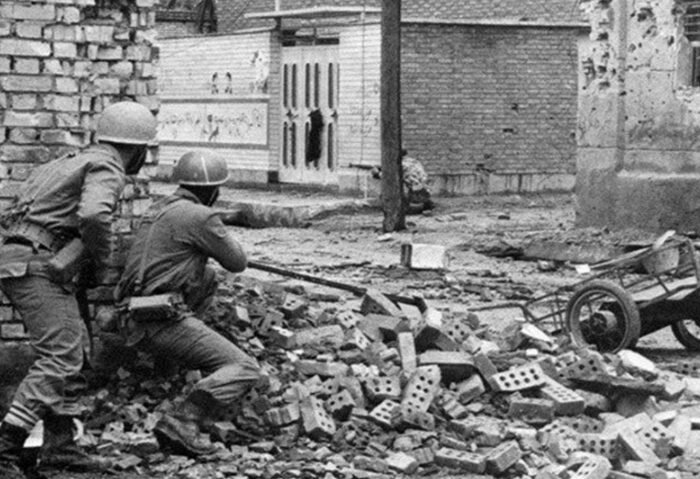
The heavily outnumbered and outgunned Iranians in Khorramshahr resisted fiercely, delaying the Iraqi forces’ advance for an entire month.
The 1980s: Sectarian Tensions and Regional Rivalries
The 1980s saw rising sectarian tensions between the two countries, partly fueled by the Iran-Iraq War and partly by domestic unrest in both nations. In Saudi Arabia, a Shia minority in the Eastern Province, where much of the country’s oil reserves are located, became increasingly restive. Iran was accused of encouraging Shia opposition in Saudi Arabia and other Gulf states, which further alarmed the Saudi leadership.
The 1987 Mecca incident, where clashes between Iranian pilgrims and Saudi security forces during the Hajj pilgrimage resulted in the deaths of over 400 people, including 275 Iranians, marked a significant deterioration in relations. Iran accused Saudi Arabia of deliberately killing its pilgrims, while Saudi Arabia accused Iran of fomenting unrest during the pilgrimage. The incident further solidified the sectarian divide between the two nations.
Post-Cold War Era: Shifting Alliances and Increased Hostility
The end of the Cold War and the collapse of the Soviet Union in 1991 marked a shift in global geopolitics, and the rivalry between Saudi Arabia and Iran entered a new phase. Both countries sought to assert their influence in a region no longer dominated by a bipolar U.S.-Soviet dynamic.
The 1991 Gulf War, triggered by Iraq’s invasion of Kuwait, provided an opportunity for Saudi Arabia to strengthen its alliance with the United States. Saudi Arabia allowed U.S. troops to be stationed on its soil, a move that angered Iran, which viewed American military presence in the Gulf as a direct threat.
During the 1990s, Saudi Arabia and Iran also competed for influence in the broader Muslim world. Saudi Arabia promoted its conservative Wahhabi ideology and funded religious institutions worldwide, while Iran continued to support Shia movements and groups, such as Hezbollah in Lebanon.
21st Century: Proxy Wars and Escalation of Tensions
The 21st century has seen an escalation of tensions between Saudi Arabia and Iran, largely played out through proxy conflicts across the Middle East. The 2003 U.S. invasion of Iraq, which led to the toppling of Saddam Hussein, removed a key Sunni counterbalance to Iran and created a power vacuum in Iraq. Iran quickly moved to exert influence in Iraq by supporting Shia militias and political groups, which alarmed Saudi Arabia and other Sunni-majority states.
The Arab Spring of 2011 further intensified the rivalry. In countries like Bahrain, Syria, and Yemen, Saudi Arabia and Iran found themselves on opposing sides of various conflicts. In Bahrain, a Shia-majority country ruled by a Sunni monarchy, Saudi Arabia intervened to suppress protests that it saw as Iranian-inspired. In Syria, Iran supported President Bashar al-Assad, a key ally, while Saudi Arabia supported various Sunni rebel groups seeking to overthrow Assad.
The conflict in Yemen became a particularly significant flashpoint. In 2015, Saudi Arabia launched a military intervention against the Houthi rebels, a group with alleged ties to Iran, who had seized the Yemeni capital of Sana’a. Saudi Arabia viewed the Houthis as an Iranian proxy, while Iran condemned the Saudi intervention as aggression against a sovereign nation.
Nuclear Ambitions and Regional Power Struggle
Iran’s nuclear program has been another significant source of tension. Saudi Arabia has been a vocal critic of Iran’s nuclear ambitions, fearing that a nuclear-armed Iran would dominate the region and threaten its security. The 2015 Iran nuclear deal (JCPOA), negotiated between Iran and the P5+1 (the U.S., U.K., France, Russia, China, and Germany), was viewed with suspicion by Saudi Arabia. The Saudis were concerned that the deal would not prevent Iran from eventually acquiring nuclear weapons and would embolden it by lifting economic sanctions.
When the United States, under President Donald Trump, withdrew from the JCPOA in 2018 and reimposed sanctions on Iran, Saudi Arabia supported the move, aligning itself closely with the U.S. position. This alignment was part of Saudi Crown Prince Mohammed bin Salman’s broader strategy to confront Iran and limit its influence in the region.
Ideological and Political Divide: Competing Visions for the Middle East
The ideological and political divide between Saudi Arabia and Iran also represents competing visions for the future of the Middle East. Saudi Arabia sees itself as the leader of the Sunni Muslim world and promotes a conservative interpretation of Islam. It has sought to maintain the status quo in the region by supporting monarchical and authoritarian governments that align with its interests.
Iran, on the other hand, portrays itself as a revolutionary force advocating for resistance against Western influence and dominance. It positions itself as the defender of oppressed peoples, particularly Shia communities across the Middle East, and has supported various non-state actors and militias in countries like Lebanon, Iraq, Syria, and Yemen.
This ideological divide is evident in the ways both countries approach regional politics, alliances, and conflicts. For Saudi Arabia, maintaining stability and ensuring the security of its monarchy is paramount, while for Iran, challenging the U.S.-led order and expanding its influence are key objectives.
Economic Competition and the Oil Market
Economic competition, particularly in the global oil market, has also contributed to the rivalry. Both Saudi Arabia and Iran are major oil producers, and their oil policies have often been at odds. Saudi Arabia, as a leading member of the Organization of the Petroleum Exporting Countries (OPEC), has often favored production cuts to stabilize prices, while Iran has sometimes pursued policies to maximize revenue by increasing production. Disagreements over oil policy have occasionally spilled over into broader political tensions.
Recent Developments: Attempts at Reconciliation and Ongoing Tensions
In recent years, there have been sporadic attempts at reconciliation between Saudi Arabia and Iran. For example, after years of strained relations, the two countries engaged in dialogue facilitated by Iraq and Oman in 2021. These talks were partly motivated by shifting regional dynamics, including the United States’ reduced involvement in the Middle East and economic pressures from the COVID-19 pandemic.
However, deep-seated distrust, ideological differences, and conflicting regional ambitions continue to hinder meaningful rapprochement. The rivalry remains intense, as both countries continue to vie for regional dominance through a combination of military, political, and economic means.
Conclusion: A Rivalry with No Clear End in Sight
The enmity between Saudi Arabia and Iran is the product of a complex web of historical, religious, ideological, and geopolitical factors. While the rivalry has ebbed and flowed over time, it has persisted due to conflicting regional ambitions, sectarian divisions, and external influences. As long as both countries see themselves as leaders of competing visions for the Middle East, the rivalry is likely to continue shaping the region’s politics and conflicts for years to come.
Attempts at reconciliation may occasionally reduce tensions, but a fundamental realignment of interests and ideologies would be required to end the rivalry, a prospect that currently seems distant. The relationship between Saudi Arabia and Iran remains one of the most critical and challenging dynamics in the Middle East, with wide-ranging implications for regional and global security.