George I of Great Britain: Family, Reign, & Death
George I ruled Great Britain and Ireland from 1714 to 1727, when he died. He was the first of three Hanoverian kings in Britain to ascend the throne under the terms of the Act of Settlement which was aimed at securing a Protestant monarchy for England. His reign represented a pivotal moment in the history of Britain in which the government gained increasing power, which in turn limited the power of the monarchy.
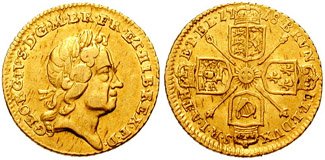
George I’s ascension marked the beginning of the Hanoverian dynasty in Britain. His reign was crucial in the transition from the absolute monarchy to a constitutional monarchy, as it led to the rise of parliamentary power and the role of the prime minister. Image: A 1718 quarter-guinea coin from the reign of George I, showing him in profile.
Early Years & Family
George, the great grandson of James I, was born in May, 1660 in Hannover, Germany. He was the eldest son of Ernest Augustus, the Duke of Brunswick-Lüneburg, and Sophia of Palatinate. It was through Sophia’s lineage that George became king, bypassing many Stuart rights to succeed the throne.
Raised a Protestant, George is said to have inherited a great deal of his mother’s traits and inclinations. In his youth, he loved hunting, but shared his father’s philandering appetites.
In his teenage years, and under the instructions of his father, George enlisted in the army and fought against the French in wars. He showed promise for exercising military command.
In the 1660s, George was involved in an affair with one of the family’s governesses, culminating in an illegitimate child. This development brought to the front issues pertaining to his marriage.

Image: George in 1680, aged 20, when he was Prince of Hanover. After a painting by Godfrey Kneller.
George’s Scandalous Marriage
In 1682, George married his first cousin Princess Sofia of sale their first child the future George III was born the following year the marriage was not particularly a happy one since George’s military ambitions kept him away from Hanover for enduring periods.
George preferred the companionship of his mistress, Ehrengard Melusine von der Schulenburg, who later became the Duchess of Munster and Kendal in Great Britain. He went on to have father three illegitimate children with her.

George married his cousin, Sophia Dorothea of Celle, in 1682. He had two children with her and three daughters with his mistress, Melusine von der Schulenburg. He divorced Sophia Dorothea in 1694. Image: Sophia Dorothea, by French painter Henri Gascar, 1686. Currently displayed at the Celle Castle museum.
Meanwhile, Sophia had been involved in an affair with Swedish count Philip Christoph von Königsmarck. Afraid of what a possible elopement would do to his court, George supported a plan to have the Count killed. Philip was eventually murdered in July, 1694. George divorced Sophia and had her confined in the Castle of Ahlden where she lived out the rest of her days until her death in 1726. Satisfied with his escapades with mistresses, George did not marry again.
Elector of Hanover

Image: George in 1706, when he was Elector of Hanover.
In 1698, Ernest Augustus died bequeathing most of his territories to George. As elector of Hanover, he played host to various iconic figures, including the mathematician Gottfried Leibniz. Though George spent long periods in Germany, he played key roles in the remodeling the British royal palaces.
He elected English architect, William Kent, to renovate the state apartments of Kensington Palace. Kent decorated the Kensington rooms with beautiful antique statues and George acquired various Old Master paintings to give life to the palace. These pieces included Reuben’s painting of the Holy Family with St. Francis and a portrait of Don Rodrigo Calderon. George also patronized music and employed the services of German British baroque composer, Handel, to write the “Water Music” for a royal event on The Thames.
The Act of Settlement (1701)
Shortly after George had taken over his paternal dukedom, the 1701 Act of Settlement was passed by Parliament. This ensured that the British crown would be passed on to George’s mother as the closest non-Catholic relative of the British Royal Family if the then-reigning William III and Princess Anne of Denmark both died without producing an heir.
In 1714, Sophia of Palatinate died making George the next in line to the throne. When Queen Anne‘s death followed in less than two months, he was immediately proclaimed King of Britain and Ireland.
Female Rulers of England and Great Britain & Their Years on the Throne
George’s Reign as King

George I became King following the death of Queen Anne, the last monarch of the House of Stuart, on 1 August 1714. Image: George c. 1714, the year of his succession, as painted by Godfrey Kneller
George’s coronation took place at Westminster Abbey in October, 1714. Even before his reign, he aligned himself with the Whig Party which was largely conservative. Once in power, he maintained his position and presided over a predominantly Whig administration. He excluded the Tories from leading roles in his government.
George’s accession brought a change in the dignities of princes. The only princely ranks were those of “Prince of Wales” and “Princess Royal.” The other members of the royal family were addressed only as “Lord” and “Lady.” The monarch’s children and paternal grandchildren were addressed as “Royal Highness,” and the paternal great grandchildren were styled “Highness.”
With his great sense of judgement and diplomacy, George I successfully built an alliance with France in 1717 to 1718. He however did not achieve similar success in domestic politics. With the likes of the unbending Robert Walpole and Viscount Charles Townshend, the king could not have his way regarding several domestic reforms. The two eventually left his government over policy disagreements but returned in 1720 upon the formation of a new Whig administration.
Prime Minister Robert Walpole
Walpole assumed the position of a de facto prime minister of Britain under the new administration. Just like the king, he desired to bring an end to the age-long volatility that afflicted British and Colonial politics under William III and Queen Anne.
He did well to ensure peace, lower taxes and remove trade limitations. He also helped to crush Jacobite tendencies and remove any hopes of reinstating the Stuart Monarchy.
Although George I rarely attended Cabinet meetings, he met with his Walpole and the other ministers privately when the need arose. He also reserved the right to depose ministers at will and the right to oversee foreign policies in a bid to protect Hanover.

A 1714 silver medallion from the reign of George I, referring to his accession in Great Britain. The Saxon Steed runs from Hanover to Britain.
Relationship with the Prince of Wales
Right from childhood, the prince detested his father. He carried memories of his father’s unsavory treatment towards his mother and how she had been imprisoned until death. Over the years, the hate worsened when the prince’s choice of godparents for his newly born son had displeased George I. The prince was banned from the palace and shunned by his father. Their relationship was eventually restored largely through the efforts of Wadpole. However, the fall out started a pattern of Hanoverians rising up against the monarch.
Later Years & Death
The final years of George’s reign were relatively calm on both sides of the Atlantic having secured stability both at home and abroad. During a visit to Hanover in 1727, George I had suffered a stroke and died. He was 67 years of age. Shortly after, the Prince of Wales succeeded the British throne as George II.

George I was succeeded by his son, George II, who became King of Great Britain and Ireland on 11 June 1727, the day of George I’s death. Image: Portrait of George II by English portrait painter Thomas Hudson, 1744.
Conclusion
Despite George’s contributions towards the subduction of the 1715 and 1719 Jacobite Rebellions, (that attempted to overthrow the Hanoverian Royal Family and put James Stuart, Anne’s Catholic half-brother, on the throne) he was largely unpopular in Britain. In addition to his inability to speak English, people still remembered the rumors of his horrific treatment of his late wife, Sophia. Undeterred, he resolved to do what was necessary to ensure the well-being of his new kingdom.
With George’s frequent visits to Hanover, he became increasingly aloof from the British government leaving the survival of the country in the hands of Walpole and others. Nevertheless, George I was instrumental in obtaining the consent of the nation in the 1725 Treaty of Hanover with France and Russia. This Treaty was aimed at countering the Austro-Spanish Treaty of Vienna and to ensure that British trade was protected.
Questions and Answers about George I of Great Britain
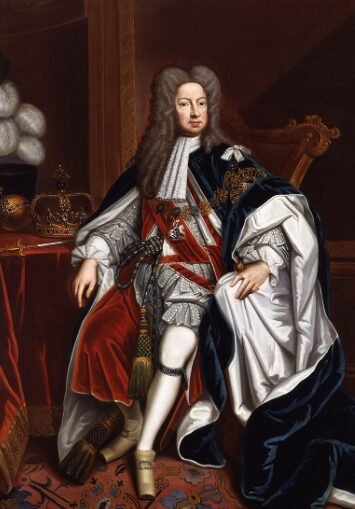
George I, also known as George Louis (German: Georg Ludwig), was King of Great Britain and Ireland from 1 August 1714 and Elector of Hanover from 23 January 1698 until his death on 11 June 1727. He was the first monarch of the House of Hanover. Portrait from studio of German-born British painter Godfrey Kneller, 1714
When did George I become King of Great Britain and Ireland?
George I became King of Great Britain and Ireland on 1 August 1714.
What titles did George I hold before becoming King of Great Britain?
Before becoming King of Great Britain, George I was the Elector of Hanover from 23 January 1698.
What were George I’s notable family connections?
George I was born to Ernest Augustus and Sophia of Hanover. He married his cousin, Sophia Dorothea of Celle, in 1682. He had two children with her and three daughters with his mistress, Melusine von der Schulenburg. He divorced Sophia Dorothea in 1694.
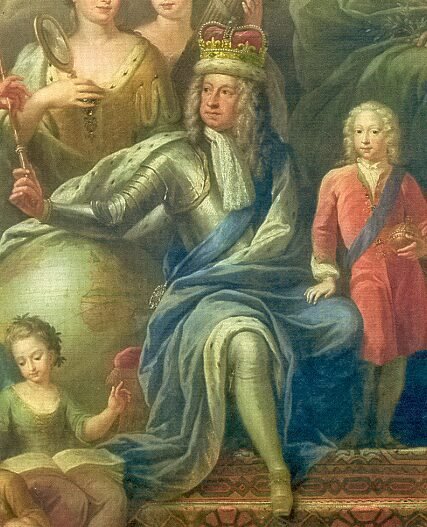
After the death of Queen Anne, George I ascended to the throne on 1 August 1714. Image: George surrounded by his family, in a painting by James Thornhill
How did George I come to the British throne?
George I succeeded to the British throne in 1714 as the closest Protestant descendant of James VI and I, following the deaths of his mother, Sophia, and his second cousin, Queen Anne.
Why was George I chosen to succeed Queen Anne?
George I was chosen due to his status as the closest Protestant descendant of James VI and I, ensuring the continuity of Protestant rule. This succession was in accordance with the Act of Settlement 1701, which aimed to exclude Catholics from the British throne.
What were the Jacobite attempts against George I?
During George I’s reign, Jacobites attempted to replace him with James Francis Edward Stuart, Anne’s Catholic half-brother, but these attempts were unsuccessful.
How did George I’s reign affect the British monarchy?
During his reign, the power of the British monarchy diminished, and Britain began transitioning to a system of cabinet government led by a prime minister. By the end of his reign, Robert Walpole had become the de facto first prime minister.
What happened to George I at the end of his life?
George I died of a stroke on 11 June 1727 while traveling to Hanover. He was buried in Hanover and remains the most recent British monarch to be buried outside the United Kingdom.
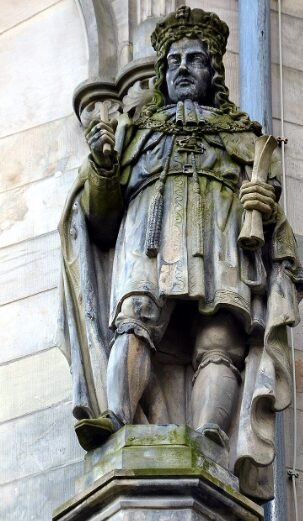
Statue of George I by German sculptor Carl Rangenier in Hanover