Hydra in Greek Mythology – Origin Story & Death

In Greek mythology, the Hydra is a fearsome, multi-headed serpent-like creature. It typically has nine heads, and for each head that is cut off, two more grow in its place.
The Hydra is one of the most famous and fearsome creatures in Greek mythology, known for its terrifying appearance and deadly abilities. As a multi-headed serpent-like monster, the Hydra’s origins are deeply intertwined with the mythological landscapes of ancient Greece, and its death at the hands of the hero Heracles (Hercules in Roman mythology) is one of the most iconic episodes of Greek legend. This creature’s story reflects themes of struggle, resilience, and the consequences of pride and defiance against the gods.
Origin of the Hydra
The Hydra’s full name in mythology is the Lernaean Hydra, named after the region of Lerna in the Argolid, a swampy area near the eastern coast of the Peloponnese. According to myth, Lerna was an ancient, almost primeval place, often associated with mystery, gateways to the underworld, and dangerous creatures.
Parentage and Family
The Hydra’s parentage is one of divine and monstrous origins. It was born to two of the most fearsome creatures in Greek mythology—Typhon and Echidna.
- Typhon: Known as the deadliest monster in Greek mythology, Typhon was a giant being with a hundred dragon heads. He was feared by gods and mortals alike, and he waged a war against Zeus himself for control of the cosmos.
- Echidna: Often called the “Mother of Monsters,” Echidna was half-woman and half-snake, and she was the mother of many of the great monsters in Greek myths, including Cerberus (the three-headed dog guarding the gates of Hades), the Chimera, and the Nemean Lion, in addition to the Hydra.
With parents like these, it is no surprise that the Hydra inherited its terrifying form and power. As a child of Typhon and Echidna, the Hydra was destined to be a force of destruction, and it was said to be nurtured by the goddess Hera.

The Hydra was born to the ancient sea gods Echidna and Typhon, who also spawned other fearsome creatures like the Chimera and Cerberus. Painting: French artist Gustave Moreau’s 19th-century depiction of the Hydra, influenced by the Beast from the Book of Revelation
The Hydra’s Purpose and Hera’s Role
In many versions of the myth, the Hydra was not just a mindless beast but served a purpose related to Hera’s vendetta against Heracles. Hera, the queen of the gods, harbored a deep hatred for Heracles because he was the illegitimate son of her husband Zeus and a mortal woman, Alcmene. As part of her ongoing attempts to destroy Heracles, Hera raised the Hydra in the swamps of Lerna, placing it there as a near-unstoppable obstacle for anyone who dared to face it.
The Hydra was more than just a physical threat. It became a symbol of divine punishment and the embodiment of insurmountable challenges. As it terrorized the surrounding lands, it also guarded one of the entrances to the underworld, adding to its menacing nature.

Echidna is a fearsome half-woman, half-serpent creature known as the “Mother of All Monsters” in Greek mythology. It’s said that this monster could produce life-ending and madness-inducing venom.
The Hydra’s Appearance and Abilities
The Hydra is most famously known for its multiple heads. Ancient sources differ on the exact number of heads it possessed, with some accounts stating it had nine heads, while others suggest it could have had more. What made the Hydra especially terrifying was its regenerative ability: for every head that was cut off, two new heads would grow in its place. This made the Hydra nearly impossible to defeat by conventional means.
Immortal Head
One of the Hydra’s heads was not only regenerative but also immortal. This head could not be killed or removed, adding to the complexity of the beast’s defeat. This characteristic played a key role in the creature’s eventual death and required extraordinary means to overcome.
Poisonous Breath and Blood
In addition to its regenerative powers, the Hydra possessed a highly toxic breath and blood. Its breath was so foul and deadly that it could kill anyone who came too close. Similarly, the Hydra’s blood was venomous and caused instant death to anyone who touched it or was struck by it. In some versions of the myth, the Hydra’s venom was so powerful that even its tracks left behind deadly fumes.
The combination of multiple regenerating heads, an immortal head, and poisonous breath and blood made the Hydra one of the most dangerous creatures in Greek mythology.
The Twelve Labors of Heracles
The story of the Hydra is most famously linked to the Twelve Labors of Heracles. These labors were a series of tasks assigned to Heracles as a form of penance. According to myth, Heracles had been driven mad by Hera, leading him to kill his own wife and children in a fit of rage. In order to atone for his crime, he was ordered to serve King Eurystheus of Tiryns, who tasked him with completing twelve nearly impossible labors.
The Second Labor: Slaying the Lernaean Hydra
The second of these labors was to kill the Lernaean Hydra. Heracles knew that this would not be an easy task, but he traveled to the swamps of Lerna where the Hydra made its lair. The creature lived in a cave surrounded by toxic fumes, making it difficult even to approach. Heracles had to face not only the Hydra itself but also the dangers of its poisonous surroundings.
The Battle with the Hydra

Image: Italian Renaissance painter Pollaiuolo’s Hercules and the Hydra (c. 1475). Uffizi Gallery, Florence, Italy
Heracles’ battle with the Hydra is one of the most famous encounters in Greek mythology, filled with challenges and clever strategies.
Heracles’ Initial Strategy
When Heracles arrived at the Hydra’s lair, he was armed with his club and sword, confident in his strength and skill as a warrior. As the Hydra emerged from its cave, Heracles began cutting off its heads one by one, but he soon realized the futility of his efforts. For every head he severed, two more would grow in its place, quickly overwhelming him.
The Role of Iolaus
Recognizing that he could not defeat the Hydra alone, Heracles called upon his nephew, Iolaus, for assistance. Iolaus played a crucial role in the battle by coming up with a clever solution to counter the Hydra’s regenerative powers. As Heracles cut off each of the Hydra’s heads, Iolaus used a burning torch to cauterize the wounds, preventing the heads from growing back. This strategy turned the tide of the battle in Heracles’ favor.
Defeating the Immortal Head
Once Heracles had neutralized the Hydra’s regenerative ability, he still faced the challenge of the immortal head. Unlike the others, this head could not be killed or removed. Heracles solved this problem by cutting off the immortal head and burying it under a massive rock, ensuring that it could no longer pose a threat.
Dipping Arrows in the Hydra’s Blood
After killing the Hydra, Heracles collected its venomous blood, recognizing its lethal power. He dipped his arrows in the Hydra’s blood, creating poisoned weapons that would serve him in future labors. These arrows would later play a significant role in several other myths, including the eventual death of Heracles himself.

Heracles, tasked with killing the Hydra, struggled to defeat the creature due to its regenerative powers. He was eventually aided by his nephew, Iolaus, who burned each neck with fire after Heracles chopped off a head, preventing new heads from growing. This strategy allowed Heracles to finally defeat the Hydra and complete his labor. Image: Mosaic from Roman Spain (AD 26)
The Aftermath of the Hydra’s Death
The defeat of the Hydra was a significant victory for Heracles, but it came with complications. After returning to King Eurystheus to report the completion of his labor, Heracles was informed that the task would not count. Eurystheus claimed that because Heracles had received help from Iolaus, the labor had been invalidated. Despite this setback, Heracles’ reputation as a hero continued to grow, and the story of the Hydra became one of his most iconic feats.
Hera’s Wrath
Hera, who had raised the Hydra as part of her vendetta against Heracles, was furious that her plan had been thwarted. However, her animosity toward Heracles would continue throughout his life, as she repeatedly sought to destroy him or cause him suffering. The Hydra’s death marked a temporary victory for Heracles, but it did not end Hera’s relentless pursuit of vengeance.
The Hydra’s Legacy in Mythology
The Hydra’s death at the hands of Heracles solidified its place as one of the most fearsome monsters in Greek mythology. Its regenerative abilities and poisonous nature made it a symbol of the kind of insurmountable challenges that heroes often had to face in myth. Beyond the myth of Heracles, the Hydra became a metaphor for problems or obstacles that grow worse when attacked, much like the creature’s multiplying heads.
Influence on Later Culture
The Hydra has influenced various forms of art, literature, and popular culture throughout history. In ancient Greece, the Hydra was depicted in sculptures, vase paintings, and other works of art. These depictions often showed the creature locked in battle with Heracles, emphasizing the hero’s strength and ingenuity in overcoming the monster’s regenerative abilities.
In modern times, the Hydra’s legacy lives on in a variety of contexts:
- The Hydra in Literature: The Hydra has appeared in various retellings of Greek myths, as well as in modern fantasy literature. It often serves as a symbol of overwhelming challenges or evil forces that are difficult to defeat.
- The Hydra in Science: The Hydra’s regenerative abilities have made it a point of fascination in scientific studies. In biology, there is a genus of small, freshwater animals called “Hydra,” which have remarkable regenerative powers, much like their mythological namesake.
- The Hydra in Popular Culture: The Hydra has been featured in films, video games, and television shows, often as a formidable monster or villain. In Marvel Comics, the organization “HYDRA” takes its name from the mythological creature, with its slogan “cut off one head, two more shall take its place” reflecting the Hydra’s legendary regenerative abilities.
The Myth’s Deeper Meaning
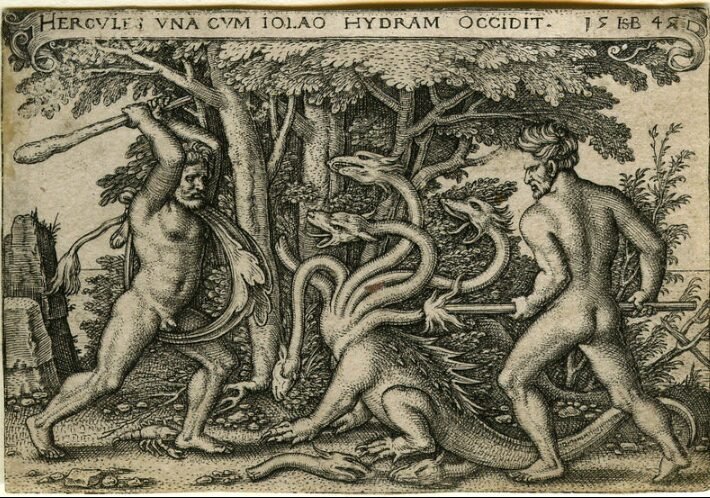
The Hydra is often depicted with massive, scaled bodies, coiling and twisting, with sharp, menacing teeth and glowing eyes. Its heads vary in size, some towering above others, with venom dripping from their fangs. The environment around the Hydra is often portrayed as a swampy, dark, and eerie landscape, reflective of its lair in the marshes of Lerna. Image: Engraving by Hans Sebald Beham
The myth of the Hydra and its defeat by Heracles resonates with several deeper themes that are common in Greek mythology.
The Triumph of Intelligence Over Strength
While Heracles was known for his immense physical strength, his victory over the Hydra was not solely a result of brute force. Instead, it was his intelligence and the assistance of Iolaus that allowed him to find a solution to the Hydra’s regeneration. This reflects the Greek cultural value of cleverness and strategy being just as important, if not more so, than sheer power in overcoming challenges.
The Symbolism of the Hydra’s Regeneration
The Hydra’s ability to grow two heads for every one that was severed can be interpreted as a symbol for problems or evils that grow worse the more one tries to fight them. In this sense, the Hydra represents challenges that require creative or non-conventional solutions, rather than direct confrontation. Heracles’ approach, with the help of Iolaus, demonstrates that some problems cannot be solved by strength alone and require strategic thinking and teamwork.
Death and Immortality
The Hydra, with its immortal head, also touches on themes of mortality and immortality. While the mortal heads could be defeated, the immortal head had to be dealt with differently, showing that some aspects of life (or death) cannot be directly conquered but must instead be contained or outsmarted.
Did you know…?
- According to the poet Hesiod, the Hydra was the offspring of the fearsome monsters Typhon and Echidna. The Hydra’s breath and blood were said to be so poisonous that even its scent could cause death. The creature had many heads, though the exact number varies across sources. In later versions of the myth, the Hydra had a regenerative ability: for every head severed, two more would grow in its place.
- Greek and Roman writers recounted that Hera placed the Hydra and the crab as constellations after Heracles slew them. These constellations, Hydra and Cancer, correspond to earlier Babylonian signs: Bashmu (Venomous Snake) and Alluttu (Crayfish).
- Archaeology has identified Lerna as a sacred site older than Mycenaean Argos.
Conclusion
The Hydra is one of the most enduring creatures of Greek mythology, not only for its terrifying form and deadly abilities but also for the deeper symbolic meanings associated with its myth. As a child of Typhon and Echidna, the Hydra was a creature of chaos and destruction, set against the hero Heracles in a battle that would test his strength, intelligence, and resourcefulness.
Heracles’ eventual triumph over the Hydra, with the help of his nephew Iolaus, remains one of the most iconic moments in Greek myth, representing the triumph of heroism and cleverness over seemingly insurmountable challenges.
Questions and Answers

In Greek mythology, the Lernaean Hydra stands as one of the most formidable adversaries. Known simply as the Hydra, this serpentine monster symbolizes resilience, regeneration, and seemingly insurmountable challenges, embodying more than just a creature of legend. Image: Caeretan black-figure hydria (c. 346 BC)
What made the Hydra so difficult to defeat?
The Hydra had a regenerative ability: for every head that was cut off, two more would grow in its place. Additionally, its breath and blood were highly toxic.
In which of Heracles’ Twelve Labors did he confront the Hydra?
Heracles fought the Hydra during his second labor, as assigned by King Eurystheus.
Where did the Hydra reside?
The Hydra lived in the swamps near Lerna, where it terrorized the local population with its venomous breath and immense strength.

The Lernaean Hydra, commonly known as the Hydra, is a serpentine monster in Greek and Roman mythology. Its lair was located at the lake of Lerna in the Argolid, a region associated with both the myth of the Danaïdes and ancient beliefs as an entrance to the Underworld. Image: Depiction of Hydra by American artist John Singer Sargent (1921)
How did Heracles manage to defeat the Hydra?
Heracles enlisted the help of his nephew, Iolaus, who cauterized each decapitated head with a torch to prevent new heads from growing back.
How did Hera complicate Heracles’ battle with the Hydra?
Hera sent a giant crab to distract and attack Heracles during his battle with the Hydra, adding further difficulty to the challenge.

In mythology, the Hydra is best known for being slain by Heracles (Hercules) as the second of his Twelve Labors. Image: Henri IV of France as Hercules defeating the Hydra, symbolizing his victory over the Catholic League during the French Wars of Religion.
What did Heracles do after defeating the Hydra?
After slaying the Hydra, Heracles dipped his arrows in the creature’s poisonous blood, creating lethal weapons for future use.
What does the Hydra symbolize in modern culture?
The Hydra is seen as a symbol of complex challenges that multiply or evolve when confronted, often referred to as a “hydra-headed problem.”
How does the story of Heracles and the Hydra illustrate key virtues?
The story highlights Heracles’ resourcefulness, adaptability, and teamwork, emphasizing the importance of strategy and persistence in overcoming seemingly insurmountable obstacles.
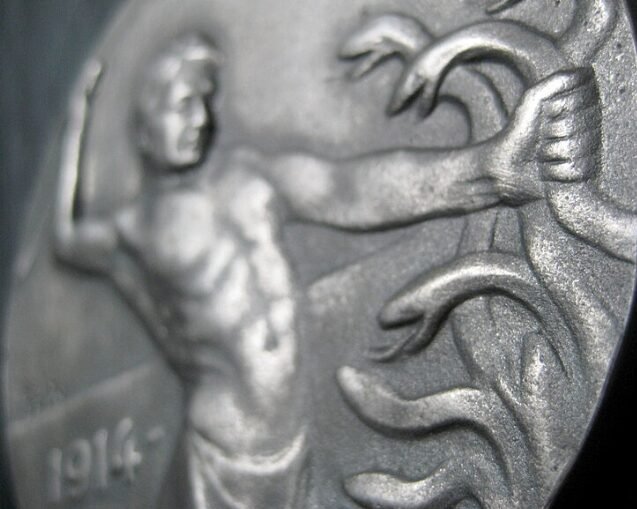
The Hydra’s regenerative powers, its immortal head, and its poisonous blood continue to fascinate and inspire storytellers, artists, and scholars to this day. Image: Reverse of a 1914 medal by Fritz Eue commemorating General Erich Ludendorff





