Female Monsters in Greek Mythology

Female monsters in Greek mythology represent a fascinating and complex aspect of ancient storytelling. These mythical creatures often embody fear, danger, and the unknown, yet they also reflect cultural ideas about femininity, power, and the natural world. Unlike traditional heroines, these female monsters challenge societal norms and stand as powerful symbols in their own right.
Some of the most iconic female monsters in Greek mythology include the Gorgons, the Sirens, the Harpies, the Furies, Scylla, Charybdis, and Echidna. These figures are not merely antagonists; they are integral to many myths, embodying different aspects of danger, transformation, and the female form.
Medusa and the Gorgons

Female monsters in Greek mythology, such as Medusa, the Sirens, and Scylla, often symbolize the dangers of temptation, sexuality, and chaos. Image: An ancient Roman work depicting the head of Head of Medusa.
Perhaps the most famous female monster in Greek mythology is Medusa, one of the Gorgons. The Gorgons were three sisters: Stheno, Euryale, and Medusa, who were depicted as terrifying creatures with snakes for hair, whose gaze could turn men to stone. While Stheno and Euryale were immortal, Medusa was mortal and, therefore, vulnerable. She became a central figure in the myth of Perseus, the hero who ultimately beheaded her.
Medusa’s story is complex. Originally, she was a beautiful maiden, but after being raped by Poseidon in the temple of Athena, she was transformed by the goddess into a hideous monster as punishment. This transformation added a layer of victimhood to Medusa’s character, making her a tragic figure as well as a fearsome one. Medusa’s ability to petrify those who gazed upon her symbolizes the deadly power of beauty and the dangerous consequences of female autonomy in a patriarchal society.
Medusa’s head, once severed by Perseus, continued to possess its petrifying power, and it was later used by the hero to defeat his enemies. The Gorgon’s head, or Gorgoneion, became a protective symbol in ancient Greek art, often placed on shields or used as a ward against evil. This duality—Medusa as both a monster and a protective force—illustrates the complex nature of female monsters in Greek mythology.
The Sirens

The Sirens were enchanting yet deadly creatures who lured sailors to their doom with their irresistible songs. Depicted as part-woman, part-bird, the Sirens lived on rocky islands, where their singing caused shipwrecks as sailors, entranced by their voices, would steer their ships toward dangerous waters.
In Homer’s Odyssey, the hero Odysseus encounters the Sirens during his journey home from the Trojan War. Warned of their danger by the sorceress Circe, Odysseus orders his crew to plug their ears with beeswax while he, curious to hear the Sirens’ song, has himself tied to the mast of the ship. As they sail past, Odysseus is captivated by the Sirens’ song but is unable to act, thanks to his restraints.
The Sirens symbolize the seductive power of the unknown, as well as the dangers of temptation and desire. Their allure is linked to the idea of forbidden knowledge or experiences that lead to destruction. Unlike many other female monsters, the Sirens’ danger lies in their voices and psychological manipulation, rather than physical violence.
The Harpies

Depiction of harpies in medieval times
The Harpies were monstrous creatures with the body of a bird and the face of a woman, often associated with storms and wind. They were known for stealing food and tormenting their victims by swooping down from the sky. The name “Harpies” comes from the Greek word harpazo, meaning “to snatch,” reflecting their role as snatchers of people and things.
One of the most famous myths involving the Harpies is the story of Phineus, a blind prophet who was punished by the gods for revealing too many divine secrets. As part of his punishment, the Harpies were sent to torment him by stealing his food before he could eat it. They were eventually driven away by the Argonauts, specifically by the winged heroes Zetes and Calais.
The Harpies symbolize the destructive forces of nature, particularly the wind, and they represent the fear of losing control or being preyed upon by unpredictable elements. In some interpretations, the Harpies also reflect anxiety about the uncontrollable aspects of femininity, such as rage and chaos.
The Furies (Erinyes)
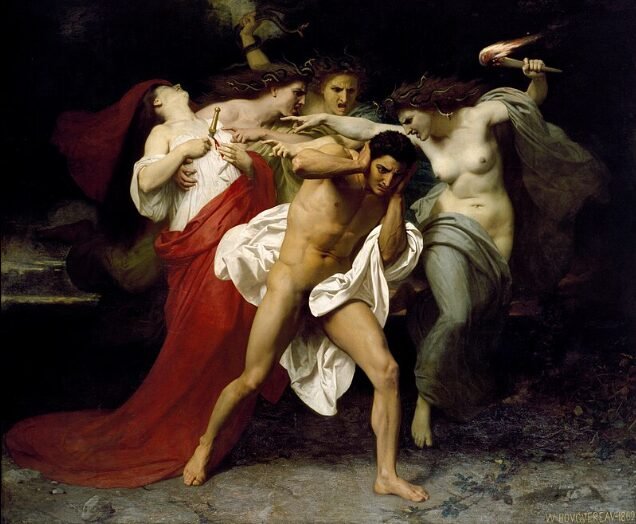
The Remorse of Orestes, where he is surrounded by the Erinyes, by French academic painter William-Adolphe Bouguereau, 1862
The Furies, also known as the Erinyes, were female deities of vengeance who pursued wrongdoers, particularly those guilty of murder, perjury, or offenses against family members. They were relentless in their pursuit of justice and were often depicted as terrifying, with snakes for hair, blood dripping from their eyes, and carrying whips or torches.
The Furies were believed to be born from the blood of Uranus, the sky god, when he was castrated by his son Cronus. In mythology, they are often shown punishing those who commit crimes against natural law, particularly familial crimes such as patricide or matricide. For example, in Aeschylus‘ trilogy The Oresteia, the Furies pursue Orestes after he kills his mother, Clytemnestra, to avenge the murder of his father, Agamemnon.
The Furies represent the ancient concept of blood vengeance and the idea that certain crimes, especially those against family, demand retribution. While their role is fearsome, they also embody a necessary force of justice in the Greek moral universe, ensuring that wrongdoers are punished.
Scylla and Charybdis
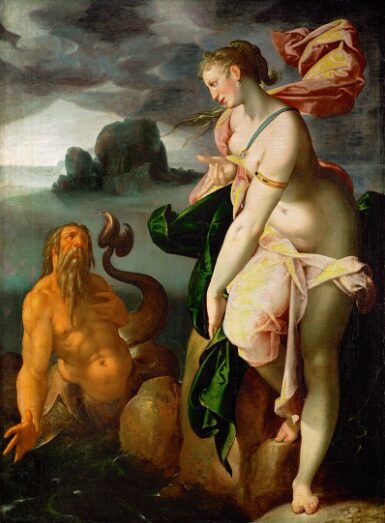
Glaucus and Scylla by Flemish painter Bartholomeus Spranger (c. 1581)
Scylla and Charybdis are two monstrous sea creatures that appear in Homer’s Odyssey and are often depicted as female forces of destruction. They guarded opposite sides of a narrow strait, forcing sailors to choose between the dangers of one or the other.
Scylla was a fearsome monster with twelve tentacle-like legs and six heads, each with three rows of sharp teeth. She would snatch sailors from ships as they passed, devouring them alive. Originally, Scylla was a beautiful nymph, but she was transformed into a monster by the sorceress Circe, who was jealous of Scylla’s beauty and her relationship with the sea god Glaucus.
On the other side of the strait was Charybdis, a massive whirlpool that would suck in and destroy entire ships. Charybdis was originally a sea goddess, but she was cursed by Zeus and transformed into a destructive force that threatened anyone who sailed too close to her.
Together, Scylla and Charybdis represent the idea of inescapable danger, where any attempt to avoid one peril leads to another. They are also often seen as metaphors for the challenges faced by sailors navigating treacherous waters, and by extension, the challenges of navigating life’s difficult choices. Scylla and Charybdis highlight the destructive potential of female power, particularly when it is transformed or corrupted.
Echidna

Echidna, known as the “Mother of Monsters,” is one of the most important female monsters in Greek mythology because she is the progenitor of many other famous monsters. She was depicted as a half-woman, half-serpent creature, with the upper body of a beautiful woman and the lower body of a serpent.
Echidna was the wife of Typhon, the most fearsome monster in Greek mythology, and together they gave birth to many of the most well-known creatures in Greek myths, including the Hydra, the Chimera, the Sphinx, the Cerberus, and the Nemean Lion. In some accounts, she is described as immortal, living in a cave deep beneath the earth where she gave birth to her monstrous offspring.

These monsters defy traditional portrayals of women, presenting femininity as powerful, dangerous, and ambiguous. Figures like Medusa or Echidna embody timeless themes of fear, power, and transformation, inspiring fascination. Image: Modern depiction of Echidna
Echidna’s role as the mother of monsters underscores her importance in the mythological landscape. She symbolizes both creation and destruction, as her offspring bring chaos and terror to the world. As a half-woman, half-serpent, she embodies the dual nature of femininity in myth—both nurturing and dangerous, capable of giving life but also of unleashing horrors upon the world.

The Sphinx

Female monsters in Greek mythology frequently act as antagonists to male heroes, presenting challenges that must be overcome not only through strength but also through wit and caution. Image: Oedipus and the Sphinx; Painting by French Neoclassical artist Jean-Auguste-Dominique Ingres
The Sphinx is another iconic female monster in Greek mythology, famous for her role in the story of Oedipus. She was a creature with the head of a woman, the body of a lion, the wings of an eagle, and the tail of a serpent. The Sphinx was known for posing a riddle to travelers, and those who could not solve it were killed.
The riddle of the Sphinx is one of the most famous in mythology: “What walks on four legs in the morning, two legs at noon, and three legs in the evening?” The answer is a human, who crawls on all fours as a baby, walks on two legs as an adult, and uses a cane in old age.
In the myth, Oedipus solves the riddle, and the Sphinx, in defeat, throws herself off a cliff. The Sphinx represents both intellectual challenge and physical danger, as she uses her cunning and riddles to ensnare her victims. Like the Sirens, her power lies in her ability to manipulate and outsmart, rather than through brute force.
Empusa

To some extent, female monsters like Empusa reflect ancient Greek attitudes toward women and their perceived threat to the social order. Image: Modern depiction of the shapeshifter Empusa
Empusa is a lesser-known but still significant female monster in Greek mythology. She was a shapeshifting creature who could take the form of a beautiful woman to lure men to their deaths. Once they were under her spell, she would devour them. Empusa was a servant of Hecate, the goddess of witchcraft, and was often associated with the supernatural and the night.
Empusa’s ability to transform and seduce her victims makes her similar to vampiric figures in later folklore, as she preys on the unwary. Her monstrous nature reflects ancient Greek fears of female sexuality and the idea that women could be dangerous and predatory if unchecked.
Symbolism and Themes

Miniature illustration of a siren
Female monsters in Greek mythology are rich in symbolism, often embodying the cultural anxieties and fears surrounding women, nature, and the unknown. They represent the tension between civilization and chaos, and between male and female power.
- Dangerous beauty: Many female monsters, like Medusa and the Sirens, are depicted as both beautiful and deadly, reflecting the idea that beauty can be deceptive and dangerous. These figures often embody the fear of female sexuality and the consequences of giving in to temptation.
- Vengeance and justice: The Furies, in particular, symbolize the power of vengeance and the idea that certain crimes, especially those against family or nature, must be punished. They represent an ancient form of justice, one that is rooted in natural law rather than human law.
- Natural forces: Many female monsters, like the Harpies and Charybdis, are closely associated with the natural world and its destructive potential. They symbolize the unpredictability of nature and the fear of losing control over one’s environment.
- The monstrous feminine: Female monsters often reflect cultural anxieties about the role of women in society. Their power is often depicted as unnatural or threatening to male authority, whether through seduction, physical strength, or intellectual cunning.
Conclusion
The female monsters of Greek mythology are among the most complex and enduring figures in ancient storytelling. They embody a wide range of symbolic meanings, from the dangers of temptation to the power of justice, and from the destructive forces of nature to the mysteries of femininity. While they often serve as antagonists in myths, they also represent important cultural ideas about power, gender, and the natural world.
These monsters challenge traditional representations of women, offering a vision of femininity that is powerful, dangerous, and, in many cases, deeply ambiguous. Whether as tragic figures like Medusa or as embodiments of natural forces like Scylla and Charybdis, these female monsters continue to fascinate and inspire, reflecting the timeless themes of fear, power, and transformation.





