Iðunn: Norse Goddess of Youth and Apples
Iðunn is a significant goddess in Norse mythology, renowned for her association with youth and vitality. Her name, which has been interpreted to mean “the rejuvenator,” “ever young,” or “the rejuvenating one,” reflects her vital role in the mythological universe. She is prominently attested in two key sources: the Poetic Edda, a 13th-century compilation of earlier oral traditions, and the Prose Edda, written by the Icelandic historian and poet Snorri Sturluson. Both texts emphasize her role as the keeper of magical apples that grant eternal youth to the gods, preventing them from succumbing to the effects of aging.
Iðunn’s Role and Attributes
Iðunn is depicted as the wife of Bragi, the skaldic god of poetry, and a pivotal figure among the Æsir gods. Her defining attribute is her possession of magical apples, kept in an eski (a wooden box), which restore youthfulness to the gods when consumed. Without Iðunn and her apples, the gods are vulnerable to aging, highlighting her critical role in maintaining the vitality of the divine realm. This role makes her an indispensable figure in Asgard, as she ensures the gods’ continued strength and immortality until Ragnarök, the prophesied end of the world.
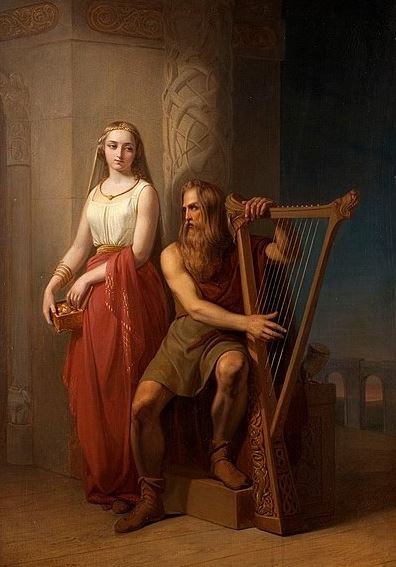
A painting depicting Idunn with Bragi (right). Artwork by Swedish painter Nils Blommér.
The Abduction of Iðunn
One of the most famous tales involving Iðunn is her abduction by the jötunn Þjazi, as recounted in the Prose Edda. The story unfolds when Loki, under duress, lures Iðunn out of Asgard into a forest with the false promise of finding apples even more wondrous than her own. Once there, Þjazi, in the form of a giant eagle, kidnaps her and takes her to his home in Jötunheimr.
Consequences of Iðunn’s Absence
The absence of Iðunn and her apples causes the gods to age rapidly, leading to a crisis in Asgard. Recognizing that Loki orchestrated her disappearance, the gods confront him and threaten him with dire consequences. To redeem himself, Loki borrows Freyja’s falcon cloak, enabling him to transform into a falcon. He locates Iðunn in Þjazi’s dwelling, transforms her into a nut, and carries her back to Asgard.
The Pursuit and Death of Þjazi
Þjazi, realizing Iðunn’s escape, assumes his eagle form and chases Loki. However, the gods set a trap by building a massive fire at the gates of Asgard. As Loki safely returns with Iðunn, Þjazi, unable to halt his momentum, flies into the flames. His feathers catch fire, and he is killed by the gods, marking a triumphant end to the ordeal.
The Myth of Heimdall, the Norse god who stood guard at the entrance to Asgard
Etymology and Historical Use of the Name
The name Iðunn has been extensively analyzed and linked to meanings of youth and rejuvenation. Over time, variations of her name have appeared, such as Idunn, Idun, Iduna, and Idunna. In the Landnámabók, an Icelandic historical text, Iðunn is noted as a personal name used in Iceland since the pagan period. It records instances of women named Iðunn, such as Iðunn Arnardóttir and Iðunn Molda-Gnúpsdóttir. Scholars like Jacob Grimm have suggested connections between the name Iðunn and other mythological terms, such as the Old English name Idonea, which may derive from Iðunn.
Attestations in Norse Literature
In the Poetic Edda, Iðunn is briefly mentioned in the poem Lokasenna, where she is introduced as Bragi’s wife. In a heated exchange, Loki accuses her of promiscuity, claiming she embraced her brother’s killer. However, this accusation is not corroborated in any other sources and is considered part of the humorous tone of the poem.
In the lesser-known poem Hrafnagaldr Óðins, Iðunn is described as one of “Ivaldi’s elder children,” hinting at a possible elven origin. She is portrayed as a mystical figure residing in dales, further emphasizing her connection to nature and immortality.
The Prose Edda provides the most detailed accounts of Iðunn. In Gylfaginning, she is introduced as Bragi’s wife and the keeper of the rejuvenating apples. Her story is central to the narrative of Loki’s mischief and Þjazi’s eventual demise. Additionally, the Skáldskaparmál refers to Iðunn as “Þjazi’s booty” and recounts the events of her abduction and rescue in greater detail. Several poetic kennings (metaphorical phrases) describe her, including “the gods’ lady” and “the gods’ age-old cure.”
How Loki became the blood brother of Odin in Norse mythology
Symbolism of Apples in Mythology
Apples play a prominent symbolic role in Iðunn’s mythos, representing youth, vitality, and fertility. This association extends beyond Norse mythology and into broader Germanic and European traditions.
Hilda Ellis Davidson, a renowned English scholar, notes that apples have been found in the Oseberg ship burial, suggesting their significance in rituals and beliefs. Additionally, nuts, another fertility symbol, are often associated with Iðunn, as evidenced by her transformation into a nut during her rescue.
Iðunn appears in art, literature, and names of publications, ships, and celestial bodies. Her rejuvenating role inspired the naming of Venus’s Idunn Mons and the Swedish icebreaker Idun
Davidson also draws parallels between Iðunn’s apples and fertility myths in other cultures. For example, in Irish mythology, sacred apples appear in stories of immortality, while in the Völsunga saga, a goddess sends an apple to grant a king’s wish for a child. These connections reinforce Iðunn’s role as a guardian of life-giving fruit.
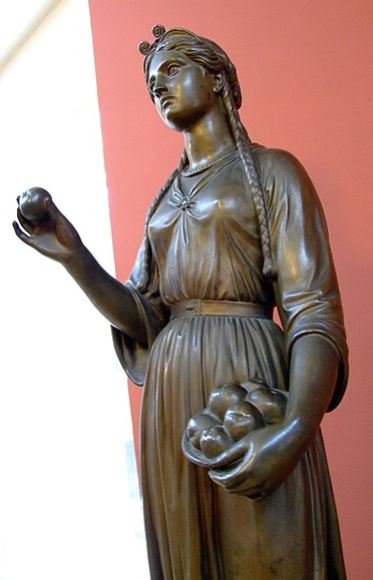
Statue of Iðunn by Danish artist Herman Wilhelm Bissen.
Theories and Interpretations
Some scholars, such as David Knipe, link Iðunn’s story to Indo-European motifs of immortality. The theft of her apples by an eagle resembles myths where celestial objects symbolizing life are stolen. Similar motifs appear in Celtic myths, such as the tale of three brothers stealing sacred apples in bird form.
John Lindow theorizes that Iðunn’s ability to grant eternal youth might extend beyond her apples, symbolizing an inherent rejuvenating power. He highlights the significance of her abduction as a reversal of typical mythological patterns, where female jötnar move to Asgard, not the other way around.
Some scholars propose that Iðunn might represent an aspect of Freyja, given their shared associations with beauty and fertility. This interpretation suggests a broader, interconnected role for goddesses in Norse mythology.
Modern Influence
Iðunn’s enduring legacy is reflected in art, literature, and popular culture. Numerous paintings and sculptures, such as Nils Blommér’s Bragi and Iðunn and John Bauer’s Loki and Idun, depict scenes from her mythological tales. Additionally, her influence extends to publications, such as the Swedish women’s journal Idun and the neopagan publication Idunna by The Troth.
The asteroid 176 Iduna and Idunn Mons on Venus are named after her, signifying her cultural and symbolic importance. The Swedish Maritime Administration recently renamed an icebreaker Idun to symbolize rejuvenation within its fleet.
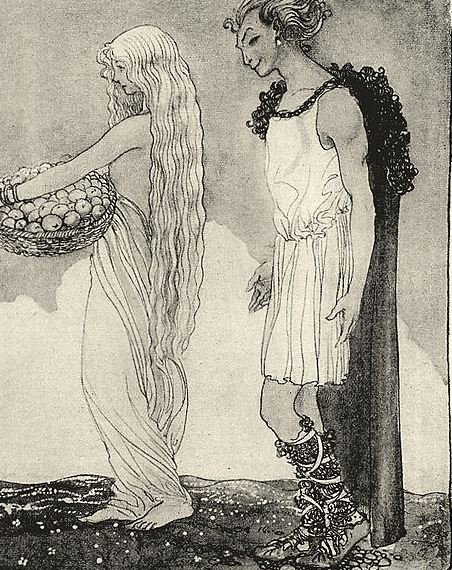
An artwork entitled “Loki and Idun”, created by Swedish artist John Bauer.
Frequently Asked Questions
What are the main sources mentioning Iðunn?
Iðunn is attested in the Poetic Edda (compiled in the 13th century) and Prose Edda (written by Snorri Sturluson in the 13th century).
What role do apples play in Iðunn’s mythology?
Her apples keep the gods youthful until Ragnarök. The Prose Edda details her critical role in preserving the vitality of the Æsir.
What is the story of Iðunn’s abduction?
Loki, under duress, lures Iðunn out of Asgard, where the jötunn Þjazi abducts her in eagle form. Her absence causes the gods to age. Loki later rescues her by turning her into a nut and escaping back to Asgard, where the gods kill Þjazi.
What does her name mean?
Iðunn means “ever young” or “rejuvenator.” Variations include Idunn, Iduna, and Idonea, with historical usage recorded in Iceland since the 10th century.
What accusations does Loki make against Iðunn in Lokasenna?
Loki accuses Iðunn of being promiscuous, claiming she embraced her brother’s killer. These claims are viewed as humorous exaggerations rather than accepted lore.





