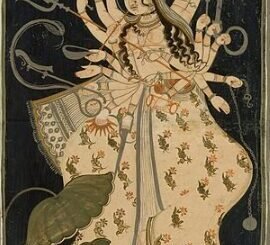
Indra in Hinduism: Origin Story & Significance
Indra, one of the most prominent deities in early Vedic Hinduism, occupies a central role in the mythology of the Rigveda and is depicted as the king of the devas (divine beings or gods). His dominion over the elements of nature, especially the sky, weather, and thunderstorms, establishes him as a significant figure in both religious and cosmic contexts.
Although Indra’s importance declines in later Hindu traditions, his foundational role as a protector of order and prosperity cements his place in Hindu mythology, ritual, and cosmology.

Image: Indra’s iconography depicts him with a thunderbolt (Vajra) and sword, riding Airavata, symbolizing his role as King of the Gods.
Below, World History Edu explores the origin story of Indra, his role in Hinduism, and the symbolic and theological significance he holds across various traditions.
Origin of Indra
Indra’s origin story, as presented in the Rigveda, is deeply rooted in the Indo-European traditions, where he is portrayed as a powerful warrior god who leads the gods in their battle against chaos and evil. He is born as the son of Dyaus Pita (the sky god) and Prithvi (the earth goddess), representing the union of the heavens and the earth. Indra’s birth symbolizes the force that brings balance and order to the world.
His character, as both a cosmic protector and a warrior, aligns with the broader Proto-Indo-European mythological tradition where gods of the sky and thunder, such as Zeus in Greek mythology and Thor in Norse mythology, play key roles.
Indra’s birth is often linked to the cosmic struggles of the gods against the forces of chaos and disorder. His first notable act of heroism is the slaying of the primordial serpent, Vritra, an asura (demon) who holds back the waters and thus threatens life and prosperity.
The above myth encapsulates a key Indo-European motif: the victory of the storm god over the serpent or dragon, a symbol of chaos. By releasing the waters trapped by Vritra, Indra restores order, allowing life to flourish. His association with rain, thunder, and lightning solidifies his role as the divine force behind the natural cycles essential for human survival.
Role of Indra in the Vedic Pantheon
Indra’s position in the Vedic pantheon is that of a supreme leader. As the Rigveda’s most frequently mentioned deity, Indra is invoked as the protector of humanity, the god of war, and the bringer of rains.
His dominion over thunderstorms and his control over rainfall make him essential to agrarian societies, which depend on the seasonal monsoons. The Rigvedic hymns describe Indra as the embodiment of strength and virility, with his mighty weapon, the Vajra (thunderbolt), symbolizing his power to destroy enemies and break through obstacles.

Tibetan bell and dorje (vajra)
In the Rigvedic worldview, the universe is divided into three realms: the heavens, the earth, and the atmosphere (Antariksha), which lies between the two. Indra’s primary domain is the atmosphere, from where he controls the weather and directs the rain-bearing clouds.
His role as a weather god aligns with his position as the protector of both gods and humans, ensuring the nourishment of the earth and the prosperity of mankind.
Indra’s relationship with other deities in the Vedic pantheon is also significant. He is often depicted as leading the devas into battle against the asuras, the forces of chaos and disorder. This cosmic struggle between the devas and the asuras mirrors the dualities that permeate Hindu cosmology—light versus darkness, order versus chaos, and good versus evil.
Indra’s leadership in these battles further emphasizes his role as a divine protector who preserves the cosmic balance. His close association with Agni (the god of fire) and Soma (the god of the sacred drink) suggests his connection to the vital forces of life and the sacrificial rituals that sustain the universe.
Indra’s Defeat of Vritra

Image: Indra is commonly depicted as the guardian deity positioned on the east side of Hindu temples.
One of the most defining myths in Vedic literature is the story of Indra’s defeat of Vritra. This tale is central to understanding Indra’s role as a god of order and prosperity. Vritra is depicted as a serpent or dragon who blocks the flow of rivers, symbolizing a drought that threatens human life and agricultural fertility. In the Rigveda, Vritra’s obstruction of the waters is a metaphor for chaos and disorder, a threat to the natural and cosmic order that sustains life.
Indra, armed with his Vajra, sets out to defeat Vritra and free the waters. His success in this battle restores the flow of rivers, brings rain to the parched earth, and ensures the continuation of life. The myth highlights Indra’s role as the bringer of rains and fertility, a crucial function in the agrarian Vedic society that depended on seasonal monsoons for agriculture.
The defeat of Vritra also has deeper symbolic meanings. In Hindu cosmology, water is often associated with life, fertility, and the sustenance of all living beings. By releasing the waters trapped by Vritra, Indra restores life and re-establishes cosmic order. This act of heroism solidifies his status as a protector of both the natural world and the moral order of society.
Indra in Post-Vedic Literature
Indra’s prominence in the Vedic texts does not carry over into later Hindu literature with the same intensity. In the post-Vedic period, particularly in the Puranas and epics like the Mahabharata and Ramayana, Indra’s role becomes more subordinate to other gods, particularly Vishnu and Shiva.
The rise of the Trimurti (Brahma, Vishnu, and Shiva) as the principal deities in later Hinduism diminishes Indra’s earlier supremacy. However, he remains a significant figure, often appearing in mythological stories as a heroic figure or as a cautionary example of arrogance and the fallibility of the gods.
One example of Indra’s reduced status can be seen in the story of Govardhan Hill, where Krishna, an incarnation of Vishnu, lifts the mountain to protect the villagers from Indra’s wrath. In this myth, Indra becomes a symbol of unchecked power and pride, and Krishna’s intervention serves as a reminder of the limitations of even the mightiest gods. This shift in Indra’s role reflects the evolving nature of Hindu theology, where the focus moves from the early Vedic gods to the more philosophical and devotional aspects of later Hinduism.
Despite this, Indra continues to hold an important place in Hindu rituals and cosmology. He remains the ruler of Svarga, the heaven of the devas, and his role as the god of rain and thunderstorms ensures his ongoing relevance in agricultural rituals and festivals.

Image: Krishna holding Govardhan Hill, artwork by Mola Ram, circa 1790, from the Smithsonian Institution’s collection.
Indra in Hindu Cosmology and the Cyclical Nature of Time
In Hindu cosmology, time is divided into vast cycles known as Yugas, and within these cycles, the role of Indra is seen as part of a broader cosmic order. According to the Puranas, the title of Indra is not permanent but changes with each Manvantara, a cyclic period of time ruled by a specific Manu (progenitor of humanity). Each Manvantara has its own Indra, indicating that the position is transient and subject to the flow of cosmic time. The current Indra of this Manvantara is called Purandhara.
This cyclical understanding of time reflects a key aspect of Hindu cosmology, where the universe is in a constant state of creation, preservation, and destruction. Indra’s role in this cosmic cycle highlights the transient nature of power and the importance of maintaining balance in the universe.
READ MORE: Hanuman – The Divine Vanara and devoted companion of the deity Rama
Indra in Buddhism and Jainism
Indra’s significance extends beyond Hinduism into other religious traditions that emerged in India, particularly Buddhism and Jainism. In Buddhist texts, Indra is known as Indā (Pali) and is depicted as the ruler of the Devas realm, one of the higher realms in the cycle of Samsara (the cycle of birth, death, and rebirth). However, his role in Buddhist cosmology is more symbolic than central, and he is often portrayed as a lesser figure compared to the Buddha. Indra’s role in Buddhism reflects the transient nature of power and the impermanence of all things, a key tenet of Buddhist philosophy.
In Jainism, Indra is also a significant figure, though his role differs from that in Hinduism and Buddhism. In Jain cosmology, Indra is not the king of the gods but the ruler of superhumans who reside in Svarga-Loka, a heavenly realm. He plays a more ceremonial role, appearing at important moments in the lives of Jain Tirthankaras (spiritual teachers). Indra’s participation in these auspicious events highlights his reverence for the spiritual path of Jainism, even though his cosmic role is less dominant than in Hinduism.
Comparative Mythology: Indra and Other Thunder Gods

Painting of Hindu god Indra on his elephant mount, Airavata, c. 1820.
Indra’s role as a storm and thunder god has drawn comparisons to deities from other mythological traditions, particularly within the broader Indo-European framework. Like Indra, gods such as Zeus in Greek mythology, Thor in Norse mythology, and Perun in Slavic mythology are associated with the sky, thunder, and storms. These gods often share similar narratives, including battles against serpent-like creatures representing chaos.
In Greek mythology, Zeus wields the thunderbolt and presides as the king of the gods, a role strikingly similar to Indra’s position in the Rigveda. Similarly, Thor, the Norse god of thunder, wields his hammer, Mjolnir, and fights against the forces of chaos, much like Indra’s battles against the asuras. These similarities point to a shared Proto-Indo-European heritage, where the storm god was a central figure in the cosmic order, responsible for maintaining balance and defeating the forces of disorder.
The comparison between Indra and these other thunder gods highlights the universality of certain mythological themes, particularly the struggle between order and chaos, which is central to many ancient religions. Indra’s role as the god who brings rain and fertility, while also being a fierce warrior, reflects the dual nature of these deities as both life-givers and destroyers.
Indra’s Iconography and Symbols
Indra’s iconography is rich with symbolism, reflecting his various roles and attributes. One of his most prominent symbols is the Vajra, a thunderbolt that represents both his power to destroy and his ability to bring life-giving rain. The Vajra is not only a weapon but also a symbol of spiritual insight and strength in both Hinduism and Buddhism.
Indra is often depicted riding Airavata, a celestial white elephant, which symbolizes strength, power, and the ability to traverse the heavens. The elephant is also associated with rain and fertility, further emphasizing Indra’s role as the bringer of monsoons. In many depictions, Indra is shown seated on a throne in his heavenly abode of Amaravati, surrounded by other gods and divine beings, illustrating his status as the king of the devas.
Indra’s association with Mount Meru, a sacred mountain in Hindu, Buddhist, and Jain cosmology, further reinforces his connection to the cosmic order. Mount Meru is considered the center of the universe in these traditions, and Indra’s dwelling at its summit symbolizes his role as a guardian of the natural and spiritual worlds.

Indra’s depiction in other Indian religious traditions, such as Buddhism and Jainism, as well as his comparison to thunder gods in other mythologies, underscores his universal appeal and the shared themes of cosmic order and chaos that permeate human religious thought. Image: Indra, mounted on his elephant, guards the entrance of the 1st-century BCE Buddhist Cave 19 at Bhaja Caves, Maharashtra.
Frequently Asked Questions

Indra is the king of the devas and the ruler of Svarga. He governs over the elements of the sky, lightning, weather, thunder, storms, rains, and river flows, and is also associated with war. Image: Modern depiction of Indra holding a lotus and his weapon the Vajra.
What role does Indra play in the Rigveda?
Indra is the most prominent deity in the Rigveda. He is celebrated as a god of order and power, particularly for defeating the asura Vritra, who blocked prosperity. By killing Vritra, Indra brings rain and sunshine, symbolizing his role as a protector and savior of humanity.
What is Vritra, and why is Indra’s defeat of Vritra significant?
Vritra is an asura who obstructed human prosperity by holding back rain and causing drought. Indra’s defeat of Vritra is significant because it symbolizes the release of water and the restoration of fertility and life, reinforcing Indra’s status as a savior.
How does Indra’s significance change in post-Vedic literature?
In post-Vedic literature, Indra’s prominence diminishes. While he remains an important figure in mythological stories, his role shifts from a central god to a powerful hero.
What does the Vishnu Purana say about Indra?
According to the Vishnu Purana, the title of Indra is not permanent. It changes with each Manvantara, a cyclic period in Hindu cosmology, where a new deity assumes the role. The current Indra of this Manvantara is called Purandhara.

Indra is typically depicted wielding a Vajra (thunderbolt) and riding Airavata, a celestial white elephant. His abode is the capital city of Svarga, Amaravati, and he is also associated with Mount Meru, a sacred mountain in Hindu cosmology. Image: Banteay Srei temple pediments depict Indra on Airavata, Cambodia, circa 10th century.
How is Indra depicted in Buddhist traditions?
In Buddhist traditions, Indra, known as Indā in Pali, rules over the Devas realm, a realm of rebirth in Samsara. However, his importance is reduced in Buddhist texts, where he is sometimes portrayed as a lesser figure who also undergoes rebirth.
What is Indra’s role in Jainism?
In Jainism, Indra is not the king of the gods but the ruler of superhumans in Svarga-Loka. He appears with his consort Indrani to celebrate key moments in the life of a Jain Tirthankara, reflecting his reverence for spiritual journeys in Jain traditions.
Which gods in other mythologies are comparable to Indra?
Indra is often compared to Zeus in Greek mythology and Jupiter in Roman mythology. His powers and attributes are also similar to other Indo-European deities like Odin, Thor, Perun, and Taranis, gods associated with thunder and sky.
How does Indra’s role reflect the dynamic nature of mythological figures?
Indra’s role and significance evolve across Hindu, Buddhist, and Jain traditions. While his prominence shifts over time, his image as a powerful and complex deity remains central in mythological studies, drawing connections to various Indo-European gods of thunder and the sky.