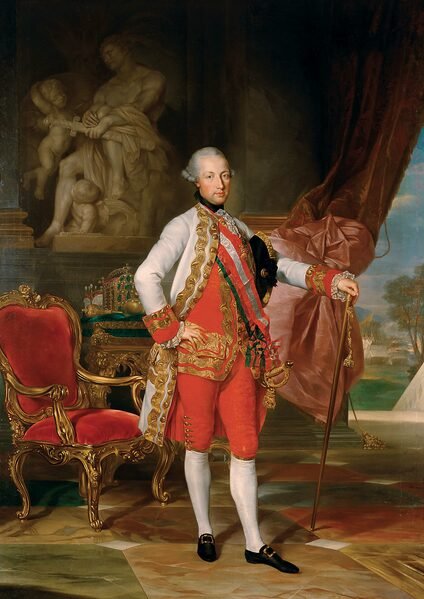
Portrait of Joseph II, painted by Austrian artist Anton von Maron, circa 1775.
Joseph II, born on 13 March 1741, was the eldest son of Empress Maria Theresa and Emperor Francis I. As an Archduke of Austria, his education emphasized enlightenment principles, influenced by philosophers such as Voltaire, Rousseau, and Hume, as well as political figures like Frederick the Great of Prussia. His practical administrative training came through direct interaction with officials managing the complex Habsburg dominions.
Joseph was baptized Josephus Benedictus Joannes Antonius Michael Adamus, a name reflecting the piety of the era. Born amidst the turbulence of the War of the Austrian Succession, he was raised with an acute awareness of the responsibilities and complexities of governance.
Marriages and Personal Losses
Joseph II married twice. His first wife, Princess Isabella of Parma, was a political match aimed at strengthening Franco-Austrian ties. Their marriage, however, was deeply affectionate. They had a daughter, Maria Theresa, but Isabella’s fears of pregnancy and health led to melancholy. She tragically died of smallpox in 1763, leaving Joseph devastated.
In 1765, Joseph reluctantly remarried Princess Maria Josepha of Bavaria, a union that proved unhappy and brief. Maria Josepha succumbed to smallpox two years later. Joseph, deeply affected by these losses, never remarried. His only surviving child, Maria Theresa, died of pleurisy in 1770, leaving Joseph without heirs.
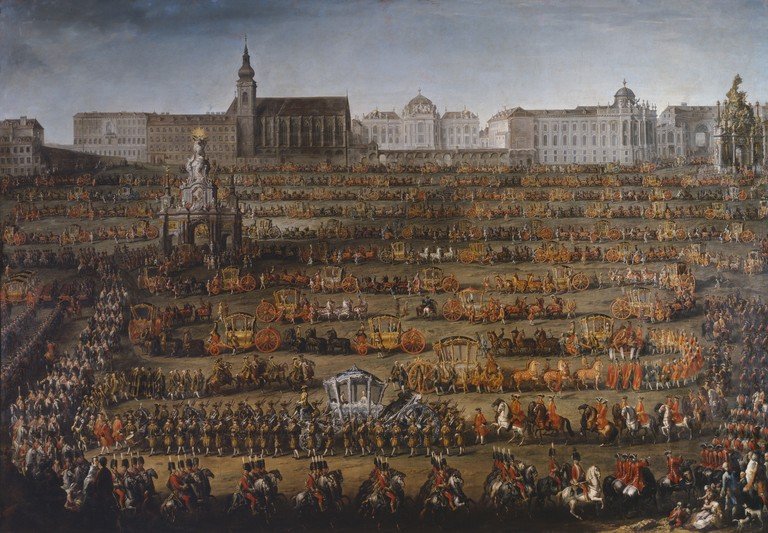
The arrival of Isabella of Parma for her wedding to Joseph II in 1760, painted by Martin van Meytens.
Rise to Power and Co-Regency
Joseph became Holy Roman Emperor in 1765, following his father’s death. However, his mother, Maria Theresa, retained real power over the Habsburg monarchy. As co-regent, Joseph contributed policy suggestions, emphasizing religious tolerance, serf emancipation, and economic liberalization.
Despite his philosophical leanings, Joseph’s overconfidence in his reforms often led to tension with his mother. For instance, their differing views on Poland’s Partition and the War of the Bavarian Succession tested their partnership. Joseph’s role remained secondary until Maria Theresa’s death in 1780, which left him free to implement his policies.
Josephinism: Domestic Reforms
As the sole ruler of the Habsburg dominions, Joseph II pursued aggressive reforms based on enlightened absolutism. His policies, known collectively as Josephinism, aimed to centralize administration, reduce Church influence, and modernize society.
Religious Reforms
Joseph’s Patent of Toleration (1781) granted limited religious freedoms to Protestants and Orthodox Christians, and his Edict of Tolerance (1782) extended rights to Jews. He reduced the Church’s authority, closing monasteries not engaged in education or healthcare. Bishops were required to swear loyalty to the state, and Joseph promoted secular oversight of religious affairs.
Abolition of Serfdom
In 1781, Joseph abolished serfdom across his lands, granting peasants personal freedom and legal equality. In 1789, he mandated cash payments to landlords instead of labor obligations, disrupting traditional feudal economies. Resistance from nobles and peasants alike undermined the sustainability of these reforms.
Economic and Administrative Changes
Joseph centralized administration, enforcing German as the empire’s official language. He introduced land tax reforms, seeking to equalize burdens across classes, but these measures faced backlash. His efforts to streamline governance often alienated local elites, especially in Hungary and the Austrian Netherlands.
Legal and Social Advances
Joseph’s legal reforms included the abolition of torture and the death penalty (in most cases). He established the Allgemeines Krankenhaus in Vienna, prioritizing public health. Compulsory elementary education expanded literacy, though his imposition of German as the language of instruction was controversial.
Foreign Policy and Territorial Ambitions
Joseph II’s foreign policy was marked by ambition and miscalculation. Despite some territorial gains, his strategies often isolated Austria.
Bavarian Succession and Prussian Rivalry
Joseph sought to annex Bavaria in exchange for the Austrian Netherlands, sparking the War of the Bavarian Succession (1778–1779). Frederick the Great of Prussia, supported by other German princes, thwarted Joseph’s plans. This rivalry strained Austria’s resources and diminished its influence in the Holy Roman Empire.
Relations with Russia and the Ottoman War
Joseph formed an alliance with Catherine the Great of Russia, leading to the Austro-Turkish War (1787–1791). Despite initial victories, the conflict drained Austria financially and militarily. The Treaty of Sistova (1791) yielded minor gains, highlighting the limitations of Joseph’s aggressive diplomacy.
French Revolution and Marie Antoinette
Joseph closely monitored the French Revolution, seeking to assist his estranged sister, Marie Antoinette, Queen of France. However, his diplomatic and military efforts were largely ineffective, and Austria’s involvement with revolutionary France became more pronounced after Joseph’s death.
Challenges and Resistance
Joseph’s reforms faced widespread opposition from various quarters:
- Nobility: The aristocracy resisted taxation reforms and loss of privileges.
- Clergy: The Church opposed secularization and state intervention in religious affairs.
- Peasantry: While emancipated, many peasants struggled with the transition to a cash-based economy.
- Regional Resistance: The Austrian Netherlands and Hungary rejected centralization and Germanization, sparking revolts such as the Brabant Revolution (1789–1790).
These challenges forced Joseph to roll back many of his reforms shortly before his death.
Personal Traits and Leadership Style
Joseph II was known for his tireless work ethic, visionary ideas, and belief in rational governance. However, his authoritarian approach and impatience often alienated those he sought to reform. Contemporaries described him as ambitious yet despotic, with a tendency to overestimate his ability to reshape society.
Despite his flaws, Joseph was a patron of the arts, supporting composers like Mozart and Salieri. He championed German culture and sought to make Vienna a center of enlightenment.
Death and Succession
Joseph II died on 20 February 1790, succumbing to tuberculosis. His epitaph, written at his request, reflects his humility: “Here lies a ruler who, despite his best intentions, was unsuccessful in all his endeavors.”
Lacking heirs, he was succeeded by his younger brother, Leopold II, who reversed many of Joseph’s reforms to stabilize the empire.
Legacy
Joseph II remains a polarizing figure in history. While celebrated for his progressive vision, his inability to reconcile reform with political realities limited his impact.
Achievements
His edicts laid the groundwork for greater religious pluralism in the Habsburg Empire.
Joseph’s efforts to abolish serfdom and promote education were ahead of their time.
His support for the arts enriched Austria’s cultural heritage.
Failures
Joseph’s rapid and sweeping reforms alienated key constituencies. Also, his foreign policies weakened Austria’s position in Europe. Many of his reforms were reversed after his death, highlighting their fragility.
Frequently Asked Questions
What was Joseph II’s approach to governance?
He was an advocate of enlightened absolutism, introducing reforms focused on secularization, modernization, and centralization, but faced opposition that undermined many of his policies.
What were some key reforms enacted by Joseph II?
He abolished serfdom, introduced religious tolerance with the Patent of Toleration (1781), secularized monastic lands, reduced the clergy’s power, and promoted administrative centralization.
Why did Joseph II’s reforms face resistance?
His rapid, sweeping changes clashed with entrenched traditions, alienated nobility, clergy, and commoners, and disrupted local governance and economic structures.
How did Joseph II contribute to the arts?
He was a patron of music, commissioning works from Mozart and supporting composers like Salieri, earning him the nickname “Musical King.”
What were Joseph II’s foreign policy goals?
He aimed to expand Habsburg territories, especially in Bavaria, but his aggressive diplomacy and wars, like the Austro-Turkish War, strained Austria’s resources and alliances.
What was Joseph II’s stance on education and medicine?
He made elementary education compulsory, promoted practical higher education, and centralized medical care with projects like the Allgemeines Krankenhaus in Vienna.
Why is Joseph II considered a significant Enlightenment monarch?
Despite failures, his reforms embodied Enlightenment ideals of rational governance, legal equality, and secularism, influencing the modernization of the Habsburg Monarchy.