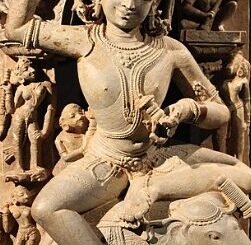
Kartikeya: Hindu God of War
Kartikeya, also known by various names such as Skanda, Subrahmanya, Shanmukha, and Murugan, is one of the most revered deities in Hinduism, particularly in South India. As the god of war, Kartikeya is associated with youth, bravery, and the destruction of evil.
He is often depicted as a powerful warrior, leading the celestial army against demons and malevolent forces. Kartikeya holds an important place in Hindu mythology and is worshipped widely in India and other regions influenced by Tamil culture.

Image: Kartikeya’s statue at Batu Caves in Malaysia.
Origins and Family
Kartikeya is traditionally described as the son of Lord Shiva and Goddess Parvati, making him the brother of Ganesha, the remover of obstacles. His birth story, rich with mythological significance, differs across Hindu texts, but the common theme involves his divine purpose to defeat the demon Tarakasura, who could only be killed by the offspring of Shiva.
One of the most popular versions of Kartikeya’s birth is recounted in the Skanda Purana. According to this legend, after the marriage of Shiva and Parvati, the gods were troubled by the demon Tarakasura, who had obtained a boon that only a son of Shiva could kill him.
However, Shiva was engrossed in deep meditation and showed no inclination toward fatherhood. The gods, desperate for a savior, approached Kama (the god of love) to awaken Shiva’s desires for Parvati. Kama succeeded but was burned to ashes by Shiva’s third eye in the process.
Nonetheless, six sparks of fire emerged from Shiva and were carried by Agni, the fire god, to the Ganges River. These sparks transformed into six divine boys, who were nurtured by six celestial nymphs known as the Krittikas.
Later, Parvati embraced these six children, merging them into one being with six heads, representing the six stars of the Pleiades cluster. Thus, Kartikeya was born and is sometimes referred to as Shanmukha, meaning “the one with six faces.”
Syncretization with Murugan
Kartikeya’s prominence is especially notable in South Indian Hinduism, where he is widely known as Murugan, the Tamil god of war. Over time, the Vedic god Skanda, identified with Kartikeya, was syncretized with the indigenous Tamil deity Murugan. This blending of beliefs resulted in Kartikeya/Murugan becoming one of the most beloved gods in Tamil culture.
Murugan is often regarded as the “God of the Tamil people,” with numerous temples and festivals dedicated to him, including the famous Thaipusam and Panguni Uthiram celebrations. His worship is particularly strong in Tamil Nadu, Sri Lanka, and regions with significant Tamil populations, such as Malaysia, Singapore, and Mauritius. The Tirumurukāṟṟuppaṭai, a classical Tamil poetic work, and the Tiruppukal, composed by the saint-poet Arunagirinathar, are key texts that celebrate the glory of Murugan.
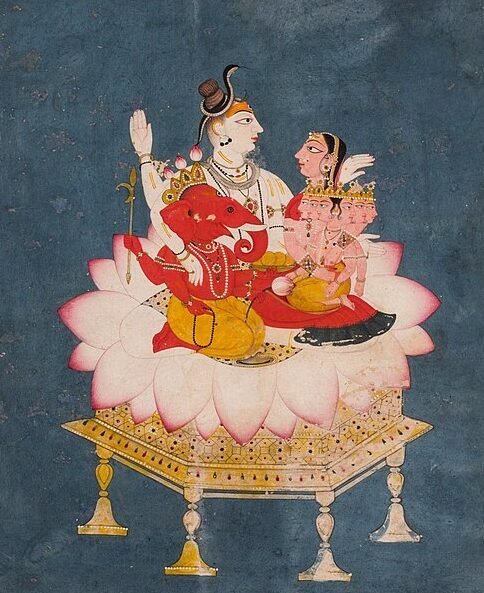
Image: An 18th-century drawing depicting a six-headed Kartikeya with his family, i.e. his father Shiva, mother Parvati, and brother Ganesha.
Role as the God of War
Kartikeya’s primary role in Hindu mythology is that of a warrior deity. He is depicted as the commander of the devas (celestial beings), leading their forces into battle against asuras (demons). His most famous victory is over the demon Tarakasura, who terrorized the heavens and the earth. According to legend, no one could defeat Tarakasura except the son of Shiva. After his birth and rapid growth, Kartikeya, armed with divine weapons, took charge of the celestial army and successfully vanquished Tarakasura, restoring peace to the cosmos.
Apart from Tarakasura, Kartikeya is also credited with defeating other demons, such as Surapadma. In Tamil mythology, Surapadma is depicted as an evil force who had taken control of the universe. Kartikeya waged a fierce battle against Surapadma, which culminated in a grand showdown. When Kartikeya finally vanquished the demon, he spared his life by transforming Surapadma into a peacock, which became his vahana (vehicle), and a rooster, which became his emblem. These two symbols—the peacock and the rooster—remain central to Kartikeya’s iconography.
Iconography and Symbols
Kartikeya is typically depicted as a handsome and youthful deity, symbolizing eternal youth and energy. His most distinguishing feature is his six heads, representing various concepts, including his ability to see and understand in all directions and his mastery over the five senses and the mind. These six heads are also associated with six primary virtues: wisdom, detachment, strength, fame, wealth, and divine power.
In most depictions, Kartikeya is shown riding his peacock vahana, Paravani. The peacock represents beauty, pride, and the destruction of harmful tendencies. The bird’s vibrant feathers symbolize the removal of vanity and egotism, aligning with Kartikeya’s role as a teacher of ethical and virtuous living.
Kartikeya wields several weapons, the most important being the spear or lance called the vel, gifted to him by his mother, Parvati. The vel is a symbol of purity, power, and wisdom, and it plays a central role in his battles against demons. In many depictions, Kartikeya is also seen carrying a flag that bears the emblem of a rooster, symbolizing his victory over evil.
Another common symbol associated with Kartikeya is the rooster. The rooster signifies his triumph over Surapadma, and it also represents awakening, vigilance, and the dawn of new beginnings. This further aligns Kartikeya with the concept of removing darkness (ignorance) and bringing light (knowledge) to the world.
Philosophy and Teachings
While Kartikeya is primarily known as a god of war, his role in Hindu philosophy extends beyond that of a mere warrior. He is also revered as a teacher of ethics and spiritual wisdom. In the Shaiva Siddhanta tradition, particularly in South India, Kartikeya is regarded as a philosopher-god who imparts the secrets of life, dharma (righteousness), and moksha (liberation).
One of the most well-known stories involving Kartikeya’s wisdom is his debate with Lord Brahma, the creator god. According to the legend, Kartikeya once asked Brahma the meaning of Om, the sacred syllable. When Brahma failed to provide a satisfactory explanation, Kartikeya challenged him and took over the role of teaching the meaning of the sacred syllable to the gods and sages.
In another story, Kartikeya competes with his brother Ganesha in a race to circumambulate the universe. While Kartikeya rides his peacock and sets off to physically travel around the world, Ganesha simply walks around his parents, Shiva and Parvati, claiming that they represent the entire universe. This story highlights the complementary nature of Kartikeya and Ganesha: Kartikeya as the embodiment of action and physical prowess, and Ganesha as the embodiment of wisdom and intellect.
Kartikeya’s teachings emphasize the importance of living a righteous life, adhering to moral principles, and pursuing spiritual growth. His philosophy encourages individuals to rise above worldly attachments and focus on the greater good, embodying the qualities of a warrior not only in battle but also in personal ethics.
Worship and Temples
Kartikeya is widely worshipped across India, especially in Tamil Nadu and other southern states. The Kaumaram sect of Hinduism is primarily devoted to the worship of Kartikeya, and many temples dedicated to him can be found throughout South India. Some of the most famous temples include:
- Palani Murugan Temple: Located in Tamil Nadu, this is one of the most important shrines dedicated to Murugan. The temple, situated atop a hill, attracts millions of devotees, especially during festivals like Thaipusam and Panguni Uthiram.
- Tiruchendur Murugan Temple: This temple, located on the shores of Tamil Nadu, is another prominent shrine where Kartikeya is worshipped in the form of Murugan. It is one of the six abodes of Murugan, also known as Arupadai Veedu.
- Swamimalai Murugan Temple: Located near Kumbakonam, this temple is famous for its legend of Kartikeya teaching the meaning of Om to his father, Shiva.
- Kartikeya Temples in Sri Lanka: Kartikeya is worshipped widely in Sri Lanka, particularly by the Tamil Hindu community. The Nallur Kandaswamy Kovil in Jaffna is a key temple dedicated to him.
Beyond India and Sri Lanka, Kartikeya is also worshipped in countries with large Tamil communities, such as Malaysia, Singapore, Mauritius, and Fiji. Festivals like Thaipusam, which celebrates the victory of Kartikeya over the demon Surapadma, are major religious events in these regions. During Thaipusam, devotees engage in elaborate rituals, including processions, body piercings, and carrying kavadi (burdens) as acts of devotion to the god.
Etymology and Names
Kartikeya is known by many names, each reflecting different aspects of his personality and mythology. The name “Kartikeya” is derived from the Sanskrit word “Krittika,” which refers to the six celestial nymphs who nurtured him. Hence, “Kartikeya” means “the son of the Krittikas.”
Other popular names for Kartikeya include:
- Skanda: Derived from the root “skand,” meaning “to leap or to attack.” This name emphasizes his role as a warrior who swiftly leaps into battle.
- Murugan: Meaning “handsome” or “youthful” in Tamil, this name highlights his eternal youth and beauty.
- Shanmukha or Arumukha: Meaning “the one with six faces,” this name references his unique iconography.
- Subrahmanya: Meaning “dear to Brahman” or “beloved,” this name reflects his association with divine knowledge and wisdom.
- Kumara: Meaning “youth,” this name symbolizes his eternal youth and vitality.
These names are used across different regions and reflect the diverse ways Kartikeya is understood and worshipped.
Conclusion
Kartikeya, the Hindu god of war, embodies a unique blend of martial prowess, wisdom, and spiritual guidance. As a warrior deity, he is revered for his victories over demons and the protection he offers to the divine realm. Yet, his role extends beyond battle, as he is also seen as a philosopher and teacher who imparts the values of righteousness and ethical living.
His widespread worship, particularly in South India and among Tamil communities worldwide, reflects his deep cultural and religious significance. Through temples, festivals, and devotional literature, Kartikeya continues to be a central figure in Hindu worship, symbolizing the triumph of good over evil and the pursuit of spiritual knowledge.
Questions and Answers
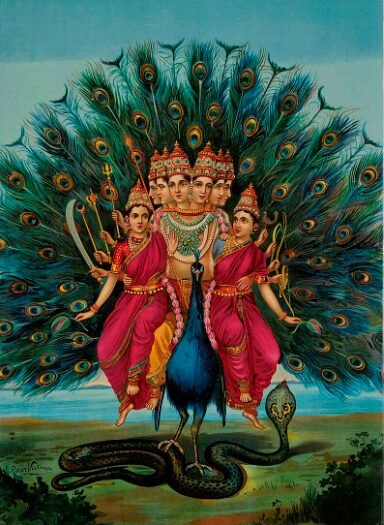
The six-headed Kartikeya with his two consorts on a peacock, painting by Indian painter Raja Ravi Varma
How did the Tamil deity Murugan become associated with Kartikeya?
After the Sangam era, it is believed that the Tamil deity Murugan was syncretized with the Vedic god Skanda, making Kartikeya a significant figure in both Tamil and Vedic traditions.
What regions and communities primarily worship Kartikeya?
Kartikeya is primarily worshipped in South India, especially in the Kaumaram sect, but he is also revered in North and East India. His worship is widespread in Sri Lanka, Southeast Asian countries like Malaysia, Singapore, Thailand, and Indonesia, as well as regions with large Tamil communities such as Fiji, Mauritius, South Africa, Canada, the Caribbean, and countries with Indian migrant populations like the United States and Australia.
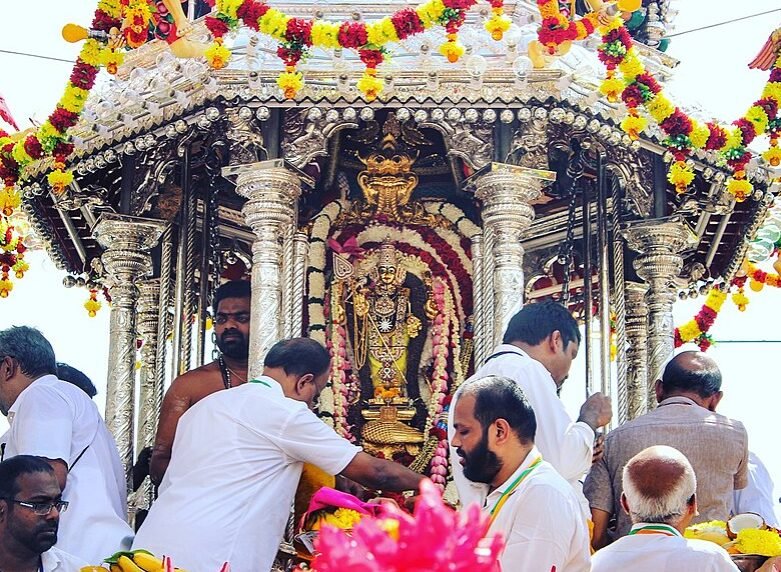
Kartikeya being worshipped during a Tamil festival of Thaipusam.
What is Kartikeya’s association with the Palani hills and the Kurinji region?
Kartikeya is considered the presiding deity of the Palani hills and the tutelary god of the Kurinji region, where his worship is particularly popular.
What is Kartikeya’s iconography, and what symbols are commonly associated with him?
Kartikeya is typically depicted as a youthful figure, either riding or standing beside a peafowl named Paravani. His banner often carries the emblem of a rooster. He wields a spear called the vel, a gift from his mother Parvati. He is sometimes shown with six heads, which relate to legends of his birth involving six boys.
What are the major contributions of Kartikeya in Hindu mythology?
Kartikeya is known for his role as a warrior who led the devas’ army and destroyed demons like Tarakasura and Surapadma. He is also considered a philosopher who taught principles of an ethical life and Shaiva Siddhanta theology.
What are some key literary works dedicated to Kartikeya?
Key Tamil literary works devoted to Kartikeya include the Tirumurukāṟṟuppaṭai by Nakkīraṉãr and the Tiruppukal by Arunagirinathar.
What are some of the different names used for Kartikeya, and what do they mean?
Kartikeya is known by many names, including:
- Skanda: meaning “to leap or attack”
- Murugan: meaning “handsome”
- Kumara: meaning “youthful”
- Subrahmanya: meaning “transparent”
- Senthil: meaning “victorious”
- Vēlaṇ: meaning “wielder of the vel”
- Swaminatha: meaning “ruler of the gods”
How does the name ‘Kartikeya’ relate to his birth story?
The name “Kartikeya” is derived from the Krittikas, handmaidens who raised six divine sparks that emerged from Shiva. These sparks became six boys, and Parvati later fused them into one entity with six heads, hence the name “Kartikeya,” meaning “of the Krittikas.”
How has Kartikeya’s influence spread across cultures?
Kartikeya’s influence spread across regions and cultures, with his name appearing on ancient Indo-Scythian coins in Greek script as Skanda, Kumara, and Vishaka. His worship has remained prominent among Tamil communities and other regions with significant Indian populations.