Kolanthes in Ancient Egypt
Kolanthes, also known as Kolanthes the Child, was a minor deity in the religious landscape of Late Period Egypt. He is primarily associated with Akhmim (Koine Panopolis), a city in the ninth Upper Egyptian Nome, where he was revered within the local pantheon. Though not as widely known as the major gods of ancient Egypt, his worship persisted through the Ptolemaic and Roman periods, with inscriptions attesting to his veneration as late as the second century BCE.
Kolanthes is notable for his role as a divine child, a common motif in Egyptian religion, where young deities often symbolized renewal, kingship, and divine legitimacy. Despite his relatively obscure status, he was linked to major deities, including Min, Repyt (Triphis), Osiris, and Isis. His presence in inscriptions, particularly in temples and rock quarries, highlights his significance within certain localized cults.
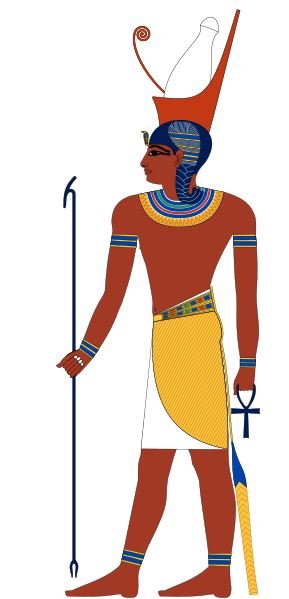
A depiction of Kolanthes.
Divine Family and Mythological Associations
Kolanthes occupied an important place within the patron trinity of Akhmim. He was regarded as the son of Repyt, the lion-headed goddess who was the principal deity of the region. However, another figure, Aperetiset, was also occasionally cited as his mother, reflecting possible variations or developments in his mythology over time. The father of Kolanthes was Min, a well-established fertility god associated with Akhmim, reinforcing his connection to the local divine hierarchy.
Additionally, Kolanthes bore strong associations with Horus, the divine child of Osiris and Isis. Like Horus, he was perceived as a youthful deity embodying divine kingship and protection. This link to Horus suggests that Kolanthes may have functioned as a localized version of the broader child-god archetype found throughout Egyptian mythology, reinforcing his connection to pharaonic power and legitimacy. His designation as “the child of Osiris and Isis” aligns him with the mythological lineage of Egypt’s divine rulers.

Cultic Sites and Inscriptions
The cult of Kolanthes was centered around Akhmim and its surrounding regions, with archaeological evidence pointing to active worship both north and south of the city. His name appears in various inscriptions, confirming the presence of his followers and religious institutions dedicated to his veneration.
Among the most significant findings are inscriptions in the quarries of Gabal El Haridi and Ptolemais Hermiou (modern-day al-Mansha). These include Demotic Egyptian rock inscriptions, which suggest that quarry workers and local inhabitants held him in high regard. Additionally, Greek inscriptions provide further evidence of his worship, indicating that his cult persisted even during the Hellenistic and Roman periods.
The inconsistencies in hieroglyphic and demotic spellings suggest that Kolanthes may not have been of purely Egyptian origin.
A particularly noteworthy discovery is a stele from the reign of Emperor Hadrian, featuring hieroglyphic inscriptions mentioning Kolanthes. The most extensive documentation of his name and attributes comes from the Temple of Athribis, where recent excavations have revealed a wealth of inscriptions detailing his role within the local pantheon. These inscriptions offer critical insights into his cultic significance, shedding light on the religious landscape of the period.

A depiction of the Eye of Horus.
The Name and Its Variations
The name “Kolanthes” appears in various linguistic forms, reflecting the complex interaction between Egyptian, Greek, and Demotic traditions. In Greek inscriptions, his name is rendered as Κολάνθης, Κολάνθας, or Κολάνθος. These variations suggest phonetic adaptations influenced by the Greek language and its representation of Egyptian sounds.
In Demotic, his name has been transliterated as “QrnDA,” based on the Manuel de Codage system. However, inconsistencies in its spelling across different inscriptions indicate a degree of fluidity in how his name was recorded. This inconsistency has led some scholars to speculate that Kolanthes may not have been of purely Egyptian origin, or that his cult may have incorporated foreign influences over time.
Variability in Hieroglyphic Spellings
Hieroglyphic inscriptions from the Temple of Athribis provide additional evidence of the flexible representation of Kolanthes’ name. Different spellings appear in various scenes, some being fully written out, while others are abbreviated.
These variations in spelling demonstrate the adaptability of Kolanthes’ name across different writing traditions and religious texts. The existence of both full and abbreviated forms suggests that he was referenced frequently enough to warrant shorthand notations, a practice common in religious inscriptions when a deity was widely recognized.

Frequently Asked Questions
Who were Kolanthes’ parents?
Kolanthes was considered the son of the god Min, with his mother identified as either Repyt (Triphis) or Aperetiset.
What was Kolanthes’ connection to Horus?
He was identified with Horus, the divine child and protector of the Pharaoh, and was sometimes called “the child of Osiris and Isis.”
Where was Kolanthes worshiped?
His cult sites were in Akhmim and its surrounding areas, including Gabal El Haridi and Ptolemais Hermiou.

What evidence exists for Kolanthes’ worship?
References to Kolanthes appear in demotic rock inscriptions, Greek inscriptions, a Roman-era stele, and temple inscriptions from Athribis.
What is the significance of Kolanthes in Akhmim’s divine family?
He was part of the region’s patron trinity and linked to local religious traditions, reinforcing his role as a divine child and protector.
FACT CHECK: At World History Edu, we strive for utmost accuracy and objectivity. But if you come across something that doesn’t look right, don’t hesitate to leave a comment below.





