Life and Major Works of Francesco Bartolozzi
Francesco Bartolozzi (1727–1815) was an Italian engraver whose artistic prowess and innovative techniques left a lasting imprint on the world of printmaking. Renowned for popularizing the “crayon” or stipple method of engraving, Bartolozzi’s career spanned several countries, including Italy, England, and Portugal. His ability to blend fine art with engraving elevated the medium, influencing both his contemporaries and future generations of artists.
Early Life and Education
Born on September 21, 1727, in Florence, Italy, Francesco Bartolozzi was initially expected to continue the family tradition by becoming a goldsmith and silversmith like his father.
However, from an early age, he exhibited a remarkable talent for drawing and design. Recognizing his son’s exceptional abilities, Bartolozzi’s father decided to nurture his artistic inclinations rather than confine him to the family trade.
To develop his skills, Bartolozzi was apprenticed to two notable Florentine artists: Ignazio Hugford, an English painter residing in Florence known for his work in religious art, and Giovanni Domenico Ferretti, a prominent painter of the Rococo period. Under their guidance, Bartolozzi spent three years studying painting, mastering techniques that would later inform his engraving work. This foundational education in painting provided him with a deep understanding of composition, anatomy, and the use of light and shadow.

Image: A painting of Francesco Bartolozz by English artist Joshua Reynolds.
Move to Venice and Training under Joseph Wagner
After completing his studies in Florence, Bartolozzi sought to expand his artistic horizons. He moved to Venice, a city renowned for its rich artistic heritage and vibrant cultural scene. In Venice, he became a pupil of Joseph Wagner, a respected engraver and printseller originally from Germany. Wagner’s workshop was a hub for artists and engravers, and under his mentorship, Bartolozzi honed his engraving skills over six years.
During this period, Bartolozzi learned various engraving techniques, including etching, line engraving, and the emerging stipple method. He also gained practical experience in the commercial aspects of art production, such as print distribution and marketing. This combination of artistic development and business acumen would prove invaluable throughout his career.
Establishing His Own Workshop
With a solid foundation in engraving and practical experience under Wagner, Bartolozzi felt prepared to establish his own workshop in Venice. His early works often reflected the styles of Venetian artists Marco Ricci and Francesco Zuccarelli, known for their landscapes and pastoral scenes. Bartolozzi’s engravings during this time showcased his versatility and ability to adapt to different artistic styles, which helped build his reputation as a skilled and adaptable engraver.
His workshop not only produced engravings but also became a space for collaboration and innovation. Bartolozzi began experimenting with techniques that would later define his signature style, blending the precision of engraving with the softness of drawing.
Move to Rome and Work on Domenichino’s Frescoes
In 1762, seeking new challenges and opportunities, Bartolozzi relocated to Rome. The city was a center of classical art and attracted artists from across Europe. While in Rome, he undertook a significant project: creating a series of engravings based on the frescoes by Domenichino at the Abbey of Grottaferrata. These frescoes depicted the life of St. Nilus, and Bartolozzi’s task was to translate these large-scale, intricate paintings into engravings that could be reproduced and disseminated.
His engravings of Domenichino’s works were met with critical acclaim. Bartolozzi managed to capture the essence of the frescoes, preserving the details and emotional depth of the original paintings. Additionally, he produced etchings of works by other Old Masters, further establishing himself as an engraver capable of interpreting complex compositions with fidelity and artistic sensitivity.
Invitation to England and Move to London
Bartolozzi’s growing reputation reached beyond Italy, attracting the attention of Richard Dalton, the English Royal Librarian. In 1763, Dalton was touring Italy in search of art acquisitions for King George III’s collection. Impressed by Bartolozzi’s engravings, Dalton offered him the prestigious position of Engraver to the King. Recognizing the opportunity to work in a new market and expand his influence, Bartolozzi accepted the offer and moved to London in 1764.
Career in London
Upon his arrival in London, Bartolozzi entered a flourishing art scene. The British aristocracy and burgeoning middle class had a keen interest in art, and there was a high demand for engravings that could bring artworks into homes and collections.
One of Bartolozzi’s most significant contributions during his time in London was the popularization of the “crayon” or stipple method of engraving. This technique involved creating images with dots and short strokes to mimic the appearance of chalk or pastel drawings. The stipple method allowed for subtle gradations of tone and a softer aesthetic, which contrasted with the harsher lines of traditional engraving.
Bartolozzi collaborated with prominent artists such as Giovanni Battista Cipriani and Angelica Kauffman, engraving their drawings and helping to disseminate their work to a wider audience. His engravings were highly sought after for their delicate beauty and technical excellence. Portraits, mythological scenes, and allegorical subjects were among the themes he explored, catering to the tastes of English collectors.
In addition to his artistic endeavors, Bartolozzi played a pivotal role in elevating the status of engraving in England. By demonstrating that engraving could be an art form in its own right, not merely a means of reproducing paintings, he inspired a generation of British engravers. His influence extended to the Royal Academy of Arts, where he became a founding member in 1768 and contributed to the education of young artists.
Notable Works
Among Bartolozzi’s significant works during his London period are:
- “Clytie” after Annibale Carracci: An engraving that showcases his mastery of translating classical paintings into prints while retaining the original’s emotional impact.
- “The Three Graces” after Angelica Kauffman: This piece exemplifies the elegance and refinement that characterized much of his work and highlights his collaboration with contemporary artists.
- Portraits of British Royalty and Nobility: Bartolozzi produced numerous portraits, including those of King George III and Queen Charlotte, which were instrumental in cementing his reputation among the British elite.

Image: Details of Francesco Bartolozzi’s stipple engraving work.
Later Years in Lisbon
In 1802, at the age of 75, Bartolozzi accepted an invitation to become the director of the National Academy of Lisbon in Portugal. The Portuguese court sought his expertise to reform the royal press and enhance the country’s artistic output. One of his primary projects was overseeing the production of an illustrated edition of “The Lusiads” (Os Lusíadas), the epic poem by Luís de Camões that is central to Portuguese literature.
While Bartolozzi was enthusiastic about his role, his advanced age meant that he delegated much of the day-to-day work to his students and assistants. Nevertheless, his presence in Lisbon had a significant impact on the local art community. He introduced new techniques and standards, influencing Portuguese engraving and printmaking practices.
Final Years and Legacy
Despite his professional success and contributions to the arts, Bartolozzi faced financial difficulties in his later years. Accumulated debts compelled him to sell many of his prints and personal belongings. The economic challenges did not diminish his commitment to his craft; he continued working until his death.
Francesco Bartolozzi passed away on March 7, 1815, in his studio in Lisbon. He was buried in a common grave at a local church, a humble end that contrasted with the esteem he held in the art world.
Bartolozzi’s legacy is profound. He bridged the gap between fine art and printmaking, demonstrating that engravings could possess the same artistic merit as original paintings or drawings. His innovative use of the stipple technique expanded the possibilities of engraving, allowing for greater tonal variation and subtlety. This advancement influenced not only his contemporaries but also set new standards for future generations of engravers.
His works remain in prestigious collections worldwide, including the British Museum, the National Gallery of Art in Washington, D.C., and the Uffizi Gallery in Florence. Art historians and collectors continue to study and admire his engravings for their technical mastery and aesthetic beauty.
Conclusion
Francesco Bartolozzi’s life was a testament to artistic dedication and innovation. From his early training in Florence to his influential years in London and Lisbon, he consistently pushed the boundaries of what could be achieved through engraving. His ability to adapt to different artistic environments and his commitment to excellence ensured that his work remained relevant and admired throughout his lifetime and beyond.
Frequently Asked Questions
When and where was Francesco Bartolozzi born?
He was born on September 21, 1727, in Florence, Italy.
What profession was Bartolozzi initially expected to pursue, and what changed his career path?
Bartolozzi was initially expected to follow his father’s profession as a goldsmith and silversmith. However, his remarkable talent in design and art led his father to support his pursuit of an artistic career instead.
He studied under two prominent Florentine artists, Ignazio Hugford and Giovanni Domenico Ferretti.
Why did Bartolozzi decide to transition from painting to engraving?
After honing his skills in painting, he chose to pursue engraving to combine his design abilities with printmaking techniques, allowing for broader artistic expression and the opportunity to reproduce artworks.
Where did Bartolozzi move to study engraving, and who was his mentor?
He moved to Venice to study under Joseph Wagner, a well-respected engraver and printseller.
He mastered the intricacies of engraving and gained valuable experience in the business aspects of art production and distribution, which later helped him establish his own workshop.
What characterized Bartolozzi’s early works after establishing his workshop in Venice?
His early works included plates crafted in the styles of Venetian artists Marco Ricci and Francesco Zuccarelli, demonstrating his versatility and technical excellence in adapting different artistic styles.
What significant project did Bartolozzi undertake when he moved to Rome in 1762?
He created a series of engravings based on the frescoes by Domenichino at the Abbey of Grottaferrata, which depicted the life of St. Nilus.
How did Bartolozzi’s work in Rome affect his reputation across Europe?
His engravings of the frescoes and etchings of Old Master works garnered widespread attention, enhancing his reputation as a leading engraver throughout Europe.
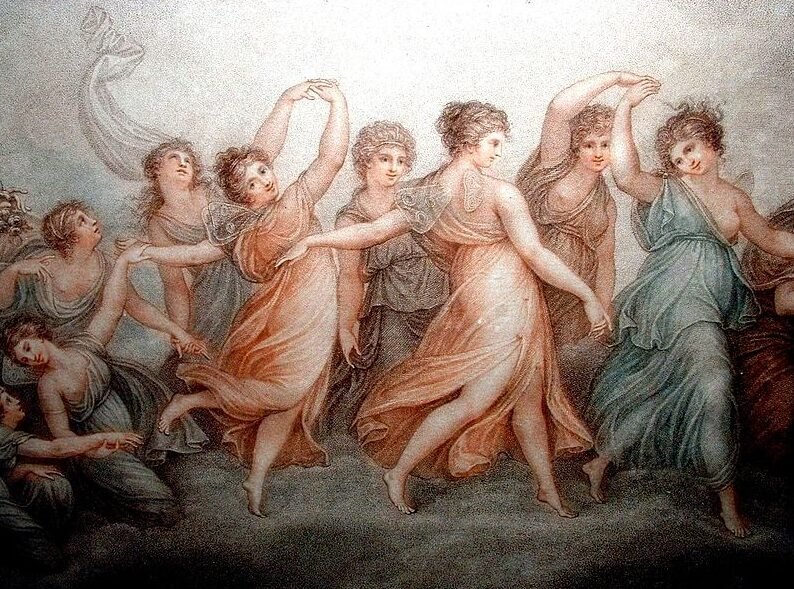
Image: This stipple engraving, “The Hours” by Bartolozzi was published in April 1788.
What was significant about Bartolozzi’s move to London in 1764?
His move marked the beginning of his most productive period, during which he became instrumental in popularizing the “crayon” method of stipple engraving in England.
He collaborated with artists like Giovanni Battista Cipriani and Angelica Kauffman. His engravings were highly sought after for their delicate quality, appealing to the English aristocracy and art collectors.
What role did Bartolozzi play in the development of printmaking in England?
He significantly influenced British engravers by introducing new techniques and elevating engraving from merely a reproductive craft to an esteemed art form.
Why did Bartolozzi move to Lisbon in 1802, and what position did he assume there?
At the age of 75, he accepted an invitation to become the director of the National Academy of Lisbon in Portugal, aiming to reform the royal press and oversee the production of an illustrated edition of “The Lusiads.”
Due to his advanced age, he delegated much of the work to his students, but his expertise and guidance significantly impacted the Portuguese artistic community.
What financial difficulties did Bartolozzi face in his later years?
Despite his fame, he faced mounting debts that forced him to sell many of his prints and personal possessions, and he struggled to secure financial stability until his death.
When and where did Francesco Bartolozzi die, and how was he buried?
He died on March 7, 1815, in his studio in Lisbon, Portugal. He was buried in a common grave at a local church, a modest end for an artist of his stature.
What is the lasting legacy of Francesco Bartolozzi in the art world?
His legacy endures through his contributions to the art of engraving. His innovative techniques and commitment to excellence influenced both contemporaries and future generations, elevating the status of engravers and expanding the possibilities of the medium.





