The Berlin Painter: History and Major Facts
The Berlin Painter remains one of the most influential and enigmatic figures in ancient Greek vase painting. Active during the late Archaic and early Classical periods, approximately between 490 and 460 BC, his work epitomizes the artistic transition that characterized early 5th century BC Athens.
The Berlin Painter’s era was marked by significant socio-political changes, including the rise of democracy and the aftermath of the Persian Wars, which profoundly influenced artistic expression. The painter’s contributions not only reflect these societal shifts but also played a pivotal role in shaping the aesthetic and technical developments of Greek ceramics.
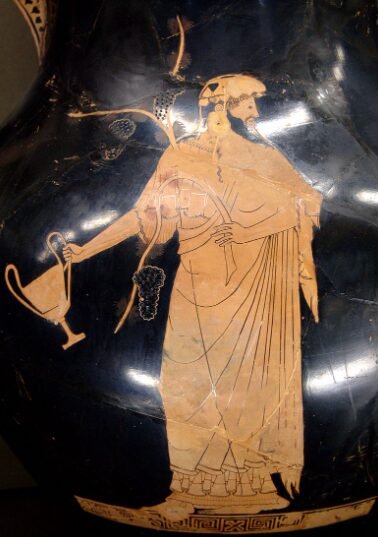
The Berlin Painter, active circa 490–460s BC, is the name assigned to a prominent Attic Greek vase-painter renowned for his exceptional talent in the early 5th century BC. Image: Dionysos holding kantharos (drinking cup) on Side A of Attic red-figure amphora, c. 490-480 BC, Vulci, Italy.
Early Career and Artistic Environment
The Berlin Painter emerged in a vibrant artistic environment where vase painting was a prominent medium for both functional and decorative purposes.
Athens, the heart of Attic pottery, was experiencing a flourishing of arts, driven by economic prosperity and cultural exchanges with other regions, particularly Italy and the wider Mediterranean. This period saw the red-figure technique, which allowed for greater detail and realism compared to the earlier black-figure style, gain widespread popularity.
The Berlin Painter adeptly mastered and refined this technique, pushing its boundaries to achieve unprecedented levels of detail and expressiveness.
Technical Innovations and Style
One of the Berlin Painter’s most significant contributions lies in his technical innovations. He perfected the red-figure technique, which involved painting the background black while leaving the figures in the natural red color of the clay. This method enabled finer lines and more intricate details, allowing for greater realism in human anatomy, drapery, and facial expressions.
The Berlin Painter’s figures are distinguished by their dynamic poses and fluid lines, which convey movement and vitality. His use of dilute glazes to add subtle red tones introduced a nuanced depth to his compositions, enhancing the visual richness of his vases.
Additionally, the Berlin Painter developed unique decorative patterns that bordered his figures, featuring alternating meander boxes and saltire squares. These patterns not only framed his subjects elegantly but also became a signature element that identified his work and influenced his contemporaries and students.
Thematic Diversity and Symbolism
The Berlin Painter exhibited remarkable versatility in his choice of themes, ranging from mythological narratives to everyday life and athletic competitions.
His vases often depicted gods, heroes, and mythological creatures, reflecting the rich tapestry of Greek mythology. Scenes involving Hermes, satyrs, and Dionysian figures are particularly prevalent in his work, showcasing his ability to capture the divine and the whimsical with equal finesse.
These mythological depictions were not merely decorative but also served as storytelling devices, conveying complex narratives and cultural values.
Moreover, the Berlin Painter also portrayed scenes of athleticism and competition, which were significant aspects of Greek culture. These depictions celebrated human excellence and the physical prowess that were highly valued in Athenian society.
By illustrating athletes in dynamic poses, he highlighted the Greek ideal of arete (excellence) and the competitive spirit that drove both individuals and the polis (city-state) towards greatness.
Economic and Cultural Impact
The extensive distribution of the Berlin Painter’s works, particularly in Italy, underscores his significant economic and cultural impact.
His vases were highly sought after in the Italian markets, reflecting the thriving trade networks between Athens and Magna Graecia (the coastal areas of Southern Italy inhabited by Greek settlers).
The presence of his vases in elite necropoleis such as Vulci and Nola indicates their status as prestigious grave goods, symbolizing wealth, cultural sophistication, and social status. This widespread export not only enhanced the Berlin Painter’s reputation but also facilitated the dissemination of Athenian artistic styles and cultural motifs across the Mediterranean.
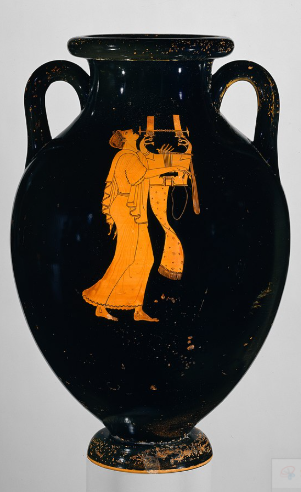
Most of the Berlin Painter’s works were found in Italy, suggesting they were exported and valued as elite grave goods in Magna Graecia and Etruria, particularly at the Etruscan city of Vulci, and Locri. Image: Kithara player, c. 490 BC
Influence on Successive Artists and Workshops
The Berlin Painter’s influence extended beyond his own prolific output through his role as a mentor and workshop leader. He trained numerous younger vase painters, including the renowned Achilles Painter, who inherited and expanded upon his stylistic legacy.
The Berlin Painter’s workshop became a center of artistic excellence, fostering a generation of artists who continued to innovate and elevate Attic vase painting. His techniques, decorative patterns, and thematic preferences were perpetuated and adapted by his students, ensuring the longevity of his artistic vision.
Throughout his career, the Berlin Painter trained many younger painters, including likely the Achilles Painter.
This mentorship contributed to the evolution of the red-figure style, as subsequent artists built upon the Berlin Painter’s foundation to explore new narrative complexities and technical refinements. The collaborative environment of his workshop facilitated the exchange of ideas and techniques, fostering a dynamic artistic community that drove continuous improvement and creativity in Greek ceramics.
Legacy and Historical Significance
The Berlin Painter’s legacy is evident in the enduring admiration for his work among art historians and collectors. His vases are considered masterpieces of ancient Greek art, celebrated for their technical precision, aesthetic beauty, and narrative depth. The Berlin Painter set high standards in vase painting, influencing not only his immediate successors but also the broader trajectory of Western art. His ability to blend technical mastery with expressive storytelling serves as a benchmark for artistic excellence.
The Berlin Painter’s significant contributions to Attic red-figure pottery, his mastery of form and narrative, and his role as a mentor to future artists solidify his place as a central figure in ancient Greek art.
Furthermore, the Berlin Painter’s work provides valuable insights into the cultural and social dynamics of ancient Athens. His depictions of mythology, athleticism, and everyday life offer a window into the values, beliefs, and practices of his society. By studying his vases, historians and archaeologists can glean information about the religious rituals, social hierarchies, and aesthetic preferences that shaped Athenian life.
Preservation and Modern Appreciation
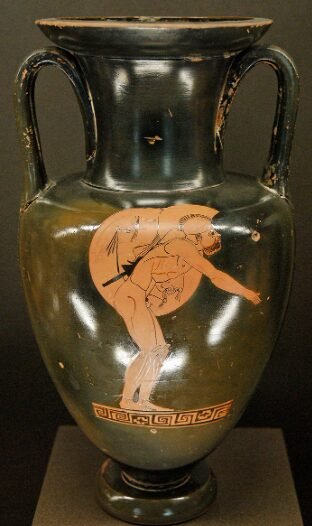
Although none of his works bear signatures, over 400 vases and fragments are attributed to him, highlighting his significance. Educated by a Pioneer Group member alongside his rival, the Kleophrades Painter, he adopted red-figure painting and advanced from the Late Archaic to the Classic Attic style. Image: Neck amphora depicting an athlete running the hoplitodromos by the Berlin Painter, c. 480 BC, Louvre
Many of the Berlin Painter’s works have been preserved and are housed in prominent museums worldwide, including the Antikensammlung Berlin and the Metropolitan Museum of Art. These collections ensure that his artistry continues to be accessible to contemporary audiences, allowing ongoing appreciation and scholarly study. The Berlin Painter’s works are frequently featured in exhibitions and academic research, highlighting their significance in the canon of ancient art.
In modern times, the Berlin Painter is celebrated not only for his technical skills but also for his ability to convey complex narratives and emotions through his art. His vases are admired for their harmonious compositions, intricate details, and the seamless integration of decorative and narrative elements. This blend of beauty and storytelling makes his work a timeless testament to the artistic achievements of ancient Greece.
Frequently Asked Questions
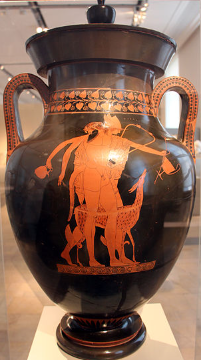
The Berlin Painter was an eminent Attic Greek vase-painter active circa 490–460 BC, recognized as one of the foremost artists of the early 5th century BC. Image: Berlin Painter’s namepiece
How did the Berlin Painter get his name?
The painter was named by famed English archeologist and art historian Sir John Beazley after a prominent lidded amphora in the Antikensammlung Berlin. The Berlin Painter is celebrated for his exceptional skill in red-figure and black-figure techniques, with over 400 attributed vases and fragments showcasing his mastery and influence.
What is the Berlin Painter’s “name vase” and what does it depict?
The “name vase” of the Berlin Painter is a large lidded amphora housed in the Antikensammlung Berlin (Number SL 474). On Side A, it depicts Hermes and a satyr, with Hermes holding a kantharos, kerykeion, and oinochoe, and the satyr playing a barbiton. A fawn stands between them, all set against a glossy black background. Side B features another satyr with a kantharos and lyre, adorned with ivy leaves, grape bunches, and a unique running spiral groundline.
What are the distinguishing features of the Berlin Painter’s artistic style?
The Berlin Painter is known for his meticulous attention to drapery and facial details, particularly the expressive eyes that are open, elongated, and positioned with pupils toward the inner eye. He utilized a dilute glaze technique to add subtle red tones and developed unique key patterns with alternating meander boxes and saltire squares. His figures are often isolated or paired without elaborate framing, set against a glossy black background.
Which mythological figures and themes are most commonly depicted by the Berlin Painter?
The Berlin Painter frequently depicted mythological figures such as Hermes and satyrs, along with themes involving fawns and Greek animals. His repertoire also included a variety of mythological narratives and athletic scenes, showcasing his versatility in portraying both divine and human subjects with emotional depth and narrative clarity.
What types of vase forms did the Berlin Painter prefer and contribute to popularizing?
The Berlin Painter favored the amphora as his most popular vase shape, particularly Panathenaic amphorae, which are his only black-figure vases. He also painted Nolan amphorae, significantly contributing to their popularity. His preference for these forms is evident in his extensive body of work, which includes a variety of shapes tailored to different thematic and functional purposes.
How did the Berlin Painter influence subsequent generations of vase-painters?
The Berlin Painter trained numerous younger vase-painters, including the famous Achilles Painter, thereby propagating his stylistic legacy. His unique key patterns and glaze techniques became hallmarks adopted by his students, ensuring his influence extended well beyond his own creations. The meticulous craftsmanship and innovative styles developed in his workshop set standards for future generations.
What is the significance of the “Kithara Player and Singer” by the Berlin Painter?
The “Kithara Player and Singer,” held at the Metropolitan Museum of Art, is a masterpiece attributed to the Berlin Painter. It demonstrates his ability to harmonize the curves of the musical instrument with the vase’s shape and depict fabric that appears to undulate with musical rhythm. The figure, crowned with laurel leaves, signifies victory in a musical competition, while the reverse side features a judge or trainer. Dated to circa 490 BC, it reflects contemporary historical events like the Battle of Marathon, adding narrative depth and contextual significance.
Where have most of the Berlin Painter’s works been found and what does this indicate about his vases?
The majority of the Berlin Painter’s works have been discovered in Italy, particularly in necropoleis of Magna Graecia and Etruria, including regions like Vulci, Nola, and Locri. This suggests that his vases were widely exported and highly valued in the Italian market, often preserved as elite grave goods. The distribution and preservation of his works in these areas indicate the esteemed status and high regard for his artistry beyond Athens.