Life and Major Works of Swiss Painter Henry Fuseli
Henry Fuseli (1741–1825) was a Swiss painter, draughtsman, and writer who became a significant figure in the art world during the late 18th and early 19th centuries.
Best known for his vivid imagination and dramatic depictions of supernatural scenes, Fuseli’s works often explore themes of horror, fantasy, and the sublime. His most famous painting, The Nightmare (1781), exemplifies his fascination with the eerie and the uncanny.
Throughout his career, Fuseli produced over 190 paintings and approximately 780 drawings, leaving a lasting impact on the Romantic movement and influencing artists such as William Blake.
Early Life and Education
Born Johann Heinrich Füssli on February 7, 1741, in Zürich, Switzerland, Fuseli was the second of 18 children in a family that valued art and education. His father, Johann Caspar Füssli, was a respected portrait and landscape painter who also authored a comprehensive book titled Lives of the Helvetic Painters, documenting the biographies of Swiss artists. Growing up in an environment that appreciated artistic pursuits, Fuseli was exposed to the world of art from an early age.
Despite his artistic inclinations, Fuseli was initially destined for a career in the church. His parents enrolled him in the Caroline College in Zürich, where he received a classical education that included studies in theology, philosophy, and languages. It was here that he met Johann Kaspar Lavater, a fellow student who would become a lifelong friend and a renowned poet and physiognomist. The two shared intellectual interests and engaged in discussions on literature, art, and moral philosophy.

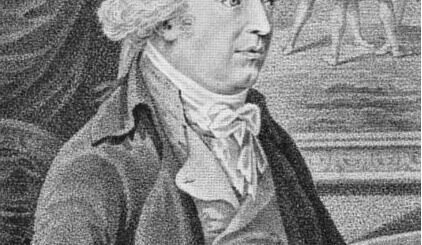
Image: A portrait of Henry Fuseli by British painter James Northcote.
Exile and Early Travels
After being ordained as a minister in 1761, Fuseli’s life took an unexpected turn. He and Lavater became involved in exposing the corrupt practices of a local magistrate who was abusing his power. Their efforts to bring justice led to retaliation from the magistrate’s influential family, putting their safety at risk. Faced with potential persecution, Fuseli was compelled to leave Switzerland to avoid retribution.
Fuseli embarked on a journey through Germany, using his time to explore new cities and immerse himself in different cultural experiences. During this period, he honed his language skills and engaged in various literary activities. In 1765, he arrived in England, settling in London. Initially, Fuseli supported himself through writing, producing translations and literary critiques. His proficiency in multiple languages—German, French, Italian, and English—allowed him to contribute to the intellectual community in London.
Transition to Art
While in England, Fuseli’s artistic talents began to draw attention. He met Sir Joshua Reynolds, a prominent English painter and the first president of the Royal Academy of Arts. Impressed by Fuseli’s drawings, Reynolds encouraged him to pursue a career in art, recognizing his potential to make significant contributions to the field. Taking this advice to heart, Fuseli decided to dedicate himself entirely to painting.
In 1770, Fuseli embarked on a transformative journey to Italy to study the works of the Renaissance masters. This sojourn lasted eight years and proved pivotal in shaping his artistic style and vision. Immersed in the artistic heritage of Rome and other Italian cities, he studied the techniques of Michelangelo, Raphael, and other great artists. Fuseli was particularly drawn to the dramatic compositions and anatomical precision of Michelangelo’s work, which would heavily influence his own approach to depicting the human form.
During his time in Italy, Fuseli changed his surname from the Germanic “Füssli” to the more Italianate “Fuseli,” reflecting his deep connection to the country and its artistic traditions. He also formed friendships with other artists, such as the Scottish painter Alexander Runciman and the Swedish sculptor Johan Tobias Sergel. These relationships enriched his artistic perspective and broadened his network within the European art community.
Return to England and Professional Success
Fuseli returned to England in 1779, stopping briefly in Zürich to visit family and friends. Upon his arrival in London, he found the art scene vibrant and full of opportunities. Alderman John Boydell, a prominent publisher and entrepreneur, was in the process of establishing the Shakespeare Gallery—a project aimed at commissioning paintings based on scenes from William Shakespeare‘s plays. Recognizing Fuseli’s talent for dramatic and emotive imagery, Boydell commissioned him to contribute to the gallery. Fuseli produced several works for this project, further establishing his reputation as an artist capable of bringing literary scenes to life.
Around the same time, Fuseli assisted the poet William Cowper with translations of Homer’s epics, combining his literary interests with his artistic pursuits. His involvement in such interdisciplinary projects showcased his versatility and deep appreciation for both visual and literary arts.
In 1788, Fuseli married Sophia Rawlins, who had been one of his models. Their marriage provided personal stability, although Fuseli’s relationships with women were often complex. That same year, he was elected as an associate member of the Royal Academy of Arts, and two years later, in 1790, he became a full academician. His diploma work, Thor Battering the Midgard Serpent, exemplified his fascination with mythological themes and showcased his skill in portraying powerful, dynamic figures.
Personal Life and Relationships
Fuseli’s personal life was marked by intense relationships and intellectual connections. One notable association was with Mary Wollstonecraft, the early feminist writer and philosopher. Fuseli had painted her portrait, and the two developed a close friendship based on mutual respect for each other’s work. Wollstonecraft proposed that they travel to Paris together, an idea that Fuseli’s wife, Sophia, vehemently opposed. The situation led to a rift, and Fuseli distanced himself from Wollstonecraft, allegedly expressing disdain for “clever women,” whom he found troublesome.
Despite this incident, Fuseli remained connected to a circle of radical thinkers and writers who gathered at the home of publisher Joseph Johnson. This group included figures like Thomas Paine, William Godwin, Joseph Priestley, and Erasmus Darwin. Fuseli’s engagement with these intellectuals reflected his broad interests beyond painting, encompassing philosophy, politics, and literature.
Academic Roles and the Milton Gallery
In 1799, Fuseli was appointed Professor of Painting at the Royal Academy, a position that allowed him to influence aspiring artists and shape the direction of British art education. He was known for his passionate lectures and emphasis on imagination and expression in art. In 1804, he became the Academy’s Keeper, responsible for overseeing the Royal Academy Schools and the training of students. He held both positions concurrently from 1810 until his death in 1825.
That same year, Fuseli embarked on an ambitious project known as the Milton Gallery. Inspired by the works of the English poet John Milton, particularly Paradise Lost, Fuseli aimed to create a series of large-scale paintings that would visually interpret Milton’s epic narratives. Over nine years, he produced 47 paintings for the gallery, pouring his creative energy into depicting scenes of cosmic battles, fallen angels, and the profound themes of good and evil.
Despite the artistic merit of these works, the Milton Gallery was not a commercial success. The public’s reception was lukewarm, and the exhibition closed in 1800 without generating significant financial returns. Nevertheless, the project demonstrated Fuseli’s dedication to his artistic vision and his willingness to undertake grand endeavors.
Artistic Style and Influence
Fuseli’s artistic style is characterized by its dramatic intensity, dynamic compositions, and focus on the supernatural and fantastical. He believed that art should evoke strong emotions and that exaggeration was necessary to convey the grandeur of historical and mythological subjects. His figures often display exaggerated musculature and are depicted in bold, contorted poses that heighten the sense of movement and tension.
A master of chiaroscuro, Fuseli skillfully used light and shadow to create stark contrasts that enhance the mood of his scenes. His palette was not particularly noted for vibrant colors; instead, he relied on tonal variations to achieve depth and atmosphere. Unconventional in his techniques, Fuseli sometimes mixed pigments directly on the canvas and did not adhere strictly to traditional methods. He rarely used live models, preferring to draw inspiration from classical sculptures and the works of Renaissance artists.
The Nightmare and Notable Works
The Nightmare (1781) is undoubtedly Fuseli’s most famous painting and serves as a quintessential example of his thematic and stylistic approach. The work portrays a woman sprawled across a bed in a deep sleep, while a demonic incubus crouches on her chest and a ghostly horse’s head emerges from behind a curtain. The painting captures the unsettling realm between sleep and wakefulness, embodying themes of subconscious fears and eroticism. Its ambiguous narrative invites various interpretations, contributing to its enduring fascination.
Other significant works by Fuseli include:
- Thor Battering the Midgard Serpent (1790): Depicting a scene from Norse mythology, this painting showcases Fuseli’s ability to portray heroic figures in action-packed compositions.
- Titania and Bottom (1790): Inspired by Shakespeare’s A Midsummer Night’s Dream, the piece highlights Fuseli’s interest in literary subjects and his talent for visual storytelling.
- The Oath of the Rütli (1779–1780): Reflecting his Swiss heritage, this painting illustrates the legendary founding of the Swiss Confederation.
Literary Contributions and Intellectual Engagements
Beyond his visual art, Fuseli was an accomplished writer and intellectual. He contributed essays and art reviews to the Analytical Review, engaging in critical discussions about art theory and aesthetics. His multilingual abilities allowed him to translate works and participate in literary circles across Europe.
Fuseli’s connections with prominent intellectuals of his time positioned him at the intersection of art, literature, and politics. The gatherings at Joseph Johnson’s home provided a forum for exchanging ideas on radical political thought, the Enlightenment, and emerging Romantic sensibilities. Fuseli’s interactions with figures like William Blake influenced his own work and helped disseminate his ideas within artistic communities.
Later Years and Teaching Legacy
In 1817, the renowned Italian sculptor Antonio Canova facilitated Fuseli’s election to the Accademia di San Luca in Rome, recognizing his contributions to the art world. Back in England, Fuseli continued to teach at the Royal Academy, mentoring a new generation of artists. His students included:
- David Wilkie: Known for his genre paintings depicting Scottish life.
- Benjamin Haydon: A historical painter and writer who advocated for grand historical subjects in British art.
- William Etty: Celebrated for his nudes and historical scenes.
- Edwin Landseer: Famous for his animal paintings and sculptures, including the lions at the base of Nelson’s Column in Trafalgar Square.
Fuseli’s influence extended to William Blake, who admired his imaginative compositions and incorporation of mythological themes. Blake’s own work shares a visionary quality with Fuseli’s, emphasizing the role of imagination in art.
Death and Posthumous Recognition
Henry Fuseli passed away on April 17, 1825, at the age of 84, at the home of the Countess of Guilford on Putney Hill in London. His death marked the end of a prolific and influential career. Fuseli was buried in the crypt of St. Paul’s Cathedral, a significant honor reflecting his status in the British art community.
At the time of his death, Fuseli was financially stable, having managed his earnings and maintained a successful career despite occasional commercial setbacks like the Milton Gallery. His works continued to be studied and appreciated by artists and scholars, although public interest fluctuated over time.
Legacy and Impact
Henry Fuseli’s legacy lies in his bold exploration of the human psyche, the supernatural, and the power of imagination. His rejection of strict adherence to classical norms in favor of expressive freedom paved the way for the Romantic movement in art. Fuseli’s emphasis on emotion, individuality, and the exploration of darker themes challenged the conventions of his time and expanded the scope of artistic subjects.
His teachings at the Royal Academy influenced numerous artists who carried forward his ideas and techniques. Fuseli’s impact is evident in the works of painters who embraced Romanticism and sought to capture the sublime and the emotional depths of human experience.
Today, Fuseli’s paintings are housed in major museums and galleries around the world, including the Tate Britain in London and the Kunsthaus Zürich. His works continue to captivate audiences with their dramatic flair and psychological complexity. The Nightmare, in particular, remains an iconic image in the history of art, symbolizing the intersection of dreams, fears, and the unknown.
Conclusion
Henry Fuseli was a visionary artist whose life and works reflect a profound engagement with the imaginative potential of art. From his early days in Switzerland through his influential career in England, Fuseli consistently pushed the boundaries of artistic expression. His fascination with mythology, literature, and the supernatural allowed him to create a unique body of work that resonates with themes of human emotion and the mysteries of the subconscious.
Frequently Asked Questions

Henry Fuseli was a Swiss painter, draughtsman, and writer known for his dramatic and supernatural subject matter. He was born on February 7, 1741, in Zürich, Switzerland. Image: A sculpture of Fuseli by British artist Edward Hodges Baily.
What was the profession of Fuseli’s father, Johann Caspar Füssli?
Johann Caspar Füssli was a portrait and landscape painter who also authored a book titled Lives of the Helvetic Painters, documenting Swiss artists.
What career was Fuseli originally intended to pursue, and where did he receive his education?
Fuseli was originally intended to pursue a career in the church. He received a classical education at the Caroline College in Zürich.
Johann Kaspar Lavater was a fellow student at the Caroline College who became a renowned poet and physiognomist. He and Fuseli became close friends during their studies.
Why did Fuseli leave Switzerland, and where did he go afterward?
He left Switzerland because he and Lavater exposed the corrupt actions of a local magistrate, leading to retaliation from the magistrate’s influential family. To ensure his safety, Fuseli traveled through Germany and eventually arrived in England in 1765.
In London, he supported himself through various writing endeavors, including translations and literary critiques.
Which prominent English painter encouraged Fuseli to focus on art, and what was the outcome?
Sir Joshua Reynolds, a prominent English painter and the first president of the Royal Academy, encouraged Fuseli to dedicate himself entirely to painting. Following this advice, Fuseli decided to pursue a career in art.
What significant changes did Fuseli make during his stay in Italy from 1770 to 1778?
During his stay in Italy, he immersed himself in studying the works of the great masters and associated with artists like Alexander Runciman and Tobias Sergel. He also changed his surname from Füssli to the more Italian-sounding Fuseli.
What was the Shakespeare Gallery, and what was Fuseli’s involvement in it?
The Shakespeare Gallery was an ambitious project established by Alderman John Boydell to illustrate the works of William Shakespeare through paintings by leading artists. Fuseli contributed several pieces to this collection upon his return to England.
What prestigious positions did Fuseli hold at the Royal Academy of Arts?
Fuseli was elected as an associate member of the Royal Academy of Arts in 1788 and became a full academician in 1790. In 1799, he was appointed Professor of Painting, and later became the Academy’s Keeper, a position he held alongside his professorship from 1810 until his death.
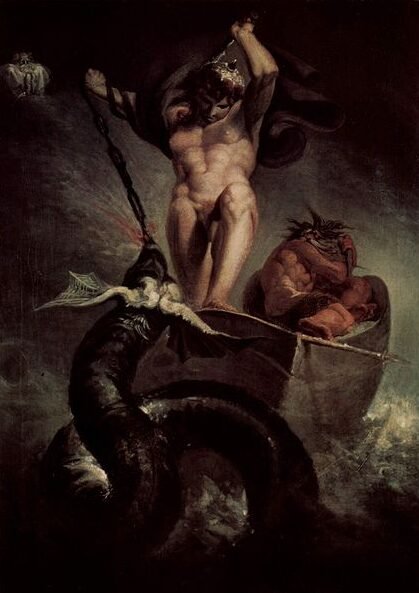
Image: Fuseli’s work entitled “Thor Battering the Midgard Serpent”
What was the Milton Gallery, and what was its outcome?
The Milton Gallery was an ambitious project launched by Fuseli in 1799, inspired by the works of poet John Milton. Over nine years, he created 47 large-scale paintings depicting scenes from Milton’s writings. Unfortunately, the gallery was not a commercial success and closed in 1800.
What is Fuseli’s most famous painting, and what does it depict?
Fuseli’s most famous painting is The Nightmare (1782). It depicts a sleeping woman oppressed by a demonic incubus, with a ghostly horse’s head peering through curtains, exemplifying his interest in the eerie and fantastical.
How did Fuseli contribute to literature and intellectual discourse besides his paintings?
Fluent in German, English, French, and Italian, Fuseli was an accomplished writer and translator. He contributed essays and art reviews to the Analytical Review and engaged in discussions on art, literature, and politics with other intellectuals.
Who were some of the notable artists who were influenced by Fuseli or were his pupils?
Notable pupils and artists influenced by Fuseli include David Wilkie, Benjamin Haydon, William Etty, Edwin Landseer, and William Blake.
When and where did Henry Fuseli die, and where was he buried?
Henry Fuseli died on April 17, 1825, at the age of 84, at the residence of the Countess of Guildford on Putney Hill in London. He was interred in the crypt of St. Paul’s Cathedral.