Life and Reign of Neo-Assyrian Queen Semiramis – According to Diodorus Siculus
Diodorus Siculus, a Greek historian from the 1st century BC, wrote an expansive history called the Bibliotheca Historica. Within this work, he provided an account of Semiramis, a semi-legendary queen of Assyria often surrounded by myth and dramatic embellishments. Diodorus’ narrative offers a mix of historical tradition, legend, and literary elaboration, showcasing Semiramis as a figure of extraordinary power, intelligence, and ambition.
Origins and Early Life
According to Diodorus, Semiramis was born under extraordinary circumstances. Her mother was the goddess Derceto (sometimes associated with the Syrian goddess Atargatis), who abandoned Semiramis as an infant. Raised by doves, she was eventually discovered by a shepherd named Simmas, who adopted her. This divine origin story highlights Semiramis’ destined greatness, situating her within a mythical framework common in ancient accounts of legendary rulers.
Diodorus emphasizes her beauty, intelligence, and charisma from an early age. These qualities would later enable her to rise rapidly in status and power, reflecting an ancient cultural ideal of rulers being exceptional in both physical and mental attributes.

Image: An 18th-century Italian illustration portrays Semiramis as an armed Amazon warrior.
Marriage to Menones
Semiramis’ life took a decisive turn when she married Menones, a general under King Ninus, the founder of Nineveh. Her beauty and brilliance reportedly captivated Menones, who often consulted her on military and political matters.
During the siege of Bactra, a city known for its formidable defenses, Semiramis played a crucial role. Using her strategic acumen, she devised a plan to infiltrate the city, leading to its conquest.
This episode cemented her reputation as a woman of exceptional ability, even in the traditionally male-dominated arenas of war and statecraft. Diodorus uses this moment to foreshadow her future as a ruler who could transcend conventional gender roles.
Marriage to Ninus and Ascension to Power
Semiramis’ intelligence and charisma attracted the attention of King Ninus himself, who fell in love with her. According to Diodorus, Ninus compelled Menones to relinquish her, a decision that led to Menones’ tragic suicide. This dramatic episode underscores Semiramis’ allure and the lengths to which men would go to possess her, though it also reflects the darker dynamics of power and ambition.
Upon marrying Ninus, Semiramis became queen and later took full control after his death. Diodorus describes her as ascending the throne with remarkable decisiveness and skill. She consolidated power swiftly, establishing herself as a capable and authoritative ruler in her own right. Her ascension is presented as both a personal triumph and a broader challenge to traditional gender norms.
Reign and Achievements
Diodorus’ account portrays Semiramis as an exceptional ruler, combining military prowess, administrative skill, and a visionary approach to governance. Key aspects of her reign include:
Founding of Babylon
Semiramis is credited with founding or significantly enhancing Babylon, one of the ancient world’s greatest cities. Diodorus describes her overseeing massive construction projects, including the building of walls, temples, and palaces. She is said to have created the Hanging Gardens, one of the Seven Wonders of the Ancient World, though this attribution is debated among historians.
These achievements reflect not only her administrative genius but also her ability to mobilize vast resources and labor. Diodorus uses these accounts to highlight her legacy as a builder and innovator.
Military Campaigns
Semiramis conducted numerous military campaigns, expanding the Assyrian Empire to unprecedented heights. Diodorus recounts her expeditions into India, a land described as mysterious and formidable. While some details are likely exaggerated or symbolic, these campaigns underscore her ambition and the breadth of her influence.
Her ability to lead armies and conquer distant lands challenged the traditional gender expectations of her time. Diodorus presents her as a warrior-queen, equal in capability to the greatest male rulers.
Governance and Reforms
Semiramis implemented significant administrative reforms, enhancing the efficiency and stability of her empire. Diodorus emphasizes her fairness, wisdom, and dedication to justice, portraying her as a model ruler. Her ability to balance military conquest with effective governance contributed to the long-term strength of her empire.
Mythical and Symbolic Dimensions
Diodorus’ account blends historical elements with myth and legend, elevating Semiramis to a quasi-divine status. Key themes include:
Semiramis’ association with the goddess Derceto reinforces her image as a ruler with divine favor. This connection legitimized her authority and added a supernatural dimension to her accomplishments.
Diodorus highlights Semiramis’ ability to excel in domains traditionally dominated by men, such as warfare and statecraft. Her life symbolizes the potential for exceptional individuals to transcend societal constraints.
In line with classical storytelling, Semiramis’ ambition and power also carry undertones of hubris. While Diodorus does not explicitly condemn her, his narrative suggests that her extraordinary achievements came at a cost, both personal and political.
Death and Legacy
Semiramis’ death is shrouded in mystery and legend. Some accounts suggest she transformed into a dove, symbolizing her divine origins and eternal legacy. Diodorus emphasizes her enduring impact, portraying her as a ruler whose accomplishments and legend would inspire awe for generations.
Her legacy, as presented by Diodorus, is multifaceted. She is celebrated as a brilliant and ambitious leader, yet her life also serves as a cautionary tale about the complexities of power and ambition.
Historical Context and Interpretation
Diodorus’ account of Semiramis must be understood within the broader context of ancient historiography. His narrative reflects both Greek perceptions of the East and the literary traditions of his time.
Key considerations include:
Greek historians often portrayed Eastern rulers, particularly women, as larger-than-life figures. This reflects both fascination and ambivalence about the power dynamics of the East, which was seen as both exotic and threatening.
Diodorus’ blending of fact and fiction is typical of ancient historiography. While some elements of Semiramis’ story may have historical basis, much of it is likely mythologized to emphasize moral and thematic lessons.
The story of Semiramis influenced later traditions, including medieval and Renaissance literature. Her life became a symbol of both the potential and the perils of female leadership.
Conclusion
Diodorus Siculus’ account of Semiramis is a rich and complex narrative, combining historical tradition, myth, and literary artistry. It portrays her as a figure of extraordinary ability and ambition, whose life challenges conventional norms and inspires admiration and reflection. Whether viewed as a historical figure, a mythological archetype, or a literary creation, Semiramis remains a compelling symbol of power, intelligence, and resilience.
Frequently Asked Questions
Who was Semiramis, and how is her story preserved?
Semiramis was a legendary Warrior-Queen of Assyria, whose life and reign are chronicled by the Greek historian Diodorus Siculus in his Bibliotheca Historica. Diodorus draws on earlier sources, including Ctesias of Cnidus, to present a narrative blending historical and mythical elements.
What is the significance of Semiramis’ origins in the narrative?
Semiramis’ origins are portrayed as semi-divine. She was born to the goddess Derceto and a mortal man, abandoned as an infant, and miraculously nurtured by doves. This divine connection emphasizes her destined greatness and positions her as a figure favored by the gods.
What does Semiramis’ name signify, and how does it relate to her myth?
Her name derives from the Syrian word for “doves,” symbolizing her mythical connection to these sacred birds. This association reinforces her divine favor and ties to her miraculous survival as an infant.
How did Semiramis rise to power?
Semiramis married Onnes, a high-ranking Assyrian official, and demonstrated her strategic brilliance during the siege of Bactra. Her success gained the admiration of King Ninus, who married her after forcing Onnes to relinquish her. Following Ninus’ death, Semiramis ascended to the throne, becoming queen regent of Assyria.
What were Semiramis’ major achievements as queen?
Her reign saw the expansion of the Assyrian Empire, monumental construction projects, and administrative reforms. She is credited with enhancing Babylon and possibly constructing the Hanging Gardens. Militarily, she led ambitious campaigns, including an invasion of India.
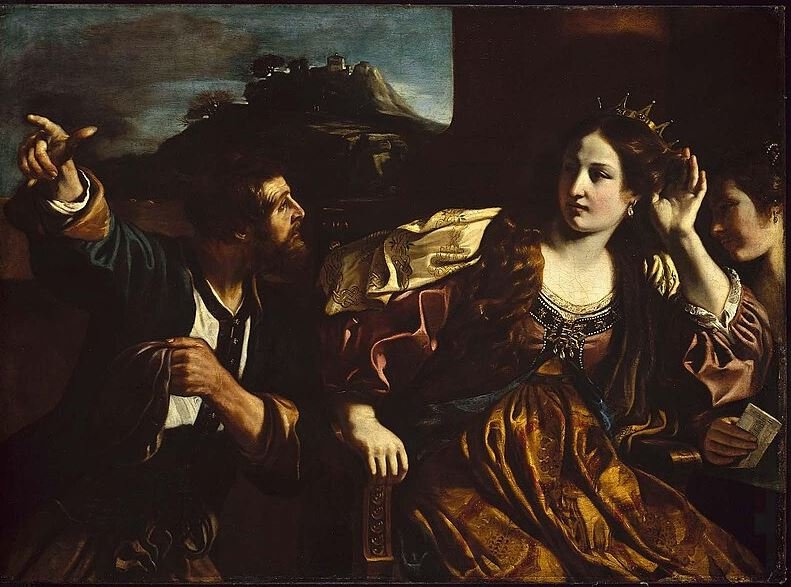
Image: A painting by Italian painter Giovanni Francesco Barbieri titled “Semiramis hearing of the insurrection at Babylon”.
What role did Semiramis play in the founding and development of Babylon?
Semiramis is credited with founding or greatly enhancing Babylon. Diodorus describes her building massive walls, temples, and palaces. While modern scholars debate the accuracy of these claims, her association with Babylon underscores her reputation as a visionary builder.
What is notable about Semiramis’ military campaigns?
She conducted a remarkable campaign against India, leading an army of millions across the Indus River. Despite initial victories, her forces were ultimately defeated. This campaign highlights her ambition and willingness to challenge the empire’s limits.
How did Semiramis strengthen the Assyrian Empire administratively?
Her reign was marked by infrastructure improvements, the construction of extensive roads, and the establishment of trade networks, which enhanced the empire’s prosperity and cohesion.
What symbolic themes does Diodorus emphasize in his account of Semiramis?
Diodorus blends history with myth, portraying Semiramis as a larger-than-life figure who transcended gender roles. Themes of divine favor, ambition, and innovation dominate her narrative, elevating her status as a symbolic ruler.
How did Semiramis’ divine origins influence her reign?
Her connection to the goddess Derceto legitimized her authority and added a supernatural dimension to her reign, reinforcing her image as a ruler destined for greatness.
How did Semiramis challenge traditional gender roles?
Diodorus emphasizes her exceptional qualities, portraying her as equal to or surpassing male rulers in intelligence, military strategy, and governance. Her life demonstrated the potential for women to lead and innovate.
What do the accounts of Semiramis’ death reveal about her legacy?
Her death is shrouded in mystery, with some accounts claiming she transformed into a dove and ascended to the heavens. Others suggest she abdicated in favor of her son, fulfilling a prophecy. These narratives underscore her semi-divine legacy.
Why does Semiramis remain an enduring symbol in history?
Whether viewed as a historical queen, mythical figure, or literary creation, Semiramis embodies ambition, resilience, and transformative leadership. Her legend continues to captivate audiences as a tale of power and innovation.
What does Diodorus’ portrayal of Semiramis suggest about his historical approach?
Diodorus blends historical elements with myth to craft a compelling story, focusing on themes of power and ambition rather than historical accuracy. His account immortalizes Semiramis as a remarkable figure in ancient history.





