Middle Assyrian Empire: History & Major Fact
The Middle Assyrian Empire, which lasted from approximately 1363 BC to 912 BC, marks a crucial era in the history of Assyria. It represents a transitional phase during which the Assyrian civilization evolved from a city-state centered around the city of Assur into a vast territorial empire that exerted influence over much of the Ancient Near East. This period saw significant political, military, and cultural developments, as well as profound changes in Assyria’s administration, society, and religion.
In this detailed exploration, World History Edu examine the key historical milestones, rulers, and developments of the Middle Assyrian Empire, as well as the major factors that contributed to its rise and fall.

The Assyrian Empire
Early Context and Foundation of the Middle Assyrian Empire
The origins of the Middle Assyrian Empire can be traced back to the Old Assyrian period, during which the city of Assur functioned primarily as a city-state and trading center. In this period, Assyria was a minor player in the politics of Mesopotamia, dominated by more powerful neighbors like the Mitanni Kingdom, Babylonia, and the Hittite Empire. The Middle Assyrian period begins around 1363 BC with the accession of Ashur-uballit I, who successfully broke free from the domination of the Mitanni and established Assyria as an independent and expanding kingdom. This achievement set the stage for Assyria’s transformation into a regional power.
Ashur-uballit I’s reign marked the beginning of Assyria’s expansionist policies, which would define much of its history in the Middle Assyrian period. He not only freed Assyria from Mitanni control but also began a series of military campaigns aimed at expanding Assyrian influence. Ashur-uballit I formed diplomatic relations with other great powers of the time, such as Egypt, by marrying his daughter to the Babylonian king. These efforts laid the foundation for Assyria’s eventual emergence as a dominant force in the region.

Amarna letter EA 15 is a royal message from Ashur-uballit I of Assyria to Pharaoh Akhenaten of Egypt.
Expansion under Adad-nirari I, Shalmaneser I, and Tukulti-Ninurta I
Following Ashur-uballit I, several powerful and ambitious rulers continued to expand the Assyrian Empire. One of the most significant early kings of the Middle Assyrian period was Adad-nirari I, who reigned from approximately 1305 to 1274 BC. Adad-nirari I launched military campaigns against the Mitanni kingdom, which was already weakened by internal strife and external pressure from the Hittites. He successfully defeated the Mitanni and brought their territories under Assyrian control, solidifying Assyria’s dominance over northern Mesopotamia.
Adad-nirari I also campaigned against Babylonia, establishing Assyria as a rival to the Babylonian kingdom. His military successes expanded Assyrian territory and helped secure Assyria’s position as a major power in the region. This period of expansion continued under Adad-nirari’s successor, Shalmaneser I, who reigned from approximately 1273 to 1244 BC. Shalmaneser I continued to consolidate Assyrian control over northern Mesopotamia and launched campaigns into the Syrian region, expanding Assyrian influence into new territories.
One of Shalmaneser I’s most notable achievements was the founding of the city of Kalhu (modern-day Nimrud), which would later become one of the major capitals of the Neo-Assyrian Empire. Kalhu was strategically located and served as an important administrative and military center during both the Middle and Neo-Assyrian periods. Shalmaneser I’s reign also saw the construction of significant public works and the expansion of Assyrian infrastructure, which helped facilitate the administration of the growing empire.
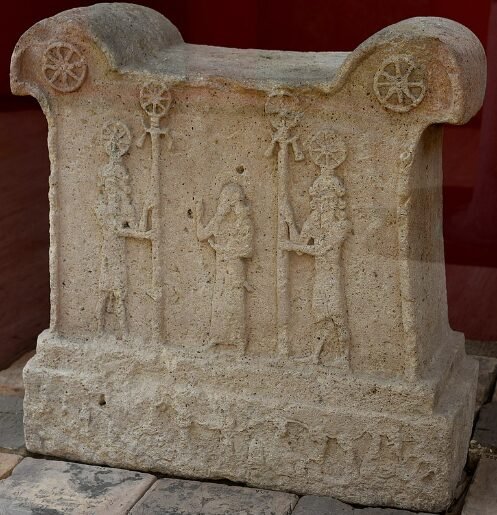
Image: A temple altar from Assur, crafted during the reign of Tukulti-Ninurta I.
The height of the Middle Assyrian Empire’s power was reached under Tukulti-Ninurta I, who reigned from approximately 1243 to 1207 BC. Tukulti-Ninurta I was one of the most ambitious and militarily successful kings of the period. His reign is particularly notable for his conquest of Babylonia, which he subjugated and ruled as part of the Assyrian Empire for several years. Tukulti-Ninurta I’s victory over Babylonia was a significant milestone in Assyrian history, as it demonstrated Assyria’s ability to challenge and defeat one of the most powerful kingdoms of the Ancient Near East.
Tukulti-Ninurta I’s reign also saw the construction of a new capital city, Kar-Tukulti-Ninurta, which he named after himself. This city was intended to serve as a symbol of Assyria’s growing power and to rival the great capitals of other empires. However, despite his military and administrative successes, Tukulti-Ninurta I’s reign ended in turmoil. He was assassinated around 1207 BC, likely as a result of internal power struggles, and his death marked the beginning of a period of decline for the Assyrian Empire.
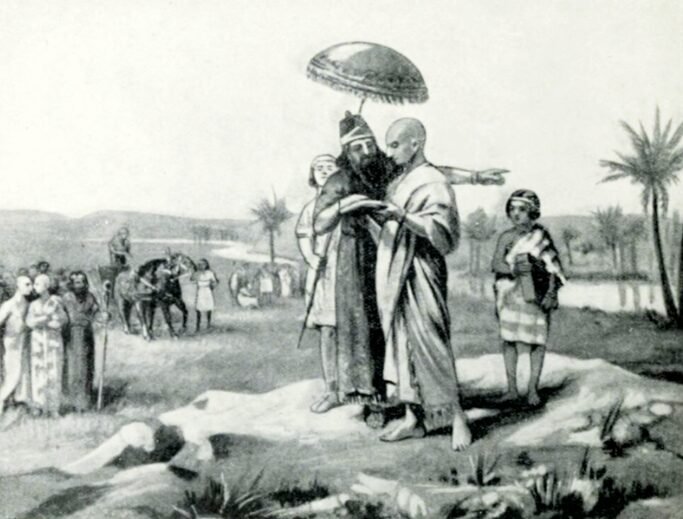
A 20th-century illustration depicting the historical negotiations over the Assyrian-Babylonian border, highlighting the diplomatic interactions between these ancient Mesopotamian powers.
Decline and Dynastic Struggles
The assassination of Tukulti-Ninurta I led to a period of instability and decline for the Middle Assyrian Empire. His death was followed by a series of dynastic conflicts and power struggles that weakened the central authority of the Assyrian state. During this time, Assyria’s territorial control began to shrink, and it faced increasing pressure from external enemies, including the Babylonians and the rising power of the Aramean tribes to the west.
Despite these challenges, some Assyrian kings continued to assert Assyria’s power in the region. Ashur-dan I, who reigned from approximately 1178 to 1133 BC, launched several military campaigns against Babylonia, continuing the long-standing rivalry between the two kingdoms. However, these campaigns did not result in lasting territorial gains, and Assyria remained in a weakened state.
Ashur-resh-ishi I, who reigned from approximately 1132 to 1115 BC, also sought to restore Assyria’s power through military campaigns. His reign was marked by frequent conflicts with Babylonia, and he succeeded in defending Assyria’s core territories from external threats. However, it was under his son and successor, Tiglath-Pileser I, that Assyria experienced a brief resurgence.

Map showing the extent of the Middle Assyrian Empire during the reign of Ashur-resh-ishi I (1132–1115 BC).
Resurgence under Tiglath-Pileser I
Tiglath-Pileser I, who reigned from 1114 to 1076 BC, is widely regarded as one of the greatest military leaders of the Middle Assyrian period. His reign marked a temporary resurgence in Assyrian power and territorial expansion. Tiglath-Pileser I launched a series of successful military campaigns that extended Assyrian influence as far as the Mediterranean coast. His armies defeated the Aramean tribes, who had been encroaching on Assyrian territory, and secured Assyrian dominance over much of northern Mesopotamia and parts of Syria.
Tiglath-Pileser I’s conquests also included campaigns against the Hittites, who had been weakened by internal strife and external pressures. He captured several important cities and regions, further expanding Assyrian territory. Tiglath-Pileser I’s reign is also notable for his efforts to improve Assyria’s infrastructure and administration. He built new fortresses, expanded road networks, and reformed the administrative system to better manage the empire’s growing territories.
However, despite these successes, Tiglath-Pileser I’s reign was followed by another period of decline. After his death in 1076 BC, Assyria once again faced internal and external challenges. His son, Ashur-bel-kala, who reigned from 1073 to 1056 BC, struggled to maintain control over the newly conquered territories, and Assyria began to lose ground to its enemies. The Aramean tribes, in particular, posed a significant threat to Assyrian power, as their invasions disrupted trade and destabilized the empire’s western frontiers.
The Final Decline and Transition to the Neo-Assyrian Empire
The second decline of the Middle Assyrian Empire, which began after the death of Tiglath-Pileser I, was characterized by a loss of territories and increasing instability. The Aramean invasions, combined with internal power struggles, weakened the Assyrian state. Many of the territories that had been conquered by Tiglath-Pileser I were lost, and Assyria’s influence was largely confined to its core regions around the city of Assur.
Despite these challenges, the decline of the Middle Assyrian Empire was not permanent. In the early 10th century BC, Assyria began to recover under the leadership of Ashur-dan II, who reigned from approximately 934 to 912 BC. Ashur-dan II focused on restoring Assyria’s control over its former territories and rebuilding its military and administrative strength. His efforts marked the beginning of a new phase in Assyrian history—the Neo-Assyrian Empire, which would go on to become one of the most powerful empires in the ancient world.
Ashur-dan II’s reign is seen as a transitional period between the Middle and Neo-Assyrian empires. He successfully reconquered many of the territories that had been lost during the previous centuries and restored Assyrian dominance over northern Mesopotamia. His military campaigns were highly successful, and he laid the groundwork for the future expansion of the Neo-Assyrian Empire.
Social, Political, and Religious Developments
In addition to its military and political history, the Middle Assyrian Empire was a time of significant social, political, and religious changes. The transformation of Assyria from a city-state into an empire required new administrative systems and social structures to manage the vast territories under Assyrian control. The Assyrian kings of the Middle Assyrian period became more autocratic, adopting the title of šar (“king”) and asserting their authority over both the state and its people.
During the Old Assyrian period, Assyrian rulers had governed in conjunction with a city assembly made up of influential figures from Assur. However, as Assyria expanded, the role of the king became more centralized, and the power of the city assembly diminished. The Middle Assyrian kings ruled as absolute monarchs, and their authority extended over the entire empire. This shift in governance required the development of new administrative systems, including territorial divisions and a hierarchy of royal officials who managed the empire’s provinces.
The construction of a sophisticated road network was one of the key administrative developments of the Middle Assyrian period. This road system facilitated communication and trade throughout the empire, allowing the Assyrian kings to maintain control over distant territories and to mobilize their armies quickly in times of conflict. The Middle Assyrian period also saw the development of a legal code, known as the Middle Assyrian Laws, which regulated various aspects of daily life, including family law, property rights, and criminal justice.

In the Old Assyrian period, rulers governed alongside a city assembly, holding the title of iššiak (“governor”). During the Middle Assyrian period, Assyrian rulers adopted the title šar (“king”), becoming autocratic monarchs and asserting themselves as equals to the rulers of other great empires. Image: Assyrian King Shalmaneser I pours out the dust of a conquered territory before his god, illustration in Hutchinson’s Story of the Nations
Religiously, the Middle Assyrian period saw important changes in the role of Ashur, the national god of Assyria. In earlier periods, Ashur had been a deified personification of the city of Assur itself, closely associated with agriculture and fertility. However, as Assyria became more militarized and expansionist, Ashur’s character evolved into that of a warrior god. This transformation reflected the changing priorities of the Assyrian state, as military conquest and imperial expansion became central to Assyria’s identity.
Ashur also became equated with the Sumerian god Enlil, who had traditionally been the head of the Mesopotamian pantheon. This syncretism elevated Ashur to a position of supreme authority within the Assyrian religious system, further solidifying the king’s role as both a political and religious leader. The Assyrian kings were seen as the representatives of Ashur on earth, and their military victories were viewed as manifestations of Ashur’s divine will.
READ MORE: Most Famous Myths from Ancient Mesopotamia
Legacy of the Middle Assyrian Empire
The Middle Assyrian Empire left a lasting legacy on the history of Mesopotamia and the Ancient Near East. Its military conquests, administrative innovations, and religious developments laid the foundation for the later Neo-Assyrian Empire, which would go on to dominate the region for centuries. The Middle Assyrian kings, particularly figures like Tukulti-Ninurta I and Tiglath-Pileser I, set important precedents for the centralization of power and the expansionist policies that would characterize Assyrian rule in the future.
The Middle Assyrian Empire also played a key role in shaping the political landscape of the Ancient Near East. Its rivalry with Babylonia, campaigns against the Mitanni and Hittites, and conflicts with the Aramean tribes helped define the power dynamics of the region for centuries. Assyria’s military prowess and strategic location made it a key player in the politics of the time, and its influence extended far beyond its borders.
Conclusion
The Middle Assyrian Empire was a period of significant transformation for Assyria. From its origins as a city-state, Assyria grew into a powerful empire that dominated much of the Ancient Near East.
Its history is marked by periods of both expansion and decline, but throughout it remained a major force in the region. The legacy of the Middle Assyrian Empire is evident in the achievements of the later Neo-Assyrian Empire, which built upon the foundations laid during this earlier period.
Questions and Answers about the Middle Assyrian Empire

The military, administrative, and religious innovations of the Middle Assyrian period had a profound impact on the history of Mesopotamia and the wider world.
When did the Middle Assyrian Empire exist?
The Middle Assyrian Empire existed from approximately 1363 BC to 912 BC.
Who was the founder of the Middle Assyrian Empire, and what was his major achievement?
Ashur-uballit I is considered the founder of the Middle Assyrian Empire. His major achievement was establishing Assyria’s independence from the Mitanni kingdom, transforming it from a city-state into an expanding empire.
What marked the end of the Middle Assyrian Empire?
The Middle Assyrian Empire ended with the death of Ashur-dan II in 912 BC, at a time when Assyria was reclaiming its former dominance, leading into the Neo-Assyrian period.
Which rulers contributed to the expansion of the Middle Assyrian Empire?
Key rulers who contributed to the empire’s expansion include Adad-nirari I, Shalmaneser I, and Tukulti-Ninurta I. These kings launched successful military campaigns that extended Assyrian control over large parts of Mesopotamia.
What was Tukulti-Ninurta I’s most notable accomplishment?
Tukulti-Ninurta I’s most notable accomplishment was his subjugation of Babylonia and the foundation of a new capital, Kar-Tukulti-Ninurta, which demonstrated his ambition to elevate Assyria’s political and military status.
Tukulti-Ninurta I’s assassination around 1207 BC led to dynastic strife, internal power struggles, and a decline in Assyrian influence, which resulted in a period of instability.

Ashur-dan I and Ashur-resh-ishi I are noted for continuing campaigns against Babylonia, maintaining Assyria’s military presence in the region despite the empire’s decline.
Who was Tiglath-Pileser I, and what was his significance to the Middle Assyrian Empire?
Tiglath-Pileser I was a Middle Assyrian king (r. 1114–1076 BC) known for revitalizing the empire through wide-ranging military campaigns that extended Assyrian power as far as the Mediterranean, briefly restoring its dominance.
What led to the second decline of the Middle Assyrian Empire?
The second decline of the Middle Assyrian Empire was caused primarily by invasions from Aramean tribes, which led to the loss of many territories outside Assyria’s core regions.
How did Ashur-dan II contribute to the revival of Assyria?
Ashur-dan II (r. 934–912 BC) focused on restoring Assyrian control over its former territories and reinforcing its presence in peripheral regions, initiating a period of recovery that laid the foundation for the Neo-Assyrian Empire.

During the Middle Assyrian period, Ashur evolved from being a deified representation of the city of Assur into a more powerful deity, equated with the Sumerian god Enlil. As Assyria grew into a militarized empire, Ashur became increasingly associated with war rather than agriculture. Image: The Assyrian sun disk.
What administrative changes accompanied Assyria’s transformation into an empire?
As Assyria grew into an empire, its rulers transitioned from governing with the title iššiak (“governor”) in conjunction with a city assembly to holding the title šar (“king”), which emphasized their autocratic rule. New administrative systems were established, including sophisticated road networks, territorial divisions, and a hierarchy of royal officials to manage the empire’s vast territories.

Kar-Tukulti-Ninurta was a new capital founded by Tukulti-Ninurta I to symbolize Assyria’s growing power. However, it was abandoned after his assassination, reflecting the political instability following his death. Image: Middle Assyrian King Tukulti-Ninurta I





