Louis XIII of France
Louis XIII was King of France from 1610 to 1643 and King of Navarre until 1620, when its crown merged with France. He was known as “Louis the Just.”
Early Life and Ascension to the Throne (1601–1610)
Louis XIII was born on September 27, 1601, at the Palace of Fontainebleau to King Henry IV and Marie de’ Medici. As the eldest son, he was titled Dauphin of France. His early childhood was marked by a strict upbringing under royal governess Françoise de Montglat. Despite being the heir to the throne, he suffered from a speech impediment and a double row of teeth, which affected his communication and public appearances.
On May 14, 1610, King Henry IV was assassinated, and the young Louis, not yet nine years old, ascended to the throne. Given his youth, his mother, Marie de’ Medici, assumed the role of regent, controlling the affairs of state. This period was marked by political instability and factional struggles, setting the stage for Louis XIII’s later assertion of power.

Portrait of Louis XIII.
Regency of Marie de’ Medici (1610–1617)
Marie de’ Medici governed France with the assistance of Italian favorites, particularly Concino Concini. Her administration was unpopular, especially among the French nobility, as she pursued alliances with Spain and neglected domestic governance. Marie confirmed the Edict of Nantes but failed to appease discontented nobles like Henri, Prince of Condé, who staged rebellions.
The turning point came in 1617 when Louis XIII, under the influence of Charles d’Albert, Duke of Luynes, orchestrated the assassination of Concini. With this decisive act, Louis effectively ended his mother’s regency, exiled her to Blois, and began his independent rule.
The Rise and Fall of Charles de Luynes (1617–1621)
Following Concini’s execution, Charles de Luynes became Louis XIII’s closest advisor. However, his governance was marred by incompetence, and he failed to secure lasting stability. Luynes’ handling of the Huguenot rebellion in 1620 proved ineffective. His death in 1621 allowed for a shift in governance, leading to a more balanced administration.
Cardinal Richelieu and Centralized Power (1624–1642)
The defining figure of Louis XIII’s reign was Cardinal Richelieu, who became the king’s chief minister in 1624. Richelieu sought to consolidate royal power by weakening the nobility and suppressing Protestant uprisings. His policies led to the Siege of La Rochelle (1627–1628), a critical battle that curtailed Huguenot military influence while maintaining their religious freedoms.
Richelieu also curtailed private violence among the nobility, banning dueling and private armies. His diplomatic strategy strengthened France against Habsburg Spain and Austria, ensuring the country’s prominence in the Thirty Years’ War.
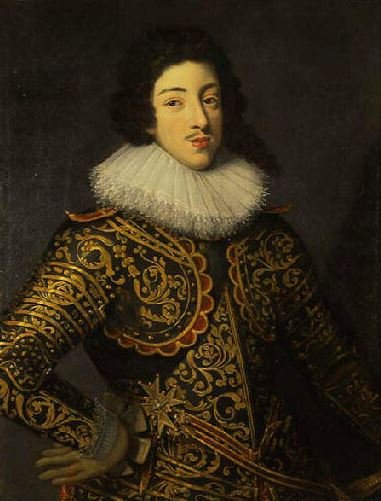
Frans Pourbus the younger’s portrait of Louis XIII.
Military Campaigns and Foreign Policy
Louis XIII’s reign was deeply involved in European conflicts, primarily against Habsburg dominance. Initially hesitant, France entered the Thirty Years’ War in 1635, aligning with Protestant states to counterbalance Spanish power. The war effort, although costly, cemented France’s role as a major European power.
Louis also expanded France’s colonial interests, securing a stronger presence in the Americas, Africa, and Asia. The 1631 Franco-Moroccan Treaty strengthened French trade and political influence in North Africa.
The Strengthening of French Absolutism
One of the most significant aspects of Louis XIII’s rule was the advancement of absolute monarchy. Richelieu’s policies ensured that France became a centralized state, reducing the power of regional governors and fortifying royal authority. The destruction of rebellious noble strongholds symbolized this shift towards a more unified France.
In 1635, Louis and Richelieu established the Académie Française, promoting cultural and linguistic unity. Their efforts also modernized France’s military and infrastructure, paving the way for future expansions under Louis XIV.
Marriage and Succession
On November 24, 1615, Louis XIII married Anne of Austria, the daughter of Philip III of Spain. Their marriage, part of a political alliance, was initially strained. After numerous stillbirths, Anne finally gave birth to a son, Louis-Dieudonné (Louis XIV), in 1638. The birth of an heir was perceived as a miracle, reinforcing the legitimacy of the Bourbon dynasty.
After years of childlessness, Louis XIII and Anne of Austria had Louis XIV in 1638, securing the Bourbon dynasty.
Louis XIII’s relationship with Anne remained distant, and he spent more time with his favorites, including Charles d’Albert and Henri Coiffier de Ruzé, Marquis of Cinq-Mars. His sexuality has been a subject of historical speculation, though no definitive conclusions exist.
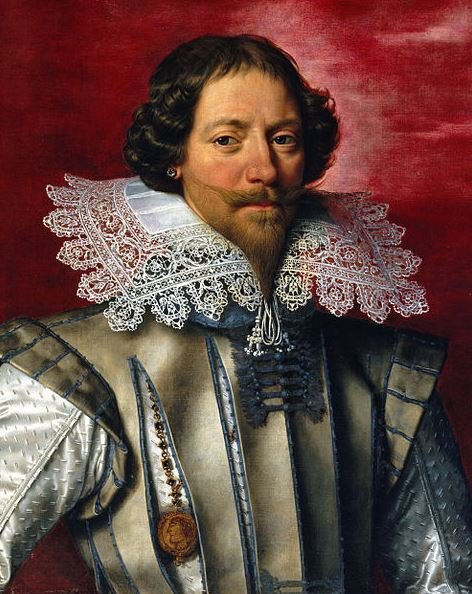
Portrait of Charles d’Albert by Flemish artist Frans Pourbus the Younger.
Cultural Contributions and Fashion
Despite his reserved personality, Louis XIII had a deep appreciation for the arts. He was instrumental in promoting classical music and ballet. His composition of the “Ballet de la Merlaison” in 1635 showcased his artistic inclinations.
The king also revolutionized men’s fashion, popularizing the use of wigs in 1624. This style became a defining feature of European aristocratic fashion for over a century.
Final Years and Death (1642–1643)
Louis XIII’s later years were marked by declining health. He suffered from what modern historians believe was extrapulmonary tuberculosis. As his condition worsened, he prepared for his son’s succession. Richelieu’s death in 1642 deprived him of his most trusted advisor, but his policies ensured the continuation of strong royal authority.
On May 14, 1643, exactly 33 years after his father’s assassination, Louis XIII passed away in Paris. His son, Louis XIV, ascended to the throne under the regency of Anne of Austria and Cardinal Mazarin, ushering in the era of the Sun King.
Legacy of Louis XIII
Louis XIII of France’s reign is often overshadowed by his son’s more illustrious rule, but his contributions to French absolutism, military expansion, and cultural development were pivotal. His partnership with Cardinal Richelieu laid the foundation for France’s golden age, proving that while he may not have been a charismatic ruler, his reign was instrumental in shaping the nation’s future.
His legacy is also preserved in literature and film, most notably in Alexandre Dumas’ The Three Musketeers, where he is depicted as a figure overshadowed by Richelieu. However, historical analyses recognize him as a capable, albeit reserved, ruler who strengthened France’s monarchy and international influence.
Frequently Asked Questions
How did Louis XIII become king?
He ascended the throne in 1610 at the age of eight after the assassination of his father, Henry IV. His mother, Marie de’ Medici, served as regent until he took full control in 1617.
What role did Cardinal Richelieu play in his reign?
Cardinal Richelieu, appointed chief minister in 1624, was the dominant force in government, centralizing power, suppressing noble revolts, and strengthening France’s position in Europe.
What was Louis XIII’s policy toward the Huguenots?
He led military campaigns against the Huguenots, culminating in the Siege of La Rochelle (1628), which ended their political and military autonomy while maintaining religious freedoms.
How did Louis XIII contribute to French culture?
He and Richelieu established the Académie Française, modernized the French navy, and promoted French art and architecture.
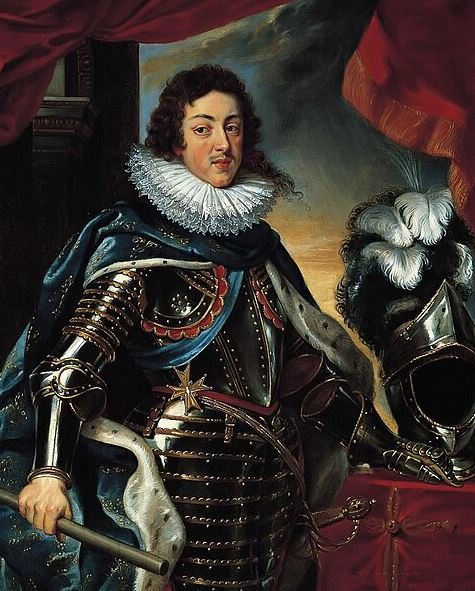
Peter Paul Rubens’ painting depicting Louis XIII.
What were the circumstances of his death?
He suffered from prolonged illness, likely tuberculosis, and died in 1643 at the age of 41, leaving the throne to his five-year-old son, Louis XIV.
How is Louis XIII portrayed in fiction?
Often depicted as overshadowed by Richelieu, he appears in works like The Three Musketeers, where he is shown as indecisive and weak compared to the Cardinal’s cunning.





