Pope Marcellus II
Pope Marcellus II’s papacy was brief yet impactful. A scholar, diplomat, and reformer, he embodied many of the values that the Church sought to uphold during the 16th century. His unwavering commitment to reform, justice, and discipline marked his tenure, even though it was cut short by his untimely death.
Early Life and Background
Marcello Cervini degli Spannocchi, later known as Pope Marcellus II, was born on May 6, 1501, in Montefano, near Macerata in central Italy. He hailed from a noble Tuscan family with origins in Montepulciano, a town that had historically been under both Sienese and Florentine control. His father, Riccardo Cervini, was an esteemed Apostolic Treasurer in Ancona and a close friend of Pope Clement VII. Cervini had two half-brothers, Alexander and Romulus, and was raised in a family that valued scholarship and service to the Church.
Educated in Siena and Florence, he became proficient in Latin, Greek, and Italian, excelling in jurisprudence, philosophy, and mathematics. His father, a believer in astrology, saw a prophecy of ecclesiastical greatness in his son’s horoscope, which played a role in guiding him toward the priesthood.

An engraving depicting Marcellus II. Artwork by Philippe Soye.
Early Career in the Church
Cervini entered papal service in his early years and was part of a delegation from Florence that congratulated Pope Clement VII on his election. Due to his father’s connections, he secured a position as a Scrittore Apostolico in the papal administration. His intellectual abilities led to his involvement in astronomical and calendar studies, an endeavor meant to realign the calendar with seasonal changes.
In 1527, he fled Rome during the Sack of Rome, a traumatic event that deeply impacted the Church and its officials. Upon his return, he entered the household of Cardinal Alessandro Farnese, a future pope. His commitment to the Church deepened, and in 1535, Cervini was ordained as a priest.
Cardinalate and Diplomatic Missions
When Cardinal Farnese ascended to the papacy as Pope Paul III in 1534, Cervini was appointed papal secretary, a role he held for 15 years. This position allowed him to work closely with the pope’s nephew, Cardinal Alessandro Farnese, and to influence Vatican policy.
In 1539, he was named Bishop of Nicastro, although he delayed his episcopal consecration until his papal election. Later that year, while still on a diplomatic mission in the Habsburg Netherlands, Pope Paul III elevated him to the rank of Cardinal-Priest of Santa Croce in Gerusalemme. Over the following years, he served as nuncio in Spain and held administrative positions in the dioceses of Reggio and Gubbio. His residence in Rome became a hub for Renaissance intellectuals, and he maintained correspondence with leading humanists of the period.
Role in the Council of Trent
One of Cervini’s most important contributions to the Church was his participation in the Council of Trent. Alongside Cardinals Reginald Pole and Giovanni Maria Ciocchi del Monte (the future Pope Julius III), he was appointed as one of the council’s three presidents. Throughout Paul III’s papacy, Cervini played a crucial role in upholding Church discipline, orthodoxy, and the authority of the papacy, sometimes clashing with Emperor Charles V over these issues.
In addition to his council duties, Cervini was appointed as the head of the Vatican Library in 1548 or 1550. His tenure saw the acquisition of over 500 new manuscripts, including 143 Greek codices. His meticulous cataloging efforts are preserved in Vaticanus Latinus 3963. During this time, he also promoted the regulation of papal printing, ensuring the quality and authenticity of ecclesiastical publications.
Papal Election and Ascendancy
Following the death of Pope Julius III in March 1555, a conclave was held to determine his successor. The papal election saw tensions between factions supporting French and Imperial interests. After four days of deliberation, on April 9, 1555, Cervini was elected pope.
Unlike most popes who adopted new names upon their election, he retained his birth name, Marcello, and became Pope Marcellus II. This decision marked him as a pope who valued tradition and authenticity. The last pope to do the same was Adrian VI in 1522, and no pope since Marcellus II has followed suit.
Brief Papacy and Reform Efforts
Marcellus II’s papacy lasted only 22 days, but his brief reign demonstrated his dedication to Church reform. His approach to governance was austere and focused on restoring ecclesiastical discipline. Despite the grandeur typically associated with papal inaugurations, he chose a subdued coronation ceremony in observance of Lent.
One of his earliest actions as pope was to decline signing the electoral capitulations agreed upon by the cardinals before his election. Instead, he assured them he would demonstrate his intent through action rather than binding himself through written commitments. He emphasized the necessity of peace among European monarchs and personally wrote to Emperor Charles V and Queen Mary I of England, urging them to uphold stability in Christendom.
Marcellus II also showed a commitment to justice, refusing to grant immediate pardons for serious crimes. When a Spanish ambassador sought absolution for killing a man, the pope declined, stating that his reign should not begin with the absolution of homicide.
Death and Burial
Despite his enthusiasm for reform, Marcellus II’s health rapidly declined due to the strains of the conclave, his rigorous papal duties, and the physical exhaustion of Holy Week observances. He suffered a stroke on April 30, 1555, and fell into a coma. The following day, May 1, he passed away, just 22 days after his election.
Pope Marcellus II’s 22-day reign was the sixth-shortest in history, highlighting how unforeseen events could swiftly change the Church’s leadership.
His remains were interred in the grottoes beneath St. Peter’s Basilica in Vatican City. His untimely death left many of his reformist initiatives unrealized, but his commitment to discipline and simplicity influenced future Church leaders.
Legacy and Cultural Influence
Despite his short reign, Marcellus II’s legacy extended beyond his papacy. His vision of a reformed, disciplined, and principled papacy resonated with later reformers. His successor, Pope Paul IV, would take a much more aggressive approach to reform, but some of Marcellus II’s ideals remained influential in the Counter-Reformation period.
One of the most lasting tributes to Marcellus II is Giovanni Pierluigi da Palestrina’s Missa Papae Marcelli, composed around 1562. This polyphonic masterpiece is often associated with efforts to align sacred music with the principles of the Council of Trent, emphasizing clarity of text and devotion.
Pope Marcellus II also ranks among the shortest-reigning popes in history. His 22-day papacy is the sixth-shortest, reflecting how unexpected circumstances could abruptly alter the course of the Church.
Frequently Asked Questions
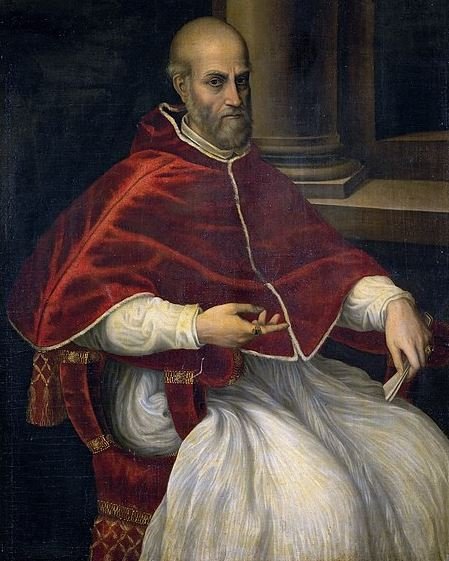
Portrait of Pope Marcellus II.
What was Pope Marcellus II’s birth name?
Marcello Cervini degli Spannocchi.
How long did Pope Marcellus II reign?
22 days, from April 10, 1555, to May 1, 1555.
What was notable about his papal name?
He was the last pope to retain his birth name as his regnal name.
What was his role before becoming pope?
He was Cardinal-Priest of Santa Croce in Gerusalemme and a papal secretary.
What was his involvement in the Council of Trent?
He was one of the three presidents and strongly defended Church orthodoxy and papal authority.
How did he die?
He suffered a stroke on April 30, 1555, and died the next night.
What is his most famous cultural legacy?
Palestrina’s Missa Papae Marcelli is traditionally believed to have been composed in his memory.
Who succeeded him as pope?
Giampietro Carafa, who became Pope Paul IV.





