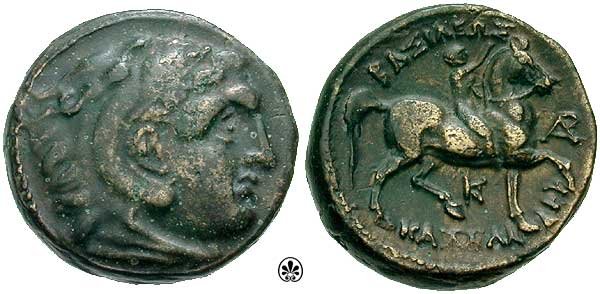
A coin of Cassander, issued after 310 BCE, depicting Alexander or Cassander wearing a lion pelt cloak.
Cassander (c. 355 BC – 297 BC), a prominent figure of the Hellenistic period, played a pivotal role in shaping the post-Alexandrian world. As the son of Antipater and one of Alexander the Great‘s contemporaries, Cassander’s life was marked by ambition, conflict, and a lasting impact on the history of Macedonia and Greece. From his early years as a student of Aristotle to his reign as King of Macedonia, Cassander’s story reflects the complexities of leadership and survival in a tumultuous era.
Early Life and Education
Cassander was born around 355 BC into a prominent Macedonian family. His father, Antipater, was a trusted general and regent under Philip II and Alexander the Great. Cassander’s upbringing provided him with exposure to politics and military strategy. He was educated at Aristotle’s Lyceum in Macedonia alongside Alexander the Great and other notable figures such as Hephaestion, Ptolemy, and Lysimachus. This shared intellectual environment cultivated connections that would later influence the power dynamics of the Hellenistic world.
Despite his prestigious background, Cassander’s early role in Alexander’s court was limited. He first appears in historical records in 323 BC, when he was sent to Babylon by his father, likely to support Antipater’s regency in Macedonia. Some accounts suggest that Cassander harbored resentment toward Alexander, which may have shaped his later actions as a ruler.
Rise to Power: The Wars of the Diadochi
The death of Alexander the Great in 323 BC triggered a power struggle among his generals, known as the Diadochi. Cassander initially played a peripheral role in these conflicts but gradually emerged as a key figure. Following Antipater’s death in 319 BC, the regency of Macedonia passed not to Cassander but to Polyperchon, a decision that sparked tension.
By defeating Polyperchon, besieging Olympias, and eliminating Alexander’s heirs, Cassander cemented his authority and established himself as ruler.
Cassander rejected this arrangement, allying himself with Antigonus, Ptolemy, and Lysimachus to challenge Polyperchon. Through military campaigns, Cassander secured control over key territories. By 317 BC, he had declared himself regent and effectively ruled Macedonia. His decisive actions included besieging Olympias, Alexander’s mother, in Pydna and confining Alexander IV and Roxana, the young heir and widow of Alexander the Great, respectively.
Successor Wars that erupted after the death of Alexander the Great
Consolidation of Power
Cassander’s consolidation of power involved both strategic alliances and ruthless decisions. In 316 BC, he married Thessalonike, Alexander’s half-sister, to strengthen his legitimacy. He also oversaw the burial of Philip III and Eurydice, further associating himself with the Argead dynasty. His founding of cities, such as Thessalonica and Cassandreia, highlighted his focus on infrastructure and economic development.
By 310 BC, Cassander eliminated potential threats to his rule by having Alexander IV and Roxana secretly executed. This act, while securing his authority, cemented his reputation for ruthlessness. He later bribed Polyperchon to eliminate another claimant, Heracles of Macedon, further consolidating his position.
Conflict with the Antigonids
Cassander’s reign was marked by ongoing conflicts with other Diadochi, particularly Antigonus Monophthalmus and his son, Demetrius Poliorcetes. The so-called Four-Years’ War (307–304 BC) saw Demetrius aiding Athens against Cassander, culminating in the creation of a Hellenic League to oppose him. Cassander’s attempts to negotiate peace with Antigonus in 303 BC failed, prompting him to form a coalition with Lysimachus, Ptolemy, and Seleucus.
The decisive confrontation came at the Battle of Ipsus in 301 BC, where Antigonus was defeated and killed. While Cassander did not participate directly in the battle, the outcome solidified his control over Macedonia and ended the immediate threat posed by Antigonus.
Rivalry between Eumenes and Antigonus, Alexander the Great’s generals
Achievements and Urban Development
Cassander’s reign saw significant urban development and efforts to stabilize the Macedonian kingdom. He founded or restored several cities, including:
- Thessalonica: Established in honor of his wife, this city became a vital economic and cultural hub in northern Greece.
- Cassandreia: Built on the ruins of Potidaea, it served as a strategic center for trade and military operations.
- Thebes: Restored by Cassander after its destruction by Alexander, the city symbolized his efforts to rebuild and strengthen key regions.

Thessaloniki and Cassandreia in modern Greece.
These initiatives not only bolstered the kingdom’s economy but also demonstrated Cassander’s pragmatic approach to governance.
Legacy and Controversies
Cassander’s legacy is complex, shaped by his ambitious nature and controversial actions. While he stabilized Macedonia and contributed to urban development, his hostility toward Alexander’s memory set him apart from other Diadochi. Ancient sources recount that Cassander could not pass a statue of Alexander without feeling faint, reflecting his deep-seated animosity.
He was responsible for the deaths of several members of Alexander’s family, including Alexander IV, Roxana, and Heracles. These actions have led to perceptions of Cassander as unscrupulous and power-hungry. However, some historians argue that his decisions were driven more by self-preservation than malice.
Decline of the Antipatrid Dynasty
Cassander’s death in 297 BC marked the beginning of the end for the Antipatrid dynasty. His sons, Philip IV, Antipater II, and Alexander V, were unable to maintain the stability he had achieved. Internal conflicts and external pressures led to the rise of the Antigonid dynasty under Demetrius I, who ousted Cassander’s successors.
Historical Interpretations
Modern historians offer varied interpretations of Cassander’s rule. Some view him as a capable but ruthless leader who prioritized stability over loyalty to Alexander’s legacy. His restoration of Thebes and the establishment of Thessalonica are seen as pragmatic moves that balanced his political ambitions with the needs of the kingdom.
Cassander’s use of coinage to project his authority also highlights his awareness of symbolism and propaganda. Coins minted during his reign often depicted Alexander or Cassander wearing a lion-skin cloak, connecting him to the legacy of the Argead dynasty.
Frequently Asked Questions
What role did Cassander play after Alexander’s death?
Cassander seized power in Macedonia by allying with other Diadochi and eliminating rivals, including Alexander IV and Roxana. He declared himself king in 305 BC.
What cities did Cassander found or restore?
Cassander founded Thessalonica and Cassandreia and restored Thebes, focusing on urban development to strengthen his rule.
What was Cassander’s relationship with Alexander the Great?
Cassander was a student of Aristotle alongside Alexander, but later became hostile to his memory, allegedly feeling faint near Alexander’s statues.
What was Cassander’s role in the Wars of the Diadochi?
He allied with Lysimachus, Ptolemy, and Seleucus against Antigonus and participated in major battles, including the decisive Battle of Ipsus in 301 BC.
What legacy did Cassander leave?
Cassander’s dynasty quickly fell after his death in 297 BC. His urban foundations, like Thessalonica, and contributions to regal iconography endured.





