Major Works of Greek Philosophy
Greek philosophy has profoundly shaped Western thought, offering foundational texts that explore a wide array of subjects, from ethics and politics to metaphysics and aesthetics. In the article below, World History Edu delves into 8 of the most significant works in Greek philosophy, examining their core themes, contributions, and enduring influence.
Plato’s “The Republic”

Central to Greek philosophy is reason and inquiry, driven by deep curiosity and the pursuit of truth about reality and the human condition. Image: Title page to Plato’s “The Republic”.
Exploration of Justice and Ideal Society
Plato’s “The Republic,” written around 380 BCE, is a seminal work in Western political philosophy. Structured as a dialogue primarily featuring Socrates, the text delves into the nature of justice and the characteristics of an ideal state. Plato challenges conventional notions of justice by proposing that it entails each class within society performing its designated role harmoniously.
Tripartite Society and Philosopher-Kings
Plato introduces a tripartite model of society consisting of rulers (philosopher-kings), guardians, and producers. This structure mirrors the tripartite nature of the human soul, divided into the rational, spirited, and appetitive parts. Philosopher-kings, who possess a deep understanding of the Forms, especially the Form of the Good, are deemed the most suitable to govern. Their rule is characterized by wisdom and a commitment to the common good, contrasting with the democratic systems Plato critiques for their susceptibility to demagoguery.
Education and the Theory of Forms
Education is pivotal in Plato’s vision, aimed at cultivating virtue and intellectual excellence. The Republic outlines an extensive educational system to identify and nurture future rulers, emphasizing both intellectual and moral development. Additionally, Plato’s Theory of Forms posits that the material world is a mere shadow of a higher, immutable reality composed of abstract Forms or Ideas, which represent the true essence of various concepts such as justice and beauty.
Enduring Influence
“The Republic” has left an indelible mark on political theory, ethics, and metaphysics. Its concepts of justice, the ideal state, and philosopher-kings continue to inspire debates on governance, leadership, and the role of intellectuals in society.
Plato’s “The Symposium”
Diverse Perspectives on Love
“The Symposium” is a rich dialogue that takes place during a convivial gathering, where various speakers present their perspectives on Eros, the god of love. The speeches range from the humorous to the deeply philosophical, offering a multifaceted exploration of love’s role in human life.

Image: A fresco from the north wall of the Tomb of the Diver in Paestum, Italy (circa 475 BC), depicting a symposium scene.
Socrates and Diotima’s Ladder of Love
Central to the dialogue is Socrates’ discourse, which draws on the teachings of Diotima, a wise woman. He introduces the concept of the “ladder of love,” which ascends from physical desire to the contemplation of the Form of Beauty itself. This ascent symbolizes the soul’s journey toward intellectual and spiritual enlightenment, suggesting that true love fosters personal growth and the realization of one’s higher potential.
Philosophical and Emotional Dimensions
“The Symposium” transcends mere romantic notions, delving into the philosophical implications of love. It explores how love serves as a catalyst for the pursuit of higher knowledge and the appreciation of beauty, intertwining emotional and intellectual dimensions in the human experience.
Influence on Later Thought
The dialogue has significantly influenced subsequent philosophical and literary traditions, shaping concepts of love and beauty in Western thought. Its blend of personal reflection and philosophical inquiry continues to resonate in discussions about the nature of love.
Plato’s “Phaedo”
Meditation on the Soul’s Immortality
“Phaedo” recounts the final hours of Socrates before his execution, presenting a profound meditation on the soul’s immortality and the afterlife. Through conversations between Socrates and his disciples, the dialogue explores the nature of the soul, arguing for its eternal existence separate from the body.
Arguments for Immortality
Socrates presents several arguments supporting the soul’s immortality, including the Theory of Recollection, which suggests that learning is a process of remembering eternal truths, and the Argument from Affinity, which posits that the soul resembles the divine and is thus immortal. These arguments aim to demonstrate that the soul’s existence transcends bodily life.
Relationship Between Body and Soul
“Phaedo” delves into the relationship between the physical and metaphysical realms, asserting that the true essence of a person resides in the soul. This perspective reinforces the importance of philosophical inquiry as a means to purify the soul and prepare it for its continued existence beyond death.
Stoic Influence and Acceptance of Fate
Socrates’ calm acceptance of his fate exemplifies Stoic ideals of maintaining inner tranquility and moral integrity in the face of mortality. His demeanor underscores the philosophical commitment to virtue and reason over fear and despair.
Impact on Metaphysics and Ethics
“Phaedo” has significantly influenced metaphysical and ethical theories, particularly regarding the nature of the soul and the afterlife. Its exploration of the soul’s immortality continues to inspire philosophical and theological debates.
Aristotle’s “Nicomachean Ethics”
Foundation of Aristotelian Ethics
“Nicomachean Ethics,” named after Aristotle’s son Nicomachus, is a foundational text in the study of ethics and moral philosophy. Composed around 340 BCE, it examines the nature of the good life and the means to achieve eudaimonia, often translated as flourishing or well-being.
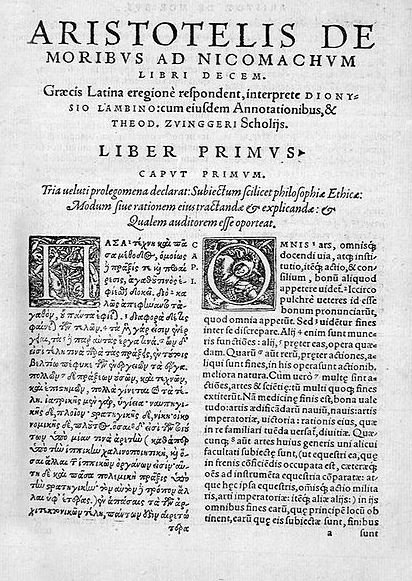
Image: The opening page of a 1566 Greek and Latin edition of “Nicomachean Ethics”.
The Concept of Eudaimonia
Aristotle posits that eudaimonia is the highest human good, attainable through the cultivation of virtues. He defines virtues as traits that balance between extremes of excess and deficiency, embodying the “Golden Mean.” For instance, courage is a virtue lying between recklessness and cowardice.
Moral and Intellectual Virtues
Aristotle categorizes virtues into moral and intellectual. Moral virtues arise from habitual actions that shape character, while intellectual virtues result from teaching and experience. This distinction underscores the importance of both ethical behavior and rational thought in achieving moral excellence.
Role of Reason in Ethical Decision-Making
Reason is central to Aristotle’s ethical framework, distinguishing humans and enabling them to discern and pursue the good. Ethical deliberation involves rational assessment of situations to determine the virtuous course of action, aligning personal behavior with the pursuit of eudaimonia.
Friendship and Community
Aristotle emphasizes the significance of friendship and community in ethical living. Humans are inherently social beings whose well-being is intertwined with their relationships and participation in civic life. “Nicomachean Ethics” presents a comprehensive account of how individuals can achieve moral excellence and contribute to the flourishing of their communities.
Lasting Influence
The text remains a cornerstone in ethical theory, influencing both ancient and modern philosophical thought. Its exploration of virtue ethics continues to inform discussions on moral character and the nature of the good life.
Plato’s “The Apology”
Socratic Defense and Philosophical Integrity
In “The Apology,” Plato presents a detailed account of Socrates’ defense during his trial in Athens, where he faced charges of impiety and corrupting the youth. Rather than pleading for mercy, Socrates uses this platform to articulate his philosophical beliefs and defend his way of life, embodying the principles of integrity and intellectual honesty.

Image: “The apology of Socrates in front of the judges”, a sculpture work by Italian artist Antonio Canova.
Examination of Wisdom and Ignorance
Socrates famously declares that he knows nothing except the fact of his ignorance, positioning himself as a perpetual seeker of knowledge rather than a corrupter of minds. Through his dialectical method, he engages with his accusers and the jury, exposing the superficiality and contradictions in their arguments. This approach underscores the importance of critical self-examination and the relentless pursuit of truth.
Moral and Ethical Standpoint
Socrates’ unwavering dedication to his principles, even in the face of death, serves as a testament to the philosophical life’s integrity. His defense emphasizes the value of individual conscience and moral duty over societal approval, highlighting the ethical responsibilities of individuals within a community.
Legacy of “The Apology”
“The Apology” remains a cornerstone in the study of ethics and political philosophy, illustrating the tension between individual morality and societal norms. Socrates’ stance has inspired countless philosophers to prioritize ethical integrity and the pursuit of knowledge.
Aristotle’s “De Anima”
Exploration of the Soul
“De Anima,” or “On the Soul,” is Aristotle’s profound inquiry into the nature of the soul and its relationship to the body. Written around 350 BCE, this work is foundational in both philosophy and psychology, offering insights into perception, imagination, and intellect.
Hierarchical Structure of the Soul
Aristotle categorizes the soul into different levels:
- Vegetative Soul: Responsible for growth and reproduction.
- Sensitive Soul: Governs perception and movement.
- Rational Soul: Unique to humans, facilitating abstract thought and reasoning.
Form and Function
Aristotle defines the soul as the form of a living being, essential for life and various functions. This perspective emphasizes the interconnectedness of body and soul, rejecting the dualistic separation proposed by other philosophers. The soul cannot exist independently of the body, as it is intrinsically linked to the organism’s functioning.
Faculties of the Soul
“De Anima” examines various faculties of the soul, including:
- Perception: The process by which the soul receives information from the senses.
- Imagination: The ability to form mental images and concepts.
- Intellect: The capacity for abstract thought and reasoning.
Impact on Psychology and Philosophy
Aristotle’s analysis in “De Anima” laid the groundwork for later discussions on the mind-body problem, cognition, and consciousness. His holistic view underscores the complexity of human cognition and the intricate relationship between mental and physical processes.
Enduring Relevance
“De Anima” continues to be a vital text in the study of psychology and philosophy of mind, influencing contemporary debates on the nature of consciousness and the interplay between mental states and physical processes.
Aristotle’s “Poetics”
Foundations of Literary Theory
“Poetics” is Aristotle’s seminal work on literary theory and criticism, focusing primarily on tragedy. Written around 335 BCE, it examines the elements that constitute effective dramatic storytelling, shaping both classical and modern approaches to literature.

Image: A translation of the “Poetics” in Arabic.
Elements of Tragedy
Aristotle identifies key elements that make up a successful tragedy:
- Plot: The coherent and unified storyline with a clear beginning, middle, and end.
- Character: Complex characters who undergo significant change, fostering deeper emotional engagement.
- Diction: The choice of language and style used in the dialogue.
- Thought: The themes and ideas explored in the narrative.
- Spectacle: The visual elements and staging of the performance.
- Song: The musical aspects that accompany the drama.
Concepts of Mimesis and Catharsis
Aristotle introduces the concept of mimesis (imitation), arguing that tragedy is an imitation of an action that is serious, complete, and of a certain magnitude. He also explains catharsis (emotional purification), where tragedy serves to evoke and subsequently purge emotions of pity and fear in the audience, providing a therapeutic experience.
Plot Structure and Unity
Aristotle emphasizes the importance of a well-structured plot, highlighting the need for unity and coherence. He advocates for a tight narrative that maintains tension and leads to a resolution, ensuring that the story remains engaging and impactful.
Influence on Dramatic Arts
“Poetics” has had a profound influence on the development of dramatic arts, informing the techniques of playwrights and literary critics alike. Its principles continue to underpin modern narrative structures and the analysis of literary works.
Lasting Significance
The work remains a foundational reference for understanding narrative techniques and the psychological impact of literature, shaping both classical and contemporary approaches to storytelling and literary criticism.
Diogenes Laertius’ “Lives and Opinions of Eminent Philosophers”
Comprehensive Biographical Compilation
“Lives and Opinions of Eminent Philosophers” by Diogenes Laertius is a crucial biographical and historical account of ancient Greek philosophers. Structured into ten books, it categorizes philosophers into pre-Socratic, Socratic, and Hellenistic periods, providing detailed narratives of their lives, teachings, and contributions.
Biographical and Anecdotal Insights
The work offers a wealth of biographical information, including personal anecdotes, philosophical doctrines, and biographical sketches. It preserves the thoughts and teachings of numerous philosophers, many of whom would otherwise be lost to history.
Coverage of Diverse Philosophical Schools
Diogenes Laertius covers a wide array of philosophical topics, including metaphysics, ethics, epistemology, and political theory. The text reflects the diverse intellectual landscape of ancient Greece, discussing major philosophical schools such as the Stoics, Epicureans, and Academics.
Preservation of Philosophical Thought
Despite criticisms for its occasional inaccuracies and lack of critical analysis, the work remains an invaluable resource for understanding the development of Greek philosophy and the personal histories of its key figures. It preserves anecdotes and quotes that offer insights into the思想 processes and cultural contexts of the philosophers.
Bridge to Modern Scholarship
“Lives and Opinions of Eminent Philosophers” serves as a bridge connecting modern scholars to the rich traditions and debates that shaped Western philosophical thought. Its comprehensive coverage makes it a fundamental text for anyone studying the history of philosophy.
Enduring Value
The compilation’s preservation of diverse philosophical viewpoints and biographical details provides a nuanced understanding of the evolution of philosophical ideas, making it an essential reference for historical and philosophical research.
Conclusion
The eight major works of Greek philosophy discussed—ranging from Plato’s dialogues and Aristotle’s treatises to Diogenes Laertius’ biographical accounts and Plotinus’ Neoplatonic explorations—collectively form a rich tapestry of intellectual thought that has profoundly shaped Western civilization. These texts address fundamental questions about justice, the nature of the soul, ethical living, the structure of reality, and the essence of beauty and love. Their enduring influence is evident in the continued study and application of their ideas in contemporary philosophical discourse, underscoring their timeless relevance and profound impact on shaping human thought and civilization.
Frequently Asked Questions
What is the central theme of Plato’s “The Republic”?
The central theme is the exploration of justice and the delineation of an ideal state, examining how a just society can be structured and the virtues necessary for its rulers and citizens.
How does Plato define justice in “The Republic”?
Plato defines justice as each part of society performing its appropriate role, leading to harmony among the classes, which mirrors the balance within an individual’s soul.
What are the three classes in Plato’s tripartite society?
The three classes are:
- Rulers (Philosopher-Kings): Guided by reason.
- Guardians: Represent the spirited aspect.
- Producers: Correspond to the appetitive aspect.
Who are the philosopher-kings, and why are they important?
Philosopher-kings are rulers who have attained a deep understanding of the Forms, especially the Form of the Good. They are important because they govern based on reason and wisdom, prioritizing the common good over personal gain.
How does Plato contrast his ideal rulers with the democratic systems of his time?
Plato contrasts them by arguing that democratic systems are susceptible to demagoguery and ignorance, whereas philosopher-kings possess the intellectual and moral excellence necessary for just governance.
What role does education play in Plato’s ideal society?
Education is crucial for identifying and nurturing future philosopher-kings. It emphasizes intellectual, moral, and physical development to ensure rulers possess the knowledge and character needed to govern justly.
What is Plato’s Theory of Forms as presented in “The Republic”?
The Theory of Forms posits that the material world is a shadow of a higher, immutable reality consisting of abstract Forms or Ideas, which represent the true essence of objects and concepts like beauty, justice, and equality.
How does the Theory of Forms relate to the concept of justice in “The Republic”?
Understanding the Forms, especially the Form of the Good, is essential for achieving true knowledge and guiding just action, reinforcing the philosopher-king’s role as a seeker of truth.
What is the significance of the harmony among the three classes in society?
Harmony among the classes ensures that each class performs its designated role, leading to a just and well-ordered society, similar to the balance of the rational, spirited, and appetitive parts of the soul.
How does Plato view the relationship between the individual and the state?
Plato views the individual’s well-being as intertwined with the state’s justice. A just state fosters the moral integrity and wisdom of its citizens, while individuals contribute to the common good by fulfilling their societal roles.
What is the role of reason and inquiry in Plato’s ideal society?
Reason and inquiry are fundamental for understanding the Forms and guiding just actions. They ensure that rulers make decisions based on wisdom and the common good rather than personal interests.
How does “The Republic” address the cultivation of virtue?
“The Republic” emphasizes an extensive education system aimed at cultivating both moral and intellectual virtues in individuals, ensuring that rulers and citizens develop the character necessary for a just society.
What criticisms does Plato have of existing political systems in “The Republic”?
Plato criticizes democratic systems for being vulnerable to leaders who prioritize personal gain over the common good and for lacking the intellectual and moral standards necessary for just governance.
How does “The Republic” integrate metaphysical concepts into its political philosophy?
“The Republic” integrates metaphysical concepts through the Theory of Forms, asserting that true knowledge of justice and the good comes from understanding these abstract Forms, which guide the just actions of philosopher-kings and the structure of the ideal state.