Canaan: History, Location, Biblical References, and Major Facts
by World History Edu · December 9, 2024
Canaan was a region of profound cultural, linguistic, and political importance in the ancient Near East. Occupying a strategic area within the Southern Levant, it played a critical role as an intermediary zone linking multiple great powers and trade networks of antiquity.
Its name appears in diverse ancient languages and textual traditions, reflecting extensive international connections. Although it never coalesced into a single unified empire, Canaan’s communities developed sophisticated urban centers, pioneered technological advancements, and participated in long-distance exchange.
Its legacy persisted through various transformations of political authority and cultural identity, ultimately influencing the religious narratives and historical memories of subsequent civilizations.
Prehistoric Foundations and Early Transformations
Before the rise of the earliest city-states, the region that would later become known as Canaan witnessed millennia of human occupation and adaptation. Prior to 4500 BC, local populations shifted from mobile foraging to settled agricultural lifestyles.
They learned to domesticate plants and animals, cultivated cereals, and crafted tools suited to farming and herding. Over time, these communities formed increasingly complex social arrangements, with permanent dwellings replacing temporary campsites.
The process was gradual but transformative: stable food production underpinned population growth and paved the way for craft specialization. Innovations in stone tool manufacture, pottery production, and early social stratification emerged from these pioneering societies.
These foundations made the area attractive to incoming groups, who brought additional skills, cultural norms, and possibly new languages, all converging to shape a region that would become a cultural crossroads.

Canaan was an ancient Semitic-speaking region in the Southern Levant, significant during the Late Bronze Age (around the 14th century BC). Image: Map of Canaan by Scottish mapmaker John Melish.
Chalcolithic Metallurgists and Shifting Settlements
Between roughly 4500–3500 BC, the Chalcolithic era saw remarkable technological innovations in what would be recognized as proto-Canaanite communities.
Skilled metallurgists learned to extract copper from ore deposits, producing tools and ornaments that enriched local economies. Connections with distant cultural spheres introduced novel ideas, as evidenced by stylistic parallels in artifacts.
An advanced metallurgical tradition indicates that these people were neither isolated nor technologically backward; they were instead active participants in knowledge exchange spanning large areas.
Alongside metalworking, settlements grew larger and more complex. Some sites were arranged around communal structures that served as focal points for religious or administrative activities.
By the period’s end, certain coastal zones witnessed the formation of significant urban hubs, anticipating the later city-states for which Canaan would become known.
Urbanization in the Early Bronze Age
The Early Bronze Age (3500–2000 BC) brought about the first true urban centers in the region. Walled cities sprouted in fertile plains, linking agricultural hinterlands with emerging trade routes.
Coastal enclaves and inland towns coordinated the movement of precious commodities, raw materials, and finished goods. Contacts with Egypt, Mesopotamia, and Anatolia became more regular as merchants, travelers, and perhaps emissaries forged lasting ties.
Administrative systems emerged to manage surpluses and labor, while monumental structures, including temples and palaces, demonstrated new forms of authority.
Although these city-states were never unified under a single crown, they established a pattern of interregional diplomacy. Eventually, however, environmental pressures, changes in trade dynamics, or internal conflicts led to partial urban decline.
Some city dwellers returned to simpler village life, reducing political complexity and altering settlement patterns. Nevertheless, the craft traditions and knowledge accrued in this era persisted, influencing future periods.
Middle Bronze Age City-States and International Contacts
From about 2000–1550 BC, Canaan entered a flourishing Middle Bronze Age phase. During these centuries, urban centers regained prominence, growing in scale and complexity.
Independent city-states, each with its own ruling elite, controlled surrounding farmland and specialized industries. Their political landscape was competitive, and military fortifications suggest concerns over security and territorial integrity.
Diplomatic contacts with powers to the north, east, and south intensified, and Canaan became a known entity in the eyes of its neighbors. Rich tomb assemblages reflect rising social stratification, while texts found elsewhere mention Canaan’s name, implying the region was recognized as a distinct cultural-geographic unit.
Interactions with Mesopotamia and other cultural heartlands enriched local traditions, spurring innovations in writing, metallurgy, and governance. Through active participation in regional affairs, Canaan’s polities influenced events beyond their borders, ensuring that their voices and interests featured in the diplomatic tapestries of the era.
Late Bronze Age Under Imperial Shadows
Between 1550–1200 BC, Canaan operated under the watchful gaze of great empires. Egypt asserted suzerainty over much of the southern Levant, stationing garrisons and demanding tribute.
Simultaneously, the Hittites, Mitanni, and eventually Assyria vied for influence in the northern reaches. This imperial competition created an intricate web of alliances, rivalries, and intrigues among Canaanite rulers.
Written correspondence from this period, most famously preserved in the Amarna letters, offers a glimpse into these entanglements. In these texts, Canaanite city leaders communicated with Egyptian pharaohs and other potentates in the lingua franca of Akkadian, revealing disputes, loyalties, and aspirations.
Challenges emerged from groups referred to as Habiru or ‘Apiru, possible mercenaries or mobile communities operating outside established hierarchies. Under imperial oversight, Canaan became a stage for negotiations, conflicts, and power plays.
The nature of rule varied locally: some cities thrived under Egyptian patronage, while others struggled with resource shortages and political uncertainty. Despite such difficulties, Canaan’s strategic position ensured that it remained at the center of imperial strategies.
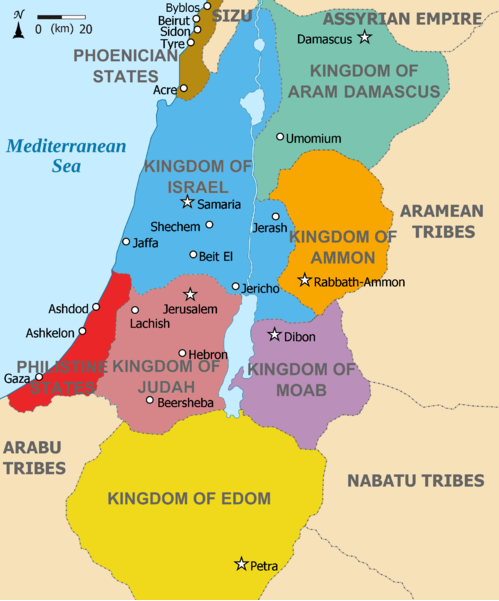
Image: Map highlighting several kingdoms of Levant.
From Bronze to Iron: Change and Adaptation
As the Late Bronze Age ended, multiple factors destabilized the long-standing international order. The so-called Bronze Age collapse, around the late 13th and early 12th centuries BC, disrupted trade networks and contributed to political fragmentation.
In Canaan, not all urban centers were destroyed or abandoned, but many adjusted to new realities. Power vacuums appeared, and different groups took advantage of altered conditions to reassert autonomy or establish new polities. Iron technology gradually spread, increasing the availability of more durable weapons and tools.
Over time, emerging states such as Israel, Judah, and various Transjordanian and coastal entities traced their cultural roots to earlier Canaanite traditions.
In some cases, continuity can be observed in agricultural practices, artistic motifs, religious symbols, and linguistic elements. The changes of this era were neither uniform nor universally catastrophic. Instead, they involved a complex mosaic of persistence, adaptation, and innovation, setting the stage for the political landscapes of the Iron Age.

Geographical Setting and Regional Diversity
Canaan’s geography encompassed a varied terrain of coastal plains, fertile valleys, rugged highlands, and desert fringes. Boundaries were never fixed, as fluctuating political conditions, population movements, and imperial definitions influenced how the region was delineated.
However, its position at the juncture of Africa and Asia ensured that Canaan served as a conduit for goods, peoples, and ideas. The abundance of agricultural resources in certain areas supported prosperous communities, while proximity to maritime routes fostered seafaring commerce.
Some zones specialized in particular commodities, such as olives, grapes, timber, or minerals. This environmental diversity allowed for a range of subsistence strategies, from settled farming in productive lowlands to semi-nomadic pastoralism in more arid zones. Thus, Canaan was never culturally homogeneous; regional identities reflected local adaptations to topography, climate, and available resources.
Linguistic Evidence and Naming Conventions
The term “Canaan” is documented in multiple ancient languages, including Hebrew, Egyptian, Akkadian, and Greek. In Hebrew texts, it appears as Kənaʿan, while Egyptian inscriptions contain related forms.
The Amarna letters mention the region in Akkadian cuneiform, and early Greek authors likewise recognized its existence. These linguistic data points suggest that Canaan was widely acknowledged by neighboring peoples. Each external observer employed the name within their own cultural and political frameworks, linking it to their interests and encounters.
Etymological debates have considered whether the name might derive from concepts such as “lowlands” or references to a distinctive product like purple dye.
While no single derivation has won universal acceptance, the discussion highlights the complexities of reconstructing ancient meanings. Regardless of its precise origin, “Canaan” served as a convenient shorthand for a place known for its city-states, trade connections, and strategic importance.
Cultural Life and Economic Activities
Canaanite material culture featured a rich tapestry of artifacts illustrating interactions with neighboring lands. Skilled artisans fashioned pottery, metal tools, textiles, and luxury goods.
Ports along the coast became nodes for maritime exchange, connecting inland communities to distant shores. Trade networks carried commodities such as copper, tin, timber, grain, oils, wine, and dyed fabrics.
Social organization often revolved around city leadership, temple economies, and agricultural cycles. Religious practices included veneration of local deities associated with fertility, weather, and maritime elements.
Over time, these beliefs influenced evolving mythologies, including those recorded in texts like those of Ugarit. The resulting cultural synthesis was fluid, shaped by the constant interplay of tradition, innovation, external influences, and ecological constraints.
Biblical Depictions and Religious Dimensions
In the Hebrew Bible, Canaan is portrayed as the land promised to the Israelites, a territory to be settled following their departure from Egypt. Numerous passages reference indigenous groups collectively labeled as Canaanites, alongside Amorites, Hittites, and others, who occupied the region before the Israelite conquests described in texts such as Joshua.
Israelite culture emerged strongly influenced, and derived, from Canaanite traditions, reflecting shared origins and practices.
The biblical narrative interprets Canaan as a stage for divine promises, moral tests, and historical turning points. While these accounts are colored by theological objectives, they reflect earlier traditions rooted in genuine experiences of settlement, interaction, and conflict.
Subsequent generations inherited these memories, shaping religious ideologies and providing a backdrop for understanding Israel’s identity.
Although biblical stories present Canaanites as distinct from Israelites, modern scholarship acknowledges the cultural overlap and common heritage shared by these populations.
Indeed, early Israel likely emerged from a milieu that included Canaanite elements. The spiritual resonance of Canaan, as a place both gifted and contested, remains influential in contemporary religious thought.

Archaeological Perspectives and Material Insights
Archaeology has played a pivotal role in uncovering the complexities of Canaan’s past. Systematic excavations at sites like Hazor, Megiddo, Tel Kabri, Gezer, and Lachish have revealed architectural remains, monumental structures, burial complexes, and administrative facilities.
These discoveries clarify how people organized their spaces, managed resources, and interacted socially. Pottery typologies help establish chronological frameworks, allowing scholars to trace changes in style, function, and technology. Epigraphic finds, including inscriptions and tablets, provide clues about language use, literacy, and political systems.
Environmental analysis, such as pollen studies and faunal remains, illuminates subsistence patterns, trade in agricultural goods, and responses to climatic shifts. The cumulative evidence challenges simplistic interpretations of collapse or invasion.
Instead, it portrays Canaan as a network of communities constantly negotiating their circumstances, absorbing new influences, and reshaping their way of life. Archaeological research continues to refine our understanding of how evolving external pressures and internal dynamics gave rise to the cultural mosaic identified as Canaanite.
Impact on Later Civilizations and Peoples
Canaan’s influence persisted long after its city-states ceased to function as they once had. The Phoenicians, who emerged from coastal Canaanite populations, became renowned seafarers, traders, and purveyors of the alphabet.
Their commercial reach and cultural gifts enriched the classical world, shaping Greek and Roman perceptions of the eastern Mediterranean. Translated and adapted religious motifs, technical expertise, and mythic narratives filtered through the centuries.
The biblical tradition carried forward the memory of Canaan’s geography and peoples, framing the region as both ancestral homeland and ideological symbol. Even as Assyrian, Babylonian, Persian, Hellenistic, and Roman authorities incorporated the Southern Levant into their empires, elements of Canaanite heritage endured in language substrata, cult practices, agricultural methods, and settlement patterns.
Over time, successive generations built upon these foundations, sometimes consciously invoking the past, at other times inadvertently preserving its legacy.
Climatic Variables, Social Evolution, and Continuity
Canaan’s historical trajectory cannot be fully understood without considering environmental and climatic factors. Periods of greater rainfall might have favored crop yields, enabling dense populations and complex societies to thrive.
Conversely, droughts or shifts in temperature could disrupt economies, prompting migrations, nomadism, or political realignments. The interplay of humans and their environment in this region exemplifies the delicate balance upon which ancient civilizations depended.
Resilient responses included diversification of resources, adaptation of cultivation techniques, and forging of alliances to secure scarce supplies. Such strategies helped communities survive in times of stress, ensuring cultural continuities amid constant change.
While Canaan’s identities transformed across millennia, its inhabitants drew on a deep reservoir of tradition, knowledge, and adaptability. This enduring legacy allowed the region’s name and character to persist in collective memory, long after the political conditions that defined it had passed.
Frequently Asked Questions
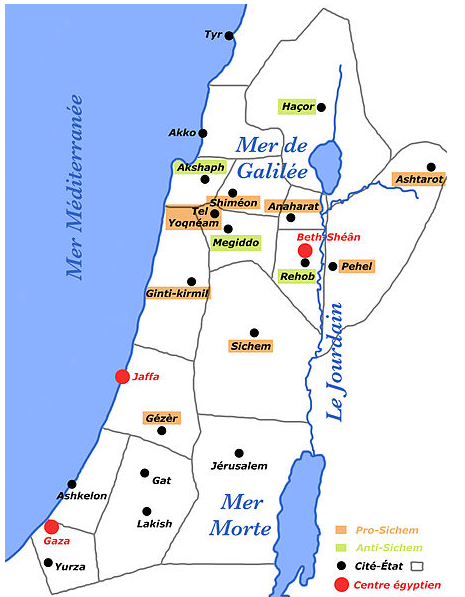
Through the transmission of the alphabet, maritime commerce, and new sociopolitical models, Canaan contributed substantially to the development of the ancient Near East and Mediterranean worlds. Image: Late Bronze Age map showing Canaan.
Where did the English term “Canaan” originate linguistically?
It originated from Hebrew (Kənaʿan), passed into Greek (Khanaan), then Latin (Canaan), and finally entered English.
How was Canaan referenced in the Late Bronze Age Amarna letters?
In the Amarna letters, Canaan was recorded in Akkadian cuneiform as Kinâḫna.
What is one proposed etymology of the name “Canaan”?
One suggestion links it to a Semitic root meaning “to be low” or “to be subdued,” possibly referring to “lowlands.”
How did ancient Egyptian sources refer to Canaan?
They used broad terms like Retjenu and identified a sub-region called Djahy, approximately corresponding to Canaan.
What cultural development characterized Canaan in the Chalcolithic period?
The Ghassulian culture introduced advanced copper smelting and metalworking techniques.
What was the political landscape of Canaan during the Middle Bronze Age?
It comprised powerful, independent city-states like Hazor, participating in extensive regional trade and diplomacy.
How did the Late Bronze Age shape Canaan’s political situation?
Canaan fell under imperial overlordship by Egypt and faced influence from Hittites, Mitanni, and Assyria, creating a complex, fragmented political environment.
Did Canaan suffer total collapse at the end of the Bronze Age?
No, the transition to the Iron Age was varied; some regions declined, others adapted, and not all sites experienced destruction.
What emerged politically in Canaan’s territory by the Iron Age?
New entities such as Israel, Judah, and the Phoenician city-states arose, building on earlier Canaanite cultural foundations.
How does the Hebrew Bible portray Canaan and its inhabitants?
It describes Canaan as the Promised Land, with diverse peoples collectively termed Canaanites, influencing Israelite identity formation.
What role did Canaanites (Phoenicians) play in wider Mediterranean history?
They were notable maritime traders, influenced alphabetic writing, founded colonies, and maintained their identity into Late Antiquity.
What do genetic studies reveal about ancient Canaanite populations?
They show genetic continuity between Bronze Age inhabitants and modern regional populations, underscoring long-term cultural persistence.