Malayan Campaign during WWII
The Malayan Campaign during World War II was a significant military confrontation between the British Commonwealth forces and the Imperial Japanese Army from December 8, 1941, to February 15, 1942. This campaign led to one of the most devastating defeats for the Allies in the Far East, culminating in the fall of Singapore and altering the balance of power in Southeast Asia.
Japanese Motivations and Preparations
By 1941, Japan had been engaged in an extended conflict with China since 1937, heavily dependent on imports like oil from the United States to fuel its military operations.
In response to Japan’s expansionist policies, particularly its occupation of French Indochina, Western powers such as the United States, the United Kingdom, and the Netherlands imposed strict embargoes on oil and other critical materials.
These sanctions aimed to curb Japanese aggression and support China but instead pushed Japan toward further military expansion to secure necessary resources.
Determined not to retreat from China, Japan planned offensives against Allied territories rich in resources. In preparation, the Japanese assembled invasion forces on Hainan Island and in French Indochina. They amassed a well-equipped and experienced military force, including over 200 tanks and nearly 800 aircraft.
Japanese intelligence units, notably Unit 82 of the Military Affairs Bureau, gathered detailed information on Allied defenses through espionage, leveraging contacts with disaffected locals and covert operatives posing as civilians.

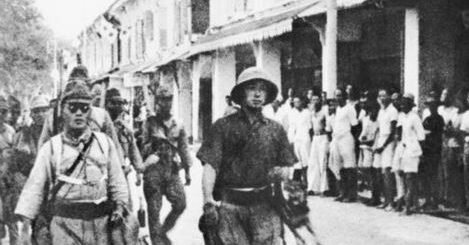
Japanese troops crouched in the street during Malaya’s invasion, leading to British surrender and occupation.
Allied Defensive Strategy and Shortcomings
The British defense strategy in the Far East, known as the Singapore Strategy, was primarily based on the assumption that a strong naval presence at the Singapore Naval Base would deter Japanese aggression. However, between the wars, this strategy suffered from neglect and underfunding.
Warnings from military leaders like Major-General William Dobbie in 1937 about vulnerabilities on Malaya’s east coast were largely ignored. Dobbie emphasized the risk of enemy landings during the monsoon season and the necessity for immediate reinforcements, but his advice went unheeded.
By 1940, Lieutenant-General Lionel Bond recognized that defending Singapore necessitated securing the entire Malay Peninsula. Nonetheless, military planners overestimated the time available to reinforce Malaya in the event of an attack and assumed that American assistance would be forthcoming.
These assumptions proved false. When Lieutenant-General Arthur E. Percival took command in 1941, it was evident that British forces were ill-prepared for the impending Japanese threat. The priority of defeating Germany first, agreed upon by Churchill and Roosevelt, relegated the Far East to a secondary theater, further limiting resources and attention.
Japanese Invasion Begins
On December 8, 1941, the Japanese launched their invasion of Malaya, synchronizing it with attacks across the Pacific, including Pearl Harbor, the Philippines, and Hong Kong. Under the command of Lieutenant General Tomoyuki Yamashita, Japanese forces made amphibious landings at Kota Bharu in Malaya and at Pattani and Songkhla in Thailand, quickly moving southward. Despite initial resistance from Thai forces, Thailand soon allied with Japan, allowing unhindered movement of Japanese troops into Malaya.
The Japanese achieved air superiority early in the campaign by attacking British airfields and destroying aircraft on the ground. The Allied air forces were equipped with outdated planes like the Brewster Buffalo and lacked sufficient training, while the Japanese deployed experienced pilots with modern aircraft. This dominance in the air severely limited Allied reconnaissance and ground support capabilities.

Image: Tomoyuki Yamashita
Tactics and Early Battles
Employing innovative tactics, the Japanese used bicycle infantry to navigate the dense jungles and poor road networks swiftly. This mobility allowed them to outflank Allied positions, isolate units, and disrupt communication lines. The Japanese also effectively utilized light tanks, against which the British and Commonwealth forces had inadequate defenses due to a lack of tanks and insufficient anti-tank weaponry.
Featuring land battles, with initial skirmishes involving British Commonwealth and Royal Thai Police, the Japanese quickly gained air and naval supremacy. They used bicycle infantry to swiftly move through jungle terrain.
The sinking of the British battleship HMS Prince of Wales and battlecruiser HMS Repulse on December 10, 1941, by Japanese aircraft marked a significant shift in naval power. With the loss of these capital ships, the Allies lost their primary naval deterrent in the region, leaving the east coast of Malaya vulnerable to Japanese amphibious operations.
Key Engagements and Allied Retreats
Several critical battles characterized the Malayan Campaign:
- Battle of Jitra (December 11–13, 1941): The Japanese overwhelmed Allied defenses, forcing a disorganized retreat and causing heavy casualties. The fall of Jitra exposed central Malaya to Japanese forces.
- Battle of Kampar (December 27–31, 1941): The 11th Indian Division delayed the Japanese advance, inflicting significant casualties. However, superior Japanese tactics and flanking maneuvers eventually compelled the Allies to withdraw.
- Battle of Slim River (January 7, 1942): In a surprise night attack, Japanese tanks penetrated Allied lines, decimating two Indian brigades and capturing critical positions. This defeat opened the road to Kuala Lumpur, the capital of Malaya.
Leadership changes, such as the replacement of Major-General David Murray-Lyon, did little to stem the tide. By mid-January, Japanese forces had captured Kuala Lumpur, further demoralizing Allied troops and disrupting command structures.
Battle of Muar and the Fall of Johor
In the southern state of Johor, the Australian 8th Division encountered the advancing Japanese. At the Battle of Gemas, the Australians inflicted heavy casualties using well-planned ambushes but ultimately could not halt the Japanese momentum. The Battle of Muar proved particularly devastating:
- The 45th Indian Brigade was effectively destroyed.
- Australian forces suffered significant losses.
- Lieutenant-Colonel Charles Anderson led a courageous fighting withdrawal, known as the “Muar Force,” allowing some troops to escape encirclement.
- Many Allied soldiers were captured or killed, with atrocities such as the Parit Sulong Massacre highlighting the brutal nature of the campaign.
Efforts to slow the Japanese advance, including destroying bridges and implementing scorched earth policies, were insufficient. On January 31, 1942, the remaining Allied forces retreated to Singapore, demolishing the causeway to delay Japanese pursuit.
Air War and Allied Deficiencies
The air campaign was disastrous for the Allies. Initial defenses relied on obsolete aircraft and inadequately trained pilots. The introduction of the Hawker Hurricane fighters came too late and in too few numbers to challenge Japanese air superiority. The Japanese, with control of the skies, provided effective close air support to their ground forces, further undermining Allied defensive efforts.
Espionage exacerbated these challenges. Captain Patrick Heenan, a British Indian Army officer, was convicted of spying for the Japanese, supplying them with critical intelligence on British air operations. His actions compromised Allied strategies and facilitated Japanese successes.
Siege and Fall of Singapore
The campaign culminated in the Battle of Singapore. Despite its reputation as an impregnable fortress, Singapore fell to the Japanese on February 15, 1942, after a week-long siege. Contributing factors included:
- Defensive Miscalculations: British defenses were oriented toward a sea-based attack from the south, neglecting the possibility of a land assault from the north via Malaya.
- Supply Shortages: Ammunition, food, and water became scarce due to Japanese control of supply lines and persistent bombardment.
- Morale and Leadership Issues: Confusion and low morale plagued the defenders. Lieutenant-General Percival’s leadership was criticized for lack of decisiveness and failure to inspire confidence.
The surrender resulted in approximately 80,000 Allied troops becoming prisoners of war, adding to the 50,000 captured or killed during the Malayan Campaign. The fall of Singapore is considered one of the worst defeats in British military history.

Reasons for Allied Defeat
Several factors contributed to the Allied defeat:
- Underestimation of the Enemy: The British underestimated Japanese military capabilities and intentions, failing to prepare adequately for an invasion.
- Inadequate Resources: The Allies lacked modern equipment, particularly tanks and aircraft, and suffered from insufficient training and numbers.
- Poor Strategic Planning: The reliance on the Singapore Strategy ignored vulnerabilities on the Malay Peninsula and over-relied on naval power that was quickly neutralized.
- Intelligence Failures: Effective Japanese espionage and poor Allied counter-intelligence allowed the Japanese to exploit weaknesses.
- Operational Inefficiencies: Coordination among British, Indian, Australian, and local forces was hampered by communication issues and differing doctrines.
Consequences and Significance
The Malayan Campaign had profound implications:
- Strategic Victory for Japan: The capture of Malaya and Singapore provided Japan with valuable resources, including rubber and tin, and a strategic base for further operations in Southeast Asia.
- Shift in Colonial Power: The swift defeat of British forces undermined colonial authority and prestige in Asia, encouraging independence movements in the region.
- Psychological Impact: The loss shattered the myth of European invincibility and exposed vulnerabilities in Western military strategies.
- Allied Reassessment: The defeat prompted the Allies to reevaluate their approach in the Pacific Theater, leading to changes in leadership, tactics, and increased cooperation among Allied nations.
Conclusion
The Malayan Campaign was a decisive episode in World War II’s Pacific Theater, highlighting the consequences of underestimating an opponent and the critical importance of intelligence, mobility, and air superiority in modern warfare. The Japanese demonstrated effective combined arms tactics, leveraging speed, surprise, and coordination to outmaneuver and overwhelm larger but poorly prepared Allied forces. The campaign’s outcome not only altered the strategic landscape in Southeast Asia but also had lasting effects on colonial relations and the future of the region.
Frequently Asked Questions

The Malayan campaign was a comprehensive defeat for the Allies due to a combination of Japanese tactical innovation, superior air and naval power, effective intelligence operations, and Allied unpreparedness.
What prompted the United States, United Kingdom, and the Netherlands to impose embargoes on Japan before the Malayan campaign?
The embargoes were imposed in response to Japan’s aggressive actions, particularly its takeover of French colonies in Southeast Asia. These actions threatened regional stability and were part of Japan’s continued military operations in China. The embargoes aimed to support China and pressure Japan to cease its military activities by restricting access to vital resources like oil and war materials.
Why did Japan decide to expand militarily into Southeast Asia in 1941 instead of withdrawing from China?
Japan viewed withdrawing from China as a dishonorable retreat that would result in a loss of face. To maintain its national pride and secure essential resources embargoed by Western powers, Japan chose to expand militarily into Southeast Asia, targeting territories controlled by the U.S., British, and Dutch to obtain the necessary materials for its war efforts.
What was the British defense strategy in the Far East called, and why was it ineffective during the Malayan campaign?
The strategy was known as the Singapore Strategy. It was ineffective because it primarily relied on stationing a strong naval fleet at Singapore to deter aggression, but between the wars, this plan was undermined by a lack of attention and funding. Additionally, the strategy did not account for the need to defend the entire Malay Peninsula, leaving it vulnerable to invasion.
Who was Major-General William Dobbie, and what did he warn about in 1937?
Major-General William Dobbie was a British military officer who, in 1937, warned that during the monsoon season, enemy forces could land on Malaya’s east coast and establish bases in Siam (Thailand). He recommended immediate reinforcements to defend these vulnerable areas, but his advice was ignored, contributing to the unpreparedness of British defenses.
How did Japanese intelligence operations contribute to their success in invading Malaya?
Japanese intelligence, through Unit 82 of the Military Affairs Bureau, gathered detailed information on Allied troop locations, strengths, and local geography. They utilized embassy staff, disaffected Malayans, and Japanese nationals posing as business people and tourists. Additionally, they connected with Malay and Indian pro-independence organizations, providing financial support in exchange for intelligence and assistance, which gave them a significant advantage.
What was Operation Matador, and why did the British decide not to implement it?
Operation Matador was a British plan for a pre-emptive invasion of southern Thailand to counter the Japanese threat. The British decided against implementing it for political reasons, fearing that invading neutral Thailand without provocation would be diplomatically damaging and might push Thailand to ally openly with Japan.
When did the Japanese invasion of Malaya begin, and who commanded the invading forces?
The Japanese invasion of Malaya began on 8 December 1941. The invading forces were commanded by Lieutenant General Tomoyuki Yamashita, leading Japan’s 25th Army.
In what ways did the Japanese gain air superiority during the Malayan campaign?
The Japanese gained air superiority by launching surprise attacks on British airfields, destroying many Allied aircraft on the ground. The Allied air forces were ill-equipped with outdated aircraft and lacked adequate training, while the Japanese had nearly 800 modern aircraft and experienced pilots, allowing them to dominate the skies.
What tactics did the Japanese use to outflank and isolate Allied units in Malaya?
The Japanese employed bicycle infantry and light tanks to swiftly move through the Malayan jungles. This mobility enabled them to outflank Allied positions, cut off lines of communication, and isolate units, which were already disadvantaged due to a lack of tanks and insufficient anti-tank weapons.
What significant naval losses did the British suffer on 10 December 1941, and what was the impact?
On that day, the British battleship HMS Prince of Wales and battlecruiser HMS Repulse were sunk by Japanese aircraft. This loss eliminated the British naval deterrent in the region, left the east coast of Malaya exposed to naval invasion, and had a profound impact on British morale and strategic capabilities.
Who was Lieutenant-Colonel Charles Anderson, and what role did he play in the Battle of Muar?
Lieutenant-Colonel Charles Anderson was an Australian officer who led the Muar Force during the Battle of Muar. After the 45th Indian Brigade was destroyed, he organized a fighting withdrawal, allowing some Allied troops to escape encirclement. Despite his efforts, many soldiers were captured or killed, including victims of the Parit Sulong Massacre. Anderson was later awarded the Victoria Cross for his leadership and bravery.
What were the strategic consequences of the Malayan campaign for both Japan and the Allies?
For Japan, the campaign was a significant strategic victory that secured valuable resources and provided a base for further operations in Southeast Asia. It showcased the effectiveness of Japanese military tactics and boosted their confidence. For the Allies, it was a devastating defeat that led to the loss of Malaya and Singapore, undermined colonial authority, and resulted in approximately 80,000 Allied troops becoming prisoners of war after the fall of Singapore.