Manetho stands as a towering figure in the annals of Egyptology, renowned for his pioneering efforts to chronicle the history of ancient Egypt. As an Egyptian priest from Sebennytos, his contributions, particularly through his seminal work Aegyptiaca (History of Egypt), have provided invaluable insights into the chronological reigns of Egyptian kings. Despite the unfortunate loss of his original writings, Manetho’s legacy endures through fragments preserved by later historians.
Below, World History Edu provides a comprehensive exploration of Manetho’s life, his major works, methodologies, and the lasting impact he has had on the study of ancient Egypt.

While debates about the accuracy and completeness of his work persist, Manetho remains a foundational figure in understanding Egypt’s vast and complex history.
Origins and Name
The true Egyptian form of Manetho’s name has been lost to history, sparking scholarly debates and various interpretations.
The most widely accepted hypotheses suggest meanings such as “Truth of Thoth,” “Gift of Thoth,” “Beloved of Thoth,” “Beloved of Neith,” or “Lover of Neith.” Thoth and Neith were prominent deities in Egyptian mythology, symbolizing wisdom and creation, respectively.
The above interpretations highlight the possible divine associations and reverence embedded in his name. Less commonly accepted theories propose meanings like “Horseherd” or “Groom” (Myinyu-heter) and “I have seen Thoth” (Ma’ani-Djehuti), though these are less supported by linguistic evidence.
Manetho was an influential Egyptian priest from Sebennytos who lived during the early third century BC in the Ptolemaic Kingdom’s Hellenistic period.
In Greek sources, Manetho’s name appears as Μανέθων (Manethōn), as evidenced by inscriptions and references by the Jewish historian Flavius Josephus in the 1st century AD.
Latinized forms such as Manethon, Manethos, and Manethonus also exist, reflecting the transliteration practices of antiquity. These variations underscore the cultural and linguistic transitions his works underwent as they were transmitted through different civilizations.
Life and Historical Context
Manetho lived during the early third century BC, a period marked by the Hellenistic influence following the conquests of Alexander the Great.
Egypt was under the rule of the Ptolemaic Kingdom, established by Ptolemy I Soter, one of Alexander’s generals. While concrete biographical details about Manetho are scarce, historical references associate him with the reigns of Ptolemy I Soter (323–283 BC) and Ptolemy II Philadelphus (285–246 BC).
The famed Greek historian Plutarch links him to Ptolemy I, whereas Byzantine chronicler George Syncellus connects him directly to Ptolemy II.

It remains unclear whether Manetho wrote the Aegyptiaca under Ptolemy I Soter or Ptolemy II Philadelphos, but it was completed by the reign of Ptolemy III Euergetes. Image (L-R): Ptolemy I, Ptolemy II, and Ptolemy III.
Additionally, references in the Hibeh Papyri suggest that if this Manetho is indeed the same historian, he might have lived into the reign of Ptolemy III Euergetes (246–222 BC). However, the true historicity of Manetho remains a subject of scholarly debate due to the absence of direct contemporary sources.
Traditionally, Manetho is described as a native Egyptian, with Egyptian as his mother tongue. Despite his indigenous background, he opted to write in Greek, targeting the Greek-speaking populace of the Ptolemaic Kingdom. This choice underscores the profound Hellenistic influence in Egypt during his lifetime, reflecting the cultural and administrative dominance of Greek language and customs in the region.
Major Works

Famed Egyptian priest Manetho authored the Aegyptiaca (History of Egypt) in Greek, a crucial chronological source detailing the reigns of ancient Egyptian kings. Image: Head of an anonymous priest of Serapis in the Altes Museum, Berlin.
Aegyptiaca (History of Egypt)
Manetho’s most renowned work is the Aegyptiaca, a comprehensive history of Egypt written in Greek. This monumental text is divided into three volumes and is particularly significant for its innovative division of Egyptian rulers into dynasties—a framework that remains a cornerstone in Egyptology today.
Unlike modern dynastic classifications, which are strictly based on bloodlines, Manetho introduced dynasties based on perceived discontinuities, whether geographical or genealogical. For instance, he differentiated between dynasties based in Memphis and Elephantine or marked changes in lineage within a dynasty, thereby providing a structured and chronological account of Egypt’s royal succession.
The Aegyptiaca not only lists the kings but also intertwines narratives that connect these rulers within a cohesive historical framework, blending mythology with recorded history. This approach provided a more comprehensive and systematic account of Egypt’s past, making it an invaluable resource for understanding the chronological reigns of ancient Egyptian kings.
Other Attributed Works
Beyond the Aegyptiaca, several other works are attributed to Manetho, though their authenticity and direct association with him are subjects of scholarly uncertainty. These include:
- Against Herodotus: Potentially an abridged or independent section of the Aegyptiaca, this work may have served as a critique or alternative account to Herodotus’ Histories.
- The Sacred Book: Details are sparse, but it likely dealt with religious or mythological aspects of Egyptian culture.
- On Antiquity and Religion: Presumably a treatise exploring the ancient religious practices and beliefs of Egypt.
- On Festivals: This work likely described various Egyptian festivals and their significance.
- On the Preparation of Kyphi: A medicinal preparation, indicating Manetho’s involvement in practical aspects of Egyptian culture.
- Digest of Physics: Suggesting an exploration of natural phenomena or scientific principles from an Egyptian perspective.
- Book of Sothis: Another treatise with uncertain attribution, possibly linked to astronomical or calendrical topics.
These additional works are not well-documented from Manetho’s time and are only mentioned in sources from the first century AD, indicating a significant temporal gap between their supposed composition and their attestations. This gap raises questions about their direct association with Manetho, suggesting that they might have been attributed to him posthumously or could have been part of a broader tradition of Egyptian historiography.
Transmission and Reception of Aegyptiaca
Unfortunately, Manetho’s Aegyptiaca did not survive intact through the centuries. Instead, its content was preserved through excerpts and references by later authors, primarily Josephus, Sextus Julius Africanus, Eusebius of Caesarea, and Syncellus.
The earliest surviving reference is found in Josephus’s Contra Apionem (“Against Apion”), written nearly four centuries after Aegyptiaca. In this work, Josephus quotes Manetho’s lists of kings but likely did not have access to the original text, suggesting reliance on secondary summaries or epitomes.
An epitome—a condensed version—of the Aegyptiaca must have circulated by the time of Josephus. This epitome preserved the outlines of Manetho’s dynastic divisions and selected details but likely diverged from the original due to alterations and omissions during transmission.
Notably, both Eusebius and Africanus preserved versions of this epitome, with Africanus’s account generally considered more reliable due to its earlier composition. These preserved fragments form the basis of modern reconstructions of Manetho’s work, allowing Egyptologists to glean insights into ancient Egyptian chronology and historiography despite the absence of the original manuscripts.
Methodology and Sources
Manetho employed king-lists as the structural backbone of his historical narrative. These lists provided a chronological framework within which he inserted narratives about each king, blending Egyptian traditions with Hellenistic historiographical methods. This approach likely drew influence from Greek historians like Herodotus, who similarly used chronological frameworks to organize their histories.
In his accounts, Manetho acknowledged using “nameless oral tradition” and “myths and legends,” a common practice among historians of his era. This admission reflects an integration of oral histories and mythological narratives into his historical framework, ensuring that both factual and cultural elements were preserved in his writings.
His work exhibits a deep familiarity with Egyptian legends, and he may have sought to harmonize Egyptian and Greek historical narratives.
For instance, he attempted to synchronize Egyptian kings with figures from Greek mythology, such as equating King Memnon with Amenophis and Armesis with Danaos. This synthesis of cultures underscores the Hellenistic milieu in which Manetho operated, bridging indigenous Egyptian traditions with the dominant Greek cultural influences of his time.
King Lists and Their Significance
Manetho’s king-list is a critical component of the Aegyptiaca. While the exact source of his lists remains unknown, they bear similarities to existing king-lists like the Turin Royal Canon. Unlike selective temple lists, which often omitted certain rulers for religious or political reasons, Manetho’s list aimed for a more comprehensive historical record.
His focus on Lower Egyptian dynasties, particularly those based in the Nile Delta, suggests that his sources were regional temple libraries under the control of the Tanite Dynasties Twenty-one and Twenty-two.
Manetho’s contributions as an Egyptian priest and historian are invaluable, providing a structured and chronological account of ancient Egypt’s rulers.
Manetho’s transcription of pharaonic names varied, sometimes directly translating or abbreviating them. For example, the Egyptian name “Men” became “Menes,” and “Menkauhor” was rendered as “Menkheres.”
However, inconsistencies and occasional alterations in these transcriptions indicate that reconstructing the original Egyptian names solely from Manetho’s accounts is challenging. These variations highlight the difficulties inherent in translating and transcribing names across different languages and scripts, especially when dealing with ancient texts where pronunciation and spelling standards were not fixed.
Content of Aegyptiaca
Manetho’s Aegyptiaca spans three volumes, each covering distinct periods and dynasties in Egyptian history:
Volume 1
- Mythological Accounts: Begins with listings of deities and demigods as early rulers of Egypt, such as Isis, Osiris, Set, and Horus. This section integrates mythological narratives with historical accounts, reflecting the interweaving of divine and human elements in Egyptian historiography.
- Historical Accounts: Transitions into historical records from Dynasty One to Eleven, covering periods like the Old Kingdom and the First Intermediate Period. This section establishes the foundation of Manetho’s chronological framework, detailing the succession of kings and their reigns.
Volume 2
Dynasties Twelve to Nineteen: Encompasses the end of the Middle Kingdom and the Second Intermediate Period, including the Hyksos invasion and the establishment of the New Kingdom. This volume highlights periods of turmoil and foreign rule, providing context for the dynamic shifts in Egyptian governance and culture.
Volume 3
Dynasties Twenty to Thirty (or Thirty-one): Details periods like the Saite Renaissance and the Achaemenid interruption of Egyptian rule. It concludes with the Ptolemaic Dynasty, reflecting the continuation of Egyptian history into the Hellenistic period. This final volume underscores the enduring legacy of Egyptian civilization even under foreign dominion.
Manetho’s work not only chronicled the succession of kings but also provided narratives that connected these rulers within a cohesive historical framework. By blending mythology with recorded history, he offered a holistic view of Egypt’s past, illustrating how divine influence and human governance intertwined to shape the nation’s trajectory.
Manetho’s innovative approach to dividing history into dynasties and his efforts to synthesize mythological and historical narratives have left an enduring legacy.
Similarities with Berossos
Manetho is often compared to Berossos, a Chaldean priest and historian, due to their similar approaches in chronicling their respective cultures’ histories. Both utilized chronological royal genealogies and extended their accounts into the mythic past, thereby intertwining divine and human narratives. This parallel suggests a common historiographical tradition in the ancient Near East, where historians sought to legitimize contemporary rule by connecting it to a storied and divine past.
Syncellus, a Byzantine chronicler, even suggested that Manetho and Berossos might have copied each other’s work. However, this claim is viewed with skepticism due to the lack of direct evidence supporting such intertextual borrowing. The similarities likely stem from shared historiographical methodologies rather than direct copying, reflecting broader cultural and intellectual currents of their time.
Impact and Legacy of Aegyptiaca
Despite the fragmentary nature of Manetho’s surviving work, Aegyptiaca has had a profound and lasting impact on the field of Egyptology. His division of Egyptian history into dynasties remains a fundamental framework for the study of ancient Egypt. This dynastic system provides a structured approach to understanding the complex succession of rulers and the socio-political dynamics that shaped Egypt over millennia.
Jean-François Champollion, the French scholar who deciphered the Rosetta Stone, reportedly relied on Manetho’s king-lists to interpret hieroglyphs. This reliance underscores the practical utility of Manetho’s work in the nascent field of Egyptology, where ancient texts and inscriptions were being unlocked and understood for the first time.
Modern Egyptologists continue to reference both Manetho’s transcriptions and the original Egyptian names, often presenting both to provide comprehensive insights into pharaonic lineages. Manetho’s method of organizing history into dynasties has become a universal standard, shaping the conceptualization of royal succession in Egypt. His work serves as a foundational reference point, facilitating the alignment of archaeological findings with historical records.
Furthermore, Manetho’s Aegyptiaca has influenced the broader understanding of ancient Near Eastern historiography, demonstrating how historians of antiquity blended mythological narratives with empirical records to construct coherent historical accounts.
Controversies and Criticisms
Manetho’s accounts have not been without controversy. One significant point of contention is his portrayal of the Jewish Exodus. In his narratives, Manetho described the Israelites as a group of lepers and shepherds expelled from Egypt, a depiction that has been cited as a source for early antisemitic narratives. This portrayal reflects broader prejudices and misconceptions prevalent in antiquity rather than an objective historical account. It is likely that such interpretations were influenced by the cultural and political contexts of Manetho’s time, where different groups often vied for prominence and legitimacy within the complex tapestry of Hellenistic society.
Additionally, the reliability of the Aegyptiaca has been questioned due to discrepancies between Manetho’s accounts and other historical records. The selective preservation and potential alterations of his work over centuries make it challenging to fully assess the factual accuracy of his narratives. Differences between Manetho’s king-lists and archaeological findings necessitate a cautious approach when utilizing his accounts as historical evidence. Scholars emphasize the importance of corroborating Manetho’s work with other sources to construct a more accurate and nuanced understanding of Egypt’s history.
The methodological contributions of Manetho, however, are widely acknowledged. His systematic approach to organizing history into dynasties and his efforts to synthesize mythological and historical narratives represent significant advancements in historiography. While the factual content of his work may be subject to scrutiny, his innovative methodologies have left an indelible mark on the study of ancient civilizations.
Manetho of Sebennytus and the Cult of Serapis

Manetho of Sebennytus significantly advanced and legitimized the Serapis religious cult, influencing his era’s religious landscape. Serapis was a famous deity during the Ptolemaic Era. Image: Marble bust of Serapis wearing a modius
Manetho of Sebennytus is believed to have served as a priest dedicated to the sun god Ra in Heliopolis. According to the Byzantine historian Syncellus, Manetho held the prominent position of chief priest. Plutarch regarded him as a knowledgeable figure regarding the worship of Serapis, a deity that combined aspects of the Egyptian gods Osiris and Apis. Serapis emerged as a syncretic god blending Greek and Egyptian religious elements, likely initiated following Alexander the Great’s founding of Alexandria in Egypt.
The introduction of Serapis into the Greek-Macedonian religious landscape was marked by the transportation of a statue of the god. This event is recorded by both the Roman historian Tacitus and Plutarch, with the statue being brought to Egypt either in 286 BC by Ptolemy I Soter or in 278 BC by his successor, Ptolemy II Philadelphus. This act symbolized the fusion of Greek and Egyptian religious practices under the Ptolemaic dynasty.
Manetho of Sebennytus played a significant role in the religious developments of his time, particularly in the promotion and authority of the Serapis cult.
Ancient traditions also suggest that Timotheus of Athens, an expert on the goddess Demeter and the Eleusinian Mysteries, collaborated with Manetho on the establishment of the Serapis cult. However, the origins of this claim are unclear and may stem from literary sources attributed to Manetho himself. If this information indeed comes from Manetho’s writings, it lacks independent verification and does not necessarily confirm the historical existence of Manetho as a priest-historian from the early third century BC.
READ MORE: Most Revered Ancient Egyptian Gods and Goddesses
Conclusion
Manetho’s contributions as an Egyptian priest and historian are invaluable, providing a structured and chronological account of ancient Egypt’s rulers that continues to inform and shape the study of Egyptology. His innovative division of history into dynasties and his synthesis of mythology with historical narrative offered a comprehensive framework for understanding Egypt’s complex and storied past. Despite the loss of his original writings, the preserved fragments of Aegyptiaca through later historians ensure that Manetho’s legacy endures, offering a window into the methodologies and perspectives of ancient historiography.
While debates about the accuracy and completeness of his work persist, Manetho remains a foundational figure in understanding Egypt’s vast and intricate history. His efforts to document and organize Egypt’s past laid the groundwork for future generations of scholars, underscoring the enduring significance of his contributions to the collective memory of one of the world’s most fascinating civilizations.
Frequently Asked Questions

He authored the Aegyptiaca (History of Egypt) in Greek, which is a cornerstone for understanding the chronological reigns of ancient Egyptian kings. Despite the loss of his original works, his contributions remain pivotal in Egyptology. Image: Manetho depicted with Ptolemy Philadelphus in the Library of Alexandria by Vincenzo Camuccini (1813)
What are some of the proposed meanings of Manetho’s name, and which deities are associated with these interpretations?
The precise Egyptian rendition of Manetho’s name is lost, leading to various hypotheses. Proposed meanings include:
- “Truth of Thoth”
- “Gift of Thoth”
- “Beloved of Thoth”
- “Beloved of Neith”
- “Lover of Neith”
Thoth and Neith are significant deities in Egyptian mythology, associated with wisdom and creation, respectively. Less accepted theories suggest meanings like “Horseherd” or “Groom” (Myinyu-heter) and “I have seen Thoth” (Ma’ani-Djehuti).
During whose reigns is Manetho believed to have lived, and which historians associate him with these rulers?
Manetho is historically linked to the reigns of:
- Ptolemy I Soter (323–283 BC): Associated by Plutarch.
- Ptolemy II Philadelphus (285–246 BC): Connected directly by George Syncellus.
Additionally, references in the Hibeh Papyri suggest that if this Manetho is the same historian, he might have lived into the reign of Ptolemy III Euergetes (246–222 BC).
In what language did Manetho choose to write his works, and what does this choice indicate about his intended audience?
Manetho chose to write his works in Greek, despite being a native Egyptian whose mother tongue was Egyptian. This linguistic choice indicates that he was targeting the Greek-speaking populace of the Ptolemaic Kingdom, reflecting the significant Hellenistic influence in Egypt during his lifetime.
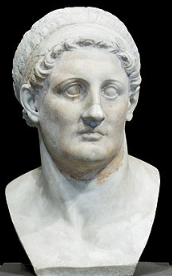
Ptolemy’s renown grew after the death of Alexander the Great. Image: Bust of Ptolemy I Soter, located at the Louvre in France
What is the Aegyptiaca, and how did Manetho structure this work?
The Aegyptiaca (History of Egypt) is Manetho’s comprehensive history of Egypt, divided into three volumes. It is significant for its innovative division of Egyptian rulers into dynasties, a framework still used by Egyptologists today. Unlike modern dynastic classifications based strictly on bloodlines, Manetho introduced dynasties based on perceived discontinuities, whether geographical or genealogical.
Besides the Aegyptiaca, what other works are attributed to Manetho, and what is notable about their documentation?
Other works attributed to Manetho include:
- Against Herodotus
- The Sacred Book
- On Antiquity and Religion
- On Festivals
- On the Preparation of Kyphi
- Digest of Physics
- Book of Sothis
These additional works are not well-documented from Manetho’s time and are only mentioned in sources from the first century AD, indicating a significant temporal gap between their supposed composition and their attestations.
How was the content of the Aegyptiaca preserved despite the loss of Manetho’s original work?
The content of the Aegyptiaca was preserved through excerpts and references by later authors, primarily Josephus, Africanus, Eusebius of Caesarea, and Syncellus. An epitome (condensed version) of Aegyptiaca circulated by the time of Josephus, preserving the outlines of Manetho’s dynastic divisions and selected details. This epitome was further preserved by Africanus and Eusebius, forming the basis of modern reconstructions of Manetho’s work.

Ptolemy II Philadelphus – second king of the Ptolemaic Dynasty
What methodology did Manetho employ in his historical narrative, and which Greek historian likely influenced his approach?
Manetho employed king-lists as the structural backbone of his historical narrative, providing a chronological framework within which he inserted narratives about each king. His approach combined Egyptian traditions with Hellenistic historiographical methods, possibly influenced by the Greek historian Herodotus. He also acknowledged using “nameless oral tradition” and “myths and legends” in his accounts.
What is the significance of Manetho’s king-list and its relation to other existing king-lists like the Turin Royal Canon?
Manetho’s king-list is a critical element of his Aegyptiaca, aiming for a more comprehensive historical record compared to selective temple lists that often omitted certain rulers for religious or political reasons.
While the exact source of his lists is unknown, they bear similarities to existing king-lists like the Turin Royal Canon. His focus on Lower Egyptian dynasties, particularly those based in the Nile Delta, suggests that his sources were regional temple libraries under the control of the Tanite Dynasties Twenty-one and Twenty-two.
How does Manetho’s approach in the Aegyptiaca compare to that of Berossos, and what did Syncellus suggest about their works?
Manetho is often compared to Berossos, a Chaldean priest and historian, due to their similar approaches in chronicling their respective cultures’ histories. Both utilized chronological royal genealogies and extended their accounts into the mythic past, intertwining divine and human narratives. Syncellus, a Byzantine chronicler, suggested that Manetho and Berossos might have copied each other’s work, though this claim is viewed with skepticism due to the lack of direct evidence.
What lasting impact has the Aegyptiaca had on modern Egyptology and historical studies?
Despite being fragmentary, the Aegyptiaca has had a lasting impact on Egyptology. Manetho’s division of Egyptian history into dynasties remains a fundamental framework for the study of ancient Egypt.
Scholars like Jean-François Champollion, who deciphered the Rosetta Stone, reportedly relied on Manetho’s king-lists to interpret hieroglyphs. Modern Egyptologists continue to reference both Manetho’s transcriptions and the original Egyptian names, using his method of organizing history into dynasties as a universal standard for conceptualizing royal succession in Egypt.





