10 Major Events in Ancient Egyptian History
Ancient Egypt, one of the most influential civilizations in history, boasts a rich tapestry of events that have shaped its development over millennia. From its inception around 3100 BC to its decline in 30 BC, the history of ancient Egypt is marked by significant occurrences that influenced not only the Egyptians but also the broader historical and cultural landscapes.
What are the significant achievements of the Ancient Egyptians?
Below, we delve into ten major events in ancient Egyptian history, examining their contexts, impacts, and legacies.
Unification of Upper and Lower Egypt (c. 3100 BC)
The unification of Upper and Lower Egypt is traditionally attributed to King Menes (or Narmer), who is believed to have been the first pharaoh of a unified Egypt. This event marked the beginning of the Early Dynastic Period. The unification brought together the Nile Delta in the north and the Nile Valley in the south under one ruler, establishing a centralized state. This consolidation allowed for the development of a more complex and sophisticated society, characterized by advancements in administration, architecture, and culture. The Narmer Palette, an archaeological artifact, symbolizes this unification, depicting the king wearing both the White Crown of Upper Egypt and the Red Crown of Lower Egypt.

The unification of Upper and Lower Egypt is one of the most significant events in ancient Egyptian history. It is traditionally attributed to the legendary King Menes, who is believed to have been the first pharaoh of a unified Egypt. Image: The front (left) and back (right) view of the Narmer Palette.
The Construction of the Pyramids (c. 2580-2560 BC)
The Old Kingdom period is often referred to as the “Age of the Pyramids,” with the construction of the Great Pyramids at Giza being the most iconic achievement. The Great Pyramid of Khufu (Cheops), built during the Fourth Dynasty, stands as a testament to the architectural and engineering capabilities of ancient Egyptians. These monumental structures served as tombs for the pharaohs and were intended to facilitate their journey to the afterlife. The construction of the pyramids required a highly organized labor force, advancements in engineering, and precise astronomical knowledge. They remain a symbol of the power and wealth of the Egyptian pharaohs and continue to be a source of fascination and study.

Image: the Great Pyramid of Giza
The Reign of Pharaoh Hatshepsut (c. 1479-1458 BC)
Hatshepsut, one of the few femalepharaohs, ruled during the Eighteenth Dynasty and is remembered as one of Egypt’s most successful and innovative leaders. Her reign was marked by stability, prosperity, and extensive building projects. She is perhaps best known for her mortuary temple at Deir el-Bahri, a masterpiece of ancient Egyptian architecture. Hatshepsut also expanded Egypt’s trade networks, notably sending an expedition to the Land of Punt, which brought back valuable goods and resources. Her reign challenged traditional gender roles and left a lasting legacy in both political and cultural spheres. After her death, attempts were made to erase her from historical records, but her achievements have since been recognized and celebrated.

Image: Statue of pharaoh Hatshepsut at the Metropolitan Museum of Art in New York City, U.S.
The Reign of Akhenaten and the Amarna Period (c. 1353-1336 BC)
Pharaoh Akhenaten is known for his radical religious reforms, which included the establishment of Atenism, a monotheistic worship of the sun disk Aten. This period, known as the Amarna Period, saw significant changes in Egyptian art, religion, and politics. Akhenaten moved the capital to a new city, Akhetaten (modern-day Amarna), which was designed to honor Aten. His reign disrupted the traditional polytheistic beliefs and diminished the power of the priesthood of Amun. However, his monotheistic experiment was short-lived. After Akhenaten’s death, his successor, Tutankhamun, restored the traditional religious practices and moved the capital back to Thebes. The Amarna Period remains a fascinating chapter in Egyptian history, illustrating the complexities of religious and political power.

Image: Statue of Akhenaten, located at the Egyptian Museum in Cairo, Egypt.
The Reign of Tutankhamun (c. 1332-1323 BC)
Tutankhamun, also known as King Tut, is one of the most famous pharaohs due to the discovery of his nearly intact tomb in 1922 by Howard Carter. Although his reign was relatively short and his accomplishments modest, the treasures found in his tomb provided invaluable insights into ancient Egyptian art, culture, and daily life. Tutankhamun ascended to the throne as a child and his reign saw the restoration of traditional religious practices following the Amarna Period. The discovery of his tomb, with its wealth of artifacts, sparked worldwide interest in Egyptology and remains one of the greatest archaeological finds of all time. The golden death mask of Tutankhamun has become an iconic symbol of ancient Egypt.

Ancient Egypt is one of the most fascinating and enduring civilizations in history, with a legacy that spans over three millennia. Image: Mask of Tutankhamun.
The Battle of Kadesh (c. 1274 BC)
The Battle of Kadesh, fought between the Egyptians under Ramses II and the Hittites under King Muwatalli II, is one of the earliest battles in recorded history for which detailed accounts exist. Although the battle ended in a stalemate, it is significant for several reasons. It is one of the best-documented battles of ancient times, with accounts from both Egyptian and Hittite sources. The battle demonstrated the military prowess of Ramses II and highlighted the importance of chariot warfare. The aftermath of the battle led to the signing of the Treaty of Kadesh in 1258 BC, the first known peace treaty in history. This treaty established a long-lasting peace between the two empires and marked a significant diplomatic achievement.

Image: An illustration depicting Ramses II during the Battle of Kadesh.
Ancient Egyptian Kings of the New Kingdom and their Accomplishments
The Reign of Ramses II (c. 1279-1213 BC)
Ramses II, also known as Ramses the Great, is often regarded as one of Egypt’s most powerful and influential pharaohs. His reign was marked by extensive building projects, including the temples at Abu Simbel and the Ramesseum. Ramses II undertook numerous military campaigns, expanding Egypt’s empire and securing its borders. His long reign and numerous monuments left an indelible mark on Egyptian history and culture. Ramses II’s legacy is evident in the grandeur of his constructions and the stability he brought to the empire. He was also known for his prolific progeny, fathering over a hundred children, which helped secure his dynasty’s continuity. His reign is often considered the pinnacle of Egypt’s power and cultural achievement.

Image: A statue portraying Ramses II.
The Third Intermediate Period (c. 1070-664 BC)
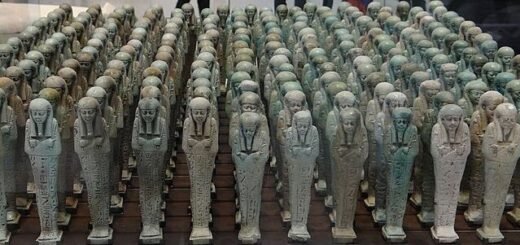
The Third Intermediate Period was a time of political fragmentation and instability following the collapse of the New Kingdom. Egypt was divided into multiple regions, each ruled by different leaders, leading to a decline in centralized power. This period saw increased foreign influence, particularly from the Libyans and Nubians. Despite the political turmoil, there were significant cultural and artistic developments. Innovations in burial practices, such as the use of coffins and shabti figures, and the production of elaborate funerary texts, like the Book of the Dead, were notable. The period also saw the rise of powerful priesthoods, particularly the High Priests of Amun, who wielded considerable influence.
The Conquest by Alexander the Great (332 BC)
In 332 BC, Egypt was conquered by Alexander the Great, marking the end of Persian rule and the beginning of the Hellenistic period. Alexander was welcomed as a liberator and crowned as pharaoh. He founded the city of Alexandria, which would become a major center of learning and culture in the ancient world. Alexandria housed the Great Library and the Lighthouse, one of the Seven Wonders of the Ancient World. After Alexander’s death, his general Ptolemy took control of Egypt, establishing the Ptolemaic dynasty. This period saw the fusion of Greek and Egyptian cultures, with advancements in science, philosophy, and the arts. The Ptolemaic rulers, particularly Ptolemy I and Cleopatra VII, played significant roles in maintaining Egypt’s prominence.

Image: Bust of Ptolemy I
The Roman Conquest (30 BC)
The Roman conquest of Egypt in 30 BC marked the end of the Ptolemaic dynasty and the beginning of Egypt as a province of the Roman Empire. The last Ptolemaic ruler, Cleopatra VII, famously allied with Julius Caesar and later Mark Antony but was defeated by Octavian (later Augustus) at the Battle of Actium. Cleopatra’s death and the subsequent annexation of Egypt brought about significant changes, integrating Egypt into the Roman economy and administration. Despite the political changes, many aspects of ancient Egyptian culture and traditions persisted. Roman Egypt became a crucial granary for the empire, and Alexandria continued to be a major cultural and intellectual hub. The blend of Egyptian and Roman elements influenced various aspects of life, from religion to architecture.

The history of ancient Egypt is marked by a series of significant events that shaped its development and left a lasting legacy on world history. Image: Statue depicting the head of Cleopatra.