Margaret Fuller: History, Works & Major Achievements
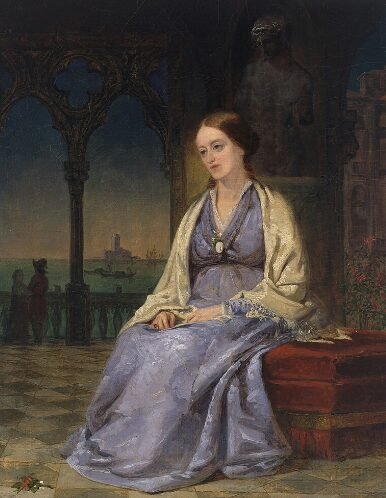
Margaret Fuller’s legacy as a trailblazing feminist and intellectual continues to inspire and resonate in contemporary discussions on gender and social justice. Image: Oil on canvas painting of Margaret Fuller by American painter Thomas Hicks (1848). Housed at the National Portrait Gallery (United States).
Margaret Fuller’s life and works represent a significant chapter in the history of American literature, journalism, and social reform. Her pioneering efforts in advocating for women’s rights and social justice have left an indelible mark on American culture and intellectual history.
Through her writing, teaching, and public speaking, Fuller challenged the limitations placed on women in the 19th century and paved the way for future generations to continue the fight for equality.
Early Life and Education
Sarah Margaret Fuller, born on May 23, 1810, in Cambridgeport, Massachusetts, was a pioneering American journalist, editor, critic, and women’s rights advocate associated with the American transcendentalism movement. Named after her grandmother, Margaret was the eldest child of Timothy Fuller and Margaret Crane Fuller. Her father, a lawyer and later a representative in the United States Congress, played a significant role in her early education.
From a young age, Fuller exhibited an insatiable appetite for learning, a trait fostered by her father, who believed in rigorous intellectual discipline. He introduced her to classical literature, philosophy, and modern languages. However, Timothy Fuller’s educational regimen was also demanding, contributing to Margaret’s bouts of ill health and intense migraines throughout her life. Her father forbade her from reading sentimental novels and other “feminine” literature, insisting instead on a curriculum that included Latin, Greek, and mathematics—subjects typically reserved for boys at the time.
Margaret’s formal education began at the Boston Lyceum for Young Ladies, but she found the curriculum there lacking and left after two years. Despite this, she continued her self-education, mastering several modern languages, including German and Italian, and immersing herself in the works of Goethe, Schiller, and other European writers.

Born in Cambridgeport, Massachusetts, Fuller received a rigorous early education from her father, Timothy Fuller, a lawyer who died of cholera in 1835. Image: Birthplace and childhood home of Margaret Fuller
Career and Contributions
In 1835, tragedy struck the Fuller family when Timothy Fuller died of cholera. This loss placed Margaret in a position of financial responsibility, as her father’s properties were largely seized by her uncles, leaving the family in difficult circumstances. To support her mother and siblings, Margaret began teaching, taking a position at Bronson Alcott’s Temple School in Boston, and later at Greene Street School.
Fuller’s teaching career, however, was just a precursor to her true calling in literature and journalism. In 1839, she held her first “Conversations,” a series of discussions among women in Boston. These meetings, aimed at educating women and promoting intellectual and social discourse, covered a wide range of topics including women’s rights, education, and the arts. The success of these conversations solidified Fuller’s role as a leading advocate for women’s education and empowerment.

After formal schooling and a stint as a teacher, Fuller began her “Conversations” series in 1839, providing women with intellectual discussions to compensate for their lack of higher education. Image: The Greene Street School in Providence, Rhode Island where Fuller taught from 1837 to 1839
Margaret Fuller’s literary career took a significant leap forward when she became the first editor of “The Dial,” a transcendentalist journal founded by Ralph Waldo Emerson in 1840.
Under her editorship, “The Dial” became a platform for the leading intellectuals of the transcendentalist movement, publishing works by Emerson, Henry David Thoreau, and other prominent writers.
Fuller’s own contributions to the journal, including her seminal essay “The Great Lawsuit. Man versus Men. Woman versus Women,” laid the groundwork for her later book “Woman in the Nineteenth Century.”
Major Works
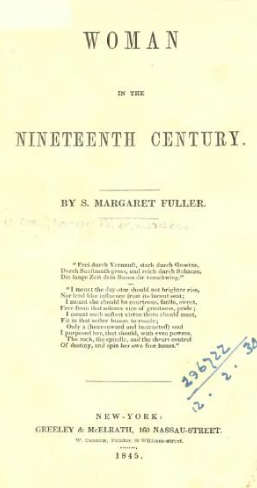
Margaret Fuller was the author of the book “Women in the Nineteenth Century”. The book is widely recognized as the first feminist book to be published in the United States. Image: Title page of Woman in the Nineteenth Century (1845)
“Woman in the Nineteenth Century” (1845)
Margaret Fuller’s most influential work, “Woman in the Nineteenth Century,” published in 1845, is considered one of the first major feminist works in the United States. This book expanded on her earlier essay “The Great Lawsuit” and argued for the intellectual and social equality of women. Fuller challenged the traditional roles of women and called for broader educational and occupational opportunities. She emphasized that women should be allowed to develop their individual talents and pursue careers of their choosing, free from societal constraints.
Fuller’s arguments were revolutionary for their time, advocating for women’s rights in an era when women were largely confined to domestic roles. Her book drew from a wide array of sources, including classical literature, philosophy, and contemporary social theory, making a compelling case for the emancipation of women.
“Summer on the Lakes” (1844)
Before “Woman in the Nineteenth Century,” Fuller published “Summer on the Lakes” in 1844, a travelogue based on her journey through the Great Lakes region. This book detailed her observations of the landscape, the people, and the Native American tribes she encountered, including the Ottawa. “Summer on the Lakes” combined personal reflection with social commentary, offering insights into the conditions and cultures of the areas she visited. Fuller’s vivid descriptions and thoughtful analysis showcased her literary talent and deepened her engagement with social issues, particularly the treatment and rights of Native Americans.
Later Career and European Influence
In 1844, Fuller accepted an invitation from Horace Greeley to join the staff of the New-York Tribune as a literary critic and journalist. This position marked a significant milestone in her career, making her the first full-time female book reviewer in American journalism. Fuller’s tenure at the Tribune was prolific; she wrote over 250 articles and reviews, covering a wide range of topics from literature and art to social reform and politics. Her columns on women’s rights, prison reform, and the abolition of slavery were particularly influential, reflecting her deep commitment to social justice.
In 1846, Fuller traveled to Europe as a correspondent for the Tribune. Her European journey was transformative, exposing her to new intellectual currents and social movements. She spent time in England, France, and Italy, meeting leading figures such as George Sand, Thomas Carlyle, and Giuseppe Mazzini. In Italy, Fuller became involved in the Italian independence movement, developing a deep connection to the country’s struggle for unification and freedom.
During her time in Italy, Fuller met Giovanni Angelo Ossoli, a nobleman and fellow revolutionary. The two developed a close relationship and had a son, Angelo Eugene Philip Ossoli, in 1848. Fuller’s experiences in Italy inspired her to write about the country’s political and social upheavals, making her one of the first female foreign correspondents to cover a major conflict.

Image: Plaque placed in 2010 on the house in Rieti, Italy
Legacy and Impact
Margaret Fuller’s life was tragically cut short in 1850 when she, Ossoli, and their son perished in a shipwreck off Fire Island, New York, while returning to the United States. Despite her untimely death, Fuller’s legacy as a pioneering feminist, journalist, and intellectual endures.
Fuller’s work, particularly “Woman in the Nineteenth Century,” had a profound impact on the women’s rights movement in America. Her writings inspired later feminists, including Susan B. Anthony, Elizabeth Cady Stanton, and many others who continued the struggle for women’s suffrage and equality. Fuller’s advocacy for women’s education and intellectual freedom laid the groundwork for future generations of women to pursue academic and professional careers.

Fuller championed women’s rights, education, and employment, and advocated for prison reform and the emancipation of slaves. Her work inspired later feminists, including Susan B. Anthony. Image (L-R): Susan B. Anthony and Elizabeth Cady Stanton
Her contributions to American literature and journalism also set a precedent for women in these fields. As one of the first women to hold a significant editorial position and work as a full-time journalist, Fuller broke new ground and challenged the gender norms of her time. Her thoughtful and incisive writing on social issues demonstrated the critical role of women’s voices in public discourse.
Criticism and Controversy
Despite her many achievements, Fuller was not without her critics. After her death, Harriet Martineau, a prominent British social theorist and writer, criticized Fuller for being more talkative than activist and for considering herself more important than others. These criticisms reflect the complex and often contentious nature of Fuller’s personality and public image. Fuller was known for her strong opinions and assertive demeanor, qualities that sometimes alienated her contemporaries but also underscored her commitment to her principles.
Frequently Asked Questions about Margaret Fuller
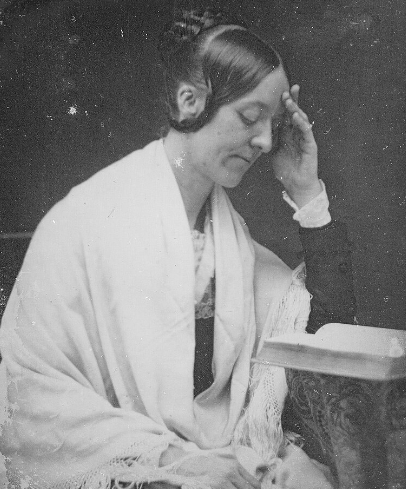
Despite initial fading posthumous recognition and criticism from contemporaries like Harriet Martineau, Fuller’s legacy as a pioneering advocate for women’s rights endures. Image: Detail of the only known daguerreotype of Fuller (by John Plumbe, 1846)
Aside from being an author, what other professions did Margaret Fuller undertake?
Margaret Fuller also worked as a teacher and a journalist. She became the first female war correspondent in the United States.
What was Margaret Fuller forbidden to read by her father during her childhood?
Margaret Fuller was forbidden by her father to read sentimental novels and other feminine materials.
Where did Margaret Fuller receive her formal education before she decided to self-educate in modern languages?
Margaret Fuller received her formal education at the Boston Lyceum for Young Ladies.
What tragic event in 1835 significantly impacted Margaret Fuller’s career and responsibilities?
The death of her father to cholera in 1835 significantly impacted her career and responsibilities, as she had to take care of her mother and family.
Which school did Margaret Fuller first teach at, and where did she go afterward?
Margaret Fuller first taught at Bronson Alcott’s Temple School in Boston and then moved to teach at Greene Street School a year later.
Who employed Margaret Fuller to be the editor of “The Dial” in 1840?
Ralph Waldo Emerson employed Margaret Fuller to be the editor of “The Dial” in 1840.
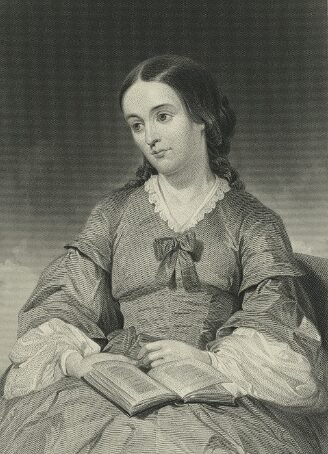
In 1840, she became the first editor of the transcendentalist journal “The Dial,” marking the start of her successful writing career. She joined the New-York Tribune under Horace Greeley in 1844, earning a reputation as the best-read person in New England and becoming the first woman to use Harvard’s library. Image: Engraving of Margaret Fuller
What book did Margaret Fuller publish in 1843, and what was it about?
Margaret Fuller published the book “Summer on the Lakes” in 1843, which consisted of her experiences in Milwaukee, Niagara Falls, and her interactions with some Native American tribes like the Ottawa.
How did Margaret Fuller increase the subscribing list of the New-York Tribune during her stay there?
Margaret Fuller increased the subscribing list of the New-York Tribune to fifty thousand after publishing her first article.
Which prominent personalities admired Margaret Fuller despite her being considered to have a bad temper?
Margaret Fuller was admired by Walt Whitman, Elizabeth Barrett Browning, and Susan B. Anthony.
Who criticized Margaret Fuller after her death and what were the criticisms?
Harriet Martineau criticized Margaret Fuller after her death, calling her a talkative rather than an activist and claiming that Fuller considered herself more important than others.





