Origins: The Era of Abraham and Ishmael
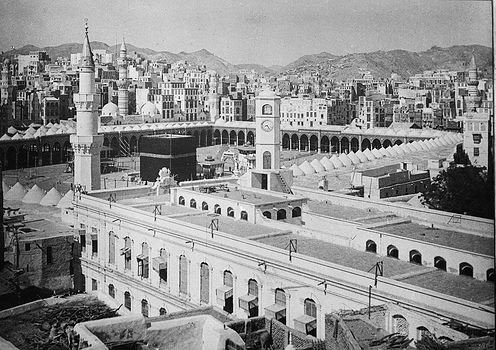
Nestled around the Kaaba in Mecca, Saudi Arabia, Masjid al-Haram’s the heart of the Hajj pilgrimage, a journey every Muslim aspires to undertake. Image: A photo of the mosque in 1910.
Construction of the Kaaba
Islamic tradition holds that the origins of Masjid al-Haram date back to the time of Prophet Abraham (Ibrahim) and his son Ishmael (Ismail). According to the Quran, Abraham was divinely instructed to build the Kaaba, a cube-shaped structure in the heart of Mecca. This act established the Kaaba as the first mosque, dedicated to the worship of one God. The foundation of the Kaaba was laid on a site believed to have been chosen by Adam, the first human, symbolizing a continuity of monotheistic worship.
The Black Stone and Divine Guidance
An essential element in the construction of the Kaaba is the Black Stone (Hajar al-Aswad), believed to be a celestial stone sent down from heaven. Islamic tradition narrates that after building the Kaaba, an angel brought the Black Stone to Abraham, who placed it in the eastern corner of the structure. The placement of the Black Stone not only sanctified the Kaaba but also established a focal point for Islamic rituals, particularly the pilgrimage rites.
Reclamation of Mecca
In the 7th century CE, Prophet Muhammad played a pivotal role in shaping the identity of Masjid al-Haram. In 630 CE, Muhammad led the peaceful conquest of Mecca, reclaiming it from polytheistic control. Upon his return, he ordered the removal and destruction of idols surrounding the Kaaba, thereby purifying the mosque as a center for monotheistic worship. This significant transformation reinforced the mosque’s status as the heart of Islamic faith and practice.
Establishing Monotheism
Under Muhammad’s leadership, Masjid al-Haram transitioned from a polytheistic hub to a unifying center for Muslims. The purification of the Kaaba symbolized the eradication of idolatry and the establishment of pure monotheism. This shift not only solidified the mosque’s spiritual significance but also enhanced its role as a unifying symbol for the nascent Muslim community.
Architectural Evolution: Umayyad and Ottoman Contributions
Umayyad Renovations
The Umayyad dynasty marked the first major architectural transformation of Masjid al-Haram. In 692 CE, Caliph Abd al-Malik ibn Marwan initiated significant renovations, raising the mosque’s outer walls and expanding its prayer spaces to accommodate the growing number of pilgrims.
By the late 8th century, further enhancements included replacing wooden columns with marble ones, extending the prayer hall wings, and constructing a minaret under Caliph Al-Walid I. These modifications not only increased the mosque’s capacity but also reflected the expanding influence of Islam across the Middle East.
Ottoman Enhancements
During the Ottoman era, Masjid al-Haram underwent substantial renovations under Sultan Selim II in 1570. The renowned architect Mimar Sinan led these efforts, introducing domed roofs adorned with intricate calligraphy and new support columns. These architectural features remain integral to the mosque’s current design.
However, natural disasters in the early 17th century caused extensive damage, prompting further restoration under Sultan Murad IV in 1629. This renovation included adding a stone arcade, constructing three additional minarets, and retiling the marble floors, preserving the mosque’s grandeur for nearly three centuries.
10 Greatest Ottoman Sultans and their Accomplishments
Modern Expansions: Saudi Era Developments
First Saudi Expansion (1955-1973)
The modern history of Masjid al-Haram commenced under Saudi rule with the first major expansion between 1955 and 1973. This phase introduced four new minarets, refurbished ceilings, and installed artificial stone and marble floors.
Additionally, the Mas’a gallery, encompassing the hills of Safa and Marwa, was integrated into the mosque through roofing and enclosures. This expansion aimed to accommodate the increasing number of pilgrims and enhance the mosque’s infrastructure, although it involved the removal of many Ottoman-era features.
Second Saudi Expansion (1982-2005)
King Fahd’s second expansion project, undertaken between 1982 and 2005, significantly enhanced Masjid al-Haram’s capacity and facilities. Key developments included the addition of a new prayer wing accessed via the King Fahd Gate and outdoor prayer areas.
From 1987 to 2005, further expansions saw the construction of additional minarets, a royal residence overlooking the mosque, and expanded prayer spaces both within and around the complex.
Modern amenities such as heated floors, air conditioning, escalators, and an advanced drainage system were implemented to improve the experience for millions of worshippers. Accessibility was also prioritized, with dedicated prayer halls and facilities for people with disabilities ensuring inclusivity for all pilgrims.
Third Saudi Expansion (2008-Present)
Announced in 2008 under King Abdullah, the third major expansion aimed to further enlarge Masjid al-Haram’s capacity. This ambitious project involved expropriating extensive land around the mosque and allocating 40 billion riyals for construction.
By 2011, the plans included a multi-level extension, new stairways and tunnels, and two additional minarets, increasing the total to eleven. The expansion also featured enhanced circumambulation areas around the Kaaba and comprehensive climate control systems.
Despite setbacks, including a crane collapse in 2015 that caused numerous casualties, construction resumed in 2017, led by the Saudi Binladin Group. The completion of the Abraj Al Bait complex and the iconic Makkah Royal Clock Tower in 2012 further symbolized the mosque’s ongoing evolution and modernization.
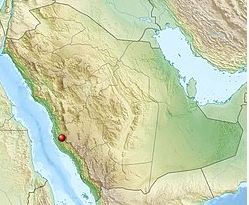
Image: The location (in red) of Masjid al-Haram in Saudi Arabia.
Challenges and Resilience
1979 Siege
A tragic event in 1979 saw extremist insurgents seize Masjid al-Haram, taking hostages and resulting in hundreds of deaths. This attack underscored the mosque’s global religious significance and the strict prohibition of violence within its sacred walls. The incident reinforced the importance of safeguarding the mosque and maintaining its sanctity as a peaceful center for worship.
COVID-19 Pandemic
The COVID-19 pandemic posed unprecedented challenges to Masjid al-Haram. In March 2020, the mosque implemented nighttime closures and suspended Umrah pilgrimages to curb the virus’s spread. Gradual resumption began in October 2020, initially limiting Umrah to Saudi citizens and residents, with visa allocations increasing in subsequent years to accommodate returning pilgrims. These measures highlighted the mosque’s adaptability in ensuring the safety and well-being of worshippers during global crises.
Spiritual and Cultural Significance
Pilgrimages: Hajj and Umrah
Masjid al-Haram is the central hub for the Hajj and Umrah pilgrimages, which are fundamental practices in Islam. The Hajj, performed during the Islamic month of Dhu al-Hijja, is one of the Five Pillars of Islam, obligatory for all able-bodied Muslims who can afford the journey.
The Umrah, a lesser pilgrimage, can be undertaken at any time of the year. Both pilgrimages involve rituals such as circumambulating the Kaaba, touching the Black Stone, and walking between the hills of Safa and Marwa. These practices commemorate the actions of Abraham, Ishmael, and Hagar, reinforcing the mosque’s deep-rooted connections to Islamic heritage.
Religious Leadership
Masjid al-Haram has been guided by a succession of esteemed imams who lead prayers and deliver sermons to millions. Prominent figures like Abd ar-Rahman as-Sudais and Salih bin Abdullah al Humaid have played pivotal roles in maintaining the mosque’s spiritual leadership. The administration of the mosque reflects broader changes within Saudi governance and religious scholarship, ensuring that it remains a center of Islamic learning and spirituality.
Architectural and Structural Features
The Kaaba
At the heart of Masjid al-Haram lies the Kaaba, a cube-shaped building that serves as the focal point for Islamic worship. Muslims worldwide face the Kaaba during daily prayers, symbolizing unity and direction in worship. The Kaaba’s sanctity is central to the rituals performed during Hajj and Umrah, making it the most revered site in Islam.
The Black Stone
Embedded in the eastern corner of the Kaaba, the Black Stone is a significant religious artifact. Pilgrims strive to touch or kiss the stone during circumambulation, emulating Abraham’s act of placement. The Black Stone is believed to be a remnant of the original structure built by Abraham, holding immense spiritual importance.
Maqam Ibrahim
Located near the Kaaba, Maqam Ibrahim is a rock believed to bear the footprint of Abraham. It is housed in a crystal dome and serves as a symbol of Abraham’s unwavering faith. Pilgrims often pause at Maqam Ibrahim to offer prayers, reflecting on the legacy of monotheistic worship established by Abraham.
Safa and Marwa
The hills of Safa and Marwa hold historical and spiritual significance, commemorating Hagar’s search for water for her son Ishmael. Pilgrims perform the sa’y ritual by walking seven times between these two hills, reenacting Hagar’s desperate search and celebrating the divine provision of the Zamzam Well.
Zamzam Well
Situated within the mosque complex, the Zamzam Well is a miraculous water source that, according to tradition, sprang up after Hagar’s search between Safa and Marwa. The water from Zamzam is considered holy and is widely consumed by pilgrims for its perceived blessings and healing properties. The well remains a vital symbol of divine intervention and sustenance.
Makkah Al Mukarramah Library
Adjacent to Masjid al-Haram is the Makkah Al Mukarramah Library, believed to be the birthplace of Prophet Muhammad, also known as Bayt al-Mawlid. This library serves as a repository of Islamic knowledge, housing numerous manuscripts and scholarly works. It underscores the mosque’s role not only as a place of worship but also as a center of learning and intellectual pursuit.
Governance and Administration
Custodian of the Two Holy Mosques
The administration of Masjid al-Haram falls under the purview of the King of Saudi Arabia, who holds the title “Custodian of the Two Holy Mosques,” referring to both Masjid al-Haram in Mecca and Masjid an-Nabawi in Medina. This role entails overseeing the mosque’s maintenance, expansions, and the facilitation of pilgrimages, ensuring that it remains accessible and accommodating to millions of worshippers.
Modern Management
Modern management practices have been implemented to handle the logistical challenges posed by the vast number of pilgrims. Innovations such as advanced drainage systems, air conditioning, heated floors, and escalators have been integrated to enhance comfort and safety. Additionally, extensive security measures are in place to protect the mosque and its visitors, reflecting its status as a global religious epicenter.
Did you know…?
By 2024, Masjid al-Haram became the world’s largest and most expensive mosque, proudly overseen by Saudi Arabia’s Custodian of the Two Holy Mosques.
Conclusion
Masjid al-Haram stands as a testament to the enduring legacy and spiritual depth of Islam. From its ancient origins with Abraham and Ishmael to its modern expansions under Saudi stewardship, the mosque has continuously evolved to meet the needs of millions of worshippers. Its architectural grandeur, coupled with profound religious significance, makes it the heart of Islamic worship and pilgrimage.





