In Greek mythology, Menelaus stands out as a key figure whose life and adventures are crucial to the saga of the Trojan War. His role and character embody themes central to Greek literature and culture, such as leadership, loyalty, heroism, and the complex relationships between gods and mortals.

Menelaus rallied many Greek city-states to sail to the city of Troy and avenge the impudence thrown at him by Trojan Prince Paris. Image: Marble bust of Menelaus, Vatican Museums, Vatican City.
READ MORE: Most Revered Deities in Greek Mythology
Origins and Family Background
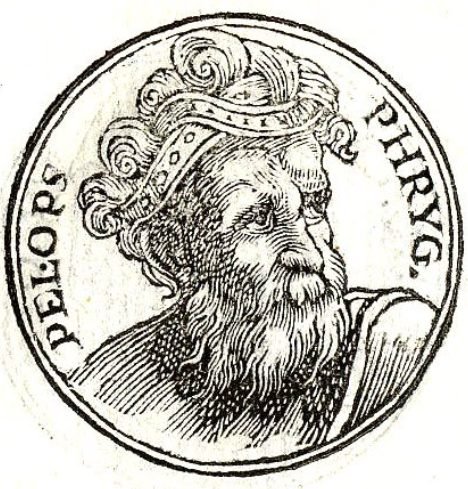
Menelaus was a king of Sparta, one of the prominent city-states in ancient Greece. He belonged to the house of Atreus, making him a descendant of Pelops and Tantalus, figures steeped in myths of tragedy and moral lessons.

Image: A painting of Tantalus by Italian artist Gioacchino Assereto.
Menelaus was the younger brother of Agamemnon, the leader of the Greek forces in the Trojan War, and had a sister named Anaxibia. According to different sources, Menelaus and Agamemnon were either the sons of Atreus and Aerope or of Atreus’s son Pleisthenes and Aerope. In some accounts, after the early death of Pleisthenes, Atreus raised his grandsons.

Family tree of Tantalus in Greek mythology
Did you know…?
Menelaus’s name, meaning “wrath of the people,” combines menos (vigor, rage, power) and laos (people).
Menelaus and Helen: A Marriage That Sparked a War
Menelaus’s marriage to Helen, famously known as Helen of Troy, was a pivotal event in Greek mythology. Helen was considered the most beautiful woman in the world, and her marriage was contested by many prominent Greek leaders.

Helen of Troy by Evelyn De Morgan (1898, London)
To manage the numerous suitors and avoid conflict, Odysseus suggested that all suitors should swear an oath to defend the chosen husband against any wrongdoing in the future. This oath played a crucial role in subsequent events.
Menelaus was chosen to be Helen’s husband, and the couple ruled Sparta together. However, their marriage was tested when Paris, prince of Troy, abducted Helen, either by seduction or by force, depending on the source. This act led to the Trojan War, as the suitors were bound by their oath to retrieve Helen and defend Menelaus’s honor.

“The Abduction of Helen” by Gavin Hamilton (1784)
Menelaus in the Trojan War
As the Trojan War broke out, Menelaus’s role was not just as a wronged husband but also as a warrior and a leader. He actively participated in numerous battles and was known for his bravery and strategic skills.
One of the most notable episodes involving Menelaus is his duel with Paris, which was supposed to decide the outcome of Helen’s fate.
Although Menelaus bested Paris in combat, the duel did not conclude definitively due to divine intervention, which saved Paris from death at the hands of Menelaus.

Menelaus is depicted in Greek vase paintings from the 6th to 4th centuries BC in scenes including his reception of Paris, retrieval of Patroclus‘s body, and reunion with Helen. Image: The body of Patroclus borne by Menelaus, Roman sculpture, Florence, Italy
Throughout the Iliad, ancient Greek poet Homer portrays Menelaus as a competent and respected leader, albeit overshadowed at times by his brother Agamemnon.
Menelaus’s character is marked by his sense of duty and honor, his emotional depth, and his resilience in the face of personal and collective crises.
The Return Home and Later Life
Unlike his brother Agamemnon, who met a tragic end upon returning home, Menelaus’s post-war life was marked by reconciliation and peace.

“The Procession of the Trojan Horse into Troy” by Giovanni Domenico Tiepolo (1773)
According to Homer’s Odyssey, after the fall of Troy, Menelaus wandered for several years, encountering various challenges that delayed his return to Sparta. Eventually, he and Helen were reconciled and lived harmoniously, hosting other heroes and providing wise counsel to younger generations.

The Burning of Troy (1759-62), oil painting by Johann Georg Trautmann
This harmonious conclusion to Menelaus’s story contrasts with the tumultuous lives and tragic fates of many of his contemporaries. It provides a narrative closure that restores order and reaffirms the values of forgiveness and stability.
Menelaus’s Role in Greek Culture and Art
In Greek vase paintings, Menelaus is often depicted in scenes from the Trojan War, particularly in moments of battle or significant encounters such as his duel with Paris or his interventions on the battlefield. These artistic representations reflect his valor and the pivotal role he played in one of the most enduring stories from Greek mythology.
In Greek tragedy, Menelaus appears as a character who deals with themes of loyalty, betrayal, and the repercussions of war. His portrayals vary, but he is consistently shown as a figure trying to navigate the challenging moral landscape that defines much of Greek tragedy.
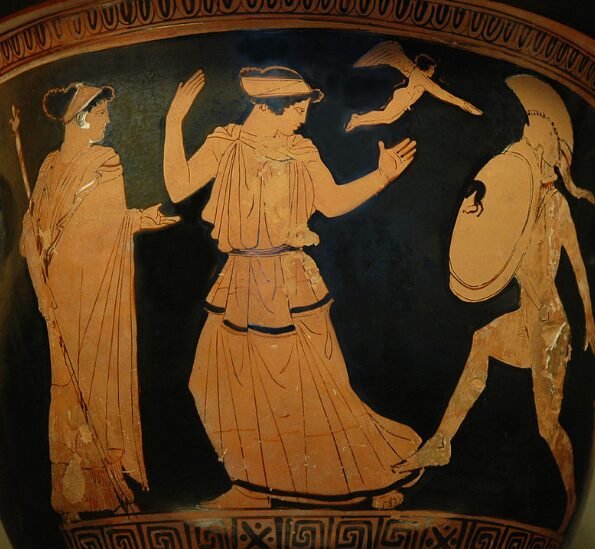
Menelaus regains Helen, detail of an Attic red-figure crater, c. 450–440 BC, found in Gnatia (now Egnazia, Italy).
READ MORE: Most Famous Heroes and Heroines in Greek Mythology
Legacy and Interpretation
Menelaus’s legacy in Greek mythology is complex. He is both a hero and a victim of fate, a leader who navigates through personal loss and political turmoil. His story offers insights into the Greek understanding of leadership, the bonds of marriage, and the responsibilities of those who rule.
His reconciliation with Helen highlights themes of love, forgiveness, and the restoration of order, contrasting with the more common tragic trajectories of mythological figures. Menelaus’s enduring love for Helen, despite the betrayal and the war it caused, speaks to the power of personal relationships in shaping history and destiny in Greek narratives.
Moreover, Menelaus’s experiences reflect the ancient Greeks’ views on divine influence and human agency. His life, marked by the interplay of divine interventions and personal choices, underscores the complex dynamics between fate and free will—a central theme in Greek philosophy and literature.
The enduring fascination with Menelaus’s character and his role in the Trojan War saga illustrates the broader cultural and historical significance of these myths. They not only entertained but also provided moral and ethical guidance, offered insights into the human condition, and helped forge a collective identity among the Greek city-states.
In conclusion, Menelaus’s narrative arc from a king in Sparta to a central figure in the Trojan War encapsulates themes of power, loss, and redemption—core elements that continue to resonate in the study of classical mythology. His journey offers profound lessons on resilience, the consequences of choices, and the enduring power of love and forgiveness.
Frequently Asked Questions
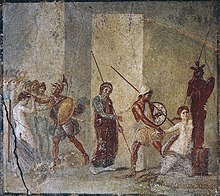
Menelaus is a central character in both Homer’s Iliad and Odyssey and was frequently depicted in Greek vase painting and tragedy, revered more for his role in the Trojan War than his family’s tragic legacy. Image: Menelaus captures Helen in Troy, Ajax the Lesser drags Cassandra from Palladium before eyes of Priam, fresco from the Casa del Menandro, Pompeii