Who wrote the Iliad – and what is it about?
The Iliad is one of the oldest and most significant works of Western literature. As an epic poem attributed to the ancient Greek poet Homer, it narrates the dramatic events of the Trojan War, focusing particularly on the themes of heroism, wrath, honor, and fate. This monumental work not only captures the essence of ancient Greek culture but also continues to resonate with modern audiences for its timeless exploration of human experiences.

Bohemian graphic artist Wenceslas Hollar’s engraved title page of a 1660 edition of the Iliad, translated by John Ogilby
Historical Context
The Iliad is traditionally dated to the late 8th or early 7th century BC. It reflects the oral traditions of ancient Greece, which were preserved and transmitted by professional storytellers known as rhapsodes.
The events described in the Iliad are set in the mythical Bronze Age, around the 12th or 13th century BC, coinciding with the historical Late Bronze Age collapse. The Trojan War, around which the poem is centered, is believed to have been inspired by actual conflicts in the region of Anatolia.
The Role of Oral Tradition
Homer likely composed the Iliad within a tradition of oral storytelling. This tradition used formulaic expressions, stock epithets, and repetitive phrases, enabling poets to craft epic tales while performing them. The poem was probably recited at public festivals, such as the Panathenaic Games in Athens, where Homeric poetry was central to cultural identity.
Authorship and the Homeric Question
The authorship of the Iliad has long been debated. Known as the “Homeric Question,” scholars have speculated whether Homer was a single individual or a collective identity representing multiple poets.

The Iliad is one of the oldest surviving works of literature, attributed to Homer and composed in Homeric Greek around the late 8th or early 7th century BC. Marble terminal bust of Homer. Roman copy of a lost Hellenistic original of the 2nd c. BC
Some argue that Homer authored both the Iliad and the Odyssey, while others believe these works emerged independently within the oral tradition. Despite these debates, Homer is widely regarded as one of the foundational figures in Western literary history.
Summary of the Iliad

The Iliad, divided into 24 books and written in dactylic hexameter, contains 15,693 lines and depicts the events of the Trojan War’s final weeks, focusing on the conflict between King Agamemnon and the hero Achilles. Image: Iliad, Book VIII, lines 245–253, Greek manuscript, late 5th, early 6th centuries AD
The Iliad begins in medias res (in the middle of things), during the final weeks of the Trojan War. Over the course of 24 books and 15,693 lines, it captures the intense conflicts among the Achaeans (Greeks) and Trojans, the involvement of the gods, and the destructive wrath of Achilles, the Achaeans’ greatest warrior.

The Rage of Achilles, fresco by Italian painter Giovanni Battista Tiepolo (1757, Villa Valmarana ai Nani, Vicenza)
Plot Overview

Achilles’ surrender of Briseis to Agamemnon, from the House of the Tragic Poet in Pompeii, fresco, 1st century AD, now in the Naples National Archaeological Museum
Invocation and Agamemnon’s Quarrel with Achilles
The poem opens with an invocation to the Muse and quickly establishes the central conflict: a quarrel between Agamemnon, the leader of the Achaeans, and Achilles.
Agamemnon’s refusal to return the captive Chryseis to her father, a priest of Apollo, causes a plague to strike the Greek camp. Under pressure, Agamemnon agrees to return Chryseis but takes Achilles’ war prize, Briseis, as compensation. Feeling dishonored, Achilles withdraws from battle.

The murder of Agamemnon (1879 illustration from Alfred Church’s Stories from the Greek Tragedians)
History and Major Facts about the Three Most Acclaimed Greek Tragedians
Divine Intervention and the Trojans’ Success
Achilles prays to his mother, the sea goddess Thetis, to persuade Zeus to favor the Trojans. Zeus agrees, and the Trojans gain the upper hand in battle. The gods frequently intervene, with Hera and Athena supporting the Greeks, while Apollo and Aphrodite favor the Trojans.

Crafted by Hephaestus, Achilles’s shield symbolizes the cosmos and human experience, reflecting the broader themes of life, war, and destiny. Image: Thetis at Hephaestus’s forge waiting to receive Achilles’s new weapons. Fresco from Pompeii, 1st century
Heroic Duels and Battles
The poem features several notable duels, including Paris versus Menelaus and Hector versus Ajax. These moments highlight individual heroism but often end inconclusively due to divine interference.

Heroism is explored through Achilles’ pursuit of eternal glory (kleos) and Hector’s loyalty to family and country, highlighting contrasting ideals of honor. Image: Ajax the Great’s Duel with Hector
Patroclus’ Death and Achilles’ Return
Achilles’ close companion, Patroclus, enters the battlefield wearing Achilles’ armor to inspire the Greek forces. Patroclus fights bravely but is killed by Hector, the Trojan prince. Overcome with grief, Achilles reconciles with Agamemnon and vows to avenge Patroclus.

Hector is Troy’s greatest warrior and a tragic hero whose death symbolizes the inevitability of fate and loss. Hector Admonishes Paris for His Softness and Exhorts Him to Go to War by J. H. W. Tischbein (1751–1828)
Hector’s Death
In a climactic duel, Achilles kills Hector outside the walls of Troy. He desecrates Hector’s body by dragging it behind his chariot, igniting the anger of the gods.

Achilles Slays Hector, by Sir Peter Paul Rubens (1630–35)
Priam’s Plea and Hector’s Burial
The poem concludes with a poignant scene where Priam, the Trojan king, visits Achilles to beg for the return of Hector’s body. Moved by their shared grief, Achilles relents, and Hector’s body is returned for a proper burial.

Priam Begs the Body of Hector by Swiss painter Henry Fuseli
Themes in the Iliad

Part of the Epic Cycle, the Iliad explores themes like glory (kleos), pride, fate, and wrath while integrating moments of comedy. The Olympian gods play a central role, intervening in battles and disputes, reflecting Ancient Greek religious beliefs. Image: The Trojan prince Ganymede filling Zeus’s cup, Geras painter, 480-470 BC, Louvre
The Iliad explores themes that are both universal and deeply rooted in ancient Greek culture:
Wrath and Pride
The poem’s central theme is the destructive power of wrath, particularly Achilles’ anger. This wrath drives much of the narrative and underscores how unchecked emotions can lead to devastating consequences.
Fate and Mortality
Characters in the Iliad grapple with their mortality and the inevitability of fate. Achilles faces a poignant choice between a long, uneventful life and a short, glorious one, ultimately choosing the latter to secure eternal renown.
Heroism and Honor
The poem examines what it means to be a hero. Achilles’ pursuit of glory (kleos) contrasts with Hector’s loyalty to his family and city. The quest for honor motivates many of the characters’ actions, often leading to tragedy.
The Role of the Gods
The Olympian gods are deeply involved in mortal affairs, acting as both protectors and antagonists. Their interventions reflect their rivalries and emotions, making them human-like despite their divine status.
The Cost of War
While celebrating martial valor, the Iliad also portrays the human cost of war. Scenes like Hector’s farewell to Andromache and Priam’s plea to Achilles highlight the suffering and loss experienced by both victors and the vanquished.

Hector’s farewell underscores the personal cost of war, portraying him as a devoted husband and father who sacrifices everything for his city. Image: Hector’s last visit with his wife, Andromache, and infant son Astyanax, startled by his father’s helmet (Apulian red-figure vase, 370–360 BC)
Major Characters

Known for its masculine, heroic tone, the Iliad features detailed battle scenes and fewer female characters than the Odyssey. Image: Calypso calling heaven and earth to witness her sincere affection to Odysseus (i.e. Ulysses) by Swiss Neoclassical painter Angelica Kauffman (18th-century)
The Iliad features a wide array of characters, each contributing to its rich narrative.
Greek (Achaean) Characters
- Achilles: The greatest Greek warrior, whose wrath and grief drive the narrative.
- Agamemnon: Leader of the Achaeans, whose arrogance sparks the conflict with Achilles.
- Odysseus: Known for his cunning, he serves as a diplomat and strategist.
- Patroclus: Achilles’ close companion, whose death becomes a pivotal moment.
- Ajax the Greater: A formidable warrior who fights Hector in a memorable duel.

The Argument between Ajax and Odysseus over Achilles’ armour, by Agostino Masucci
Trojan Characters

Achilles kills Hector after a relentless chase around Troy. He desecrates Hector’s body by dragging it behind his chariot, enraging the gods. Image: Achilles versus Hector
- Hector: The Trojan prince and hero, renowned for his courage and sense of duty.
- Priam: The wise and compassionate king of Troy, who grieves deeply for his sons.
- Paris: Hector’s brother, whose abduction of Helen sparks the war.
- Helen: The most beautiful woman in the world, her abduction is the cause of the conflict.

Priam at the feet of Achilles by French painter Jérôme-Martin Langlois
Gods and Goddesses
- Zeus: King of the gods, who oversees and often manipulates events.
- Hera: Zeus’s wife, who favors the Greeks.
- Athena: The goddess of wisdom and war, supporting the Greeks.
- Apollo: The god of the sun, who aids the Trojans.
- Aphrodite: The goddess of love, who protects Paris and favors the Trojans.

Mars and Venus Surprised by Vulcan (1827) by Alexandre Charles Guillemot
Structure and Literary Style
The Iliad is composed in dactylic hexameter, a poetic meter common in ancient Greek epic poetry. Its language is a mix of Ionic and Aeolic dialects, reflecting its origins in oral tradition.
Key Stylistic Features
- Stock Epithets: Repeated descriptive phrases (e.g., “swift-footed Achilles”) that aid in oral recitation.
- Similes: Extended comparisons that add depth and vividness to the narrative.
- Repetition: The use of recurring phrases and scenes to create rhythm and emphasize key themes.
Cultural and Historical Significance

The Iliad‘s formal style, including repetitions, similes, and epithets, and its humanized portrayal of gods have made it a cornerstone of European literature. Image: Zeus aiming his thunderbolt at a winged and snake-footed Typhon. Chalcidian black-figured hydria (c. 540–530 BC), Staatliche Antikensammlungen (Inv. 596)
The Iliad offers valuable insights into the values, beliefs, and practices of ancient Greek society. It emphasizes the importance of honor, the warrior ethos, and the interplay between human effort and divine will.
Depictions of Warfare
The poem provides detailed descriptions of Bronze Age combat, including chariot warfare, armor, and weapons. While some aspects may reflect later periods, the Iliad preserves elements of Mycenaean military practices.
Religion and Mythology
The Iliad reflects the Greek understanding of the gods as active participants in human affairs. It also highlights the cultural significance of rituals, such as burial rites and sacrifices.
The Iliad’s Enduring Legacy
The Iliad has had a profound impact on Western literature, art, and culture. Its themes and characters have inspired countless adaptations, from ancient tragedies to modern novels.
Influence on Literature
- Ancient Greek tragedians, such as Aeschylus, Sophocles, and Euripides, drew heavily on the Iliad for their plays.
- Roman authors, including Virgil, imitated Homeric themes in works like the Aeneid.
- The poem continues to inspire contemporary writers, such as Madeline Miller in The Song of Achilles.
Cinematic and Artistic Representations
- The Trojan War has been depicted in numerous films, including Troy (2004), which starred Brad Pitt as Achilles, Eric Bana as Hector, and Orlando Bloom as Prince Paris.
- Artistic depictions of scenes from the Iliad, such as Hector’s death or Achilles’ shield, remain popular subjects in visual art.
Philosophical and Psychological Insights
The Iliad has been analyzed for its exploration of human emotions and decision-making. Scholars like Simone Weil and Jonathan Shay have examined its relevance to understanding war and trauma.
Conclusion
Homer’s Iliad is a timeless masterpiece that transcends its historical origins. Through its vivid characters, intricate narrative, and profound themes, it captures the complexity of human experience and the enduring allure of heroism. Whether studied for its literary brilliance or its cultural insights, the Iliad remains a cornerstone of world literature and a testament to the power of storytelling.
Frequently Asked Questions

The Iliad is an ancient Greek epic poem attributed to Homer, focusing on the final weeks of the Trojan War. It explores themes of heroism, honor, wrath, fate, and mortality. Image: Inscription of lines 468–473, Book I. 400–500 AD, from Egypt. On display at the British Museum, London.
When was the Iliad composed?
The Iliad was likely composed in the late 8th or early 7th century BC and reflects oral traditions.
How is the Iliad structured?
The poem is divided into 24 books, written in dactylic hexameter, and consists of 15,693 lines.
The Iliad focuses on a short period during the final year of the war, not the entire ten-year conflict.

Key motifs include honor and glory, the inevitability of death, and the interference of gods in human affairs. Image: The Funeral of Patroclus by French painter Jacques-Louis David, 1778.
What is the significance of the Iliad in literature?
The Iliad is one of the oldest works of Western literature and remains a foundational text for understanding heroism, leadership, and the human condition.
How does the Iliad begin?
The poem begins in medias res (in the middle of things) with an invocation to the Muse, focusing on a quarrel between Agamemnon and Achilles.

The Muses in Greek mythology. Image: Apollo and the Muses on Mount Helicon (1680) by French painter Claude Lorrain
What triggers the conflict between Agamemnon and Achilles?
Agamemnon dishonors Achilles by taking his war prize, Briseis, after being forced to return Chryseis to her father, a priest of Apollo.
How does Achilles respond to Agamemnon’s actions?
Achilles withdraws from battle and asks his mother, Thetis, to persuade Zeus to favor the Trojans, leaving the Greeks in a desperate position.
What role does Paris play in the war?
Paris, the Trojan prince, abducted Helen, sparking the Trojan War. He later challenges Menelaus to a duel, which ends inconclusively when Aphrodite saves Paris.

Helen is the wife of Menelaus, whose abduction by Paris sparks the Trojan War. She is often called “the face that launched a thousand ships.” Image: “The Abduction of Helen” by Scottish painter Gavin Hamilton (1784)
How does Patroclus influence the story?
Patroclus, Achilles’ close companion, dons Achilles’ armor and leads the Myrmidons into battle. He is slain by Hector, which reignites Achilles’ involvement in the war.

Achilles returns to avenge Patroclus’ death, knowing it will seal his own fate. His grief and rage drive him to confront Hector. Image: Triumphant Achilles dragging Hector’s body around Troy, from a panoramic fresco of the Achilleion
How does the Iliad end?
The poem ends with the funeral of Hector, Prince of Troy, after he is slain by Achilles. It does not include the fall of Troy.
What are the major themes in the Iliad?
Key themes include wrath, pride, fate, mortality, heroism, the role of the gods, and the human cost of war.

The poem ends with Hector’s burial. Priam’s plea for his son’s body leads to a temporary truce and a moment of shared humanity between Achilles and Priam. Image: Priam Pleading with Achilles for the Body of Hector by Gavin Hamilton (1775)
How are the gods involved in the story?
The Olympian gods frequently intervene in mortal affairs, motivated by their rivalries and passions, highlighting the vulnerability of humans and the whims of divine power

The Iliad captures the brutality and heroism of war, while also emphasizing its human cost through moments of compassion, loyalty, and love. Image: Depiction of Achilles and the Myrmidons
What historical period does the Iliad reflect?
The Iliad draws on the values and warfare of the Mycenaean age, blending elements of Bronze Age and later Greek culture.
Why is the Iliad considered timeless?
The Iliad resonates with universal themes such as the fleeting nature of life, the consequences of anger, and the search for meaning, making it relevant across cultures and eras.
The Iliad has inspired countless adaptations, from ancient tragedies to modern works like Madeline Miller’s The Song of Achilles.

They share a deep bond of friendship, often interpreted as a brotherly or romantic relationship. Image: Achilles tending the wounded Patroclus (Attic red-figure kylix, c. 500 BC)
Is the Iliad difficult to read?
It can be challenging due to its ancient language, cultural context, and complex names, but modern translations make it more accessible.
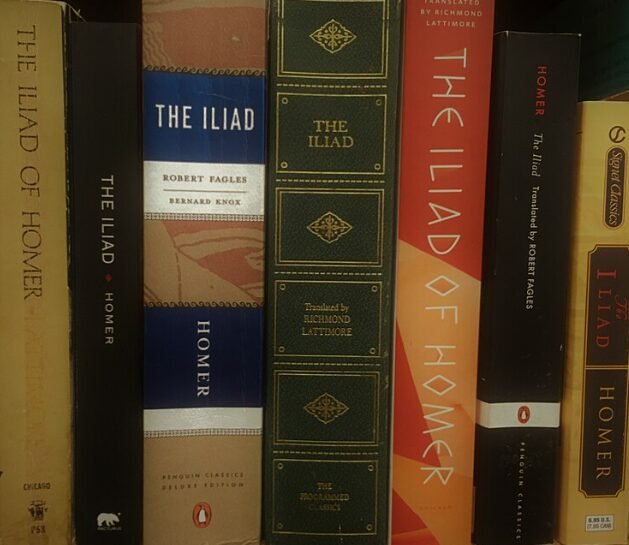
Sampling of translations and editions of Homer’s Iliad in English
How does the Iliad depict women?
Women are portrayed in various roles—war prizes, divine figures, and emotional anchors—reflecting their complex status in Greek society.
Does Achilles die in the Iliad?
No, Achilles’ death is not included in the Iliad. His death occurs in later myths, after the events of the poem.





