Michael Faraday: History, Notable Works and Facts

Michael Faraday was an eminent English scientist known for his significant contributions to the fields of electromagnetism and electrochemistry.
Michael Faraday was born on September 22, 1791, in Newington Butts, a village in Surrey, England. He came from a humble background; his father, James Faraday, was a blacksmith, and his mother, Margaret Hastwell, was a homemaker.
Faraday’s family struggled financially, and young Faraday received only a basic education at a local school until the age of 13, when he had to leave to help support the family. Despite these limitations, Faraday’s innate curiosity and determination to learn set the stage for his future achievements.
At the age of 14, Faraday became an apprentice to George Riebau, a local bookbinder and bookseller. This position proved to be a significant turning point in his life.
Surrounded by books, Faraday educated himself by reading voraciously. He developed an interest in science, particularly in electricity and chemistry, through reading works by prominent scientists of the time, such as Isaac Watts’ “The Improvement of the Mind” and Jane Marcet’s “Conversations on Chemistry.”

Michael Faraday, one of the most admired scientists of the 19th century, overcame his humble beginnings through a combination of insatiable curiosity and fierce determination. Despite limited formal education, he carried out groundbreaking research that laid the principles for transformers and generators. Image: Portrait of Faraday in 1842 by English painter Thomas Phillips
Entry into the World of Science
Faraday’s entry into the scientific community was serendipitous. In 1812, a customer at Riebau’s shop gave him tickets to attend lectures by the renowned chemist Humphry Davy at the Royal Institution. Faraday attended these lectures, took meticulous notes, and later bound them into a book, which he sent to Davy along with a letter expressing his desire to work in science. Impressed by Faraday’s enthusiasm and potential, Davy offered him a job as his assistant in 1813.
Working with Davy was a formative experience for Faraday. He accompanied Davy on a European tour, during which he was exposed to the scientific elite of the time and observed various experiments and demonstrations. This exposure broadened his knowledge and solidified his commitment to a career in science. Upon their return to England, Faraday continued to work at the Royal Institution, where he would spend the rest of his career.
Major Scientific Accomplishments

Michael Faraday created the first carbon and chlorine compounds, C2Cl6 and C2Cl4, in 1820 and developed a comprehensive theory of electrical action by 1839. Image: Electromagnetic rotation experiment of Faraday, 1821, the first demonstration of the conversion of electrical energy into motion
Electromagnetism
Faraday’s most significant contributions to science were in the field of electromagnetism. His work laid the foundation for many modern technologies and advanced the understanding of electromagnetic phenomena.
- Electromagnetic Induction: In 1831, Faraday discovered electromagnetic induction, a principle that describes how a changing magnetic field can induce an electric current in a conductor. This discovery was monumental, as it formed the basis for the generation of electricity. Faraday’s experiments demonstrated that moving a magnet through a coil of wire could generate an electric current, a principle that underpins electric generators and transformers.
- Electromagnetic Field: Faraday’s experiments with the magnetic field around a conductor carrying a direct current led to the concept of the electromagnetic field. He showed that a magnetic field could influence the area around it, and this field could affect other materials. This idea was revolutionary and later became a cornerstone of classical field theory in physics.
- Electromagnetic Rotation: Faraday’s invention of the first electromagnetic rotary device in 1821 marked the beginning of electric motor technology. His simple yet ingenious device converted electrical energy into mechanical motion, demonstrating the practical application of electromagnetic principles. This work paved the way for the development of electric motors, which are ubiquitous in modern machinery and appliances.
Electrochemistry
Faraday also made substantial contributions to electrochemistry, the study of the relationship between electricity and chemical reactions.
- Laws of Electrolysis: Faraday formulated the laws of electrolysis, which quantify the relationship between the amount of electric charge passed through an electrolyte and the amount of substance deposited at the electrodes. These laws were fundamental in understanding electrochemical reactions and have applications in various industries, including electroplating, battery technology, and metallurgy.
- Terminology: Faraday introduced several key terms still used in electrochemistry today, such as “anode” (the positive electrode), “cathode” (the negative electrode), “electrode” (the conductor through which electricity enters or leaves an electrolyte), and “ion” (the charged particles that move towards the electrodes).
Chemistry

Faraday used a glass bar in 1845 to demonstrate that magnetism can affect light passing through a dielectric material. Image: Equipment used by English scientist Faraday to make glass.
Faraday’s contributions to chemistry were equally impressive and influential.
- Discovery of Benzene: In 1825, Faraday discovered benzene, a fundamental organic compound. Benzene’s unique structure and properties make it a key substance in organic chemistry, with extensive applications in the chemical industry, including the production of plastics, resins, synthetic fibers, rubber, dyes, detergents, drugs, and pesticides.
- Clathrate Hydrates: Faraday investigated the clathrate hydrate of chlorine, a compound in which gas molecules are trapped within a lattice of water molecules. This work was significant in the study of gas hydrates, which have implications for natural gas storage and transport.
- Bunsen Burner: Faraday invented an early form of the Bunsen burner, a device that provides a clean, controllable flame for laboratory experiments. This tool became a staple in chemical laboratories and is still widely used today.
- System of Oxidation Numbers: Faraday developed the system of oxidation numbers, which helps chemists understand and balance chemical reactions. This system is essential for studying redox reactions and remains a fundamental concept in chemistry education and research.
Faraday as an Educator and Communicator
Faraday’s ability to convey complex scientific concepts in a clear and accessible manner was one of his most remarkable traits. He was a gifted lecturer and a passionate advocate for science education. His Christmas Lectures at the Royal Institution, aimed at young audiences, became an annual tradition and continue to this day. These lectures were designed to inspire and educate the public about scientific principles and discoveries.
Faraday’s dedication to public science education extended beyond his lectures. He wrote extensively for general audiences, contributing articles to popular science magazines and giving public demonstrations. His ability to simplify and explain scientific concepts made him a beloved figure in the scientific community and beyond.
Recognition and Legacy

He is commemorated with a plaque near Isaac Newton’s tomb at Westminster Abbey, a testament to his immense contributions to science. Image: Plaque erected in 1876 by the Royal Society of Arts in Marylebone, London.
Faraday’s contributions to science were widely recognized during his lifetime and continue to be celebrated today. He received numerous honors and awards, including being elected a Fellow of the Royal Society in 1824. Despite his lack of formal education and mathematical training, Faraday’s intuitive and experimental approach to science earned him a lasting legacy as one of the greatest experimentalists in the history of science.
One of the most significant acknowledgments of Faraday’s work came from James Clerk Maxwell, who mathematically formalized Faraday’s experimental findings into what are now known as Maxwell’s equations. These equations form the foundation of classical electromagnetism and are considered one of the great achievements of 19th-century physics. Maxwell praised Faraday’s conceptual understanding of electromagnetic fields, noting that Faraday’s use of lines of force demonstrated a deep and profound insight into the nature of electromagnetic phenomena.
In recognition of Faraday’s contributions, the SI unit of capacitance was named the farad. This honor reflects Faraday’s lasting impact on the field of electrical science and his role in advancing the understanding of electrical and magnetic phenomena.

Albert Einstein, one of the most influential physicists of the 20th century, kept a picture of Faraday on his study wall, alongside portraits of Isaac Newton and James Clerk Maxwell. Image: A 1921 picture of Albert Einstein.
Ernest Rutherford, a pioneer in nuclear physics, also acknowledged Faraday’s immense contributions. Rutherford remarked that no honor was too great for Faraday, given the magnitude and extent of his discoveries and their influence on both science and industry. Faraday’s work not only advanced scientific knowledge but also had practical applications that transformed industries and improved the quality of life for countless people.
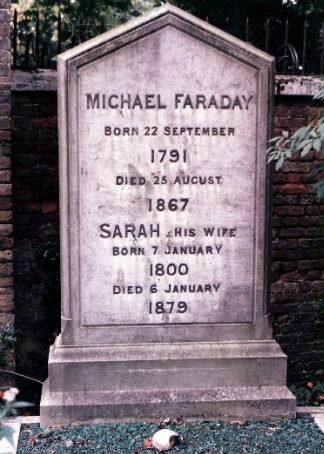
Michael Faraday passed away on August 25, 1867, at 75. Image: Faraday’s grave at Highgate Cemetery, London
Personal Life and Character
Faraday’s personal life was marked by his strong moral character and dedication to his principles. He was a devout Christian and a member of the Sandemanian Church, a sect of the Church of Scotland. His faith played a significant role in his life and influenced his approach to science and work. Faraday believed that his scientific pursuits were a way to understand and appreciate the natural world, which he saw as a reflection of divine creation.
Faraday married Sarah Barnard in 1821, and their marriage was a happy and supportive partnership. Despite the demands of his scientific career, Faraday remained devoted to his family and maintained a balanced and fulfilling personal life.
Faraday’s humility and modesty were notable aspects of his character. He consistently downplayed his achievements and often attributed his success to hard work and perseverance rather than innate talent. This humility endeared him to his colleagues and students and contributed to his reputation as a man of great integrity and honor.

Michael Faraday received numerous honors and awards, including being elected a Fellow of the Royal Society in 1824.
Did you know…?
- Influential works like Isaac Watts’ “The Improvement of the Mind” and Jane Marcet’s “Conversations on Chemistry” fueled Faraday’s interest in science, particularly electricity.
- Faraday married Sarah Barnard on June 12, 1821. He was a devoted Christian and served as a deacon in the Church of Scotland.
- Faraday declined a knighthood, preferring to remain plain Mr. Faraday. The acclaimed scientist cited religious reasons for the decline.
- The University of Oxford awarded Faraday an honorary Doctor of Civil Law degree in 1832.
- Albert Einstein kept a picture of Faraday on his study wall alongside portraits of Isaac Newton and James Clerk Maxwell, acknowledging Faraday’s pivotal role in the advancement of science. Ernest Rutherford recognized Faraday’s immense contributions by stating that no honor was too great for a man whose discoveries had a profound impact on both science and industry.
Conclusion
Michael Faraday’s life and accomplishments are a testament to the power of curiosity, perseverance, and dedication to knowledge. From his humble beginnings as a bookbinder’s apprentice to becoming one of the most influential scientists in history, Faraday’s journey is an inspiring example of how passion and determination can overcome obstacles and lead to extraordinary achievements.
Faraday’s discoveries in electromagnetism and electrochemistry revolutionized scientific understanding and laid the groundwork for numerous technological advancements that continue to shape our world. His contributions to chemistry, including the discovery of benzene and the invention of the Bunsen burner, further highlight his versatility and impact across multiple scientific disciplines.
Faraday’s legacy as an educator and communicator of science is equally significant. His ability to make complex scientific concepts accessible to the public and inspire future generations of scientists remains an enduring part of his legacy.
Questions and Answers about Michael Faraday

Faraday’s scientific expertise was applied practically through government roles, including Professor of Chemistry at the Royal Military Academy in Woolwich (1830–1851) and Scientific Advisor to Trinity House (1836–1865). Image: Statue of Faraday in Savoy Place, London. Sculptor John Henry Foley.
What were some of Michael Faraday’s groundbreaking discoveries?
Faraday’s groundbreaking discoveries include the principles of electromagnetic induction, diamagnetism, and electrolysis.
How did Faraday establish the concept of the electromagnetic field?
Faraday established the concept of the electromagnetic field through his meticulous experiments on the magnetic field around a conductor carrying a direct current. He demonstrated that magnetism could influence light rays and discovered an intrinsic relationship between the two phenomena.
What is the principle of electromagnetic induction, and why is it significant?
The principle of electromagnetic induction explains how a changing magnetic field can induce an electric current in a conductor. This principle is fundamental to the operation of electric generators and transformers, making it significant for both scientific understanding and practical applications in technology.

Born as the third of four children, Faraday had to educate himself with minimal schooling. At 14, he became an apprentice to George Riebau, a bookbinder and bookseller, where he read extensively. Image: Portrait of young Michael Faraday, c. 1826
What were some of Faraday’s contributions to the field of chemistry?
In chemistry, Faraday discovered benzene, investigated the clathrate hydrate of chlorine, invented an early form of the Bunsen burner, and developed the system of oxidation numbers. He also coined essential scientific terms such as “anode,” “cathode,” “electrode,” and “ion.”
What position did Faraday hold at the Royal Institution, and what was notable about his teaching style?
Faraday was the first Fullerian Professor of Chemistry at the Royal Institution, a position he held for life. He was known for his ability to communicate complex ideas in clear and accessible language, which helped popularize science and inspire future generations of scientists.
How did James Clerk Maxwell build upon Faraday’s work?
James Clerk Maxwell built upon Faraday’s work by formulating a set of equations that mathematically described electromagnetic phenomena, known as Maxwell’s equations. Maxwell praised Faraday’s use of lines of force and recognized his deep understanding of the subject.
What unit is named in honor of Michael Faraday, and what does it measure?
The SI unit of capacitance, the farad, is named in honor of Michael Faraday. It measures the ability of a system to store an electric charge.
What is Faraday’s legacy in modern science and technology?
Faraday’s work laid the foundations for many aspects of modern science and technology. His discoveries in electromagnetism and electrochemistry revolutionized scientific understanding and paved the way for numerous technological advancements. Faraday’s ability to transcend the limitations of his formal education and his dedication to experimentation and clear communication continue to inspire scientists and engineers today.





