Mímir in Norse Mythology: Origin Story & Death
Mímir is one of the most enigmatic and revered figures in Norse mythology, known for his immense wisdom and deep connection to knowledge. His story is closely intertwined with the themes of memory, sacrifice, and the pursuit of knowledge, which are central to the myths of the Norse gods.
Mímir’s legacy is largely defined by his origin, role in the Æsir-Vanir War, and, most famously, his decapitation and continued presence as a source of wisdom for the chief god Odin.
This detailed exploration of Mímir’s origin and death delves into the symbolic meaning of his story, his importance in Norse cosmology, and his lasting legacy in myth.
Mímir’s Origin and Etymology
The origin of Mímir is somewhat mysterious, as Norse mythology doesn’t provide a direct creation myth for him. However, his name and role as a wise figure suggest that he was one of the primordial beings or gods, present before the major events of Norse mythology began to unfold. His name holds the key to understanding his essence, and linguists and scholars have long debated its meaning.
The name Mímir is derived from the Proto-Indo-European root (s)mer-, which means “to think, recall, reflect, or worry over.” This root is found in various ancient languages, including Sanskrit (smárati, meaning “he remembers”), Avestan (hi-šmaraiti), and Ancient Greek (mermaírō, meaning “to care for”). The Gothic word maúrnan, meaning “to mourn or grieve,” also shares this root. These linguistic connections suggest that Mímir’s name is deeply linked to concepts of memory, reflection, and wisdom. Scholars believe that Mímir’s name is connected to the modern English word memory, which aligns with his role as the keeper of knowledge and wisdom in the Norse pantheon.
One of the most prominent interpretations of Mímir’s name comes from the scholar Rudolf Simek, who translates it as “the rememberer” or “the wise one.” This fits well with Mímir’s role in the mythology, as he is known for his vast knowledge, which he guards at his well and shares with Odin even after his death. Mímir’s name itself, therefore, hints at his profound connection to wisdom, memory, and reflection—qualities that define his character throughout the myths.
Mímir’s Role in the Æsir-Vanir War
Mímir plays a crucial role in one of the earliest recorded conflicts in Norse mythology: the Æsir-Vanir War. This war was a significant event that saw the two groups of gods, the Æsir and Vanir, clash over differences in their values and practices. The Æsir, led by Odin, were gods associated with war, power, and rulership, while the Vanir, including gods like Freyr and Freyja, were more connected to fertility, prosperity, and the natural world.
The cause of the war is somewhat ambiguous, but it is believed that the Vanir were angered by the Æsir’s treatment of a Vanir-associated figure, Gullveig, whom the Æsir attempted to kill by burning her three times. After a prolonged and destructive war, neither side could claim victory, and the two groups decided to call a truce. As part of the peace agreement, both sides exchanged hostages to symbolize their commitment to cooperation and unity.
Mímir was one of the hostages sent by the Æsir to the Vanir. Along with him, the Æsir sent another god named Hœnir, who was thought to be wise and capable of leadership. In return, the Vanir sent Njord and his children Freyr and Freyja to live with the Æsir.
Initially, the Vanir believed that Hœnir would be a suitable leader for them, especially when Mímir was by his side offering wise counsel. However, the Vanir soon grew suspicious of Hœnir’s abilities. Without Mímir’s guidance, Hœnir often deferred decision-making, replying to every question with, “Let others decide.” This led the Vanir to believe that they had been deceived by the Æsir in the exchange of hostages.
In their anger, the Vanir took drastic action: they beheaded Mímir and sent his severed head back to the Æsir. This act marked a critical point in the story of Mímir and solidified his role as a martyr for wisdom.

Mímir’s Death and the Preservation of His Head
Mímir’s decapitation at the hands of the Vanir did not end his story. In fact, his death only heightened his importance in Norse mythology, especially in relation to Odin. Upon receiving Mímir’s head, Odin did not simply mourn the loss of a wise counselor. Instead, he sought to preserve Mímir’s wisdom by embalming the head with herbs and magic so that it would not decay. Odin then spoke powerful charms over the head, granting it the ability to continue speaking to him, offering guidance and revealing secret knowledge.
Mímir’s head became a prized possession for Odin, serving as a source of wisdom throughout the myths. Odin would often consult the head of Mímir when seeking advice or counsel, particularly in moments of great importance, such as during the events leading up to Ragnarök, the prophesied end of the world in Norse mythology. The preservation of Mímir’s head and its continued ability to offer wisdom underscores the idea that knowledge and memory are eternal and transcend physical death. Even after Mímir’s physical demise, his intellect and insight remained intact, helping to guide the gods in their decisions.

Odin preserves Mímir’s head with herbs and magic, allowing it to continue offering secret knowledge and counsel to him even after death. Image: An illustration of Odin discovering Mímir’s headless body.
Mímir’s Well and Odin’s Sacrifice
Mímir is also closely associated with a well, known as Mímisbrunnr (Mímir’s Well), which is said to be located beneath one of the roots of Yggdrasil, the world tree. Mímisbrunnr is a well of profound wisdom, and it is said that Mímir drinks from it every day. This well is a central symbol in Norse mythology, representing the deep, hidden knowledge that underlies the cosmos.
One of the most famous stories involving Mímir’s well concerns Odin’s sacrifice. In his quest for knowledge, Odin sought to drink from Mímir’s well, knowing that it would grant him unparalleled wisdom. However, Mímir did not grant Odin access to the well freely. In exchange for a drink, Odin had to sacrifice one of his eyes, which he dropped into the well as a pledge. This act of self-sacrifice on Odin’s part is emblematic of the Norse gods’ willingness to endure great suffering in their pursuit of knowledge and power.
After sacrificing his eye, Odin gained immense wisdom from Mímir’s well, and this knowledge played a critical role in his leadership of the Æsir. His missing eye became a lasting symbol of his sacrifice and his relentless pursuit of understanding.
The well itself, much like Mímir, is a symbol of memory and reflection. Just as Mímir’s head preserved his wisdom after his death, the well stores the knowledge of the cosmos, accessible only to those willing to make a great sacrifice.
Mímir in the Poetic and Prose Eddas
Mímir’s presence in Norse literature is primarily found in the Poetic Edda and the Prose Edda, two of the most important sources of Norse mythology. These texts, written in the 13th century, preserve much of what is known about the ancient myths and gods.
In the Poetic Edda, Mímir is mentioned in several poems, including Völuspá and Sigrdrífumál. In Völuspá, Mímir’s role as a keeper of wisdom is emphasized, particularly in his relationship with Odin. One stanza references Odin’s sacrifice of his eye to Mímir’s well, while another describes how, during the events of Ragnarök, Mímir’s sons are at play while “fate burns.” Unfortunately, no further details about these “sons” of Mímir have survived in the surviving myths. The poem also depicts Mímir’s severed head giving counsel to Odin in preparation for the final battle at Ragnarök.
In Sigrdrífumál, Mímir’s decapitated head is once again mentioned, highlighting its continued ability to speak and offer wisdom even after death.
In the Prose Edda, written by Snorri Sturluson, Mímir’s role is further elaborated upon. In Gylfaginning, Snorri describes Mímir as the owner of Mímisbrunnr and explains how he drinks from the well to gain wisdom. The text also relates that the well is located beneath one of the three roots of Yggdrasil, in the realm of the frost giants (Jötnar). The Prose Edda also recounts how, at the onset of Ragnarök, Odin rides to Mímir’s well to seek counsel for the coming events, illustrating how vital Mímir’s wisdom is even at the end of time.
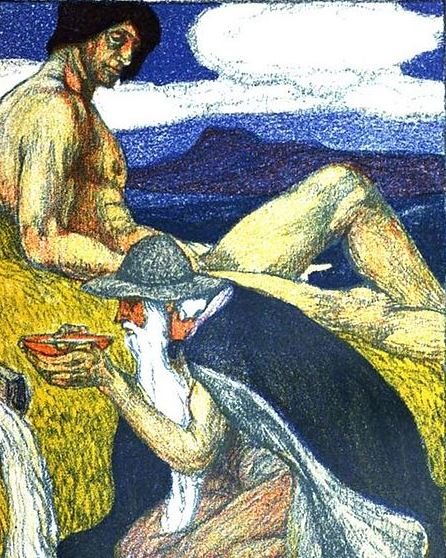
Mímisbrunnr is Mímir’s well, located beneath Yggdrasil, the world tree. It contains great wisdom, and Odin sacrifices an eye to drink from it, gaining immense knowledge. Image: Odin sips from Mímisbrunnr while Mímir watches.
Mímir in Other Sources and Interpretations
Mímir also appears in Heimskringla, a collection of sagas by Snorri Sturluson that includes a euhemerized account of the Æsir-Vanir War. In this version, Mímir is described as a man of great understanding, sent to the Vanir along with Hœnir. The saga explains how the Vanir, dissatisfied with the exchange, beheaded Mímir and sent his head back to Odin.
In addition to his role in the Eddas and Heimskringla, Mímir’s name appears in various kennings, which are metaphorical expressions used in Old Norse poetry. For example, the term “Mím’s friend” is a kenning for Odin, indicating their close association. Other kennings refer to Mímir’s connection to wisdom and jötnar (giants), further emphasizing his complex role in Norse cosmology.
Some scholars have also theorized that Mímir may be related to other figures in Norse mythology. One theory, based on a stanza from Hávamál, suggests that Mímir could be Odin’s maternal uncle. In the stanza, Odin learns nine magical songs from the brother of his mother, Bestla, and some scholars believe that this unnamed brother could be Mímir. If true, this would further solidify Mímir’s connection to Odin and his role as a familial figure of great wisdom.
Mímir’s Legacy and Symbolism
Mímir’s story is one of the most enduring in Norse mythology because of its deep symbolism and the themes it represents. His decapitation and subsequent preservation by Odin underscore the idea that knowledge and wisdom are eternal, even beyond death. Mímir’s role as the keeper of the well of wisdom and his connection to Yggdrasil, the world tree, position him as a central figure in the Norse understanding of the cosmos.
One of the most significant aspects of Mímir’s legacy is his association with sacrifice. Both Mímir’s death and Odin’s sacrifice of his eye to drink from Mímir’s well highlight the importance of giving something up in the pursuit of knowledge. In Norse mythology, wisdom is not something that comes easily; it requires loss, suffering, and often, physical sacrifice. This is a recurring theme in the myths, where gods and mortals alike must endure hardship to gain the wisdom they seek.
Mímir’s head, preserved by Odin, symbolizes the preservation of memory and knowledge even after death. It reflects the Norse belief that wisdom transcends the physical world and continues to be accessible to those who seek it. Odin’s continued reliance on Mímir’s head for counsel speaks to the Norse understanding that knowledge is not static but requires constant reflection, interpretation, and application.
Mímir’s well, too, represents a deeper, cosmic understanding of knowledge. The well is not just a source of wisdom for the gods but a symbol of the hidden, often unattainable knowledge that lies beneath the surface of the world. It requires sacrifice to access, and even then, its depths can never be fully plumbed.
Mímir in Modern Culture
Mímir’s legacy continues in modern culture, particularly in the realm of video games, literature, and media that draw inspiration from Norse mythology. One notable modern depiction of Mímir is in the God of War video game series.
In the 2018 game God of War and its 2022 sequel God of War Ragnarök, Mímir plays a significant role as a wise and humorous guide to the protagonist, Kratos. Voiced by Scottish actor Alastair Duncan, Mímir offers counsel, shares stories of the gods, and provides insight into the events unfolding around the characters.
In these games, Mímir’s severed head serves much the same purpose as it does in the original myths: he continues to provide wisdom even after death, embodying the eternal nature of knowledge and reflection.

Did you know…?
- The name Mímir is believed to derive from the Proto-Indo-European verb (s)mer-, meaning “to think, recall, or reflect.” Scholars connect the name to the concept of memory, with interpretations such as “the rememberer” or “the wise one.”
- In yet another version, Mimir is portrayed as a smith who taught the hero Siegfried his trade. These varying tales emphasize Mimir’s deep association with wisdom, craftsmanship, and the mysterious forces of knowledge in Norse mythology.
Conclusion
Mímir’s story in Norse mythology is one of profound wisdom, sacrifice, and the eternal pursuit of knowledge. His decapitation during the Æsir-Vanir War and the preservation of his head by Odin symbolize the Norse belief that wisdom transcends death and that true knowledge requires great sacrifice.
Mímir’s association with the well of wisdom beneath Yggdrasil further connects him to the cosmic understanding of knowledge, memory, and the hidden truths of the universe.
Though Mímir’s role in the myths may seem secondary compared to gods like Odin or Thor, his importance as a source of wisdom and his symbolic significance make him one of the most enduring figures in Norse mythology.
Questions and Answers

Who is Mímir in Norse mythology?
Mímir is a figure in Norse mythology known for his immense wisdom. After being beheaded during the Æsir-Vanir War, his head was preserved by Odin, who used it to gain secret knowledge and counsel.
What significant event happens to Mímir during the Æsir-Vanir War?
Mímir is beheaded during the Æsir-Vanir War, but Odin preserves his head, which continues to offer wisdom and guidance.
How does Odin benefit from Mímir after his beheading?
Odin carries Mímir’s preserved head, which continues to recite secret knowledge and offer counsel to Odin.
In which Norse texts is Mímir mentioned?
Mímir appears in the Poetic Edda and Prose Edda, where he is associated with wisdom and knowledge. His severed head continues to provide counsel to Odin, particularly after Odin sacrifices an eye to drink from Mímir’s well.
What is Mímisbrunnr, and how is it related to Mímir?
Mímisbrunnr is a well associated with Mímir, often linked to Yggdrasil, the world tree, and symbolic of deep wisdom.
What relationship do scholars propose between Mímir and Odin’s family?
Some scholars suggest that Bestla, Odin’s mother, may be Mímir’s sister, making Mímir Odin’s maternal uncle.





