Children of Aphrodite in Greek Mythology
Aphrodite, the Greek goddess of love, beauty, and desire, plays a central role in the pantheon of Greek mythology. As a deity representing love in its many forms—romantic, erotic, and sometimes even manipulative—Aphrodite had relationships with gods, mortals, and heroes, resulting in a lineage that reflects both her divine attributes and her influence over human affairs.
Aphrodite’s children embody different aspects of love, war, beauty, and desire, showcasing the goddess’s varied influence on both the divine and mortal worlds.
In the article below, World History Edu provides an exploration of her children in order to gain insight into Greek mythology’s complexity, where love and desire often intertwine with conflict, heroism, and fate.

The Birth of Venus (c. 1485) by Sandro Botticelli
Eros (Cupid)

Cupid and Psyche (1843) by Jean-Pierre Saint-Ours
Eros, known as Cupid in Roman mythology, is arguably the most famous child of Aphrodite. He personifies love, desire, and erotic attraction, often depicted as a mischievous winged youth with a bow and arrows that could make gods and mortals fall in love. While some accounts describe Eros as a primordial force older than Aphrodite, later myths established him as the son of Aphrodite and Ares, the god of war.
Eros’s nature reflects both the beauty and danger of love. His arrows could incite passion, but they could also bring about chaos, confusion, and even destruction. This duality is a reflection of his parentage—Aphrodite, the goddess of love, and Ares, the embodiment of war. Eros is often seen in stories as a playful yet powerful figure, influencing the actions of gods and mortals alike through his ability to spark intense desire.
One of the most famous myths involving Eros is his love affair with the mortal woman Psyche. This story highlights the complexity of love—its trials, tribulations, and ultimate redemption. Psyche’s journey to reunite with Eros after being separated by divine forces symbolizes the struggles inherent in love, but also its transformative power.
Phobos and Deimos

Phobos (Fear) and Deimos (Terror) are twin sons of Aphrodite and Ares. Unlike their half-brother Eros, who represents the more romantic and passionate side of love, Phobos and Deimos personify the darker consequences of war and violence. These twins accompanied their father Ares into battle, embodying the fear and terror that warfare evokes in combatants and bystanders.
Phobos and Deimos were often depicted as attendants of Ares during warfare, driving his chariot into battle. Their presence serves as a reminder of the destructive consequences of unchecked aggression and the emotional toll of war. In art and literature, they are portrayed as embodiments of the fear that paralyzes soldiers, turning the battlefield into a place not only of physical but also psychological conflict.
Though they are children of Aphrodite, Phobos and Deimos represent the complex interplay between love and war, showing how Aphrodite’s lineage includes not just passion and beauty but also the darker, more tumultuous aspects of human emotions.
Harmonia

Harmonia, the goddess of harmony and concord, is another daughter of Aphrodite and Ares. In contrast to her brothers Phobos and Deimos, who represent fear and terror, Harmonia embodies peace and unity. Her nature reflects the idea that love and war, though seemingly opposites, can give birth to balance and reconciliation.
Harmonia is most famously associated with her marriage to Cadmus, the founder and first king of Thebes. Their union was celebrated by the gods, and Harmonia was gifted a magical necklace, known as the Necklace of Harmonia, which was said to bring misfortune to its possessors. Despite the tragic legacy of the necklace, Harmonia and Cadmus’s marriage represents the hope that love and war can coexist in a harmonious balance, where conflicts can lead to peace and resolution.
Harmonia’s role in Greek mythology symbolizes the potential for reconciliation and peace after conflict, making her an important figure in the broader narrative of love and war in Greek mythology.
Anteros

Anteros, god of requited love and counterpart to Eros, rewards mutual affection and punishes unrequited love, symbolizing balance and sincerity in relationships, often depicted with scales. Image: A statue of Anteros by English sculptor Alfred Gilbert.
Anteros is the god of requited love and the avenger of unrequited love, born from the union of Aphrodite and Ares. His role complements that of his brother Eros, as Anteros ensures that love is reciprocated and punishes those who scorn love or fail to return affection. Anteros represents the idea that love must be balanced—unrequited or one-sided love leads to pain, while mutual love results in fulfillment and harmony.
Anteros is often depicted as a counterbalance to Eros, symbolizing the give-and-take nature of love. He serves as a reminder that love must be nurtured and reciprocated to thrive. His existence also underscores the consequences of rejecting love or not valuing its importance.
In some myths, Anteros is said to have been born because Eros was lonely and needed a companion, further highlighting the theme of love as a mutual exchange. Anteros’s presence in Greek mythology emphasizes the importance of balanced relationships, where affection and desire are reciprocated for love to be truly fulfilling.
Priapus
Priapus (Priapos), another child of Aphrodite, is a god associated with fertility, garden abundance, and male genitalia. In many myths, Priapus is the son of Aphrodite and Dionysus, the god of wine and festivity. However, some accounts also suggest that his father may be Hermes or even Zeus. Priapus is often depicted as a rustic fertility deity, known for his oversized phallus, symbolizing male virility and the fertility of the land.
Priapus’s role in Greek mythology reflects the more primal and earthy aspects of love and fertility. He was worshiped as a protector of gardens and livestock, with statues of him often placed in fields to promote growth and guard against thieves. While Priapus is often seen as a comedic or vulgar figure in mythology due to his exaggerated sexual characteristics, his association with fertility and agriculture made him an important deity in rural communities.
His connection to Aphrodite emphasizes the link between love, desire, and the natural cycles of fertility and abundance, showing how love in Greek mythology is tied not only to human relationships but also to the forces of nature.
Aeneas
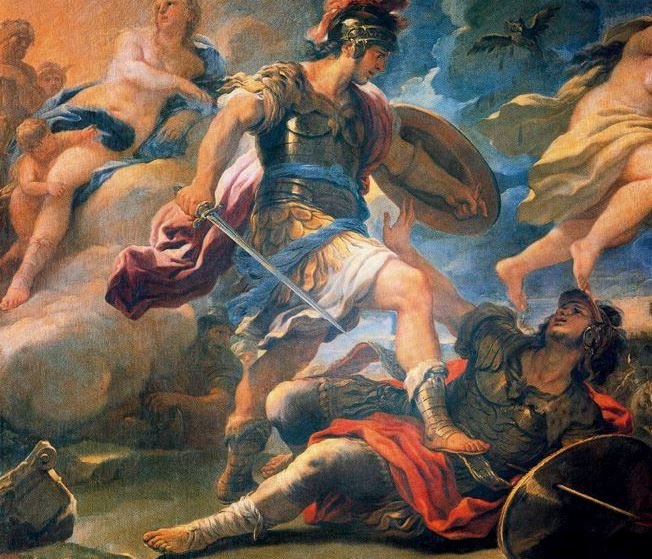
Aeneas, son of Aphrodite and Anchises, was a Trojan hero who led survivors after Troy’s fall, later founding Rome. Roman mythology honors him as the first true Roman hero and ancestor. Image: An artwork depicting Aeneas (middle) with a sword and shield.
Aeneas is perhaps the most famous mortal child of Aphrodite. He was born from the union of Aphrodite and Anchises, a mortal prince of Troy. Aeneas plays a crucial role in both Greek and Roman mythology, particularly in the story of the Trojan War and its aftermath. In Homer’s Iliad, Aeneas is depicted as a valiant warrior who fights on the side of the Trojans, and he is protected by his divine mother during several key moments in the war.
However, Aeneas’s most important legacy is found in Roman mythology, where he becomes the central figure in Virgil’s epic poem, the Aeneid. After the fall of Troy, Aeneas leads a group of survivors on a journey to establish a new homeland, which eventually leads to the founding of Rome. Aeneas’s role as the progenitor of the Roman people reflects his significance not only as a hero of Troy but also as a symbol of Roman identity and destiny.
Aphrodite’s relationship with Anchises and her protection of Aeneas during his trials highlight her role as a mother and protector, adding another dimension to her character beyond love and desire.
Peitho

Peitho is the goddess of persuasion and seduction, often considered a daughter of Aphrodite. In some versions, she is viewed as Aphrodite’s close companion rather than a direct offspring, but her association with Aphrodite’s domain of love and desire remains clear. Peitho represents the persuasive and seductive aspects of love, the power of charm, and the influence one can have over others through words and actions.
Peitho’s presence in Greek mythology underscores the idea that love is not always straightforward or based on mutual attraction—sometimes it requires persuasion, charm, and even manipulation. Her role complements Aphrodite’s ability to influence relationships and desire, reflecting the many forms that love can take.
In Greek culture, Peitho was often invoked in matters of courtship and marriage, as persuasion and agreement were seen as key elements in forming successful unions. She represents the softer, more subtle power of love that can sway hearts and minds without force or coercion.
Rhodos (Rhode)

Rhodos, also known as Rhode, is the daughter of Aphrodite and Poseidon. She is associated with the island of Rhodes, which was named after her. According to myth, Rhodos became the wife of Helios, the sun god, and the island of Rhodes was considered sacred to Helios. Together, Rhodos and Helios had seven sons, who became the rulers of Rhodes and were associated with its prosperity and wealth.
Rhodos’s connection to both Aphrodite and Helios reflects her dual influence in matters of love and light, symbolizing the union of beauty, fertility, and the life-giving power of the sun. Her role in mythology is closely tied to the prosperity of the island of Rhodes, which became a major center of trade, culture, and art in the ancient world.
Rhodos’s marriage to Helios and her divine lineage highlight the interconnections between different deities in Greek mythology, showing how love and beauty can influence other aspects of life, such as the natural world and the prosperity of cities and nations.
Hermaphroditus
Hermaphroditus is the child of Aphrodite and Hermes, and he represents the union of male and female characteristics. According to myth, Hermaphroditus was a beautiful youth who was fused with the nymph Salmacis, resulting in a being that embodied both male and female qualities. This duality made Hermaphroditus a symbol of androgyny and the blending of gender traits.
The story of Hermaphroditus reflects themes of transformation and the fluid nature of identity, particularly in matters of love and desire. As a child of both Aphrodite and Hermes, Hermaphroditus embodies the combination of beauty, desire, and communication, as Hermes is the god of messengers and travelers. This union of traits symbolizes the interconnectedness of different aspects of identity and the complexities of human relationships.
Hermaphroditus’s role in mythology challenges traditional notions of gender and sexuality, offering a more fluid and inclusive understanding of love and desire. The myth also highlights the transformative power of love, as it can change not only emotions but also physical and personal identities.
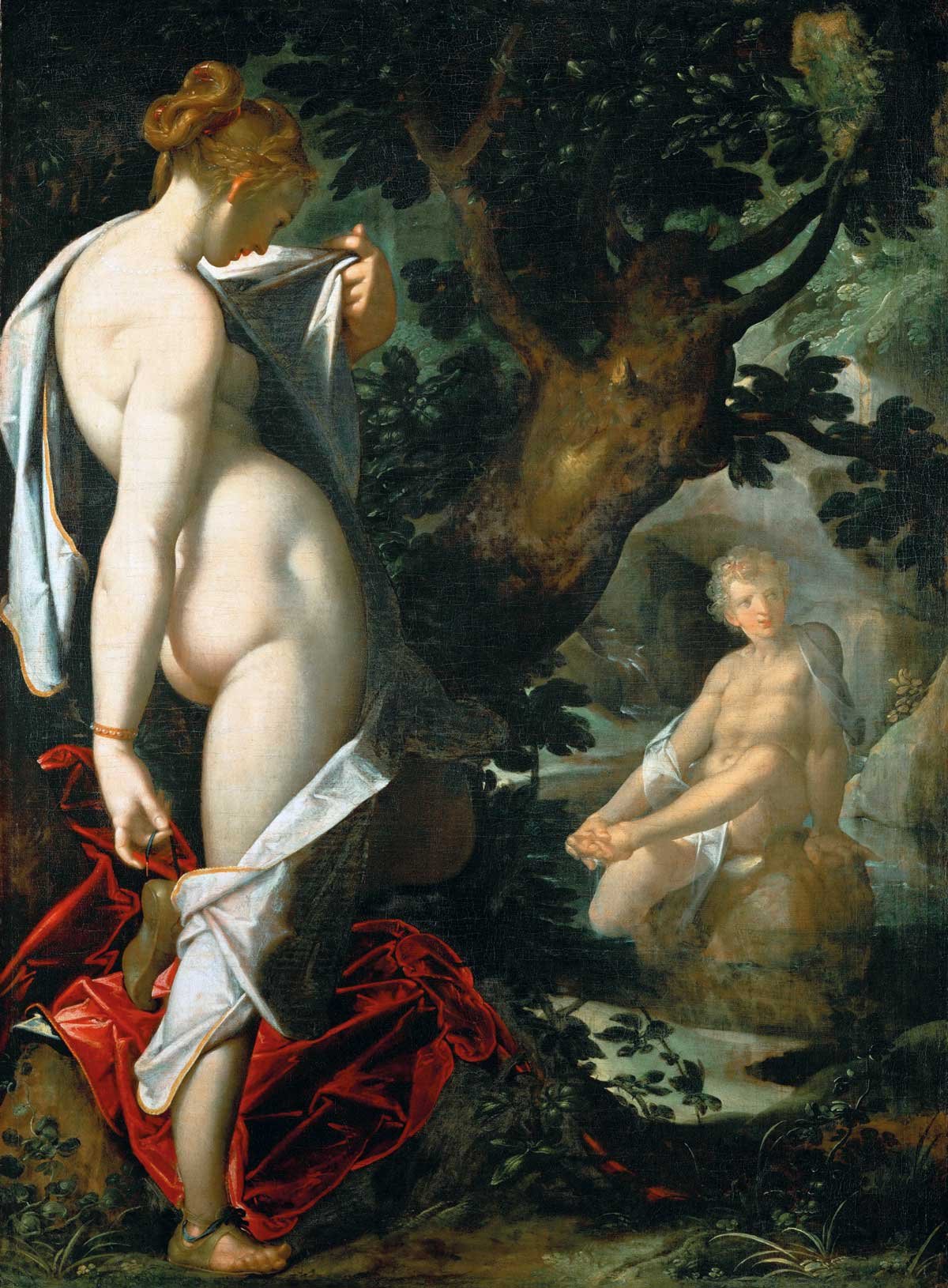
Hermaphroditus and Salmacis (detail), by Bartholomeus Spranger, c.1585, Kunsthistorisches Museum, Vienna. Kunsthistorisches Museum, Vienna 1
The Graces (Charites)
In some versions of Greek mythology, the three Charites, or Graces—Aglaea, Euphrosyne, and Thalia—are considered daughters of Aphrodite and Dionysus (though other myths attribute their parentage to Zeus and Eurynome). The Graces represent beauty, charm, and joy, and they were often depicted as attendants of Aphrodite, enhancing her presence with their radiance and elegance.
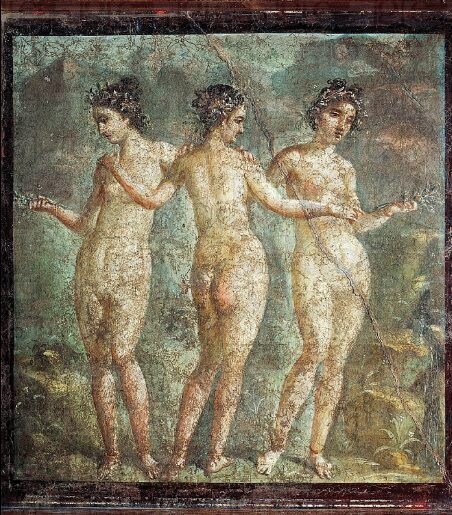
The three Charites in Greek mythology
The Graces were associated with the pleasures of life, particularly those related to art, music, and social gatherings. They were often invoked in celebrations, and their role in mythology emphasizes the importance of beauty and grace in human interactions and the enjoyment of life’s pleasures.
As daughters of Aphrodite, the Graces reflect the goddess’s influence over beauty and social harmony, demonstrating how love and desire can create joy, creativity, and connection among people. Their presence in mythology highlights the role of aesthetic pleasure and charm in both divine and mortal affairs.
Conclusion
Aphrodite’s children in Greek mythology represent a wide array of divine and human qualities, from love and desire to fear, terror, fertility, and persuasion. Through her relationships with gods and mortals, Aphrodite’s offspring embody the complex nature of love and its various manifestations in life, both positive and negative.
From Eros, the embodiment of erotic desire, to Aeneas, the mortal hero destined to found Rome, the children of Aphrodite showcase the goddess’s far-reaching influence in Greek mythology. Each child reflects different aspects of their mother’s domain, demonstrating how love, beauty, and desire are interwoven with the broader themes of war, fate, and the human experience.





