Monument to Columbus in Madrid
The Monument to Columbus (Monumento a Colón) in Madrid stands as a significant tribute to Christopher Columbus and his voyages that opened the way to the European colonization of the Americas. Situated in Plaza de Colón (Columbus Square), it is a symbol of Spain’s historic connection to Columbus’ expeditions and serves as a reminder of the nation’s past imperial glory. The monument has an interesting backstory, involving its conception, delayed construction, artistic features, and several relocations, all of which add layers to its cultural and historical significance.
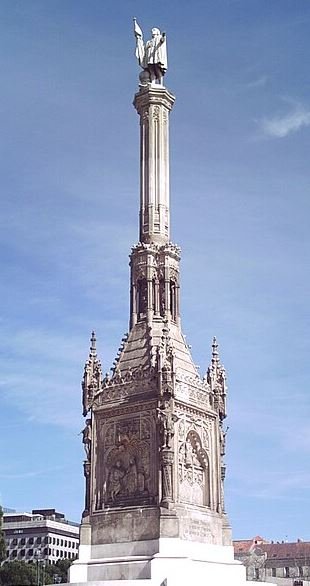
The Monument to Columbus in Madrid is more than just a physical structure; it is a symbol of Spain’s national identity, its historical legacy of exploration, and its contributions to global history. Image: A picture of the monument located in Plaza de Colón in the Spanish capital.
In this detailed explanation, World History Edu delves into the history of the monument, starting from its initial proposal in the mid-19th century to its current form in the 21st century, while also examining key facts that highlight its significance in Spain’s historical landscape.
Origins: Queen Isabella II’s Vision (1864)
The initial idea for a national monument dedicated to Christopher Columbus in Madrid came from Queen Isabella II of Spain. In 1864, she proposed creating a commemorative monument as a way to honor Columbus’ historic voyage in 1492, which had profound consequences for Spain and the rest of Europe. The project was also part of a broader movement during the 19th century in Europe to celebrate national heroes through public monuments. Queen Isabella II’s decision to memorialize Columbus coincided with Spain’s desire to highlight its past dominance and achievements, especially during a time of internal political and social instability.
However, before the project could advance significantly, political turmoil in Spain intervened. The Glorious Revolution of 1868 overthrew Queen Isabella II, forcing her into exile. As a result, many of her initiatives, including the Columbus monument, were shelved.
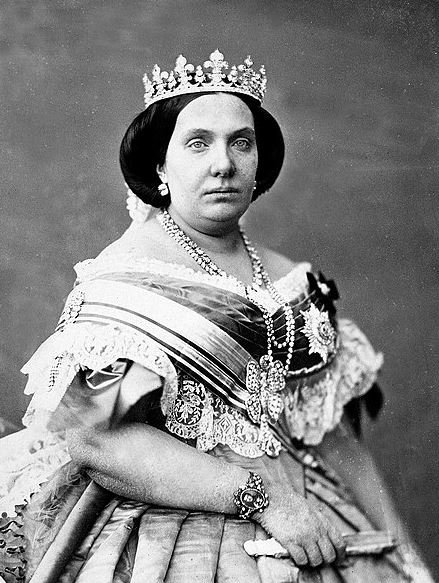
Image: An 1860 portrait of Isabella II.
Revival and Public Competition (1877)
The idea to construct the Monument to Columbus was resurrected years later under King Alfonso XII, who ruled Spain after the Restoration of the monarchy in 1874. In 1877, the project gained traction as the royal family prepared for the wedding of Alfonso XII and María de las Mercedes, a high-profile union that attracted national attention.
As part of the efforts to revive the monument project, a public competition was organized to select the best design for the Columbus monument. Various prominent architects and artists submitted their ideas. Arturo Mélida, a well-known architect and sculptor, won the competition with his design that featured a Gothic Revival style, which was popular at the time. His design for the base of the monument was both intricate and monumental, capturing the grandeur that Spain wanted to project through the memorialization of Columbus.
Construction of the Monument (1881–1885)
Construction of the monument began in 1881, but the project experienced various delays. Arturo Mélida’s design called for a 17-meter-high Gothic Revival base, which became a focal point of the monument’s architecture. The base is notable for its richly detailed ornamentation, which reflected the Gothic style’s emphasis on verticality and intricate carvings. The monument’s foundation was built from stone, and the design incorporated elements that alluded to Spain’s religious and historical themes.
The construction of the monument was supposed to be completed by 1886, but the unexpected death of King Alfonso XII postponed the inauguration. By 1885, however, the monument’s base had been completed, although the statue of Columbus, which would top the base, had not yet been delivered.
The Statue of Columbus: Jerónimo Suñol’s Masterpiece (1892)
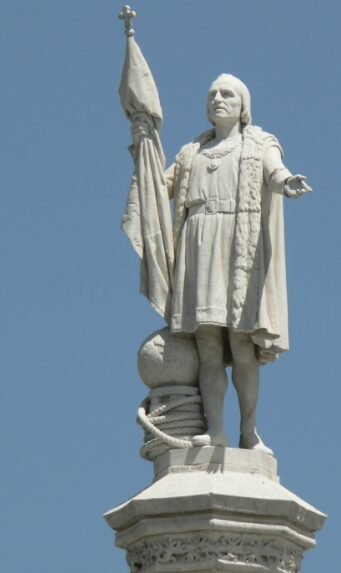
The statue of Christopher Columbus, which crowns the monument, is the work of Jerónimo Suñol, a Spanish sculptor known for his precision and attention to detail. The 3.3-meter-high statue is made from Carrara marble, a material traditionally used for prestigious sculptures due to its durability and fine texture.
The statue of Columbus depicts him in a confident stance, holding a flag of Castile, which symbolizes his role in claiming new territories for Spain during his voyages. The figure of Columbus is shown gazing ahead, evoking a sense of determination and foresight that characterized his expeditions across the Atlantic.
Suñol’s statue was finally completed and delivered to the Ayuntamiento de Madrid in 1892, coinciding with the 400th anniversary of Columbus’ first voyage to the Americas. The timing of the statue’s completion gave extra historical and celebratory weight to the monument’s purpose, aligning its unveiling with the quincentennial celebrations of Columbus’s achievements.
Delays and Inauguration
Although the base was completed in 1885, the monument’s official inauguration was delayed due to King Alfonso XII’s death. It wasn’t until 1892, when Suñol’s statue was completed and installed, that the monument was officially inaugurated. This delay meant that the monument’s construction spanned nearly a decade from conception to completion.
Despite these challenges, the Monument to Columbus became one of the central landmarks in Madrid, with the imposing Gothic Revival base and the marble statue of Columbus symbolizing Spain’s deep historical connections to the Age of Exploration.
Relocation of the Monument (1976–1977)
In 1976, the Monument to Columbus was dismantled as part of a broader urban redevelopment plan in Madrid. The city government decided to relocate the monument from its original location in Plaza de Colón to a nearby site called Jardines del Descubrimiento (Gardens of Discovery). This new location, situated within the same square, was designed to accommodate the monument within a landscaped setting that allowed for greater public accessibility and visibility.
The relocation process took about a year, and by 1977, the monument was re-erected in its new position. The decision to move the monument was part of Madrid’s modernization efforts during the final years of Francisco Franco’s regime, which saw various changes in the city’s layout and design.
Return to the Original Location (2009)
In 2009, as part of a large-scale renovation of the Prado-Recoletos axis, which is one of Madrid’s most important cultural and historical avenues, the decision was made to move the Monument to Columbus back to its original location in Plaza de Colón. The Prado-Recoletos axis is home to major landmarks like the Prado Museum and the National Library, and placing the Columbus monument back in its original spot emphasized its importance in Madrid’s urban and cultural landscape.
The monument’s return to its initial location highlighted its status not just as a tribute to Columbus, but as a central symbol in Madrid’s public space. Plaza de Colón, with the monument at its heart, remains a prominent gathering place for both locals and tourists.
Artistic and Symbolic Significance
The Monument to Columbus in Madrid is a fascinating example of 19th-century Gothic Revival architecture, which was part of a broader trend across Europe at the time. The monument’s base, designed by Arturo Mélida, features elaborate Gothic elements such as pointed arches, intricate stone carvings, and detailed reliefs. This design choice links the monument to the medieval heritage of Spain, which was a key era of national formation and consolidation.
The statue of Columbus, meanwhile, is an important work of 19th-century Spanish sculpture. Jerónimo Suñol’s rendition of Columbus reflects the ideals of exploration, ambition, and conquest. The marble figure holding the Castilian flag is a reminder of Spain’s imperial past and the voyages that expanded European knowledge of the world.
Legacy and Cultural Importance
Today, the Monument to Columbus serves as a reminder of Spain’s role in global exploration and the colonization of the Americas. While the monument itself celebrates the achievements of Christopher Columbus, it also evokes complex histories, including Spain’s colonial legacy. Over time, such monuments have been viewed with a mix of admiration for exploration and conquest and critical reflection on the consequences of European imperialism, particularly the impact on indigenous peoples of the Americas.
Despite these differing perspectives, the Monument to Columbus in Madrid remains a focal point in the city’s landscape. The Plaza de Colón, where it stands, is often used for public events, demonstrations, and national celebrations, ensuring that the monument continues to play a role in contemporary Spanish society.
Questions and Answers
Where is the Monument to Columbus located?
The Monument to Columbus is located in Madrid, Spain, in the Plaza de Colón.
Who designed the Gothic Revival-style base of the monument?
The Gothic Revival-style base was designed by Arturo Mélida.
Who created the statue of Christopher Columbus that tops the monument?
The statue of Christopher Columbus was created by Jerónimo Suñol.
When was the initial idea to create a national monument for Columbus proposed, and by whom?
The idea was proposed in 1864 by Queen Isabella II.
Why was the original project to create the monument halted?
The project was halted due to the 1868 Glorious Revolution.

What event led to the revival of the monument project?
The project was revived to commemorate the marriage of King Alfonso XII and María de las Mercedes.
When did the public competition to select the monument design take place, and who won?
The public competition took place in 1877, and Arturo Mélida’s design was selected.
When was the 17-meter-high base of the monument constructed?
The base was constructed between 1881 and 1885.
Why was the planned inauguration of the monument in January 1886 delayed?
The inauguration was delayed due to the death of King Alfonso XII.
How tall is the statue of Columbus, and what material is it made from?
The statue is 3.3 meters tall and made from Carrara marble.
What does the statue of Columbus depict?
The statue depicts Columbus holding a flag of Castile.
When was the statue completed and delivered to the Ayuntamiento de Madrid?
The statue was completed and delivered in 1892.
What happened to the monument in 1976?
The monument was dismantled and relocated to the Jardines del Descubrimiento in 1976.
When was the monument returned to its original location, and why?
The monument was returned to its original location in 2009 during the renovation of the Prado-Recoletos area.