Muslim Conquest of Persia: History and Major Facts
The Muslim Conquest of Persia, also known as the Arab Conquest of Iran, was a transformative series of military campaigns conducted by the Rashidun Caliphate between 632 and 654 CE. This conquest led to the downfall of the Sasanian Empire, the decline of Zoroastrianism, and significant demographic and cultural shifts within Persia. Understanding the origins, effects, and significance of this conquest provides valuable insights into the profound changes that shaped the region’s historical trajectory.
Background: The Sasanian Empire Before the Conquest
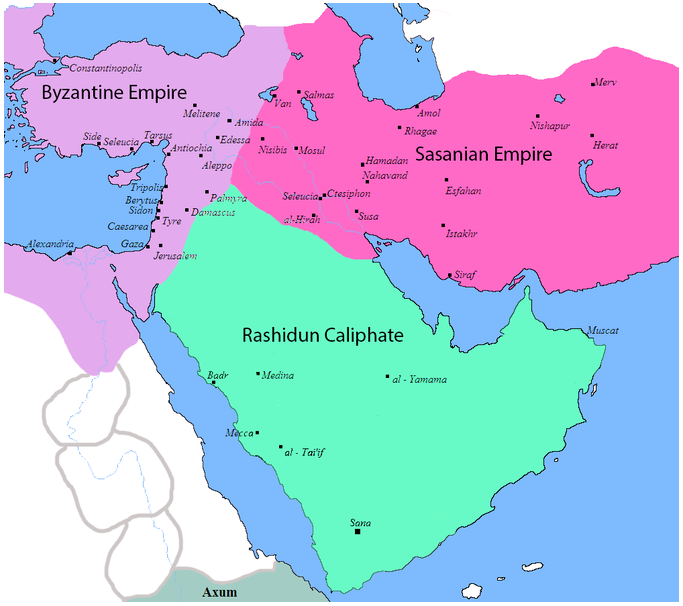
Image: Map of West Asia’s empires before Muslim conquests.
By the early 7th century, the Sasanian Empire, once a dominant power in the Middle East, was grappling with severe political instability. The execution of Shah Khosrow II in 628 CE plunged the empire into a period of chaos known as the Sasanian Interregnum (628–632 CE). During these four years, ten different rulers ascended to the throne, each facing internal dissent and power struggles. This rapid turnover of leadership eroded central authority, making cohesive governance nearly impossible.
The prolonged Byzantine-Sassanian War of 602–628 CE had exhausted the Sasanian military. Continuous battles with the Byzantine Empire drained resources and manpower, leaving the army depleted and less effective. Additionally, the Sasanians faced new threats from emerging powers, such as the Khazars in Transcaucasia, further stretching their military capabilities thin.
The Sasanian society was rigidly stratified into four classes: priests, warriors, secretaries, and commoners. Economic strain from constant warfare devastated trade routes and industries, leading to widespread poverty and dissatisfaction among the populace. The agrarian economy faltered under heavy taxation, and the rapid rise of provincial landholders, or dehqans, undermined the central administrative structures. These factors collectively contributed to the weakening of the Sasanian state.
Origin Story: Causes of the Conquest
Following the death of Prophet Muhammad in 632 CE, the Rashidun Caliphate under the leadership of the first four caliphs embarked on an aggressive expansionist policy. Driven by a combination of religious zeal, political ambition, and strategic considerations, the Caliphate sought to consolidate and expand its territories beyond the Arabian Peninsula.
The internal turmoil within the Sasanian Empire presented a strategic opportunity for the Rashidun Caliphate. The weakened state, marked by political fragmentation and military exhaustion, was ill-prepared to resist external invasions. This vulnerability made Persia an attractive target for conquest, as the Caliphate aimed to secure its eastern frontiers and eliminate potential threats.
Key military leaders, such as Khalid ibn al-Walid and Sa’d ibn Abi Waqqas, played pivotal roles in the initial invasions and subsequent campaigns. Their strategic prowess and leadership were instrumental in securing early victories, which set the stage for the broader conquest of Persia. Additionally, the administrative policies of Caliph Umar ibn al-Khattab further facilitated the efficient governance and integration of conquered territories.

Major Campaigns and Battles
Initial Incursions
The first Muslim invasion of Sasanian territory occurred in 633 CE, targeting Asoristan—the Sasanian political and economic center in Mesopotamia. Under the command of Khalid ibn al-Walid, Muslim forces swiftly captured key territories. However, Khalid was soon redeployed to the Levant to counter Byzantine advances, allowing the Sasanians to temporarily regain control in Mesopotamia.
Battle of al-Qadisiyyah (636 CE)
The Battle of al-Qadisiyyah stands out as a decisive confrontation in the Muslim conquest of Persia. Led by Sa’d ibn Abi Waqqas, the Muslim army faced the formidable Sasanian forces in 636 CE. Through superior tactics and disciplined coordination, the Muslims achieved a crushing victory, effectively dismantling Sasanian military dominance in Mesopotamia and paving the way for further incursions into Persian heartlands.
Battle of Nahavand (642 CE)
The Battle of Nahavand, fought in 642 CE, is often referred to as the “Victory of Victories” due to its critical impact on the Sasanian Empire. Under the command of Sa’d ibn Abi Waqqas, Muslim forces decisively defeated the Sasanian army, leading to the complete collapse of organized Persian resistance. This battle marked the end of the Sasanian dynasty and solidified Muslim control over Persia.

Image: Painting of Nahavand Castle, a key Sasanian stronghold.
Umar ibn al-Khattab’s Strategic Leadership
Caliph Umar ibn al-Khattab orchestrated a comprehensive and multi-pronged invasion of the remaining Sasanian territories in 642 CE. His strategic acumen, coupled with the disciplined organization of the Rashidun military, facilitated rapid advancements and undermined the Sasanian ability to mount effective resistance. Umar’s policies emphasized coordinated attacks, efficient logistics, and the appointment of competent commanders to oversee different regions.
In 644 CE, Umar was assassinated by a Persian slave named Abu Lu’lu’a Firuz. Despite this setback, the Rashidun Caliphate maintained its momentum, continuing the conquest with minimal disruption. Successive caliphs, particularly Uthman ibn Affan, ensured that the campaigns remained focused and effective, ultimately leading to the complete downfall of the Sasanian Empire by 651 CE.
Effects of the Conquest
The Muslim conquest resulted in the dissolution of the Sasanian Empire, leading to the establishment of Muslim governance across Persia. The administrative structures of the Sasanians were largely retained and adapted to fit the needs of the Rashidun Caliphate. Provinces were divided into districts and sub-districts, ensuring continuity in governance and facilitating effective control over the newly acquired territories.
One of the most profound effects of the conquest was the gradual Islamization of Persia. Zoroastrianism, the predominant religion of the Sasanian Empire, faced significant decline. Zoroastrians were designated as dhimmi (protected people) and required to pay the jizya (a special tax) in exchange for protection and exemption from military service. While initial conversions were limited, over centuries, Islam became the dominant religion, especially after the Safavid dynasty in the 16th century established Shia Islam as the state religion.
Despite the conquest, Persian culture and language exhibited remarkable resilience. Middle Persian (Pahlavi) gradually evolved into New Persian, incorporating significant Arabic vocabulary, particularly in religious and administrative contexts. The Persian script was adapted to the Arabic alphabet, facilitating the spread of Islam while preserving Persian literary and cultural identity. This cultural synthesis contributed to the development of a distinctive Persian-Islamic civilization, influencing various fields such as literature, architecture, and science.
The conquest led to significant economic transformations. The integration into the Rashidun Caliphate opened new trade routes and facilitated economic growth in regions like Khorasan and Transoxiana. However, the initial period was marked by economic strain due to the costs of warfare and the disruption of established trade networks. Over time, the consolidation of Muslim rule stabilized the economy, promoting agricultural productivity and urbanization.
The Muslim conquest induced notable demographic shifts. Many Zoroastrians fled eastward to India, where they established communities known as Parsis. The conquest also led to the migration of Arabs into Persian territories, contributing to the cultural and genetic blending of the two populations. Additionally, the imposition of the jizya tax influenced social stratification, as non-Muslims faced economic pressures to convert or migrate.
Significance of the Conquest
The Muslim conquest marked the definitive end of the Sasanian Empire, one of the most powerful Persian empires in history. The fall of the Sasanians removed a major rival to the Byzantine Empire, altering the balance of power in the Middle East. The conquest facilitated the rise of Islamic governance, establishing a new political order that would dominate the region for centuries.
The Islamization of Persia had enduring religious, cultural, and social implications. It not only transformed the religious landscape but also influenced legal and administrative systems. The integration of Persian administrative practices into the Islamic framework enhanced the efficiency and adaptability of Muslim governance. Moreover, the blending of Islamic and Persian cultures enriched the broader Islamic civilization, contributing to advancements in various intellectual and artistic domains.
The conquest fostered a unique cultural synthesis between Arab and Persian traditions. Persian scholars, poets, and administrators played crucial roles in the intellectual and cultural advancements of the Islamic world. This fusion led to the creation of a rich Persian-Islamic cultural heritage, evident in masterpieces of literature, architecture, and scientific thought. Cities like Baghdad emerged as centers of learning and cultural exchange, attracting scholars from diverse backgrounds.
Influence on Subsequent Islamic Empires
The Muslim conquest of Persia set a precedent for subsequent Islamic empires, including the Umayyad and Abbasid Caliphates, and later the Safavid, Ottoman, and Mughal empires. The administrative and cultural practices established during the Rashidun period provided a foundation for effective governance and cultural flourishing in these later dynasties. The conquest also facilitated the spread of Islam into Central Asia and the Indian subcontinent, shaping the religious and cultural landscapes of these regions.
Historical Significance
The conquest exemplifies how internal political fragmentation and military exhaustion can render an empire vulnerable to external invasions. It highlights the strategic importance of unified leadership and military prowess in determining the fate of empires. The Muslim conquest of Persia is a testament to the profound and lasting changes that can result from a combination of military strategy, political opportunism, and cultural integration.
Contemporary Relevance
Today, the legacy of the Muslim conquest of Persia continues to influence Iran’s cultural and religious identity. Understanding this historical event is crucial for comprehending the development of modern Iranian society and its position within the Islamic world. The cultural and linguistic transformations initiated during the conquest have left an indelible mark on Persian art, literature, and social structures, contributing to Iran’s rich and diverse heritage.
Conclusion: The Enduring Legacy of the Muslim Conquest of Persia
The Muslim Conquest of Persia was a transformative event that reshaped the political, social, and religious landscape of the region. It marked the end of the Sasanian Empire, led to the decline of Zoroastrianism, and initiated the gradual Islamization of Persia. Despite initial resistance and periods of rebellion, the Rashidun Caliphate successfully integrated Persia into the Islamic world, laying the foundation for subsequent Islamic empires that would further expand and enrich the cultural tapestry of the Middle East.
Frequently Asked Questions
What was the Muslim Conquest of Persia?
The Muslim Conquest of Persia, also known as the Arab Conquest of Iran, was a series of military campaigns conducted by the Rashidun Caliphate between 632 and 654 CE. This conquest led to the downfall of the Sasanian Empire, the decline of Zoroastrianism, and significant demographic and cultural transformations within Persia.
What factors contributed to the decline of the Sasanian Empire before the Muslim invasion?
Several factors weakened the Sasanian Empire prior to the Muslim invasion:
- Prolonged Warfare: The Byzantine-Sassanian War of 602–628 CE drained resources and military strength.
- Political Instability: The execution of Shah Khosrow II in 628 CE led to rapid political decline and the enthronement of ten new rulers within four years.
- Social and Economic Turmoil: Economic strain from constant warfare devastated trade routes and industries, causing widespread poverty and dissatisfaction.
- Decentralization: The Sasanian Interregnum (628–632 CE) marked a period of civil war and decentralization, making effective governance nearly impossible.
What were the initial Muslim incursions into Sasanian territory?
The Rashidun Caliphate launched its first invasion of Sasanian Persia in 633 CE, targeting Asoristan, the Sasanian political and economic center in Mesopotamia. Commanded by Khalid ibn al-Walid, Muslim forces swiftly conquered key territories. However, Khalid was later redeployed to the Levant, allowing the Sasanians to temporarily regain control in Mesopotamia.
What was the significance of the Battle of al-Qadisiyyah in the Muslim conquest of Persia?
The Battle of al-Qadisiyyah (636 CE) was a decisive confrontation where Sa’d ibn Abi Waqqas led the Muslim army to a crushing defeat against the Sasanian forces. This victory permanently ended Sasanian control west of modern-day Iran and paved the way for the Muslim forces to advance into the heart of Persia, effectively dismantling Sasanian military dominance in the region.
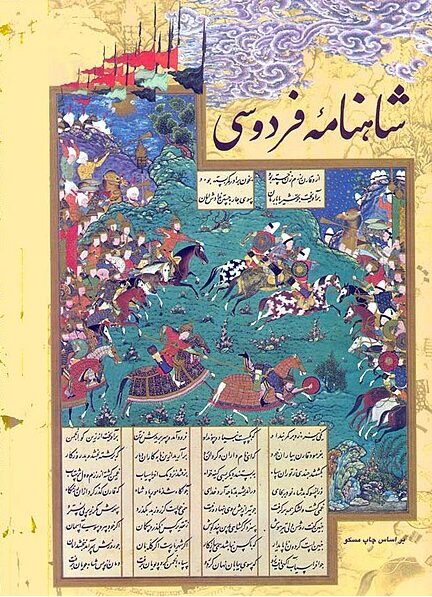
Image: Depiction of the Battle of Qadisiyyah from a Shahnameh manuscript.
How did Caliph Umar ibn al-Khattab influence the Muslim conquest of Persia?
Caliph Umar ibn al-Khattab played a pivotal role in the Muslim conquest of Persia:
- Strategic Leadership: In 642 CE, Umar orchestrated a coordinated and multi-pronged invasion of the remaining Sasanian territories, leveraging disciplined military organization.
- Administration and Planning: Umar appointed multiple commanders to oversee different regions, ensuring efficient and effective military campaigns.
- Persistence After Assassination: Despite Umar’s assassination in 644 CE by a Persian slave, the Rashidun Caliphate maintained its momentum, leading to the complete downfall of the Sasanian Empire by 651 CE.

Image: Calligraphic seal with Umar’s name.
What was the impact of the Muslim conquest on Zoroastrianism in Persia?
The Muslim conquest led to the gradual decline of Zoroastrianism, Persia’s predominant religion:
- Persecution: Zoroastrians faced forced conversions, executions, and displacement.
- Migration: Many Zoroastrians fled eastward to India, where they established communities known as Parsis.
- Islamization: Over centuries, Islam became the dominant religion in Persia, especially after the Safavid dynasty in the 16th century, which established Shia Islam as the state religion.
How have modern scholars re-evaluated the traditional narrative of the Muslim conquest of Persia?
Modern scholarship has introduced nuanced perspectives challenging the traditional narrative:
- Parvaneh Pourshariati’s Thesis: In her work, Pourshariati argues that the Sasanian Empire was highly decentralized and was more of a confederation with the Parthians. Internal dissent and fragmentation made the empire ill-prepared to resist the Muslim forces.
- Alternative Perspectives: Some Iranian historians emphasize that Persians actively resisted the Arab invaders more vigorously than previously acknowledged, highlighting persistent rebellions and military opposition.
How did the administration and governance of Persia change under Muslim rule?
Under Muslim rule, the administrative structures of the late Sasanian period were largely retained and adapted:
- Continuation of Sasanian Structures: The division of provinces into districts and sub-districts (ustans and shahrs) was maintained, ensuring continuity in governance.
- Taxation Policies: Non-Muslims, particularly Zoroastrians, were designated as dhimmi (protected people) and required to pay the jizya (a special tax) in exchange for protection and exemption from military service.
- Urbanization: Increased urbanization occurred, especially in regions like Khorasan and Transoxiana, with cities such as Merv and Nishapur becoming thriving metropolises.
What cultural and linguistic transformations occurred in Persia following the Muslim conquest?
The conquest initiated significant cultural and linguistic changes:
- Language Shift: Middle Persian (Pahlavi) gradually evolved into New Persian, incorporating substantial Arabic vocabulary, particularly in religious and administrative contexts. The Persian script was adapted to the Arabic alphabet.
- Cultural Resilience: Despite adopting Islam, Persian culture and administrative practices remained influential, contributing to the development of a distinctive Persian-Islamic civilization.
- Integration of Traditions: Persian scholars, poets, and administrators played vital roles in blending Islamic and Persian traditions, enriching the broader Islamic world.
What is the enduring legacy of the Muslim conquest of Persia?
The Muslim conquest of Persia had profound and lasting impacts:
- End of the Sasanian Empire: The conquest marked the end of the Sasanian dynasty and the collapse of organized Persian resistance.
- Islamization and Cultural Synthesis: Islam became the dominant religion, and Persian culture significantly influenced Islamic civilization, contributing to advancements in literature, architecture, science, and governance.
- Historical Significance: The conquest exemplifies how internal political fragmentation can be exploited by external forces, leading to transformative changes in a region’s historical trajectory.
- Contemporary Relevance: The legacy of the conquest continues to shape Iran’s cultural and religious identity, playing a crucial role in understanding the development of modern Iranian society and its position within the Islamic world.