Mycenaean Pottery: History, Significance and Major Facts
Flourishing from around 1600 to 1100 BCE in mainland Greece and the Aegean islands, the Mycenaean civilization is renowned for its distinctive pottery. These works offer insight into its cultural, economic, and artistic practices. As a result, some scholars have described Mycenaean pottery is one of the most important archaeological artifacts used to understand the development, trade, and artistic achievements of this ancient civilization.

Ephyrean goblet represents the pinnacle of craftsmanship by a Mycenaean potter. Its located at the Archaeological Museum of Ancient Corinth, Greece.
Historical Background
The Mycenaeans emerged after the collapse of the Minoan civilization on Crete and were heavily influenced by Minoan culture, especially in the early stages of their development. As they grew in power, the Mycenaeans established a network of palatial centers, such as Mycenae, Tiryns, and Pylos, which became hubs for production, trade, and administration. Pottery was a key part of Mycenaean life, used for both everyday domestic activities and religious or burial practices.
Evolution of Mycenaean Pottery
Mycenaean pottery developed over several phases, with styles and techniques evolving throughout its history.
Early Mycenaean (Late Helladic I, c. 1600–1500 BCE)
Mycenaean pottery in this period closely resembled Minoan ceramics, especially in decorative techniques and shapes. The pottery of this phase was mainly characterized by simple, functional forms such as cups, jars, and amphorae. Decorations were typically abstract, with spirals, lines, and simple geometric patterns being the dominant motifs. The clay used was of high quality, and the pottery was fired at high temperatures, making it durable.
Middle Mycenaean (Late Helladic II, c. 1500–1400 BCE)
In this period, Mycenaean pottery began to develop a more distinct style, although Minoan influence remained strong. The pottery became more refined, with a broader range of shapes and a higher level of craftsmanship. Vessels such as stirrup jars, kraters, and pyxides (small, cylindrical boxes) became popular. The stirrup jar, a type of vessel with a false spout and a pair of handles, was particularly significant as it was used for the storage and transport of liquids, especially olive oil and wine.
Decorations during this phase became more elaborate, with marine motifs such as octopuses, shells, and fish becoming popular. Floral designs, including lilies and rosettes, were also common. These motifs were often painted in a dark color (usually brown or black) on a light background, a style known as “dark-on-light.” This was a departure from the earlier Minoan tradition of light-on-dark decoration.
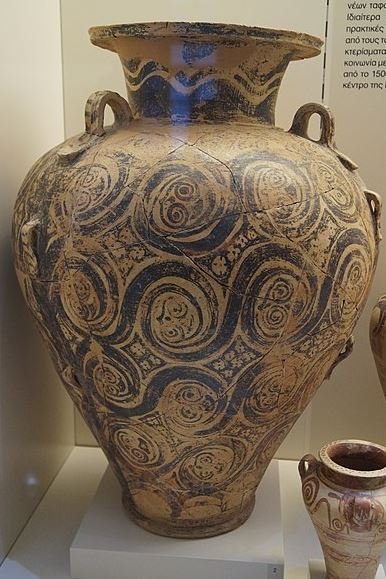
At the Archaeological Museum of Nafplion, you’ll find a pear-shaped jar from Chamber Tomb 10 of the Dendra Cemetery, dating back to 1500–1450 BC.
Late Mycenaean (Late Helladic III, c. 1400–1100 BCE)
The Late Mycenaean period represents the peak of Mycenaean pottery production. During this time, Mycenaean pottery became highly standardized, with mass production in large workshops. This was the period of the greatest Mycenaean influence, with pottery being exported throughout the Mediterranean, including to Cyprus, the Levant, Italy, and Egypt.
The shapes of pottery became more standardized, with specific types of vessels being produced for particular purposes. Stirrup jars, for example, were used for oil and wine, while kraters were used for mixing wine and water. The kylix, a shallow drinking cup, became one of the most characteristic shapes of Mycenaean pottery.
The decoration of pottery in this period also became more standardized, with certain motifs being repeated across different types of vessels. Marine motifs continued to be popular, but geometric patterns such as spirals, meanders, and zigzags became more dominant. Human figures and scenes, such as chariot processions and warriors, began to appear in the decoration of pottery, although these were relatively rare compared to the geometric and floral motifs.
Shapes and Functions of Mycenaean Pottery
Mycenaean pottery was produced in a variety of shapes, each with a specific function. The most common types of vessels included:
- Stirrup Jars: These were among the most distinctive Mycenaean vessels and were used for storing and transporting liquids, particularly oil and wine. The name “stirrup jar” comes from the shape of the handles, which resemble stirrups. The jar has a false spout, with the real spout located on the side.
- Krater: A large bowl used for mixing wine and water. Kraters were often elaborately decorated and were used in both domestic and ceremonial contexts. There were several types of kraters, including the bell-shaped krater and the volute krater.
- Kylix: A shallow drinking cup with a wide bowl and two handles. The kylix was a popular shape for drinking vessels and was often decorated with geometric patterns or simple motifs.
- Amphora: A tall, two-handled jar used for storing and transporting liquids. Amphorae were often used as grave markers or for funerary purposes in addition to their everyday use.
- Pyxis: A small, cylindrical box with a lid, used for storing small items such as jewelry or cosmetics.
Decoration and Motifs
The decoration of Mycenaean pottery was primarily painted, although there is evidence of incised decoration on some vessels. The motifs used in Mycenaean pottery were diverse and included geometric, floral, marine, and human figures. The most common colors used in decoration were black, brown, and red, although other colors such as white and yellow were occasionally used.
Geometric patterns were the most common form of decoration on Mycenaean pottery. These included spirals, zigzags, meanders, and triangles. These patterns were often arranged in horizontal bands around the vessel, creating a sense of rhythm and order.
Flowers and plants were another common motif in Mycenaean pottery. Lilies, rosettes, and palmettes were frequently used in the decoration of vessels. These motifs were often stylized and arranged in symmetrical patterns.
The sea played a significant role in Mycenaean life, and marine motifs were a popular decorative theme. Octopuses, fish, and shells were frequently depicted on Mycenaean pottery, often in a highly stylized manner.
Although less common than geometric or floral motifs, human and animal figures did appear in the decoration of Mycenaean pottery. These figures were often depicted in scenes of warfare or hunting, reflecting the militaristic nature of Mycenaean society. Chariots, warriors, and horses were common motifs, as were animals such as birds and bulls.
Regional Variations
While Mycenaean pottery was relatively uniform in style, there were some regional variations in shape and decoration. For example, pottery from the Argolid region (where Mycenae is located) tended to be more elaborately decorated than pottery from other regions, such as Thessaly or Laconia. Pottery from the island of Cyprus, which was heavily influenced by Mycenaean culture, also exhibited distinctive features, such as the use of polychrome (multi-colored) decoration.
Trade and Distribution
Mycenaean pottery was widely traded throughout the Mediterranean, and its distribution provides valuable insight into the trade networks of the Mycenaean civilization. Pottery has been found at sites across the Aegean, as well as in Cyprus, the Levant, Italy, and Egypt. The presence of Mycenaean pottery in these regions suggests that the Mycenaeans were engaged in extensive trade, both with neighboring cultures and with more distant civilizations.
The standardization of Mycenaean pottery, particularly in the Late Helladic period, facilitated its mass production and distribution. Workshops in major Mycenaean centers, such as Mycenae and Tiryns, produced large quantities of pottery, which were then exported to other regions. The presence of Mycenaean pottery in tombs and settlements in the Levant, for example, indicates that Mycenaean goods were highly valued by local elites and may have been used as prestige items in trade or gift exchange.
Role in Burial Practices
Mycenaean pottery played an important role in burial practices, both as grave goods and as markers of social status. Pottery vessels were often placed in tombs as offerings to the deceased, and the quality and quantity of pottery in a tomb were often indicative of the social status of the individual buried there. Wealthy individuals were buried with elaborate pottery, while poorer individuals had simpler, more functional vessels.
In addition to being placed in tombs, pottery was sometimes used as grave markers. Large amphorae or kraters were placed at the entrance to tombs, serving as both markers of the tomb and as offerings to the deceased.
Decline and Legacy
The Mycenaean civilization began to decline around 1200 BCE, possibly due to a combination of factors, including internal conflict, invasions, and natural disasters. As the palatial centers collapsed, the production of Mycenaean pottery also declined. The distinctive styles of Mycenaean pottery disappeared, and local ceramic traditions began to re-emerge in different regions of Greece.
Through its trade and distribution, Mycenaean pottery played a key role in the spread of Mycenaean culture throughout the Mediterranean, and its influence can be seen in the ceramic traditions of later cultures.
Despite the decline of the Mycenaean civilization, its pottery had a lasting impact on the art and culture of the ancient world. Mycenaean pottery influenced the development of later Greek ceramic traditions, particularly during the Geometric period (c. 900–700 BCE), when geometric patterns became the dominant form of decoration. The widespread distribution of Mycenaean pottery also contributed to the spread of Mycenaean culture and influence throughout the Mediterranean.
Frequently asked questions
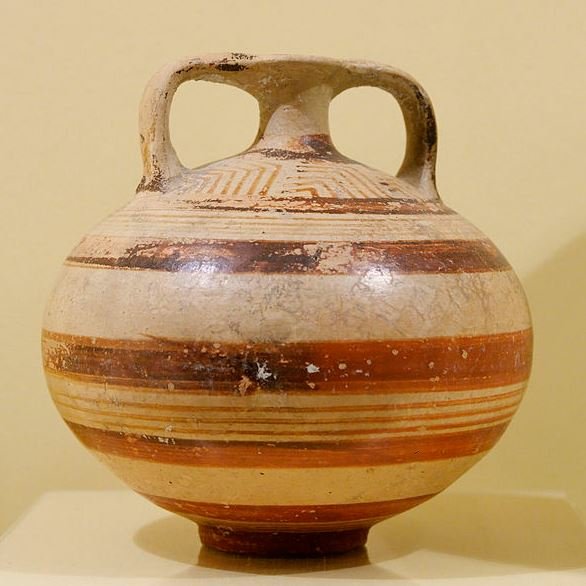
This is a Mycenaean stirrup jar, dating back to 1400–1200 BC.
How did Mycenaean pottery evolve from its Minoan origins?
Mycenaean pottery (circa 1550-1055 BCE) was initially influenced by the Minoans of Crete, especially in its early stages (circa 1550-1455 BCE). However, it eventually developed its own distinct shapes and styles. Mycenaean pottery, although inspired by Minoan techniques and motifs, became less refined compared to Minoan craftsmanship but used superior clay materials and firing techniques. Over time, the designs became more symmetrical, stylized, and minimalist, focusing on marine and plant life.
What were the main motifs and designs featured on Mycenaean pottery?
Mycenaean pottery featured stylized depictions of marine life, such as octopuses and nautiluses, as well as plant motifs like lilies and ivy. These designs followed the vessel’s contours, a practice inherited from Minoan styles. Over time, these motifs became more symmetrical, with larger empty spaces left on the pottery, reflecting a more minimalistic approach. Eventually, geometric patterns, including dark bands and simplified octopus tentacles, became common.
How did the Mycenaean conquest of Crete influence their pottery?
After the Mycenaean conquest of Crete around 1450 BCE, Mycenaean pottery began to dominate the Greek mainland and the Aegean. This period marked a shift where Mycenaean wares became indicators of political dominance. Two main decorative styles emerged: the Pictorial style, depicting scenes from daily life, and the Pattern style, which focused on geometric shapes and marine motifs. The overall decoration became more minimalistic as time passed.
What were some of the common shapes of Mycenaean pottery?
Common shapes in Mycenaean pottery included the stirrup jar, a vessel used to store liquids like wine and oil, and the alabastron, a squat jar with small ribbon handles used to store unguents. Other forms included one-handled teacups, tankards, and jugs with vertical strap handles. Over time, vessels like stemmed drinking cups evolved, with longer stems and shallower bowls. Some vessels were tin-plated to imitate metal versions.
How did the design of Mycenaean pottery change over time?
Mycenaean pottery designs became more abstract over time. For instance, early depictions of octopuses were lifelike, but later versions became highly stylized, with symmetrical and simplified tentacles. The use of dark bands as decoration also increased, with the neck of vessels reserved for pictorial scenes such as chariots and warriors. These more abstract designs were likely influenced by textiles and contemporary art forms.
What were the regional variations in Mycenaean pottery styles in the 12th century BCE?
By the 12th century BCE, regional variations became more pronounced. Four main styles emerged:
- Closed style: Filled the entire vessel with patterns, especially rosettes and birds.
- Fringed style: Combined bold curves and fine detailed decoration.
- Pictorial style: Continued with detailed scenes like the famous Warrior Vase.
- Granary style: Featured minimalistic decoration, often with only bands or monochrome slips.
What role did figurines, sarcophagi, and rhyta play in Mycenaean pottery?
Mycenaean pottery included clay figurines, typically female, which were highly stylized and may have represented nature goddesses or served as votive offerings. From around 1200 BCE, animal figurines also became popular. Clay sarcophagi were used for burials, a tradition inherited from the Minoans. Additionally, rhyta, conical vessels used for religious ceremonies, were made and decorated like other pottery.
How did Mycenaean pottery influence later Greek pottery traditions?
Mycenaean pottery had a lasting influence on later Greek pottery, particularly during the Geometric period of the 8th century BCE. The stylized designs and minimalistic approach of Mycenaean pottery laid the groundwork for the geometric patterns that would dominate Greek art. Additionally, Mycenaean potters set up workshops abroad, spreading their styles and techniques across the Mediterranean, influencing regions from Anatolia to Spain.





