Stoneware in the Minoan Civilization
Minoan stoneware was an essential aspect of ancient Cretan civilization. The works highlight the remarkable craftsmanship and artistic sophistication of the Minoans, who thrived during the Bronze Age (circa 3000-1450 BCE).
The Minoans, centered on the island of Crete, are often celebrated for their advanced society, particularly their achievements in art, architecture, and trade. Minoan stoneware exemplifies their skill in creating utilitarian and decorative objects.
Below, World History Edu covers key elements of Minoan stoneware, its characteristics, the raw materials used, techniques, cultural significance, and its place in Minoan society.
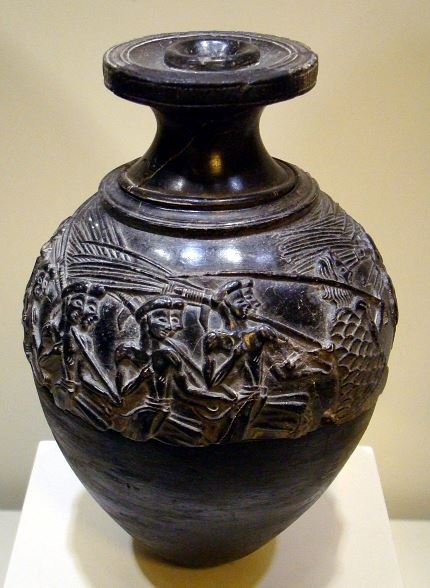
The Harvester Vase, a Minoan stone rhyton, is housed in the Heraklion Archaeological Museum in Greece.
Characteristics of Minoan Stoneware
Minoan stoneware includes a variety of vessels and objects, often made from locally sourced stones. These items, crafted with a high level of precision and artistry, show not only an aesthetic appeal but also practical utility. Stoneware artifacts include vases, bowls, rhytons (ritual vessels), lamps, and cosmetic containers.
These items reveal the Minoan’s sensitivity to form, symmetry, and proportion, with attention to detail in surface finishing and decoration. The artisans achieved smooth surfaces and intricately carved designs, highlighting the versatility and beauty of stone.
The objects exhibit a range of shapes and sizes, often imitating forms found in Minoan pottery. Stone vases, for instance, replicate the contours and proportions of ceramic vessels but are distinguished by their weight and durability. Notably, some stoneware items, such as libation tables and larnakes (stone coffins), were symbolic in nature, indicating the spiritual and ritual importance of these objects.
Types of Stone Used
The Minoans selected stones based on color, texture, and durability, all of which influenced the visual and tactile qualities of the finished product. Key types of stone used include:
- Steatite (Soapstone): Commonly used for its workability, steatite is a soft, malleable stone that allows for intricate carving and detail. Its smooth texture also made it suitable for objects that required a high polish.
- Alabaster: This translucent, fine-grained stone was highly prized for its delicate appearance. Alabaster was often used for cosmetic jars and ceremonial objects, as its lightness and luminosity added an ethereal quality to the finished pieces.
- Basalt: A hard, dark stone, basalt was used for more utilitarian items that required durability, such as grinding tools and heavier vessels. Although challenging to work with, basalt gave a polished, sturdy finish that was ideal for long-lasting objects.
- Marble: Less common than other stones, marble was occasionally used for prestigious items. Its smooth, white appearance added elegance to ceremonial pieces, though its hardness made it more difficult to shape than softer stones.
- Serpentine and Schist: These stones were accessible and workable, making them popular choices for everyday items. Their earthy colors added a natural aesthetic to stoneware, aligning with the Minoans’ connection to nature.
Techniques of Minoan Stonework
The Minoans employed a variety of techniques to transform raw stone into finished objects, showing advanced knowledge of tools and methods. These techniques included:
- Carving and Incising: Artisans used simple tools to carve intricate designs and motifs on the surface of stoneware. Incising allowed them to create patterns and textures, adding a decorative layer to functional items.
- Drilling and Hollowing: Drilling was essential for making vessels, especially those with narrow necks. The artisans drilled into the stone and then hollowed out the center to create containers for liquids or grains. This process required precision and control, as a misstep could lead to cracking or breaking.
- Polishing and Finishing: Minoan artisans applied polishing techniques to enhance the appearance of the stone’s natural color and grain. They used abrasives to smooth surfaces, creating a glossy finish that emphasized the aesthetic appeal of the stoneware. This finishing process also helped seal the stone, making it more resistant to wear and damage.
- Inlay and Gilding: Some high-status items were decorated with inlaid materials, such as precious metals or colored stones, which added visual contrast and luxury. Gilding (applying a thin layer of gold) was also practiced, particularly on ceremonial objects, emphasizing their symbolic value.
Iconography and Motifs
The decoration on Minoan stoneware often reflected themes prevalent in Minoan art and culture. Common motifs include spirals, waves, and floral patterns, as well as representations of animals and marine life. These designs suggest a deep connection to the natural world, which was a hallmark of Minoan art.
The spiral motif, for example, may symbolize continuity or the cyclical nature of life, while marine creatures, such as octopuses and fish, reflect the Minoans’ maritime orientation and reliance on the sea for trade and sustenance.
Some stoneware items also depict religious or ceremonial scenes, suggesting their role in rituals. Rhytons, which are conical or horn-shaped vessels often used for pouring liquids, were decorated with images of deities, animals, or processions, signifying their use in libations or religious ceremonies.
Cultural Significance of Minoan Stoneware
Minoan stoneware was not just utilitarian but also held cultural and symbolic importance. These objects were part of daily life, religious practices, and social ceremonies, representing different aspects of Minoan society.
Stone vessels, for example, were used in both domestic and religious contexts, suggesting that these items had dual functions. In domestic settings, stoneware served as storage and preparation tools for food and other substances, while in temples and shrines, they played a role in offerings and libations.
The production of stoneware may have also served as a means of social differentiation. Given the skill required to create fine stoneware, such objects were likely reserved for the elite, signifying wealth and status. The complexity and artistry of certain pieces, especially those made from rare stones or adorned with gold, suggest that these items were highly valued, possibly as heirlooms or gifts.
Minoan Trade and Stoneware
The Minoans engaged in extensive trade networks that linked them to various regions of the Mediterranean, including Egypt, Anatolia, and the Levant. Stoneware, with its high durability and aesthetic appeal, became one of the commodities traded by the Minoans. Archaeological evidence shows that certain types of stone and stoneware were imported, indicating a preference for exotic materials in addition to local resources.
Through the selection of materials, intricate crafting techniques, and symbolic motifs, Minoan artisans created objects that served both practical needs and symbolic purposes.
The presence of Minoan stoneware in distant locations give credence to the importance of these objects in establishing trade relations and cultural exchanges. By trading stoneware, the Minoans were able to spread their influence and artistic styles, as evidenced by Minoan artifacts found in settlements across the Aegean. This exchange enriched Minoan culture, allowing them to incorporate foreign artistic elements and techniques into their own stoneware.
Preservation and Archaeological Discovery
Minoan stoneware has been preserved in various archaeological contexts, including palaces, tombs, and religious sites. The durability of stone has allowed many objects to survive the passage of time, offering insights into Minoan society, art, and beliefs. Key archaeological sites like Knossos, Phaistos, and Malia have yielded numerous stoneware artifacts, allowing researchers to study the development and diversity of Minoan craftsmanship.
Through these discoveries, archaeologists have been able to piece together the evolution of Minoan stoneware, from its functional beginnings to its later stages as a highly refined art form. The distribution of stoneware artifacts across different sites also provides clues about Minoan trade routes, social stratification, and ritual practices.
The Decline of Minoan Stoneware
The decline of the Minoan civilization around 1450 BCE, possibly due to natural disasters or invasions, led to a reduction in the production of stoneware. However, the techniques and styles developed by Minoan artisans influenced subsequent cultures in the region. The Mycenaeans, who took control of Crete after the decline of the Minoans, adopted some Minoan artistic elements, including aspects of stoneware production.
What are the major differences between Mycenaean and Minoan Art?
Questions and Answers
When did Minoan craftsmen begin producing stone vessels, and how long did this craft last?
Minoan craftsmen started making stone vessels around 2500 BCE during the early Bronze Age, and this craft continued for about a thousand years.
What tools and techniques did Minoan artisans use to carve stone vessels?
Minoan artisans used chisels, hammers, saws, blades, and occasionally harder stones to cut softer materials. They applied abrasives like sand or emery for finishing. For hollowing, they used copper drills turned with a bow and an abrasive to carve out the interior.
What types of stones did Minoan craftsmen work with?
Minoans used various stones, including marble, limestone, gypsum, alabaster, basalt, obsidian, rock crystal, soapstone, schist, and serpentine, often selecting stones for their natural color variations to enhance the vessel designs.
What influenced the shapes and decoration of Minoan stone vessels?
Many stone vessels mirrored the shapes of contemporary pottery and even adopted decorations like the Marine Style, featuring motifs such as octopuses and shells.
Where were Minoan stone vessels produced and traded?
Minoan stone vessels were produced across Crete, in locations like Knossos, Phaistos, Malia, Mochlos, and Zakros. They were admired and traded throughout the Aegean, including the Cycladic islands.
What were some popular shapes and designs in Minoan stoneware?
Popular shapes included the “bird’s nest” lidded bowl, often used for oils, and the “blossom bowl” with petal-like carvings. Minoans also crafted larger, complex vessels like rhytons (ritual vases) with conical forms or animal shapes such as bulls or shells.
Describe the significance and design of the Chieftain Cup.
The Chieftain Cup is a notable Minoan rhyton depicting a young Cretan prince addressing a captain. The scene shows intricate carvings and a conical shape, capturing a high level of artistic detail.
How did stoneware production change after the Mycenaean takeover of Crete?
After the Mycenaeans took over Crete around the 15th century BCE, stoneware production largely ceased, except at Knossos, where vessels became larger and more functional. By the early 14th century BCE, stoneware production had ended on Crete.
What is one of the most famous Minoan stone rhytons, and where can it be found today?
One of the most famous rhytons is the serpentine bull’s head from the Little Palace at Knossos (c. 1600-1500 BCE), which is now housed in the Archaeological Museum of Heraklion. It features gilded horns, rock-crystal eyes, and a realistic design.
What makes the Harvester Vase from Hagia Triada a significant example of Minoan stonework?
The Harvester Vase, dated to around 1500-1450 BCE, is a rhyton featuring a detailed relief of 27 figures in a sowing festival, showcasing the skill of Minoan stone carvers in creating lively and intricate scenes.

A closer view of the Harvester Vase.
Describe the notable rock-crystal bowl and jug attributed to Minoan craftsmanship.
The rock-crystal bowl from Mycenae has a duck-head handle and may have been used for cosmetics. A rock-crystal jug from Zakros, likely used for libations, features a collar of gilded ivory discs and a handle of green beads, demonstrating Minoan artisans’ precision and artistic skill.