Naa Gbewaa: Founder of the Kingdom of Dagbon
Naa Gbewaa, also known as Nedega or Kulu Gbagha, is recognized as the founding figure of the Kingdom of Dagbon, a prominent state in what is now northern Ghana. His legacy is not only tied to the establishment of Dagbon but also to the formation of several other kingdoms and states in West Africa, such as the Mossi Kingdoms in present-day Burkina Faso.
Gbewaa’s influence continues to resonate today in the traditional systems of governance, royal succession, and cultural identity in northern Ghana and neighboring regions.

Naa Gbewaa’s founding of the Kingdom of Dagbon represents one of the most significant moments in the history of northern Ghana and West Africa.
Early Life and Founding of Dagbon
Though specific details about Naa Gbewaa’s early life are sparse and largely rooted in oral tradition, it is believed that he migrated from an area further north with his followers.
This migration likely occurred due to political or environmental pressures, leading Gbewaa and his people to settle in the area that would become the Kingdom of Dagbon.
His leadership, military prowess, and ability to unite various clans and ethnic groups under his rule were instrumental in the formation of the kingdom.
Naa Gbewaa established a centralized and prosperous state, securing territory that spanned much of what is now northern Ghana. He is credited with introducing governance systems that would shape the political and social structure of Dagbon for centuries. Under his reign, the kingdom thrived, becoming a regional power in terms of trade, culture, and military strength.
Gbewaa’s Family and Legacy
Naa Gbewaa fathered several children, each of whom played a significant role in the expansion and diversification of his legacy. His children went on to establish or rule over important territories, further extending Gbewaa’s influence beyond the borders of Dagbon.
- Yemtori (Yennenga): One of Gbewaa’s most well-known children, Yemtori, also referred to as Yennenga, traveled northward, eventually marrying Rialle. Together, they had a son named Ouedraogo, who went on to found the Mossi Kingdoms in present-day Burkina Faso. This connection established by Yemtori created a lasting relationship between the Dagbon and Mossi kingdoms, reinforcing Naa Gbewaa’s influence across a wider region.
- Gundo Naa Kachaɣu: Gbewaa’s eldest daughter, Kachaɣu, became the first Gundo Naa, the highest-ranking female royal title in Dagbon. The title of Gundo Naa is reserved exclusively for women, and it continues to play a critical role in Dagbon’s royal structure to this day. The Gundo Naa has substantial influence in matters of governance, especially in overseeing the selection of chiefs and resolving internal conflicts.
- Naa Ʒirli (Zirile): The eldest son of Naa Gbewaa, Zirile, was expected by some to succeed his father. However, as will be discussed, his succession was interrupted by a significant internal conflict.
- Fɔɣu (Kufɔɣu): Gbewaa’s preferred successor, Fɔɣu, was chosen despite not being the eldest son. This decision would later lead to a tragic outcome.
- Naa Shitɔbu: Shitɔbu eventually led most of Naa Gbewaa’s children and descendants, maintaining Dagbon’s royal lineage and identity after Gbewaa’s death.
- Gmamprugulana Tohigu (Tosugu): Tohigu, another of Gbewaa’s sons, moved to Gambaga, where he established a kingdom that would become Mamprugu. Today, Mamprugu is one of the key traditional kingdoms in northern Ghana, with its own rich history and strong cultural ties to Dagbon.
Succession Conflict and the Division of Old Dagbon
One of the most critical events following Naa Gbewaa’s reign was the internal conflict over his succession. Despite Gbewaa’s choice of Fɔɣu as his successor, Zirile, his eldest son, disagreed with the decision.
This internal family conflict escalated to violence when Zirile murdered Fɔɣu to eliminate the competition for the throne. The news of Fɔɣu’s death devastated Naa Gbewaa, and according to the traditional oral history of Dagbon, Gbewaa “disappeared into the ground,” a euphemism used by Dagbon historians to describe his passing.
The power vacuum left by Gbewaa’s death led to further disputes among his children. Kachaɣu, his eldest daughter, briefly assumed the royal regalia and took on the leadership of the kingdom, making herself queen. However, Zirile forced her to give up the regalia and took control. Despite Zirile’s actions, many of Gbewaa’s children, including Kachaɣu, ultimately supported Shitobu, who became the recognized leader of post-Gbewaa Dagbon.
This period of internal strife contributed to the eventual fragmentation of Old Dagbon. Some of Gbewaa’s children and their descendants moved to other regions to establish or rule new states.
Tohigu, for example, left to form Mamprugu, while Gmantambo moved further south and founded the kingdom of Nanung. These new states, including Dagbon, Mamprugu, and Nanung, all trace their origins back to Naa Gbewaa, and together they form the basis of the Mole-Dagbani states in northern Ghana.
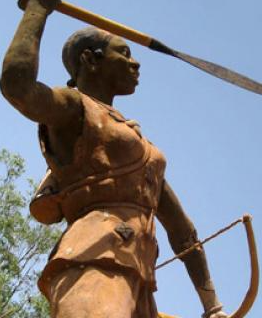
Naa Gbewaa’s descendants established several states, including the Mossi Kingdoms in Burkina Faso. He created a stable and prosperous kingdom. Image: Statue of Yemtori.
Cultural and Political Impact of Naa Gbewaa
Naa Gbewaa’s legacy extends beyond his role as a founding figure in West African history. His governance style, which emphasized unity, military strength, and centralized authority, left an indelible mark on the political structures of Dagbon and other kingdoms. The chieftaincy system that he established has endured for centuries and continues to function in modern Ghana.
In Dagbon, the ruler is known as the Yaa Naa and resides in the Gbewaa Palace, a reflection of the enduring significance of Naa Gbewaa’s leadership. The royal family of Dagbon, descended from Gbewaa, continues to follow traditional succession practices that often involve competition among royal candidates rather than a strict adherence to primogeniture. This method of succession, established in the aftermath of Gbewaa’s death, has been integral to maintaining stability within the royal family and ensuring capable leadership for the kingdom.
The Gundo Naa title, which Kachaɣu first held, remains one of the most important positions in Dagbon’s royal hierarchy. The Gundo Naa plays a crucial role in managing succession disputes and serves as an advisor to the Yaa Naa. This tradition of strong female leadership within Dagbon highlights the unique aspects of Gbewaa’s legacy, where women held and continue to hold significant power.

Relations with Other Kingdoms
The reach of Naa Gbewaa’s legacy extended beyond Dagbon through the migrations and conquests of his descendants. The most notable example is the Mossi Kingdoms, founded by Ouedraogo, the grandson of Naa Gbewaa through his daughter Yemtori (Yennenga). The Mossi Kingdoms became a powerful political entity in West Africa, and they maintained a close relationship with Dagbon, underscoring the enduring familial and cultural ties that originated with Naa Gbewaa.
Mamprugu, established by Gbewaa’s son Tohigu, also developed into a strong kingdom. While Mamprugu and Dagbon share the same ancestry, their histories diverged following the split of Old Dagbon. Mamprugu’s succession system differs from Dagbon’s, as it follows a more rigid form of primogeniture, favoring the eldest male heir, whereas Dagbon employs a competitive process for selecting a ruler.
Despite these differences, both kingdoms maintain cultural connections to Naa Gbewaa, and their symbols reflect this shared heritage. Dagbon is associated with the Lion of Gbewaa, a symbol of strength and leadership, while Mamprugu adopted the elephant as its emblem, representing power and endurance.
Modern Significance
Today, the descendants of Naa Gbewaa continue to play vital roles in the cultural and political life of northern Ghana. The Yaa Naa of Dagbon, the Nayiri of Mamprugu, and the chiefs of Nanung all trace their lineage back to Gbewaa, ensuring that his legacy remains at the heart of the traditional governance systems in these regions. The Gbewaa Palace in Yendi, where the Yaa Naa resides, stands as a symbol of the continuity of Dagbon’s royal lineage.
The continued use of traditional systems of succession, the influence of the Gundo Naa, and the shared cultural symbols across the Mole-Dagbani states are testaments to the lasting impact of Naa Gbewaa. His descendants have maintained not only political power but also cultural influence, preserving the traditions and practices that have defined their people for centuries.
Questions and Answers about Naa Gbewaa and the Kingdom of Dagbon

Naa Gbewaa’s legacy is not limited to Dagbon alone, as his descendants went on to establish other important states, including Mamprugu, Nanung, and the Mossi Kingdoms. Image: Map of West Africa during AD 1530, showing the area (light green) occupied by the Mossi Kingdoms.
Who was Yemtori (Yennenga), and what was her role in expanding Gbewaa’s legacy?
Yemtori (Yennenga) was Naa Gbewaa’s daughter. She traveled north and married Rialle, and their son, Ouedraogo, founded the Mossi Kingdoms in present-day Burkina Faso.
What was the significance of Gundo Naa Kachaɣu in Dagbon’s history?
Gundo Naa Kachaɣu, Naa Gbewaa’s eldest daughter, became the first Gundo Naa, a prestigious title reserved for women in Dagbon’s royal hierarchy.
What internal conflict arose after Naa Gbewaa chose his successor?
Naa Gbewaa chose his younger son, Fɔɣu, as his successor, bypassing his eldest son, Zirile. Zirile, angered by this decision, murdered Fɔɣu, leading to Gbewaa’s heartbroken death.
How is Naa Gbewaa’s death described by Dagbon historians?
Dagbon historians use a euphemism to describe Naa Gbewaa’s death, stating that he “disappeared into the ground,” a traditional way of referring to the passing of a king.
What happened after Naa Gbewaa’s death in terms of leadership?
After Naa Gbewaa’s death, Kachaɣu briefly assumed leadership but was forced to step down by Zirile. Most of Gbewaa’s children, including Kachaɣu, eventually followed Shitobu, who maintained leadership over Dagbon.
Who was Shitobu, and what role did he play in Dagbon’s continuity?
Shitobu, despite not being Naa Gbewaa’s eldest son, retained the royal regalia and continued to rule Dagbon. His leadership helped maintain the kingdom’s continuity.
What region did Tohagu rule, and how does it relate to Mamprugu?
Tohagu, another son of Naa Gbewaa, ruled over the land that would later become Mamprugu, an important kingdom in northern Ghana.
How does Mamprugu’s claim to eldership differ from Dagbon’s tradition?
Mamprugu claims eldership based on primogeniture, favoring the eldest male, but Naa Gbewaa did not follow this system. He selected Fɔɣu, a younger son, as his successor, rather than his eldest child.
How do both Dagbon and Mamprugu manage succession today?
Today, both Dagbon and Mamprugu use a system of succession by competition, rather than strict primogeniture, where different candidates compete for leadership.
What symbols are associated with Dagbon and Mamprugu?
Dagbon is associated with the Lion of Gbewaa, a symbol of its heritage, and the ruler resides in the Gbewaa Palace. Mamprugu adopted the elephant as its emblem