Dutch Naval Officer Michiel de Ruyter
Michiel Adriaenszoon de Ruyter, born on March 24, 1607, in Vlissingen (also known as Flushing) in the province of Zealand, Netherlands, was one of the most celebrated and skilled naval commanders in history.
His life spanned an era of intense naval rivalry and warfare in Europe, particularly between the Dutch Republic, England, and France. Over the course of his remarkable career, De Ruyter became a national hero in the Netherlands for his daring exploits, brilliant tactics, and unwavering commitment to defending Dutch maritime interests. He played a crucial role in the Dutch Republic’s survival during a period when its existence was threatened by powerful enemies.
Early Life and Background
De Ruyter’s early years are somewhat shrouded in mystery, and many stories about his youth are of questionable historical accuracy. What is known is that he was born into a modest family. His father, Adriaen Michielszoon, was a seaman who eventually became a member of the beer porters’ guild, while his mother, Aagje Jansdochter, came from a similarly humble background. De Ruyter’s early exposure to the sea, a common aspect of life in the coastal town of Vlissingen, was pivotal in shaping his career.
At the age of 11, De Ruyter embarked on his first seafaring experience as a boatswain’s apprentice, a typical starting age for boys from Zeeland. The sea offered a viable career path for young boys from lower-income families, and De Ruyter quickly demonstrated his aptitude for maritime life. His early work, like many boys in his situation, involved labor-intensive tasks such as handling ropes and assisting the crew, but these experiences were essential in teaching him the skills necessary for the leadership roles he would later assume.

Born in Zeeland, De Ruyter began his seafaring career early and, by age 30, had become a shipmaster in the Dutch merchant fleet. Image: De Ruyter.
Early Military Service
By the time De Ruyter was in his mid-teens, Europe was engulfed in the Eighty Years’ War (1568–1648), a struggle between the Dutch Republic and Spain for Dutch independence. In 1622, at the age of 15, De Ruyter fought as a cannoneer in the Dutch army, under Maurice of Nassau, during the relief of the city of Bergen-op-Zoom, which was besieged by Spanish forces. This experience marked his first taste of military action, but his participation was short-lived. After this brief foray into land warfare, De Ruyter returned to his first love—the sea.
Following his military service, De Ruyter steadily climbed the ranks of the Dutch merchant fleet. He became a boatswain and later a chief mate, gradually earning the respect of his peers for his competence and leadership skills. By the age of 30, he had achieved the rank of shipmaster. His merchant voyages during this time took him to various parts of Europe, including Spain and Portugal, and as far as the Barbary Coast in North Africa, where European traders frequently interacted with the infamous Barbary pirates.
Time in Dublin and Merchant Career
According to an anonymous English biographer, De Ruyter spent several years in Dublin, Ireland, working for the Vlissingen-based Lampsins brothers’ merchant house between 1623 and 1631. During this period, he is said to have improved his English and even gained a slight knowledge of Irish. His time in Dublin also strengthened his international connections and broadened his understanding of global trade, a valuable asset when he later commanded Dutch naval forces. His fluency in English would prove particularly useful during the Anglo-Dutch Wars, as it allowed him to communicate effectively with captured English officers.
By the early 1630s, De Ruyter had established himself as a capable merchant ship captain, traveling to distant regions such as the Mediterranean and the Barbary Coast. During this time, he sometimes referred to himself as “Machgyel Adriensoon,” using the Zeelandic dialect, a reflection of his local roots. It was only later in his career that he adopted the surname “De Ruyter,” likely a nickname. The origin of this name is debated; it may have come from the Dutch verb ruyten or ruiten, meaning “to raid,” a reference to his work as a privateer. Another theory is that “De Ruyter,” which translates to “horseman,” was a nod to one of his grandfathers, who had served as a cavalry trooper.
Personal Tragedies and Family Life
In 1631, De Ruyter married Maayke Velders, a farmer’s daughter, but tragedy struck when both she and their newborn daughter died later that same year. Devastated, De Ruyter threw himself into his work, taking on more voyages and increasing his involvement in maritime trade. In 1636, he remarried, this time to Neeltje Engels, the daughter of a wealthy burgher. Neeltje gave birth to four children, although one died shortly after birth. The surviving children were Adriaen (born 1637), Neeltje (born 1639), and Aelken (born 1642).
During this period, De Ruyter captained several ships, including the Groene Leeuw (“Green Lion”), which he used for whaling expeditions to the Arctic island of Jan Mayen. His ventures as a merchant and whaler were financially successful, allowing him to purchase his own ship, the Salamander, and build a small fortune. However, despite his success in the private sector, De Ruyter would soon be called back into military service.
Early Naval Career and the Dunkirkers
In 1637, De Ruyter became the captain of a private ship tasked with hunting the Dunkirkers, privateers who operated out of Dunkirk and preyed on Dutch merchant shipping. These privateers were a significant threat to Dutch maritime trade during the Eighty Years’ War, and De Ruyter’s mission was to protect Dutch ships from their attacks. He fulfilled this role with distinction until 1640, gaining valuable experience in naval combat and strategy.
In 1641, De Ruyter was nominated by the Admiralty of Zeeland to command the Haze, a 26-gun merchant ship that had been converted into a man-of-war. His ship was part of a fleet under Admiral Gijsels, which was sent to support the Portuguese during the Portuguese Restoration War against Spain. Although this expedition had limited success, De Ruyter distinguished himself in a naval battle off Cape St. Vincent on November 4, 1641. Despite the loss of two ships and the fleet’s inability to achieve its primary objective, De Ruyter’s performance in battle caught the attention of higher authorities.
After this expedition, De Ruyter returned to his merchant career, sailing on behalf of the Lampsins brothers or as the owner of his ship. Between 1642 and 1651, he made several profitable voyages to regions such as Morocco, Brazil, and the West Indies. By 1651, he had amassed enough wealth to retire from active seafaring and settle in Vlissingen with his family.
The First Anglo-Dutch War
De Ruyter’s retirement did not last long. In 1652, the First Anglo-Dutch War broke out between the English Commonwealth and the Dutch Republic. Despite initial reluctance, De Ruyter agreed to return to service, commanding a squadron of warships for the Admiralty of Zeeland. His initial position was as a commandeur (a rank equivalent to commodore), where he was responsible for protecting Dutch merchant convoys from English attacks.
In August 1652, De Ruyter’s fleet encountered an English force commanded by General-at-Sea George Ayscue near Plymouth. In the ensuing Battle of Plymouth on August 16, De Ruyter outmaneuvered the English, successfully defending the Dutch merchant convoy despite being outnumbered. This victory made him a national hero in the Netherlands, and his reputation as a brilliant naval commander began to grow.
De Ruyter went on to participate in several key battles of the First Anglo-Dutch War, including the Battle of Kentish Knock and the Battle of the Gabbard. After the death of Maarten Tromp, the Dutch Republic’s supreme naval commander, at the Battle of Scheveningen in 1653, De Ruyter was offered command of the entire Dutch fleet. However, he declined, citing his lack of experience and concern over the potential for conflict with more senior officers such as Witte de With and Johan Evertsen. Instead, Colonel Jacob van Wassenaer Obdam was appointed as the new supreme commander.

The Mediterranean and Barbary Coast Missions
In 1655, De Ruyter accepted a position as vice-admiral of the Admiralty of Amsterdam. His first major mission in this new role was to lead a squadron to the Mediterranean, where he was tasked with protecting Dutch trade and ransoming enslaved Christians from the Barbary corsairs. During this mission, De Ruyter successfully negotiated peace agreements with several North African states, including Salé, and captured several notorious corsairs. His efforts earned him widespread praise and reinforced his reputation as a skilled and diplomatic leader.
The Second Anglo-Dutch War and the Raid on the Medway
De Ruyter’s greatest achievements came during the Second Anglo-Dutch War (1665–1667). In 1666, he led the Dutch fleet to victory in one of the most famous naval engagements of the era, the Four Days’ Battle. This battle, which took place from June 11 to June 14, was a prolonged and brutal contest between the Dutch and English fleets. Despite being outnumbered and facing a formidable English force, De Ruyter’s tactical brilliance allowed the Dutch to secure a hard-fought victory. The battle solidified his status as one of the greatest naval commanders of his time.
In 1667, De Ruyter orchestrated the Raid on the Medway, one of the most daring and successful naval operations in history. The Dutch fleet, under De Ruyter’s command, sailed up the River Thames and attacked the English fleet at anchor in the Medway River. The Dutch forces managed to destroy much of the English fleet, including the capture of the flagship HMS Royal Charles, which they towed back to the Netherlands as a trophy. The Raid on the Medway was a humiliating defeat for the English and effectively ended the Second Anglo-Dutch War in favor of the Dutch Republic.
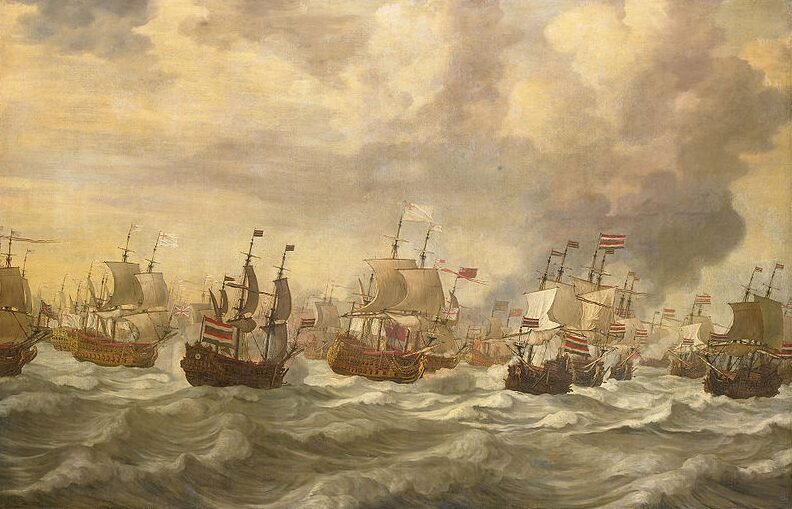
Image: An illustration depicting the Four Days’ Battle.
The Third Anglo-Dutch War and Defense of the Dutch Coast
The Third Anglo-Dutch War (1672–1674) was part of a larger European conflict known as the Franco-Dutch War. This time, the Dutch Republic faced the combined forces of England and France. De Ruyter once again played a central role in defending the Dutch Republic from invasion. His leadership in the battles of Solebay, Schooneveld, and Texel in 1672 and 1673 prevented the Anglo-French forces from landing troops on the Dutch coast.
De Ruyter’s success in these battles was due not only to his naval tactics but also to his ability to inspire loyalty and confidence in his men. Known for his humility and refusal to accept special treatment, De Ruyter earned the affectionate nickname “Bestevaêr” (grandfather) from his sailors. His disregard for hierarchy and his willingness to share the dangers of battle with his crew endeared him to the men under his command.

Lieutenant-Admiral General and Final Campaigns
In recognition of his service, De Ruyter was promoted to the newly created rank of lieutenant-admiral general in 1673, making him the highest-ranking officer in the Dutch navy. This rank was created specifically for De Ruyter, a testament to his extraordinary contributions to the defense of the Dutch Republic.
Despite his advancing age, De Ruyter continued to lead Dutch naval forces into battle. In 1676, during the Franco-Dutch War, he was sent to the Mediterranean to assist the Spanish in their conflict with France. De Ruyter’s final campaign took place in the waters off Sicily, where he commanded a joint Dutch-Spanish fleet against the French. On April 22, 1676, during the Battle of Augusta, De Ruyter was mortally wounded by a cannonball that struck his leg. He died a week later, on April 29, in the city of Syracuse.
Legacy and Honors
Michiel de Ruyter was given a state funeral in the Netherlands, and his body was buried in the Nieuwe Kerk in Amsterdam. His tomb became a national monument, and his legacy has endured for centuries. De Ruyter is remembered not only for his naval victories but also for his leadership, humility, and commitment to protecting Dutch interests.
Numerous statues and streets in the Netherlands are named in his honor, and several ships of the Royal Netherlands Navy have been named HNLMS De Ruyter. De Ruyter is also credited with helping to found the Netherlands Marine Corps in 1665, which remains an important part of the Dutch armed forces to this day.
In popular culture, De Ruyter’s life has been the subject of books, films, and even postage stamps. A 2015 biopic, Michiel de Ruyter, starring Frank Lammers, brought his story to a new generation of viewers.
De Ruyter’s impact on Dutch naval history cannot be overstated. His brilliant tactics, fearless leadership, and diplomatic acumen helped secure the Dutch Republic’s survival during a tumultuous period in European history. His legacy as one of the greatest naval commanders of all time continues to be celebrated both in the Netherlands and around the world.
Questions and Answers
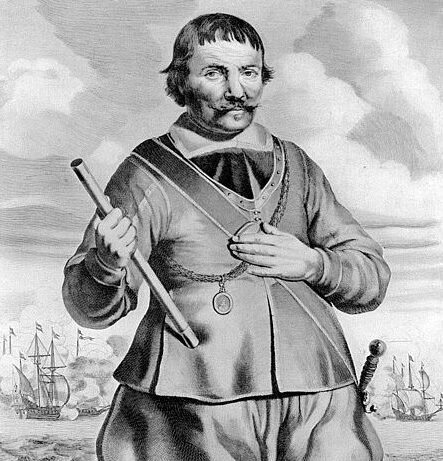
Michiel de Ruyter is celebrated for his strategic brilliance during the Anglo-Dutch Wars, earning him a place among history’s greatest naval commanders.
When and where was Michiel Adriaenszoon de Ruyter born?
Michiel Adriaenszoon de Ruyter was born on March 24, 1607, in Vlissingen (Flushing), a town in the province of Zealand, Netherlands.
De Ruyter was the son of Adriaen Michielszoon, a seaman who later became a member of the beer porters’ guild, and Aagje Jansdochter.
At what age did De Ruyter begin his seafaring career, and what was his first position?
De Ruyter began his seafaring career at the age of 11 as a boatswain’s apprentice, a common starting age for boys from Zeeland.
What role did De Ruyter play during the Eighty Years’ War?
In 1622, during the Eighty Years’ War, De Ruyter served as a cannoneer in Maurice of Nassau’s army during the relief of Bergen-op-Zoom.
What languages did De Ruyter speak, and how did he learn them?
De Ruyter spoke fluent English and serviceable French. He likely learned English during his time in Dublin, where he worked as a factor for the Lampsins brothers from 1623 to 1631.
How did De Ruyter acquire his nickname?
The origin of De Ruyter’s nickname is debated. It might come from the Dutch verb ruyten or ruiten, meaning “to raid,” reflecting his privateering activities, or from “ruyter,” meaning “horseman,” possibly in honor of his grandfather who was a cavalry trooper.
What personal tragedy did De Ruyter experience in 1631?
In 1631, De Ruyter married Maayke Velders, but both she and their newborn daughter died within the same year.
What was De Ruyter’s role in combating Dunkirkers?
From 1637 to 1640, De Ruyter captained a private ship tasked with hunting Dunkirkers, privateers who preyed on Dutch merchant ships.
How did De Ruyter distinguish himself during the Portuguese Restoration War?
In 1641, De Ruyter commanded Haze, a 26-gun merchant ship converted to a man-of-war, and distinguished himself in a naval battle off Cape St. Vincent, though the mission ultimately returned home without success.
De Ruyter attempted to retire in 1651 after making profitable voyages. However, when the First Anglo-Dutch War broke out in 1652, he returned to service, commanding a Zeeland squadron.
What significant naval battle did De Ruyter win in 1652?
On August 16, 1652, De Ruyter led his fleet in the Battle of Plymouth, successfully defending a convoy of Dutch merchant ships against an English attack, making him a national hero.
In 1655, De Ruyter led a squadron to the Mediterranean to protect Dutch trade and negotiate peace with Barbary corsairs, successfully capturing several corsair ships and securing a peace agreement with Salé.
Why did De Ruyter decline command of the Dutch fleet after the death of Maarten Tromp?
De Ruyter declined command of the Dutch fleet after Tromp’s death because he felt unqualified and wanted to avoid conflict with more senior officers like Witte de With and Johan Evertsen.
What honors did De Ruyter receive for his role in the Battle of the Sound in 1658?
For his role in the Battle of the Sound, where a Dutch-Danish fleet relieved the siege of Copenhagen, De Ruyter was knighted by the Danish king, Frederick III.
What were De Ruyter’s major accomplishments during the Second Anglo-Dutch War?
De Ruyter’s major accomplishments during the Second Anglo-Dutch War included leading the Dutch fleet to victory in the Four Days’ Battle (1666) and orchestrating the Raid on the Medway (1667), where he captured the English flagship, HMS Royal Charles.
How did De Ruyter prevent an Anglo-French invasion during the Third Anglo-Dutch War?
During the Third Anglo-Dutch War (1672–1674), De Ruyter’s leadership at the battles of Solebay, Schooneveld, and Texel thwarted Anglo-French invasion attempts.
What rank was created specifically for De Ruyter in 1673?
The rank of lieutenant-admiral general was created specifically for De Ruyter in 1673 in recognition of his outstanding service.
How did De Ruyter meet his end?
De Ruyter was mortally wounded during the Battle of Augusta in 1676, as part of the Franco-Dutch War. He died on April 29, 1676, in Syracuse.
What honors did De Ruyter receive posthumously?
De Ruyter was honored with a state funeral and buried in the Nieuwe Kerk in Amsterdam. He is remembered with statues, streets named after him, and several Royal Netherlands Navy ships bearing his name.
He is credited with founding the Netherlands Marine Corps, and his successful naval career left a lasting legacy in Dutch naval history.





