
Image: Daughter of Niobe bent by terror, Niobe room in Uffizi gallery
READ MORE: Most Powerful Greek gods and goddesses
Niobe’s Parentage and Background

In Greek mythology, Niobe was the daughter of Tantalus and either Dione, Eurythemista, or Euryanassa.
Niobe was the daughter of Tantalus, the king of Sipylus, a city located near modern-day Manisa in western Turkey. Tantalus himself was a complex figure in Greek mythology, infamous for his own hubris and for the punishment he received in the underworld for offending the gods. He committed a grievous crime by either stealing ambrosia and nectar from the gods or, more notably, by attempting to serve his son, Pelops, as a meal to the gods. For these acts, Tantalus was condemned to eternal torment in Tartarus, symbolizing the fate of mortals who defy divine authority.

Niobe’s father was Tantalus, who ruled over the ancient city of Sipylus, located near modern-day Manisa in Turkey, at the foot of Mount Sipylus. Image: A painting of Tantalus by Italian artist Gioacchino Assereto.
The kingdom of Tantalus was situated in a region rich with mythological associations. The city of Sipylus, also known as Tantalis, was said to be located at the foot of Mount Sipylus. According to ancient sources, including the Roman writer Pliny the Elder, the city was destroyed by an earthquake and replaced by Magnesia ad Sipylum. Niobe’s family was often associated with this area, blending history and myth in the context of Anatolia’s ancient kingdoms. Despite her father’s ties to Phrygia, Niobe is also sometimes associated with Lydia, suggesting a broader Anatolian influence.
Niobe’s lineage was impressive: her father, Tantalus, had been welcomed as a guest at the table of the gods, and her husband, Amphion, was a son of Zeus and Antiope. Amphion, along with his twin brother Zethus, ruled over Thebes, and Amphion’s musical talents were renowned. Hermes, the messenger god, had given Amphion a golden lyre, and his music was so powerful that it is said to have helped him build the walls of Thebes. With such a prestigious family background, Niobe’s pride was understandably great, but it was this same pride that led to her downfall.
Niobe’s Hubris
Niobe’s tragic tale is most often centered around her pride, or hubris, and the resulting punishment. She boasted about her numerous children, known as the Niobids, claiming superiority over the goddess Leto, who had only two children—Apollo and Artemis. Niobe is traditionally said to have had fourteen children, seven sons and seven daughters, though some versions of the myth list fewer offspring.
Her hubris was evident in her public declarations. Niobe looked down on Leto, taunting her for having fewer children and questioning why the people of Thebes should worship Leto rather than herself, as Niobe believed she was more blessed by the gods.
Niobe’s speech, filled with pride, was a direct affront to Leto. Niobe was unable to see the danger in comparing herself to a goddess, an act that was seen as deeply offensive in Greek mythological tradition, where mortals were expected to maintain reverence and humility toward the divine.
Niobe’s boast not only reflected her arrogance but also emphasized the importance of children in the ancient world, where large families were seen as a sign of wealth, status, and divine favor. However, in this myth, Niobe’s many children became the source of her ruin rather than her strength.
The Punishment of Niobe
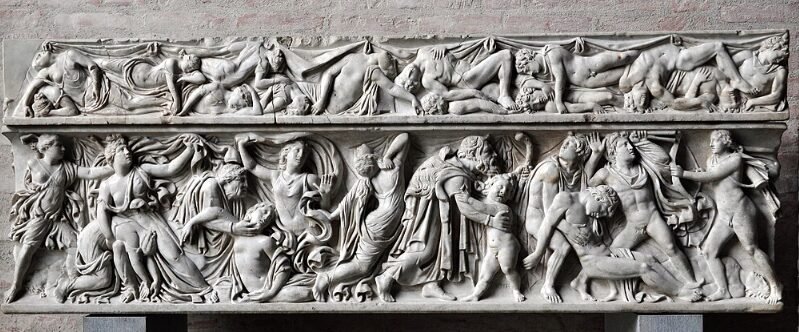
Image: Roman sarcophagus showing the murder of Niobeʼs children. Ca 160 AD. Glyptothek, Munich.
Niobe’s pride did not go unpunished. Leto, deeply insulted by Niobe’s words, sent her children, the twin gods Apollo and Artemis, to exact revenge. Apollo, the god of archery, music, and prophecy, killed Niobe’s seven sons, while Artemis, the goddess of the hunt and chastity, killed her seven daughters.
Some variations of the myth claim that only six of each were killed, with one son and one daughter spared—Meliboea (later known as Chloris) and Amyclas. Chloris’s name, meaning “the pale one,” suggests that she was left forever marked by the trauma of the massacre.
Amphion, Niobe’s husband, either committed suicide out of grief or was killed by Apollo for attempting to retaliate. In some versions, he tried to storm Apollo’s temple in rage but was struck down by the god’s arrows. The death of Niobe’s children and husband left her utterly desolate.

Image: Apollo and Artemis shoot Niobe’s sons, some fleeing on horseback, in an idyllic landscape fresco from Pompeii (1st century BC – 1st century AD).
Unable to cope with the overwhelming grief, Niobe fled back to Mount Sipylus, her childhood home. There, according to the myth, she was transformed into stone by the gods.
However, her suffering did not end with this transformation. Even as a stone, Niobe continued to weep for her lost children, and water was said to pour from the stone in eternal mourning.
This story gave rise to a natural rock formation on Mount Sipylus that was said to resemble a weeping woman. The formation, known as the Weeping Rock, still exists today and has been a source of fascination for travelers since antiquity.

Niobe’s transformation from a proud mother to a stone eternally weeping for her lost children serves as a powerful reminder of the consequences of hubris. Image: The Weeping Rock on Mount Sipylus in Manisa, Turkey, has been linked to Niobe’s legend.
Niobe in Ancient Literature
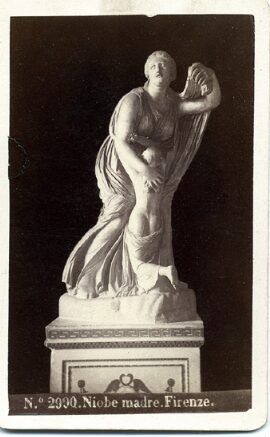
Niobe’s story is mentioned by Achilles in Homer’s Iliad, and later writers also connect her to Thebes, though no shrine in her honor existed there. Instead, her association is more closely tied to the mythological landscape of Sipylus, where she was said to brood over her sorrow. Image: Picture of the Uffizi sculpture representing Niobe photographed by Giorgio Sommer
Niobe’s tragic tale appears in several key works of ancient literature. One of the earliest references to Niobe is found in Homer’s Iliad, where Achilles recounts Niobe’s story to Priam. The context of this story is significant, as it highlights Niobe as a symbol of prolonged grief. Just as Niobe grieved endlessly for her children, Priam grieved for his son Hector, whose body lay unburied after being killed by Achilles.
Niobe is also mentioned in Sophocles’s Antigone. As Antigone faces her own death, she draws a parallel between herself and Niobe, seeing her impending doom as a reflection of the loneliness and isolation that Niobe endured. Niobe’s silence in the face of her suffering became a symbol for Antigone’s own defiance and tragic fate.
In addition to Homer and Sophocles, the playwright Aeschylus wrote a play titled Niobe, though only fragments of this tragedy survive. In these fragments, Niobe is depicted as a silent, veiled figure, overwhelmed by grief, which reflects the somber tone of her story.
The Roman writer Hyginus also retells Niobe’s story in his Fabulae, a collection of myths, presenting a brief and straightforward version of the events. Another account of the myth comes from Parthenius of Nicaea, who offers a unique variant in which Niobe’s father is named Assaon, and her husband Philottus. This version of the myth presents a different set of circumstances for the deaths of her children.
Niobe in Art
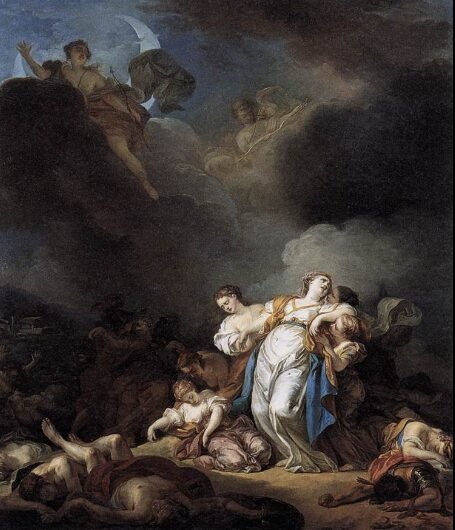
Niobe’s slain children lay unburied for nine days as Niobe abstained from food, stricken with grief. After the gods finally buried her children, Niobe returned to her homeland of Sipylus, where she was transformed into a stone, forever mourning her loss. Image: 1770 painting by French painter Anicet Charles Gabriel Lemonnier
Niobe’s story was not only a popular subject in literature but also in ancient Greek art. Vase paintings, sculptures, and frescoes often depicted the moment of the Niobids’ slaughter by Apollo and Artemis.
One of the most famous ancient depictions of this event is attributed to the Niobid Painter, an anonymous Athenian vase painter from the 5th century BC. The Niobid Painter’s work on an Attic red-figure calyx-krater shows Apollo and Artemis killing the Niobids, with a dynamic composition that captures the horror of the scene.
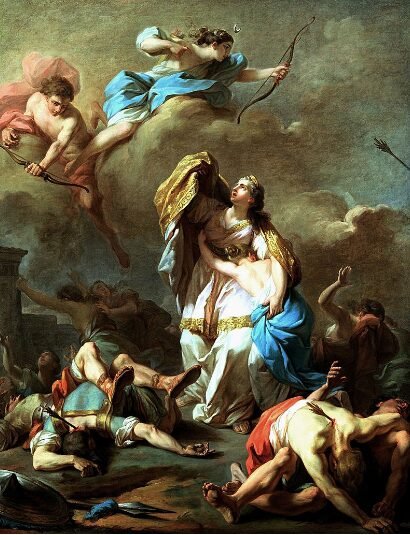
Image: 1772 painting by French painter Pierre-Charles Jombert
In sculpture, the Niobid Group, discovered in Rome in 1583, is one of the most prominent depictions of Niobe’s story in classical art. The lifelike marble sculptures portray Niobe trying to protect her children from the arrows of Apollo and Artemis. These sculptures were later taken to the Uffizi Gallery in Florence, where they remain on display.
Niobe’s Legacy in Modern Art and Culture
Niobe’s tragic story continued to inspire artists and writers throughout history. During the Renaissance and Baroque periods, Niobe’s grief and the punishment of her children became popular subjects for painters.
Notable works include Dutch painter Abraham Bloemaert’s The Death of Niobe’s Children (1591), English artist Richard Wilson’s The Destruction of the Children of Niobe (1760), and French painter Jacques-Louis David’s Diana and Apollo Piercing Niobe’s Children with Their Arrows (1772). These paintings focus on the emotional intensity of Niobe’s grief and the divine wrath of Apollo and Artemis.
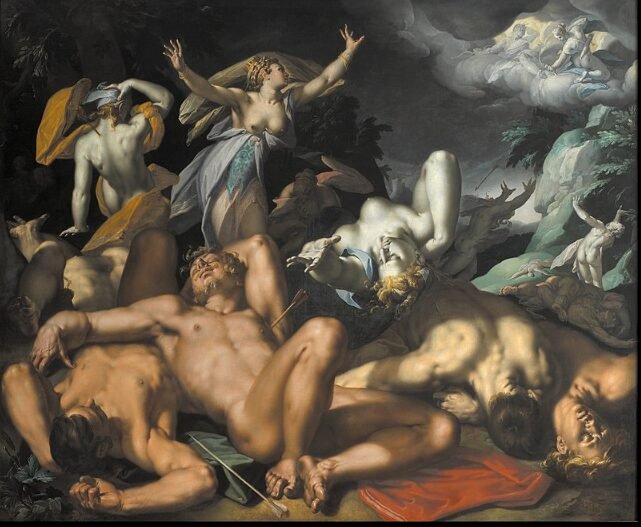
Image: 1591 painting by Dutch painter Abraham Bloemaert
In literature, famed English playwright William Shakespeare references Niobe in his play Hamlet. In Act 1, Scene 2, Hamlet compares his mother’s tears for his dead father to those of Niobe, describing her as “all tears.” This comparison emphasizes Queen Gertrude’s grief, though it also hints at the fleeting nature of her mourning in light of her quick remarriage.
American writer William Faulkner also draws on the Niobe myth in his novel Absalom, Absalom! Faulkner likens the character Ellen Sutpen to Niobe, describing her as “a Niobe without tears,” conveying a profound sense of grief and desolation that extends beyond physical weeping.
Niobe’s influence has even extended into the realm of modern science. When the element tantalum was discovered, its name was inspired by Niobe’s father, Tantalus, due to its resistance to acid. Later, when mineralogist and chemist Heinrich Rose discovered that tantalum contained a second element, he named it niobium after Niobe, continuing the mythological association.
Frequently Asked Questions
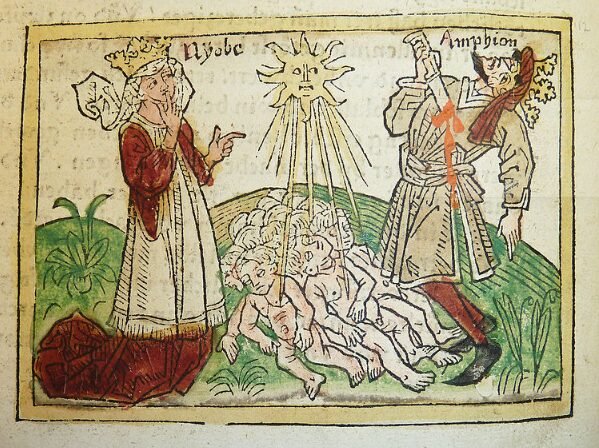
Niobe was the sister of Pelops and Broteas and became the wife of Amphion, one of the twin founders of Thebes. Image: Woodcut illustration of Niobe, Amphion and their dead sons, ca. 1474 – Penn Provenance Project
Who was Niobe’s husband, and what was he known for?
Niobe’s husband was Amphion, son of Zeus and Antiope. He was known for his musical abilities, having been taught by Hermes, and used his music to build the walls of Thebes.
How many children did Niobe have, and why was this significant in the myth?
Niobe had fourteen children (seven sons and seven daughters, known as the Niobids). She boasted about her children, comparing herself to Leto, who only had two, which angered Leto and led to Niobe’s tragic downfall.
What punishment did Leto inflict on Niobe for her hubris?
Leto sent her children, Apollo and Artemis, to kill Niobe’s children. Apollo killed her sons, and Artemis killed her daughters. In some versions, one or two of her children, Meliboea (Chloris) and Amyclas, were spared.

Niobe’s tale of pride and tragic downfall serves as a warning against hubris in Greek mythology. Image by French artist Jacques-Louis David showing Niobe and Her Daughter (1775–80)
What happened to Niobe after the deaths of her children?
Devastated by the loss of her children, Niobe fled to Mount Sipylus, where she was turned into stone. The “Weeping Rock” on Mount Sipylus, a natural rock formation that resembles a woman’s face, is associated with Niobe’s eternal mourning.
What are some ancient literary references to Niobe’s story?
Niobe’s story is referenced in Homer’s Iliad, where Achilles compares Niobe’s mourning to that of Priam for his son Hector. In Sophocles’s Antigone, Antigone compares her impending death to Niobe’s tragic fate.

Niobe’s story is most famously known for her hubris, as she boasted about her superiority over Leto, the mother of Apollo and Artemis, because she had more children. In retaliation, Leto sent Apollo and Artemis to kill all of Niobe’s children. Image: A 1772 painting by Jacques-Louis David shows Niobe desperately shielding her children from Greek deities Apollo and Artemis.
How has Niobe’s myth been depicted in ancient Greek art?
Niobe’s tragedy was depicted in vase paintings, frescoes, and sculptures. The Niobid Painter from the 5th century BC illustrated the slaughter of the Niobids on an Attic vase now housed in the Louvre. The Niobid Group of sculptures, discovered in Rome in 1583, also depicts Niobe shielding her children from Apollo and Artemis’s arrows.
How has Niobe’s story been referenced in modern literature?
In William Shakespeare’s Hamlet, Queen Gertrude’s grief is compared to Niobe’s unending tears. William Faulkner, in Absalom, Absalom!, compared Ellen Sutpen to Niobe in her sorrow.





