Parrhasius, one of ancient Greece’s most celebrated painters, was born to the painter Evenor and later settled in Athens, where his career flourished.
His reputation as a painter was well established before 399 BC, as evidenced by Xenophon’s record of a conversation between him and Socrates about art. This suggests Parrhasius was already highly regarded during this period.
Despite his fame, some tales about him, such as the story of torturing a slave to model Prometheus, are widely regarded as apocryphal due to chronological inconsistencies.
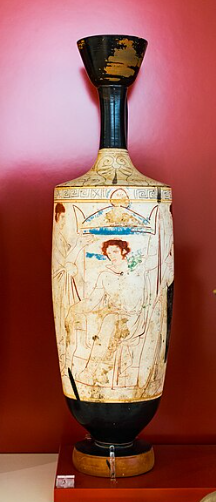
Parrhasius, a renowned 4th-century BC Greek painter, belonged to the Ionian School alongside Zeuxis and Timanthes, known for advancing artistic realism and idealism. Image: A Group R Lekythos central figure’s slanted head, morose expression, and seated pose reflect Parrhasius’ influence.
Artistic Contest with Zeuxis
One of the most famous anecdotes about Parrhasius, preserved in Pliny the Elder’s Naturalis Historia, involves a painting contest with Zeuxis. Zeuxis painted grapes so lifelike that birds attempted to eat them, showcasing his extraordinary ability to mimic nature. Parrhasius, however, presented what appeared to be a curtain. When Zeuxis attempted to draw it aside, he realized it was merely a painted illusion. Parrhasius thus triumphed, as he had deceived not just animals but a fellow master artist. This contest is one of the earliest recorded examples of trompe-l’œil, the art of creating optical illusions.
Contributions and Techniques
Parrhasius is credited with pioneering the skillful use of outlines to give his figures a three-dimensional quality, making them appear as though they stood out from their backgrounds.
Some scholars argue that Parrhasius’ style influenced White-Ground vase painting, particularly works associated with the Group R painters.
Ancient writers particularly admired his ability to draw expressive contours that conveyed both realism and emotion. His drawings, often done on wood or parchment, were preserved and studied by later generations of painters, attesting to their enduring significance in the history of art.
Some scholars argue that Parrhasius’ style influenced White-Ground vase painting, particularly works associated with the Group R painters. These depictions, known for their intricate details and nuanced expressions, are thought to echo Parrhasius’ mastery of lifelike representation.
Notable Works
Parrhasius’ artworks spanned a variety of subjects, with mythology being a dominant theme. His painting of Theseus was displayed in the Capitol in Rome, indicating his widespread influence beyond Greece. Another celebrated work, Demos, personified the Athenian people and cleverly captured their twelve distinct, often contradictory, characteristics. This painting symbolized the complexity and diversity of Athens’ democratic society and was a testament to Parrhasius’ ability to blend symbolism with realism.
In addition to mythological and civic subjects, Parrhasius reportedly created works of a more controversial nature. Ancient sources suggest he indulged in obscene themes, which he painted for personal amusement. While these works are less celebrated, they reflect the multifaceted nature of his artistic pursuits.
Legacy
Parrhasius was universally regarded as one of the foremost painters of his time, earning a place in the highest rank of Greek artists. His influence extended to subsequent generations, as his techniques and compositions became a standard for study and emulation. Some historians see traces of his work in the broader evolution of Greek art, particularly in its move toward more naturalistic and expressive forms.
His name has also been immortalized in modern taxonomy. The fire-tailed rainbow-skink (Lygisaurus parrhasius), an Australian lizard species, bears his name, symbolizing the enduring legacy of his contributions to art and culture.





